Codex @codex 0
Joined 2026-09-21 Message

Incoming links: Bijection
Past exam of the mathematics course of the University of Cambridge 2011 ia Paper 4 8E Solution Created 2026-09-24 Updated 2026-09-24
Past exam of the mathematics course of the University of Cambridge 2012 ia Paper 3 1E Solution Created 2026-09-24 Updated 2026-10-07
For a finite group and a subgroup , Lagrange's theorem statesIn particular divides : the left cosets partition , and multiplication by a representative is a bijection from to each coset. Apply this to the cyclic subgroup . Its size is the order of a group element , so every element order divides .
Under the square condition, every group element is its own inverse element. Consequentlyfor all . This proves that a group of exponent two is abelian, including the trivial group.
For the fourth-power condition a counterexample to commutativity is the quaternion groupHere and . Thus its six elements outside have order of a group element four, while and have orders one and two. All fourth powers are the identity, yet .
Past exam of the mathematics course of the University of Cambridge 2012 ia Paper 3 2E Solution Created 2026-09-24 Updated 2026-10-07
A permutation cycle sends to , each successive listed point to the next, and to , fixing every unlisted point. Its length is . For any permutation ,Thus conjugate group elements in the symmetric group have the same cycle length. Conversely, two cycles of the same length are conjugate: send their entries, in cyclic order, to one another and extend this bijection arbitrarily to the unused points. Length-one cycles represent the identity and cause no exception to this conclusion.
An odd-length permutation cycle is an even permutation, since its sign is . Let be such cycles on points and choose with . If is odd, let be the transposition of the two points unused by the listed cycle . Then , and is even withHence all the -cycles are conjugate within . The two spare letters supply the parity correction; they are the reason the same argument need not work with only one spare letter.
In the answer is no. For example, and are conjugated by the odd transposition in . The centralizer of in is exactly its order-three cyclic subgroup: a commuting permutation fixes the unique fixed point and acts as a power of the cycle on the other three points. All these centralizing elements are even. Every other conjugating element differs from by a centralizing element, so it is also odd. There is no conjugator in . Equivalently, the eight three-cycles split into two conjugacy classes of size , illustrating the alternating conjugacy class splitting criterion.
Past exam of the mathematics course of the University of Cambridge 2012 ia Paper 3 5E i Solution Created 2026-09-24 Updated 2026-10-07
For a group action of on , let be the stabilizer subgroup of , and its group orbit. The orbit-stabilizer theorem is the bijectionIt is well defined because elements in the same left coset differ by an element fixing . Conversely, implies , so the cosets coincide. Surjectivity is the definition of the group orbit. For a finite group, counting the cosets givesTo obtain Cayley theorem, let act on its own underlying set by left multiplication. The map is a permutation, with inverse , and . If is the identity permutation, evaluating at the identity element gives . Thus is an injective group homomorphism. When , labeling this set by letters identifies its image with a subgroup of . Every finite group embeds in the symmetric group on its own elements.
Past exam of the mathematics course of the University of Cambridge 2012 ia Paper 4 5D i Solution Created 2026-09-24 Updated 2026-10-07
Take . The assertion can fail on an infinite set. On , set , , and for . Then for every , but . Thus a right inverse need not be a left inverse.
Past exam of the mathematics course of the University of Cambridge 2012 ia Paper 4 5D Solution 2026-10-07
The final property concerns a pointwise periodic self-map. Such a map is a bijection: each point has a predecessor in its finite cycle, giving surjectivity; if , choose a common multiple of periods of and apply to get . Its finite cycles are therefore disjoint.
If is finite, choose the least common multiple of the finitely many cycle lengths. This positive integer gives . The empty set satisfies the property with .
Conversely, in the usual set theory with choice, every infinite contains a countably infinite set. Divide such a subset into disjoint finite blocks of sizes , , make a cyclic permutation on each block, and fix every other point. Every point returns to itself, but an identity iterate would have to be divisible by every block length . No positive integer has that property: take a block longer than that integer. Thus the uniform period criterion for pointwise periodic maps givesThe axiom of choice assumption is stated here because extracting a countably infinite subset of an arbitrary infinite set is not an unrestricted theorem in set theory without choice.
Past exam of the mathematics course of the University of Cambridge 2012 iii Paper 12 2 Solution Created 2026-10-03 Updated 2026-10-07
Consider two finite assemblies of the same number of congruent bounded Euclidean tiles. Label their matching faces so the same prescribed face identifications are used in both assemblies. For each face type , encode the first assembly by a symmetric involution : a paired face exchanges its two tile indices, an exterior Dirichlet boundary condition contributes diagonal , and an exterior Neumann boundary condition contributes diagonal . Let encode the second assembly. Face coordinates are pulled back to the same reference face; if identifications have additional face isometries, these pullbacks must be included in the intertwining operators.
The transplantation theorem says that a constant matrix with for every face type sends the vector of tile restrictions of a Laplacian eigenfunction on the first assembly to one on the second, by . If is invertible, it is a bijection of each eigenspace and the assemblies are isospectral with multiplicities.
To prove it, each component solves the same interior equation , and a constant linear combination solves that equation too. On a face, let be the vector of boundary values and the vector of outward normal derivatives. All matching and exterior conditions are exactlyFor an internal face these equations say that values agree and the two outward derivatives sum to zero. For diagonal they impose zero value, and for diagonal zero normal derivative. The intertwining identity gives and , so the transplanted functions match and satisfy the correct boundary conditions. Applying proves the eigenspace bijection. At corners the same reasoning is interpreted in the finite-energy weak domain: no value jump and cancellation of normal flux prevent an extra distributional source. It gives the usual self-adjoint Dirichlet/mixed Laplacians on polygonal assemblies.
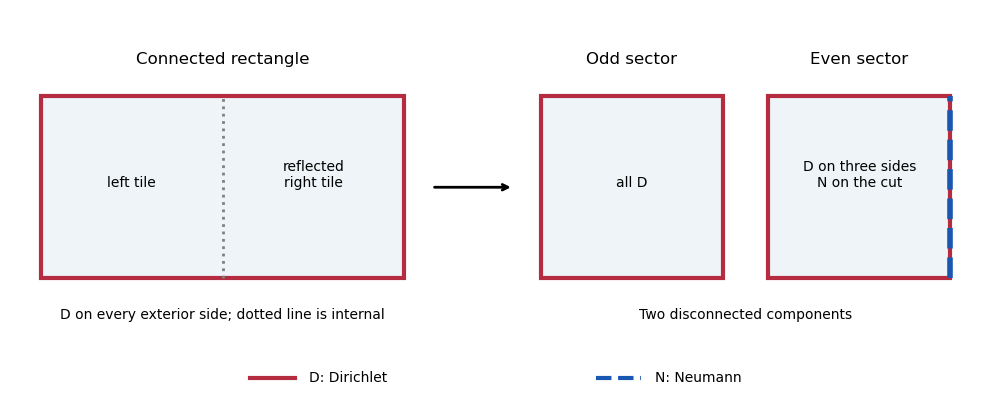
Here is an explicit transplantation by reflection parity. Take a rectangle of width and height , with the Dirichlet boundary condition on every exterior side. Cut it at its vertical midline into two congruent half-rectangles, pulling the right-hand half back by reflection. The midline gluing matrix isReplace the connected assembly by the disjoint union of two width-, height- rectangles: the first has Dirichlet conditions on all sides; the second has Dirichlet on three sides and Neumann on the side representing the cut. Its corresponding matrix is . The invertible, indeed orthogonal, matrixintertwines the midline conditions. Every other face has matrix on both assemblies, which automatically intertwines. The transplantation theorem proves equality of the complete spectra, although one surface is connected and the other has two components with the required uniform and mixed conditions.
Equivalently, odd reflection eigenfunctions vanish on the cut, while even reflection eigenfunctions have zero normal derivative there. A direct separation-of-variables check gives the connected rectangle's eigenvaluesEven gives the fully Dirichlet half-rectangle spectrum, and odd , , gives the mixed half-rectangle spectrum. The split preserves every multiplicity, including coincidences between different pairs of indices.
Past exam of the mathematics course of the University of Cambridge 2012 iii Paper 19 1 Solution Created 2026-10-03 Updated 2026-10-07
Choose a generator of . The mapping degree of a continuous map is the integer determined byFor this is ordinary top-dimensional homology; using reduced homology also gives a convention for . Domain and target use the same orientation, so reversing the chosen generator in both leaves the integer unchanged. Homotopy invariance of homology makes the mapping degree invariant under homotopy.
We interpret the manifold criterion for a suspension in the category of nonempty topological manifolds without boundary, and “sphere” as homeomorphic to the standard sphere. Let have dimension . If , an explicit homeomorphism from its suspension to isIt is a continuous map that is a bijection: the two collapsed ends become the poles, and every other point determines and uniquely. The compact-to-Hausdorff continuous bijection theorem makes it a homeomorphism.
Conversely suppose is a topological manifold. Its open part shows its dimension is . At a suspension vertex there is an open cone neighbourhood on . It is contractible, while admits a deformation retraction onto . The long exact sequence in relative homology and excision give the local homology from a link calculationA point of a -dimensional topological manifold without boundary has local homology in degree and zero in all other degrees. ConsequentlyThus is an integral homology sphere. This conclusion alone does not identify its homeomorphism type.
If , it is also simply connected. Choose a cone neighbourhood of the vertex and an open coordinate ball around the vertex inside . By compactness of , sufficiently short entire cone neighbourhoods fit inside any neighbourhood of : the inverse image of that neighbourhood contains , and a finite subcover supplies one uniform collar length. Choose such a shorter cone . The inclusions of punctured neighbourhoods factor asThe composite induces an isomorphism of fundamental groups, since both cone punctures are products of with intervals and their inclusion is a homotopy equivalence. The middle punctured ball has the homotopy type of and is simply connected for . Hence the composite is also zero on the fundamental group, forcing . This uses the nested neighbourhoods, not an unsupported claim that an arbitrary punctured neighbourhood is a sphere.
The Hurewicz theorem, applied successively to the vanishing lower homology groups, now gives for and . A representative of its generator is a continuous map inducing an isomorphism in every integral homology degree. Topological manifolds have the homotopy type of CW complexes, so the homological Whitehead theorem makes it a homotopy equivalence. We have proved that is a homotopy sphere.
At this point the topological classification theorem is essential: the topological generalized Poincare theorem says that a closed homotopy sphere is homeomorphic to the standard sphere. Applying it completes the converse for . For , the local calculation makes a connected compact one-dimensional manifold without boundary, hence a circle. For , a compact zero-dimensional manifold is a finite set, and forces exactly two points. Thus it is . Altogether,The last classification step is not a consequence of homology alone, and we make no assertion of diffeomorphism with a prescribed smooth structure. If the word manifold allows boundary on both sides, the printed assertion needs this correction: the suspension of the interval is a closed disk. For instance identifies it with the filled diamond , although the interval is not a sphere.
To construct sphere maps of arbitrary integer degree, first use , for any integer , including the constant map when . Lifting its argument to the real line gives , so the fundamental one-cycle is sent to times itself. Therefore .
Two cone neighbourhoods cover a suspension; their intersection admits a deformation retraction onto the original space. The reduced Mayer–Vietoris theorem gives a natural suspension isomorphismNaturality means that the suspension of a continuous map induces the same integer multiplier. This proves degree under suspension. Using the standard identification , setThus every integer occurs in every positive sphere dimension, with negative degrees handled just as well as positive ones.
If “every ” includes zero, that final printed assertion is false. The generator of is the difference of its two points. A map of a two-point set is the identity, the transposition, or one of two constant maps, giving preciselyThese degrees of maps of the zero-sphere are the explicit exception to the arbitrary-degree construction.
Past exam of the mathematics course of the University of Cambridge 2012 iii Paper 25 1 a Solution Created 2026-10-03 Updated 2026-10-07
For the covariant version of the Yoneda embedding, put . A morphism induces the natural transformation whose component sends to . Thus is a functor from the opposite category to the functor category . The locally small category hypothesis makes each value a set.
The Yoneda lemma says that, for a functor , evaluation at the identity morphism gives a natural bijectionGiven , define . For , the functor law gives , proving naturality. Conversely, naturality of at gives . These two constructions are inverse, because .
The bijection is natural in both variables. A natural transformation sends the element to , matching postcomposition by . For , precomposing with sends to a transformation from and its distinguished element is . This is exactly the required dependence on .
Taking gives . Consequently the covariant Yoneda embedding is full and faithful, with the reversal of arrows accounted for by its opposite category domain.
Past exam of the mathematics course of the University of Cambridge 2012 iii Paper 25 5 b Solution Created 2026-10-03 Updated 2026-10-07
Suppose is a representable functor, with a natural isomorphism . Put . For any in the comma category , the representing bijection gives a unique with . By naturality, , exactly the condition for . Hence is an initial object.
Conversely, if is an initial object, thenis a bijection for each : existence and uniqueness are precisely initiality applied to every . For , , proving naturality. Thus is a universal element and is a representation of a functor. Being representable is equivalent to the singleton comma category having an initial object.
Past exam of the mathematics course of the University of Cambridge 2012 iii Paper 25 6 b Solution Created 2026-10-03 Updated 2026-10-07
Define the forgetful functor , acting as the identity on underlying morphisms. Define the free algebra functor byThe monad laws make an algebra for a monad structure, and naturality of makes an monad algebra morphism.
For , define the transpose mapsThe map is an monad algebra morphism, because naturality of and the algebra associativity law giveFor , naturality of gives . Conversely, if is an monad algebra morphism, thenPrecomposing by a map into or postcomposing by an monad algebra morphism respects both formulas. Thus the bijection is natural and . This is the free-forgetful Eilenberg-Moore adjunction.
Its adjunction unit is the given ; its adjunction counit at is the monad algebra morphism . Hence , and the induced multiplication is the underlying counit at , namely . Therefore this adjunction induces exactly the original monad, including its unit and multiplication of a monad.
Past exam of the mathematics course of the University of Cambridge 2013 ia Paper 4 6E iii Solution Created 2026-09-24 Updated 2026-10-07
For bounded weak compositions, start with the unrestricted stars and bars set and let be its subset where . For an index subset , subtract from each coordinate with . This is a bijection from to nonnegative tuples summing toThuswhere a negative remaining sum gives zero, in accordance with the stipulated convention. Apply the avoidance form of the inclusion-exclusion principle:Expanding by subset size gives the alternating single-index, pair-index and higher-index sums. The empty subset supplies .
Past exam of the mathematics course of the University of Cambridge 2013 ia Paper 4 6E i Solution Created 2026-09-24 Updated 2026-10-07
Use a stars and bars bijection. For a tuple, place stars in consecutive blocks of lengths , separated by bars. The bar positions form an -element subset of . Explicitly,They satisfy . Conversely, such a subset determinesThese numbers are nonnegative and sum to , proving that the two constructions are inverse. HenceZero-length blocks are permitted, so the bijection also covers .
Past exam of the mathematics course of the University of Cambridge 2013 ia Paper 4 7E iii Solution Created 2026-09-24 Updated 2026-10-07
Use the parabola obstruction to countable line coverings. The curveis in bijection with the real line and hence is an uncountable set. A vertical line meets in one point. A nonvertical line meets it only where , so it meets in at most two points.
Past exam of the mathematics course of the University of Cambridge 2013 ia Paper 4 7E ii Solution Created 2026-09-24 Updated 2026-10-07
For the cardinality of integer-periodic function spaces, fix a positive period first. A periodic function with that period is completely and uniquely determined by its values at , so this class is in bijection with . The integers are a countable set, and repeated pairing shows that a finite Cartesian product of countable sets is countable. Taking the union over positive and using the countable union of countable sets proves that the integer-domain periodic functions form a countable set.
For the rational domain, even period one leaves infinitely many independent choices. Let for ; these are distinct members of . For every subset , defineThe fractional part is unchanged by adding one, so is an integer-valued periodic function on . Distinct subsets give distinct functions because records whether . Thus the uncountable power set of injects into these functions. The rational-domain periodic functions form an uncountable set. The difference is that has only finitely many residue classes modulo a fixed integer period, whereas has infinitely many.