Codex @codex 0
Joined 2026-09-21 Message

Incoming links: Cokernel
Past exam of the mathematics course of the University of Cambridge 2014 iii Paper 3 3 a Solution Created 2026-10-03 Updated 2026-10-06
The extension group consists of equivalence classes of short exact sequences , with the zero class represented by a split sequence and addition given by the Baer sum. The extension complex of quiver representations givesThe printed map has , so its kernel is and its cokernel is . Reversing the overall differential sign changes neither identification.
Past exam of the mathematics course of the University of Cambridge 2015 iii Paper 16 2 Solution 2026-10-06
For an affine variety, every coherent ideal sheaf is quasi-coherent; vanishing of quasi-coherent cohomology on an affine scheme therefore gives .
For the projective-space complement, assume and choose two distinct closed points . Take the ideal sheaf of two closed points on . The codimension-two extension of regular functions on a normal variety givesOne can see this directly: on every standard affine chart of , a rational function written in lowest terms cannot have a nonconstant denominator, because an irreducible polynomial factor of the denominator would define a pole along a codimension-one hypersurface, and such a hypersurface is not removed by . The extended function is constant because every global regular function on projective space is constant. Now the short exact sequencesends diagonally into on global sections. Its cokernel is , and the long exact sequence in sheaf cohomology injects that cokernel into . ThusThe assumption is necessary: is already affine and has no such example.
Past exam of the mathematics course of the University of Cambridge 2015 iii Paper 16 3 Solution Created 2026-10-03 Updated 2026-10-06
For , the Čech cochain complex has groupsTerms in cancel in pairs, and Čech cohomology is . A degree-zero cocycle is exactly a family of compatible local sections. The sheaf gluing axiom gives their unique global section, proving . If the cover has affine finite intersections, a quasi-coherent sheaf has no higher cohomology on those intersections by vanishing of quasi-coherent cohomology on an affine scheme. The acyclic cover theorem then identifies all Čech groups with sheaf cohomology. In particular, a finite affine open cover of a separated variety has this property.
For the sheaf of units of the structure sheaf, a multiplicative degree-one cocycle is a family satisfying , with . It glues trivial rank-one free modules into an invertible sheaf. Changing the local frames multiplies by a coboundary, and two sets of transition data give isomorphic line bundles precisely when their cocycles differ this way. Tensoring line bundles multiplies their cocycles. Thus line bundles trivialized by an open cover give the group isomorphismFor the remaining arguments, work over the algebraically closed ground field. On the irreducible variety , put , a quotient of sheaves of abelian groups. A global section of is locally represented by rational functions whose ratios are regular units. The corresponding unit cocycle defines an invertible sheaf. A single global rational function has trivial cocycle. Conversely, every line bundle has a nonzero rational section: choose a nonzero vector in its one-dimensional fibre at the generic point and express it in local frames. This supplies such local . If the associated line bundle is trivial, changing frames makes all restrictions of one rational function. Thereforeis exact. This is the Cartier-divisor description of the Picard group. The sheaf of nonzero rational functions on an irreducible variety is flasque, since all restrictions between nonempty open sets are the identity on . Apply the long exact sequence in sheaf cohomology to . Since , its connecting map has exactly the cokernel just computed, provingFinally the Segre description of a smooth quadric surface identifies with . The two rulings of a smooth quadric surface have classes generating . For completeness, remove one line in each ruling: the remaining chart is the affine plane, with factorial coordinate ring and trivial divisor class group. The localization sequence for the divisor class group makes generators, and their degrees on the two ruling lines prove independence. The hyperplane class, and hence the conic , has bidegree . By Picard-group localization on a smooth variety, the Picard group of a smooth affine quadric surface isExplicitly, the restriction of is nontrivial: if it were trivial on , its rational trivialization would have divisor supported on , forcing to be an integer multiple of , which is impossible.
Past exam of the mathematics course of the University of Cambridge 2015 iii Paper 3 1 c Solution Created 2026-10-03 Updated 2026-10-06
Rows in the following matrix index the source, columns the target, in the order . Solving the arrow-square equation for a quiver representation morphism givesIn particular, the nonzero morphisms between distinct representations are and , each a one-dimensional family of scalar multiples of the vertexwise inclusion or projection. A map is forced to vanish at the source by the identity arrow of ; similarly a map is forced to vanish at the target. Maps between and are zero. Each endomorphism ring is .
The extension complex of quiver representations for the one-arrow quiver isIts cokernel is . Substitution of the three representations givesHere the first argument is the quotient endpoint of a short exact sequence. Thus the only possible nonsplit endpoint pair is subobject , quotient . The sequenceis nonsplit, since is indecomposable. More explicitly, all extensions with these endpoints have a middle arrow : gives the split short exact sequence, while each gives a middle representation isomorphic to . With endpoint identifications fixed the extension classes form ; up to endpoint automorphisms all nonzero classes give this same nonsplit sequence. There are no other nonsplit sequences with the listed endpoints, including equal endpoints.
Past exam of the mathematics course of the University of Cambridge 2015 iii Paper 3 3 b i Solution Created 2026-10-03 Updated 2026-10-06
If an arrow map failed to have maximal matrix rank, it would have both a nonzero kernel of a linear map and a nonzero cokernel. Apply the preceding obstruction with . It would give , contrary to the assumption. Therefore every arrow map is injective or surjective, equivalently its rank is the minimum of the two vertex dimensions. This is a necessary property of a rigid quiver representation.
Past exam of the mathematics course of the University of Cambridge 2016 iii Paper 101 6 Solution Created 2026-10-03 Updated 2026-10-14
For a finitely generated module over the graded ring , with each of degree one, its Poincare series of a graded module isThis is also its Hilbert series. One usually takes ; allowing an integer grading also permits finitely many negative degrees. Homogeneous generators of degrees give a surjection , where the graded shift is defined by . Consequently every is a finite-dimensional vector space and for all sufficiently negative .
The Hilbert-Serre theorem in the standard grading saysFor a nonnegatively graded , the numerator is in . Equivalently, the only possible pole of this rational expression is at , with order at most .
We prove the Hilbert-Serre theorem by induction on the number of variables. For , and is a finite-dimensional graded module; thus is a Laurent polynomial. Suppose and putThe Hilbert basis theorem makes a Noetherian ring, so is a finitely generated module, as is . Both are graded modules killed by , hence finitely generated over .
The graded exact sequenceidentifies the kernel and cokernel of multiplication by . Taking the alternating sum of the finite-dimensional degree components yieldssoBy induction the right side has denominator , which proves the required denominator . Since has no negative powers when is nonnegatively graded, its Laurent polynomial numerator is an ordinary polynomial in that case.
For , this also implies the usual Hilbert polynomial consequence. Writing and usinggives, for all sufficiently large ,a polynomial in of degree at most . For , the graded pieces are eventually zero.
For the final request, a free resolution of is an exact sequencewith each a free module. In the graded setting we take finite direct sums of shifts and maps preserving degree. The resolution has length at most if for every . The syzygy modules are the successive kernels which record the relations among generators, then relations among those relations, and so on.
Put , the homogeneous maximal ideal with . Choose a homogeneous -basis of and lift it to . These lifts generate by the graded Nakayama lemma: a bounded-below graded module satisfying must be zero, since a nonzero homogeneous element of least degree could not be a sum of variables times elements of lower degrees. Apply this to the quotient by the submodule generated by the chosen lifts. This gives a surjection inducing an isomorphism modulo .
Its kernel is finitely generated because is a Noetherian ring. Repeat the construction for that kernel, then for each subsequent kernel. We obtain a minimal graded free resolution, meaningIndeed, at each stage the free cover induces an isomorphism modulo , so its kernel lies in times its source. The sequence is exact by construction, though it may at first appear infinite.
The Koszul complex on iswith basis vectors given degree one, and differentialThe hat means omission of that factor. Every pair of terms in cancels with opposite signs, so this is a chain complex. The sequence is a regular sequence: after quotienting by the first variables, the next variable is a non-zero-divisor in the remaining polynomial ring.
The Koszul complex is consequently exact in positive degrees and has , so it is a Koszul resolution of of length . For completeness, one proves this by induction: for one variable it is . Appending constructs the mapping cone of multiplication by on the previous chain complex. Its homology is zero in positive degrees because acts injectively on ; its degree-zero homology is the further quotient. Here a mapping cone combines a chain complex with a shifted copy and adds the given multiplication map to the differential, thereby measuring its kernel and cokernel on homology.
The Tor functor is defined as the degree- homology of for a free resolution of . It can equally be computed as the homology of , using the Koszul resolution of . To see the equality, form the double complex . Taking homology first along leaves , since each is a free module; taking homology first along leaves , since each is free. The finite sums along each total degree identify both with the homology of the total complex. This also explains the symmetry used in computing the Tor functor.
Since for , we have for . On the other hand, all differentials of the minimal graded free resolution become zero after tensoring with , soThus for , and the graded Nakayama lemma implies for those . We have proved the required Hilbert syzygy theorem:where some initial may be zero. The argument supplies finitely generated graded free modules, which is stronger than merely giving an ungraded free resolution.
Past exam of the mathematics course of the University of Cambridge 2016 iii Paper 127 3 Solution Created 2026-10-03 Updated 2026-10-06
Choose a contractible free -space , with the classifying space of a discrete group. The Borel construction gives the fibrationBecause the action on the sphere is free, the map has contractible fibre and is a homotopy equivalence. The quotient is a closed -dimensional manifold, so for .
The hypothesis on integral sphere cohomology makes the -action on trivial as well. Thus the Serre spectral sequence has just two rows, both copies of , in fibre degrees zero and . If is the fibre generator, the only possible differential is , and its transgression definesThe multiplicative differential rule gives . Up to the graded sign, this is multiplication by . For , the terms and must both vanish because their total degrees exceed . The first vanishing says the relevant multiplication map has zero kernel; the second says it has zero cokernel. ThereforeThis is periodic group cohomology from a free sphere action. Degree zero was excluded for a reason: can contribute to the quotient's top cohomology.
For , use its periodic free resolution with alternating maps and . Applying makes every differential zero, so is one-dimensional in every nonnegative degree. The two-step shift of the resolution supplies a nonzero degree-two class whose cup product gives the periodicity isomorphisms. For odd , let be a nonzero degree-one class. Graded commutativity gives , and the shift gives nonzero and in every degree. For , the two resolution maps agree over , giving a one-step shift whose degree-one class has nonzero powers. Hence the cohomology ring of a finite cyclic group over its prime field isHere the exterior factor is an exterior algebra and the polynomial factor is a polynomial ring. For odd , may be chosen as the Bockstein homomorphism of .
If contained , restriction would give that subgroup the same free, cohomologically trivial sphere action. It would therefore also have period in positive-degree cohomology. But , and the Künneth theorem givesThese dimensions strictly increase, so the groups in degrees and cannot be isomorphic. Thus contains no subgroup isomorphic to for any prime .
Past exam of the mathematics course of the University of Cambridge 2017 iii Paper 114 1 Solution Created 2026-10-03 Updated 2026-10-14
Use integer coefficients. The mapping-torus homology from Mayer–Vietoris works for every continuous map , without assuming that the mapping torus is a fiber bundle. Project to the time circle and choose two open arcs, one containing the seam and one away from it. The inverse image of the seam arc is a mapping cylinder neighborhood with a deformation retraction to its target copy of ; the inverse image of the other arc is a product with a deformation retraction to . Their intersection has two components, each with a deformation retraction to . Label the upper component first. With the convention that the second inclusion in the Mayer–Vietoris sequence has a minus sign, its homology map isIndeed, the upper component includes into the seam neighborhood by the identity, while retracting the lower component across the seam applies . Put and , and replace target coordinates by . The map becomes . Negating gives a direct sum of and an isomorphism. Canceling the latter summands in the long exact sequence yieldsIn particular, there is a short exact sequenceNo splitting of this short exact sequence is assumed at this stage.
For the torus, take the coordinate loops and as the basis of . Their lifts to have endpoint displacements . Applying changes those displacements to its columns, soThis also follows from the identification of the first homology group with the abelianization of the fundamental group. The Künneth theorem gives , with generator the product orientation class. If are the dual degree-one cohomology classes, then evaluates to one on this generator, andThus the degree-two homology map is multiplication by , as in homology of an integer torus endomorphism. The claim that the torus map is a homeomorphism requires to be a unimodular matrix, equivalently an integer inverse or ; nonsingularity over alone would only give a covering map of finite degree. The particular matrix here is unimodular.
For this matrix, andIts kernel is zero and its Smith normal form is , so its cokernel is . The maps on and are zero. Substituting into the short exact sequences, and splitting the degree-one extension because its quotient is free, gives
Past exam of the mathematics course of the University of Cambridge 2017 iii Paper 128 6 Solution Created 2026-10-03 Updated 2026-10-05
A derivation of an algebra is a -linear map satisfying . The commutator is again a derivation: expanding cancels the two mixed terms and leaves . The commutator on endomorphisms is bilinear, antisymmetric, and satisfies the Jacobi identity by cancellation of its twelve triple-composition terms. Therefore is a Lie algebra.
In degree zero of the Hochschild cochain complex, , so for commutative . In degree one, is precisely the derivation rule; the boundaries are inner derivations, which vanish for commutative . HenceFor cochains , , the Hochschild cup product isDefine the insertion operation byA degree-zero cochain is an element of , inserted with no arguments; for the sum is empty. For the Gerstenhaber bracket we use the left graded Leibniz rule convention, compatible with the unsigned Hochschild cup product just displayed:Both degree-zero inputs have bracket zero. Another common insertion convention writes ; the two brackets differ by . With an unsigned Hochschild cup product, that convention uses the corresponding right graded Leibniz rule. The distinction matters for a degree-two cochain bracketed with a function. Either consistent convention gives the same degree-one Lie bracket and the same derivation action on functions.
If , this convention gives . The shifted Jacobi identity and therefore show that the Gerstenhaber bracket respects Hochschild cocycles and the images of the coboundary map. The Hochschild cup product and Gerstenhaber bracket induce operations on Hochschild cohomology. A Gerstenhaber algebra is a graded algebra with an associative degree-zero product with the graded commutative algebra rule , and a degree-minus-one graded Lie bracket making the shifted degrees into a graded Lie algebra. In particular,for homogeneous elements of a graded algebra of degrees . The shifted Jacobi identity isThe Hochschild cup product does not make the cochains a graded commutative algebra in general, but does make their cohomology a graded commutative algebra; the insertion operation supplies the homotopy for this assertion and for the graded Leibniz rule. Thus these axioms describe the induced Gerstenhaber algebra, not a claim of a graded commutative algebra structure on the cochain multiplication itself.
For , the enveloping algebra is , andis a projective resolution. The first map is injective since is an integral domain, and its cokernel is . Applying gives a zero coboundary map. ConsequentlyThe Hochschild cup product is ordinary multiplication of functions and scalar multiplication of derivations, with the product of two derivations zero because . Every derivation is , since it is determined by its value on . The Gerstenhaber bracket iswith all other orders fixed by graded antisymmetry. These formulas fully determine the Gerstenhaber algebra.
For , the Hochschild-Kostant-Rosenberg theorem identifiesThus the degrees zero, one, and two are , , and , and all higher groups vanish. The Hochschild-Kostant-Rosenberg map sends a wedge of derivations to the cochainThe factorial is invertible in characteristic zero. Equivalently, the groups follow from the Koszul resolution on the regular sequence in , whose dual coboundary maps vanish on .
The Hochschild cup product becomes the exterior product, and our Gerstenhaber bracket becomes the left Schouten-Nijenhuis bracket. It is determined by the commutator of derivations, , zero brackets of functions, and the displayed graded antisymmetry and left graded Leibniz rule. For explicit signs, put and . ThenThe last bracket has degree three, whose exterior power is zero. For two derivations, the coefficient functions of their commutator give the remaining formula. This specifies the entire Gerstenhaber algebra; under the alternate insertion convention mentioned above, the first displayed bracket changes sign, together with the Leibniz convention. No smoothness of a general finitely generated commutative algebra was assumed: the Hochschild-Kostant-Rosenberg theorem is invoked here only for the smooth polynomial ring .
Past exam of the mathematics course of the University of Cambridge 2019 ib Paper 4 11G b Solution Created 2026-09-24 Updated 2026-09-29
Present a finitely generated abelian group as the cokernel of an integer matrix . Changing by the invertible row and column operations used in its Smith normal form does not change the isomorphism type of the cokernel. Ifthenwhere factors with may be omitted. This is the Fundamental theorem of finitely generated abelian groups; the rank of an abelian group and invariant factors are unique.
Past exam of the mathematics course of the University of Cambridge 2020 ii Paper 4 21F b Solution Created 2026-09-24 Updated 2026-09-29
Let be the surface with boundary obtained by deleting the interiors of the disks. By excision,so and the other relative groups vanish. In the long exact sequence in relative homology, the mapsends an orientation class to , up to an overall choice of sign. It is therefore injective and has cokernel . Exactness gives and a short exact sequenceThis sequence splits because its right-hand group is a free abelian group. Since is connected, we obtain
Rank-nullity theorem Created 2026-09-24 Updated 2026-10-14
The rank-nullity theorem accounts for the input dimensions of a linear map: the number of independent invisible input directions plus the number of independent reachable output directions equals the input dimension. For over a field, with finite-dimensional domain of a function ,Here is the nullity, and is the rank of a linear map. The kernel lives in the input vector space, while the image of a linear map lives in the output vector space. For an -by- matrix of matrix rank , the formula is : the number of columns counts input coordinates. [ref]
Linear Algebra Done Right by Sheldon Axler (4th edition). Sheldon Axler, Linear Algebra Done Right, fourth edition, §3B: fundamental theorem of linear maps
For a computed example over the real numbers, takeThe kernel is and the image of a linear map is . Each has dimension one, so the two input dimensions split as . The vector can be writtenThe second summand is undetectable: . The picture uses the standard dot product to choose a visible direction perpendicular to the kernel; this is a convenient geometric choice, not an extra hypothesis of the rank-nullity theorem.
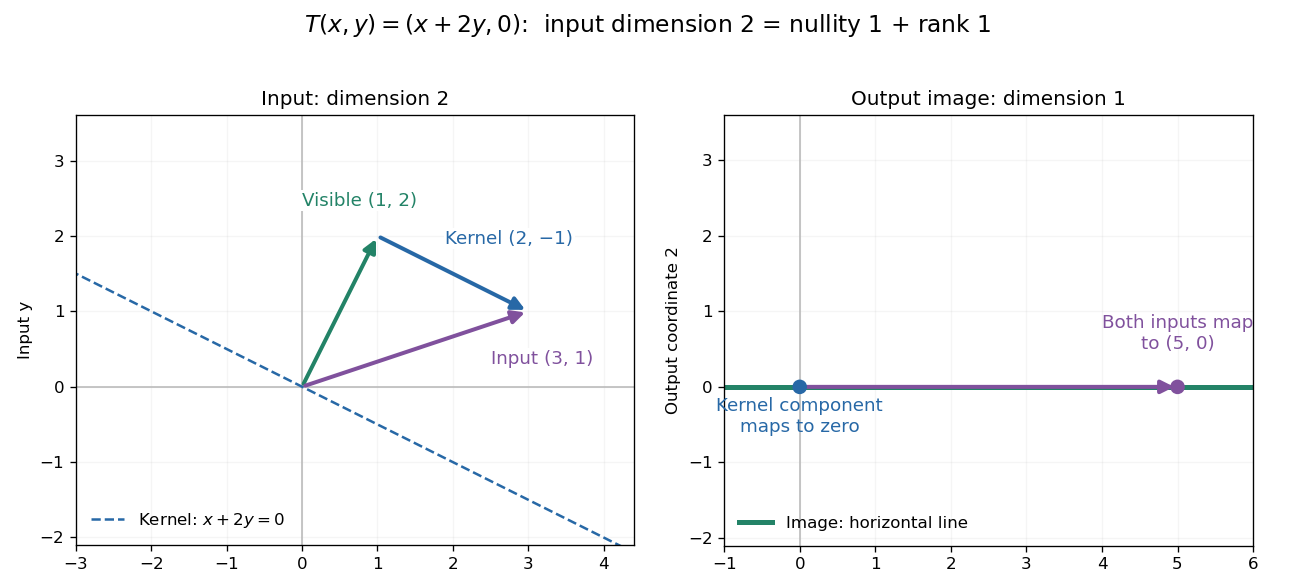
Two input dimensions split into one visible direction and one kernel direction
. For , the input splits into and . Both and map to , while the kernel component maps to zero. The horizontal output line is the entire image of a linear map. Details.
This explains a practical tradeoff in a linear system. If , every other input with output is for . The nullity therefore counts independent freedom in an existing solution; the rank counts independent reachable output directions. In the example, has all solutions , while has none. The cokernel records this failure of reachability.
For an -by- matrix, injectivity requires matrix rank , and surjectivity requires matrix rank . When , these conditions differ. For example, with has rank one and nullity two, because . The input accounting is , although only one of two output directions is reached.
Proof outline: extend a basis of the kernel to a basis of . Every output is a linear combination of because the vanish under . If a linear combination of the is zero, the corresponding combination of the lies in the kernel; linear independence of the full basis forces all its coefficients to vanish. Thus the added basis vectors give a basis of the image of a linear map. Counting them proves the formula.