Compton scattering redistributes photon energy and momentum in a collision with a charged subatomic particle, here an electron. For a free electron initially at rest in the chosen inertial frame, an incident photon of energy leaves with energy after deflection through . The angle is between the incident and outgoing photon directions; it is not the electron recoil angle. Four-momentum conservation giveswhere is the electron rest mass and its final kinetic energy. The photon energy loss pays for the electron recoil: neither energy nor momentum disappears.
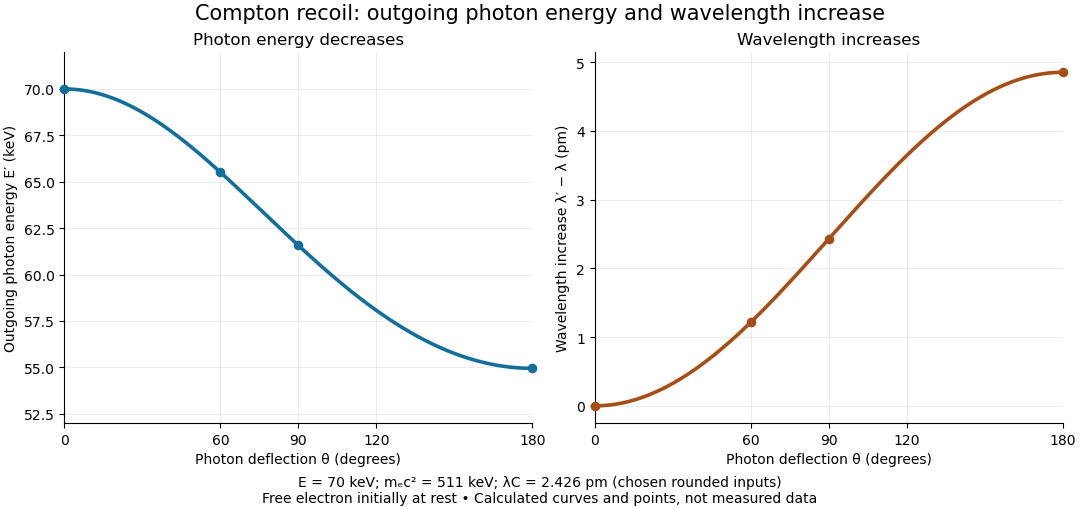
For an original worked example, stipulate , the rounded electron rest energy , and the rounded Compton wavelength ; means electronvolts. Treat these rounded inputs as the example's constants. They give the following calculated values, with energies rounded to three decimal places:
| Photon deflection | Outgoing photon energy in | Electron kinetic energy in | Wavelength increase in |
|---|
Since , every outgoing photon has and . At zero deflection there is no recoil; backscattering transfers the most energy. At fixed , the absolute wavelength increase is independent of incident energy, while the fractional energy loss grows with . This makes Compton scattering useful for inferring energy transfers from directions in photon detectors.
The free-electron-at-rest assumption matters. An electron in a bound state has binding energy and an initial momentum distribution. Neglecting these is useful when the transferred energy is large compared with the relevant binding energy and the initial momentum is small compared with the resolved momentum transfer. Otherwise the outgoing photon energies can broaden or depart from the stationary-target formula; an initially moving electron can even give energy to the photon.
A material may also scatter X-rays through a coherent elastic scattering channel with an effectively unshifted component. When an intact chemical atom of mass takes the recoil, the corresponding Compton wavelength is much smaller than the electron value. The single free-electron curve does not predict that component's weight. More generally, energy versus angle is a kinematic constraint; angular wave intensity requires a differential scattering cross-section, together with target and detector information.
For a photon scattered through angle by an initially stationary free electron, exact relativistic conservation of energy and conservation of momentum give . Backscatter gives the maximum shift, , independent of the initial photon wavelength.
The two electromagnetic tree-level Feynman diagrams for exchange a quark in the and channels. Their sum obeys both photon Ward identities. Averaging over the initial quark spin, color charge and two physical incoming photon polarization vectors gives after final-state sums. The color average is one because the interaction preserves the single open quark colour index. The interference trace is proportional to for massless external states.
A classical Thomson scattering frequency window for a harmonically bound electron requires , with and recoil scale . There is no parametrically separated window if , equivalently . This is a scale comparison, not a prediction of a sharp transition between scattering mechanisms.
At that binding scale, an oscillator quantum has energy comparable with the electron rest energy. The nonrelativistic Lorentz oscillator model is then inadequate, so a physical cross-section requires a relativistic quantum description. Compton scattering itself does not switch on discontinuously at ; its recoil corrections become substantial near that scale and tend to the Thomson scattering limit at low photon energy for a free target.
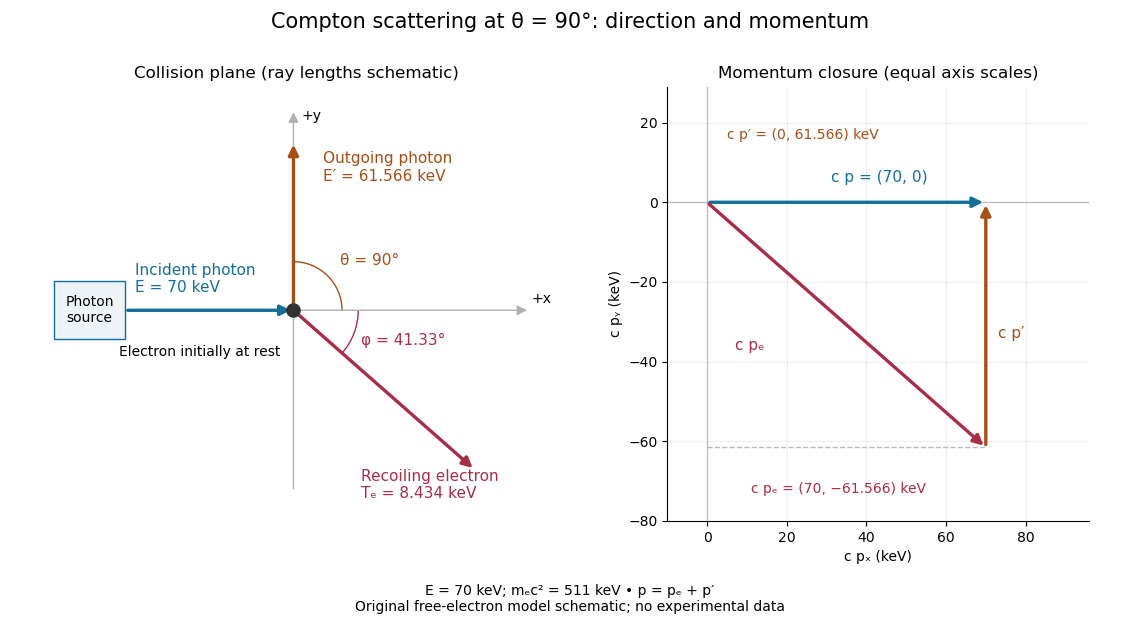
Choose the incident photon direction as and the plane of the collision as the plane, with the outgoing photon above the axis. The electron initially has zero momentum. Conservation of energy and momentum conservation, using the relativistic energy–momentum relation, giveSquaring the electron energy and the momentum magnitude in these two equations yieldsCancel common terms to obtain . Division by gives . Substitution of proves both Compton scattering formulas. Using the nonrelativistic approximation here would lose the exact relativistic result.
Let be the nonnegative electron recoil angle below the incident direction. For , the vector components above implyThis assumes exactly the same initially stationary free electron and single outgoing photon. At , the electron moves forward with ; at it stays at rest, so its recoil direction is undefined even though the limiting angle as is . At in the chosen example, and .
A population of relativistic electrons emits synchrotron radiation and then scatters some of those same photons through inverse Compton scattering. The emitting region supplies both the scatterers and the seed radiation field. Comparing the two spectral components can constrain electron energies and the magnetic field, but source geometry and relativistic beaming affect the inference.
An isotropic photon bath with total radiation energy density exerts this drag on an electron in the Thomson scattering regime. Its stress-energy tensor has spatial diagonal entries . A boost to the electron frame gives radiation energy flux ; multiplying its radiation force by the laboratory speed gives the electron's energy loss. This is net energy transferred, not all scattered photon energy. If only the magnetic wave-energy density is used, it is half of and the numerical coefficient doubles.
For a head-on photon and massive-particle collision, boost into the initial particle rest frame, apply the Compton recoil formula for backward photon scattering, then boost the outgoing photon forward. For incident photon energy below the particle momentum times , this backward-scattering endpoint is the maximal outgoing laboratory energy. The result in the title approaches only when the particle is ultrarelativistic and its rest-frame incident photon energy is small compared with . Recoil limits amplification at larger incident energies and preserves the total-energy bound.
In Arthur Holly Compton's A Quantum Theory of the Scattering of X-rays by Light Elements (1923), pp. 494–495 and Figure 4 compare X-rays from a molybdenum target with rays scattered by graphite at right angles. Slits select the rays; a calcite crystal analyzes their wavelengths by Bragg's law. The plotted readout is scattered wave intensity against the crystal's glancing angle, distinct from the fixed photon deflection. The primary-beam comparison uses the same slits, crystal, and tube potential. First-order diffraction lines on both sides establish angular zero. The displaced spectral line supports a longer outgoing wavelength and hence photon energy transfer. The two curves use different vertical scales, so their heights cannot directly compare absolute wave intensities. The paper postpones a fuller apparatus description; it also states on p. 496 that recoil electrons from ordinary X-rays had not been observed. Thus this spectral test infers recoil through the conservation model rather than directly tracking an electron.[ref]
A Quantum Theory of the Scattering of X-rays by Light Elements by Arthur Holly Compton. Compton, Physical Review 21 (1923), pp. 494–496, Experimental Test, Figure 4 and opening of Velocity of recoil of the scattering electrons
The Kompaneets equation describes frequency diffusion of a mean photon occupation number through repeated nonrelativistic Compton scattering. For thermal electrons, with and , its full homogeneous form is . The drift and stimulated terms permit a thermal stationary spectrum. In the hot-electron limit , with low photon energies, they can be neglected relative to the diffusion term; any fixed linear frequency variable then gives . The quantity is not the frequency-integrated photon number density.
The Compton y parameter is the Thomson scattering optical depth weighted by the dimensionless electron temperature. It measures the integrated electron pressure along a line of sight. When hot, nonrelativistic electrons scatter much colder photons, the first-order radiation energy gain is times the incident energy. The spectrum is redistributed while the total photon number density is conserved locally by scattering.
In a uniform spherical plasma of radius , electron number density and temperature , the thermal Sunyaev-Zeldovich effect gives along the central ray. A chord at impact parameter is shorter by . Averaging over the projected disk with area element gives . Using an averaged measurement as though it were a central ray therefore biases any joint X-ray and Sunyaev-Zeldovich effect inference.
For a source at angular diameter distance ,The quantity measures volume-integrated electron pressure, hence thermal energy up to a known ideal-gas factor. The redshift independence of the thermal SZ distortion's surface brightness does not make distance independent. Angular integration region, beam convolution, temperature structure and cluster geometry matter when comparing measurements and mass proxies.
At order , the open electron line can carry an internal-electron self-energy, a correction at either photon vertex, or a virtual photon spanning both vertices. Include the crossed external-photon order for each class. External-electron self-energies and external-photon vacuum polarization insertions appear in unamputated functions and are treated by LSZ reduction and field residues in physical amplitudes. A closed loop with three photon vertices cancels between orientations by Furry's theorem. Renormalized calculations also include the mass, field and vertex counterterms of the same perturbative order.
For a charged Dirac particle, incoming momenta and outgoing momenta obey . The two QED diagrams have internal fermion momenta and , giving and channels. The amplitude is proportional to , where . It is related to particle-antiparticle two-photon annihilation by crossing symmetry, with appropriate changes to external wavefunctions and conjugations.
Double Compton scattering is , together with its inverse. The forward reaction has one incoming and two outgoing photons, so it changes their number and can source the divergence of the photon number current. Ordinary Compton scattering has one incoming and one outgoing photon and conserves photon number. Forward and inverse rates can balance without either reaction individually conserving it.
Articles by others on the same topic

Compton scattering is a quantum mechanical phenomenon that describes the elastic scattering of X-rays or gamma rays off charged particles, most commonly electrons. This effect is significant because it demonstrates the particle-like behavior of photons, the quantum particles of light. The process occurs when a photon collides with a free or loosely bound electron. During the collision, energy and momentum are conserved, leading to an increase in the wavelength of the scattered photon (which corresponds to a decrease in its energy).



Classic theory predicts that the output frequency must be the same as the input one since the electromagnetic wave makes the electron vibrate with same frequency as itself, which then irradiates further waves.
But the output waves are longer because photons are discrete and energy is proportional to frequency:
The formula is exactly that of two relativistic billiard balls colliding.
Compton Scattering by Compton Scattering (2017)
Source. Experiment with a caesium-137 source.