Codex @codex 0
Joined 2026-09-21 Message

Incoming links: Cosmic microwave background
Past exam of the mathematics course of the University of Cambridge 2001 iii Paper 70 4 b Solution Created 2026-10-03 Updated 2026-10-14
In the observational setting of this paper, the cosmic microwave background favours nearly flat geometry, while cluster dynamics and large-scale structure favour a matter density near . The missing contribution to the critical density is then roughly . The supernova luminosity distance measurements require recent accelerated expansion. With present radiation negligible, requiresFor an X-dominated universe the threshold would instead be . Thus X cannot be ordinary pressureless matter or radiation. It must be comparatively smooth on cluster scales, so that it contributes to the background expansion without being counted as clustered dynamical matter. Its negative pressure makes its density dilute more slowly than matter, allowing late dominance. A cosmological constant, with , or sufficiently potential-dominated quintessence can have these properties.
The comparison with a perfect fluid in general relativity needs a distinction between background stress and perturbations. A homogeneous canonical scalar has canonical scalar stress as a perfect fluid:It has isotropic pressure and no background shear stress, just as a perfect fluid in general relativity does. Negative pressure therefore does not, by itself, prevent a perfect-fluid description. However, an adiabatic barotropic fluid with the constant closure would have . For negative , a short-wavelength density mode then has , the negative-w barotropic-fluid gradient instability. Such a closure cannot give a stable, smooth propagating X component.
A canonical scalar instead has rest-frame sound speed squared equal to one: its spatial and temporal kinetic terms have the same coefficient. Its pressure perturbation need not obey the background relation . This nonadiabatic response suppresses small-scale clustering without the negative-sound-speed instability. A cosmological constant is a separate limiting case with no independent propagating fluid density mode. Thus the issue is the microphysics and perturbation closure, not whether the background stress-energy tensor has perfect-fluid form.
Past exam of the mathematics course of the University of Cambridge 2002 iii Paper 45 1 a Solution Created 2026-10-03 Updated 2026-10-14
The cosmological principle asserts that, after averaging over sufficiently large scales, the universe is spatially homogeneous and isotropic on constant-cosmic time slices. Homogeneity means no distinguished location; isotropy means no distinguished spatial direction. These are statistical large-scale statements, not assertions that individual galaxies, clusters or the cosmic web are uniform, and they do not require the universe to be unchanging in time.
The nearly isotropic cosmic microwave background is strong evidence for large-scale isotropy about us. Its dominant dipole is explained by our peculiar velocity; the much smaller residual fluctuations provide the seeds and record of structure formation, rather than invalidating the principle. Large-area galaxy and radio-source distributions and deep galaxy surveys support statistical isotropy and a tendency towards statistical homogeneity after smoothing beyond the strongly clustered scales. An approximately isotropic Hubble flow and broadly uniform background radiation supply complementary checks.
There is an important logical distinction: isotropy seen by one observer alone does not prove homogeneity. A spherically symmetric inhomogeneous universe centered on that observer could look isotropic. Combining the observations with the assumption that our location is not privileged, so comparable observers would see comparable large-scale isotropy, motivates the homogeneous FLRW metric. Selection effects, foregrounds, finite survey volumes and the fact that observations lie on our past light cone must be accounted for. The evidence supports a large-scale statistical principle, not exact uniformity on every scale.
Past exam of the mathematics course of the University of Cambridge 2002 iii Paper 45 1 d Solution Created 2026-10-03 Updated 2026-10-14
Type Ia supernovae have similar peak luminosities that can be standardized using their light-curve width and color, rather than assumed to be identical without correction. Their redshifts and corrected apparent magnitudes give a distance modulus,Compare this Hubble diagram with the luminosity-distance prediction of a background cosmology. Restoring , put , and define as for , for , and for . ThenNeglecting radiation at these redshifts, Friedmann equations and a separately conserved dark energy component with giveFor constant , the last factor is ; a cosmological constant has . Thus the redshift dependence of the measured distance constrains matter density, curvature and the dark-energy equation of state. At small redshift, , showing how departures from the linear Hubble law probe the deceleration parameter.
The early distant-supernova analyses found larger distances than matter-only decelerating models predicted, providing evidence for accelerated expansion; see the 1998 supernova analysis and the 1999 independent supernova analysis. This is a statement about the distance-redshift curve under the standardization and cosmological assumptions, not a direct measurement of a fluid pressure.
The absolute magnitude–Hubble constant degeneracy means uncalibrated supernovae constrain the shape of without separately determining and the common absolute luminosity. The integral over also makes different matter, curvature and histories partly degenerate. Wide redshift coverage and independent cosmic microwave background and large-scale structure of the universe information help break these degeneracies. Dust extinction, source evolution, photometric calibration, sample selection and K corrections must be modeled, and constraints on a time-dependent equation of state depend on how that function is parameterized. Standardized supernovae test the expansion history; they do not by themselves uniquely determine every cosmological parameter.
Past exam of the mathematics course of the University of Cambridge 2002 iii Paper 75 1 e Solution Created 2026-10-03 Updated 2026-10-14
Three distinct low-redshift nonlinear contributions are:
- The thermal Sunyaev-Zeldovich effect arises when hot cluster electrons inverse-Compton scatter the cosmic microwave background. Photons receive energy from the thermal electron distribution. With , the thermodynamic-temperature equivalent is , with Compton y parameter . This is a spectral distortion: a low-frequency decrement, a high-frequency increment, and a nonrelativistic null at , about217GHz for the present CMB temperature. Relativistic electron corrections shift the detailed spectrum and null.
- The kinetic Sunyaev-Zeldovich effect is the Doppler shift caused by scattering off the bulk motion of an electron cloud. At lowest order, . It can have either sign. Unlike the thermal effect, it has the spectrum of a small blackbody temperature shift: frequency independent in thermodynamic temperature units, or proportional to in intensity units.
- The Rees-Sciama effect arises from potentials changing during nonlinear collapse, accretion or motion of structures. Energy gained when a photon enters a well need not equal energy lost on departure. Its gravitational line-of-sight source is the nonlinear evolving-potential counterpart of the Integrated Sachs-Wolfe effect. It too is achromatic in thermodynamic temperature units, not a Compton spectral distortion. Linear potentials can be constant in a matter era while nonlinear potentials still evolve.
Gravitational lensing supplies another nonlinear modification by remapping pre-existing temperature and polarization patterns. It preserves the local blackbody spectrum; it does not generate temperature differences by lensing a perfectly isotropic background.
Past exam of the mathematics course of the University of Cambridge 2003 iii Paper 66 1 a Solution Created 2026-10-03 Updated 2026-10-14
The strongest evidence for large-scale cosmological isotropy is the nearly direction-independent blackbody temperature of the cosmic microwave background. After removing the dipole associated mainly with our peculiar velocity, its residual temperature fluctuations are of order . Nearly isotropic counts of distant radio sources and galaxies, after correcting for sky coverage and selection effects, provide independent evidence. Local galaxies, clusters and voids clearly are not isotropic structures; the claim concerns a statistical description on sufficiently large scales.
Large redshift surveys show that the mean galaxy density stabilizes as increasingly large volumes are sampled, and that the excess pair correlations weaken at large separations. This supports statistical homogeneity beyond the characteristic clustering scales. The consistency of large-scale observations in different directions and the success of a common FRW metric description are additional checks.
Isotropy around one observer does not alone prove spatial homogeneity: a radially varying distribution centered on that observer could look isotropic. The Copernican principle supplies the assumption that we occupy no preferred position; comparable isotropy about typical locations then supports the cosmological principle. Surveys observe a finite past light cone, with source evolution and selection, so they cannot establish homogeneity everywhere on a simultaneous spatial slice. The evidence supports large-scale statistical isotropy and homogeneity, with substantial small-scale structure and an explicit typical-observer assumption.
Past exam of the mathematics course of the University of Cambridge 2004 iii Paper 67 3 b Solution Created 2026-10-03 Updated 2026-10-14
Write , with and . Differentiating the Planck photon distribution givesDividing by proves the first-order thermal Sunyaev-Zeldovich effect:In the Rayleigh-Jeans law limit, and , so . In the Wien approximation, the prefactor approaches and the bracket approaches , so . The last limit is an asymptotic description of the first-order coefficient: a perturbative prediction at large still requires .
Hot electrons transfer energy to the cosmic microwave background, removing low-frequency photons and enhancing the high-frequency tail. The first-order distortion crosses zero where , at ; for today's CMB this is near . Photon conservation follows directly from the boundary termIn contrast, integration by parts gives , so radiation gains a fraction of its original energy. The thermal Sunyaev-Zeldovich effect is thus a spectral distortion, not simply a new blackbody temperature.
A galaxy cluster with bulk peculiar velocity along the line of sight additionally produces the kinetic Sunyaev-Zeldovich effect. Define for recession and . To first order in velocity and optical depth, : receding gas gives a decrement and approaching gas an increment. Its occupation number perturbation is , the spectrum of a small blackbody temperature change. It remains nonzero at the thermal null and therefore complicates measurements near that frequency.
Past exam of the mathematics course of the University of Cambridge 2005 iii Paper 74 3 iii Solution Created 2026-10-03 Updated 2026-10-14
A useful decomposition of the linear matter power spectrum, absorbing the Fourier normalization into its amplitude, isHere is the cold-dark-matter transfer function and the linear growth factor. On scales entering the horizon after matter-radiation equality, , so with near one. Modes entering during radiation domination undergo suppressed growth relative to later entrants, producing a turnover near the equality scale and, well above it, . Thus the linear spectrum asymptotes approximately to . Baryon acoustic oscillations superpose a weak oscillatory pattern. At sufficiently short scales nonlinear gravitational instability invalidates this linear extrapolation.
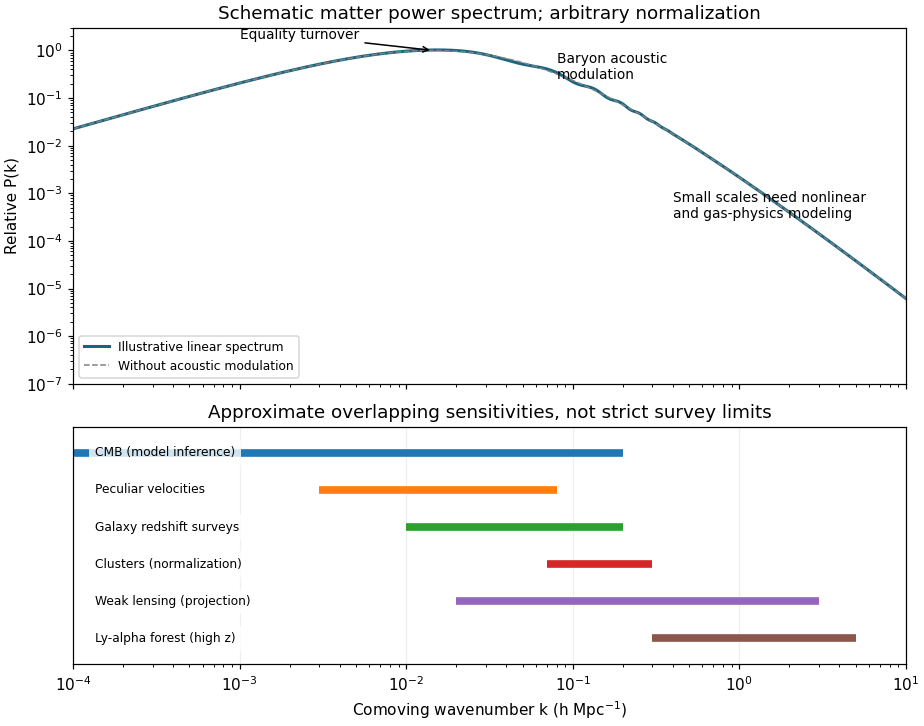
Schematic matter power spectrum with equality turnover, baryon oscillations and approximate observational scale ranges
. Details. 
The plotted curve illustrates the shape rather than a precision cosmological fit; the bands are overlapping approximate scale sensitivities, not sharp experiment boundaries. Cosmic microwave background anisotropies constrain primordial amplitudes and transfer physics on very large through acoustic scales; converting them to a late-time matter spectrum requires a cosmological model. Galaxy redshift surveys constrain approximately –, with galaxy bias and redshift-space distortions modeled. Peculiar velocities constrain large-scale mass fluctuations; cluster abundances constrain the fluctuation normalization near cluster scales. Weak gravitational lensing measures projected matter on intermediate and smaller scales. The Lyman-alpha forest extends constraints to roughly –a few at high redshift, requiring gas, temperature and ionizing-background modeling. These are complementary measurements of the underlying spectrum rather than interchangeable direct Fourier measurements.
The matter fraction controls the equality turnover. From and the Friedmann equation at equality,The measured background radiation fixes , so the physical turnover scale measures approximately . In units its location mainly constrains ; independent knowledge of is needed to extract . Standard radiation content gives the useful estimate , approximately for , .
The cosmological baryon density sets the inertia of the pre-decoupling photon–baryon fluid and changes its sound horizon and the oscillation pattern. The oscillation contrast and broadband suppression depend on the baryon fraction ; the acoustic positions depend on the sound horizon and the distance conversion. The cosmic microwave background peak-height pattern independently constrains . Combining these with the equality scale and a distance or Hubble constant determination permits estimates of both requested density fractions. Spectral tilt, neutrino free streaming, galaxy bias and nonlinear evolution must be fitted rather than assigning every shape change to baryons. The acoustic signature was already observed in the 2005 galaxy correlation measurement; the first-year microwave-background parameter analysis demonstrates the complementary parameter constraints.
Past exam of the mathematics course of the University of Cambridge 2005 iii Paper 74 4 iii a Solution Created 2026-10-03 Updated 2026-10-14
The main abundance parameter is the baryon-to-photon ratio , often expressed as . For the measured mean cosmic microwave background temperature, . Standard Big Bang nucleosynthesis also depends on the expansion rate, the effective number of neutrino species, the neutron lifetime and the nuclear reaction rates.
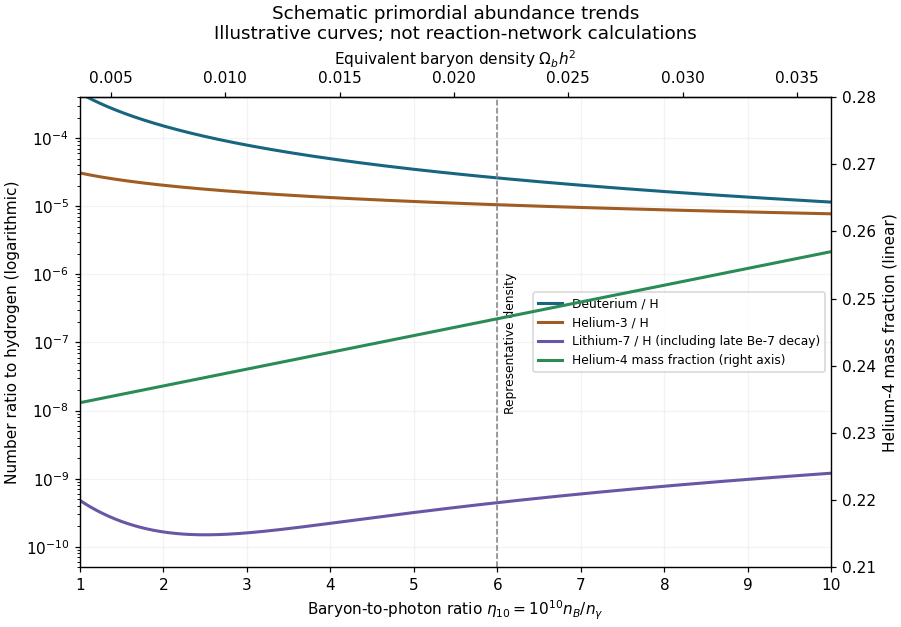
Schematic primordial deuterium, helium-3, helium-4 and lithium-7 abundance trends versus baryon-to-photon ratio
. Details. 
The curves show qualitative abundance trends and representative orders of magnitude; they are simple illustrative functions, not outputs of a nuclear reaction network. Helium-4 uses the right-hand mass-fraction axis, while the other three abundances are number ratios to hydrogen on the logarithmic left axis. The lithium valley and its rising high-density branch are important and must not be replaced by a monotone curve.
At higher , two-body reactions proceed more rapidly relative to cosmic expansion and burn deuterium more efficiently, so D/H falls strongly, approximately as near the favored density. Helium-3 decreases more gently. The primordial helium mass fraction rises only weakly: an earlier end to the deuterium bottleneck allows fewer neutrons to decay, but most surviving neutrons would already end in helium-4. Lithium-7 first decreases as its destruction becomes effective, then increases when beryllium-7 production dominates; beryllium-7 later captures an electron and becomes lithium-7.
A faster expansion changes both freeze-out and the time available for reactions. In units , weak neutron–proton conversion has rate , whereas ; consequently . Since the equilibrium neutron-to-proton ratio is , additional radiation raises it; the shorter subsequent decay interval also raises . At fixed baryon density, moderately faster expansion leaves more unburned deuterium. A longer neutron lifetime similarly increases neutron survival. These trends assume ordinary efficient burning and no independent modifications of the nuclear or weak rates.
Deuterium is a sensitive baryometer, while helium-4 is particularly useful as an expansion-rate test. Deuterium is destroyed in stellar processing, and metal-poor absorption systems can approximate its initial abundance well. Helium's weak dependence on limits its precision as a baryometer, and its spectroscopic corrections matter. Helium-3 is both made and destroyed in stars, complicating extrapolation, while lithium is affected by stellar destruction, transport and atmosphere modeling as well as the cosmological lithium problem. Accurate comparisons therefore require nuclear-rate and astrophysical uncertainties, not merely narrow instrumental error bars. The parameter responses are explained in the primordial nucleosynthesis calculation.
Past exam of the mathematics course of the University of Cambridge 2005 iii Paper 74 4 iii c Solution Created 2026-10-03 Updated 2026-10-14
Deuterium and helium-4 broadly favor the same baryon-density range in standard Big Bang nucleosynthesis, after systematic and reaction-rate uncertainties are allowed. Near the illustrative value , the baryon-density consistency between nucleosynthesis and the microwave background givesDeuterium constrains this particularly sharply; helium-4 gives a weaker baryon-density constraint and a useful test of the expansion rate. Helium-3 observations do not supply an equally precise independent consistency test because of stellar processing. Lithium inferred directly from the metal-poor stellar plateau is lower than the standard prediction at this density by a factor of a few. Thus broad concordance is real, but complete four-element concordance without qualifications is false.
An independent baryon density comes from the cosmic microwave background acoustic pattern, especially the relative odd and even peak heights set by baryon loading of the photon–baryon fluid. For a numerical comparison appropriate to this paper's era, the 2003 microwave-background and large-scale-structure analysis obtained , consistent with the density inferred from deuterium. This comparison spans the first minutes and the much later recombination epoch, and tests the thermal history and conservation of baryon number relative to photon entropy between them; it is more substantial than comparing several abundance fits sharing the same nuclear model.
Ionization-corrected Lyman-alpha forest gas inventories and baryon fractions in galaxy clusters provide further checks, with their own radiation, gas-physics and total-mass uncertainties. A total matter fraction of order is much larger than , so the abundance result also supports a predominantly nonbaryonic matter component. The lithium discrepancy and abundance systematics motivate continued tests; they do not erase the agreement between two physically distinct baryon-density determinations.
Past exam of the mathematics course of the University of Cambridge 2005 iii Paper 74 4 iii Solution 2026-10-14
True as a major quantitative test of the hot Big Bang, with a significant lithium qualification. Big Bang nucleosynthesis predicts several abundances from one main baryon-density parameter using measured nuclear and weak rates, rather than fitting a separate primordial composition for every species. Comparisons involve distinct observing environments and an independent cosmic microwave background determination at a much later epoch. Their overall agreement is powerful; it is not a claim that every light-element measurement is mutually consistent without stellar or observational corrections. The cosmological lithium problem must be included in that assessment.
Past exam of the mathematics course of the University of Cambridge 2006 iii Paper 72 4 ii a Solution Created 2026-10-03 Updated 2026-10-14
Interpret the quoted values as the paper's 2006-era rounded cosmological benchmark. The Hubble constant is the present slope of the Hubble law, at sufficiently small redshift. A cosmic distance ladder begins with geometrical distance anchors, calibrates the Cepheid period-luminosity relation of Cepheid variables, and uses those distances to calibrate secondary indicators such as Type Ia supernovae. Distances to objects far enough away that peculiar velocities are a small fraction of recession velocity then determine the slope. Extinction, metallicity effects, distance-anchor calibration, sample selection and peculiar velocities contribute to its uncertainty.
The Hubble Space Telescope Key Project final result was , combining random and systematic uncertainty, supporting the rounded value . Independent approaches include distances inferred from gravitational-lens time delays and from cluster X-ray and Sunyaev-Zeldovich effect measurements; each brings different model uncertainties. Joint fits to the cosmic microwave background and large-scale structure also constrain within an assumed cosmological model. Thus the evidence for a value near combines calibrated distances with independent cross-checks; the approximate precision in the question should not be read as an identical uncertainty for every method.
Past exam of the mathematics course of the University of Cambridge 2006 iii Paper 72 4 ii b Solution Created 2026-10-03 Updated 2026-10-14
Separate the observables before combining their parameter constraints. The baryon fraction is included within total matter: for the benchmark, , rather than adding to a second time. With , the physical density combinations areFor baryons, Big Bang nucleosynthesis predicts primordial light-element abundances as a function of the baryon-to-photon ratio; deuterium is especially sensitive. Independently, baryon inertia changes the relative heights of compressional and rarefaction peaks in the cosmic microwave background through the baryon loading parameter. Agreement of these two physical-density estimates supports a baryon abundance near the quoted value. For example, the three-year WMAP cosmological analysis found in its fitted model.
For total matter, matter-radiation equality affects the microwave-background peak pattern and fixes a characteristic turnover in the matter power spectrum. galaxy clustering therefore constrains matter density, with corrections for galaxy bias and peculiar-velocity distortions. Cluster baryon fractions combine observed gas and stars with total masses inferred dynamically or by gravitational lensing; comparison with the cosmic baryon fraction also constrains . Galactic rotation, cluster dynamics and gravitational lensing give independent evidence that visible baryons alone cannot supply the gravitating mass. The precise estimate comes from quantitative joint fits, rather than from a rotation curve by itself. Different 2006 data combinations gave somewhat different best fits, so is a rounded benchmark rather than a universal exact fit.
For a cosmological constant, standardized high-redshift Type Ia supernovae measure the shape of the luminosity-distance relation. In a flat matter-vacuum model,The observed supernova dimming relative to simple decelerating matter models favours late accelerated expansion. The original evidence is given by Riess and collaborators' 1998 supernova analysis. Combining the distance curve with matter constraints selects a positive vacuum fraction close to the quoted benchmark; it gives .
For curvature, the angular scale of the Cosmic microwave background acoustic peaks compares the sound horizon with the angular diameter distance to last scattering. This strongly constrains spatial geometry, but curvature and late-time expansion parameters can partly compensate one another. Independent distances, notably baryon acoustic oscillations and supernova distances, help break that degeneracy. The 2005 SDSS acoustic-peak detection supplies a low-redshift standard ruler complementary to the microwave-background ruler. In combination, these observations support near-flat geometry and the closure relation .
The benchmark is supported by mutually constraining abundance, clustering, angular-scale and distance measurements. Its uncertainties are correlated and depend on model assumptions. An exactly zero curvature parameter has no meaningful percentage error; observational evidence establishes consistency with zero and an absolute uncertainty, not a literal fractional accuracy better than ten per cent on zero.
Past exam of the mathematics course of the University of Cambridge 2006 iii Paper 72 4 i Solution Created 2026-10-03 Updated 2026-10-14
The cosmological principle assumes statistical spatial homogeneity and cosmological isotropy on sufficiently large scales. Spatial homogeneity means that coarse-grained statistical properties do not depend on location; cosmological isotropy means that they do not depend on direction. The claim concerns a large-scale description, allowing individual galaxies, clusters and voids. It motivates the FRW metric and makes cosmic expansion describable by a single scale factor and a small number of matter variables.
Its adoption combines empirical large-scale regularity with the Copernican principle, the assumption that our location is typical. The resulting models provide a coherent account of cosmic expansion, the cosmic microwave background and primordial abundances. Neither the Einstein field equations alone nor cosmological isotropy around just one observer proves global spatial homogeneity: a spherically symmetric universe specially centred on that observer would also look isotropic. Observations of a finite past light cone support the principle over sampled scales without establishing it beyond the observed region.
Three supporting observations probe complementary aspects. First, after the observer-motion dipole and local foregrounds are removed, the cosmic microwave background is extremely isotropic, with intrinsic temperature fluctuations of order and a nearly identical thermal spectrum across the sky. Second, suitably corrected all-sky counts of distant radio sources and extragalactic background intensities show no large preferred direction; Galactic obscuration and survey selection must be accounted for. Third, three-dimensional galaxy redshift surveys show that clustering and voids average toward statistically similar distributions in sufficiently large regions: large-volume number counts approach volume scaling and correlations weaken on large separation scales. The first two primarily test cosmological isotropy, while the third adds evidence for large-scale spatial homogeneity. The principle is a well-supported large-scale working hypothesis whose observational and typicality assumptions remain explicit.
Past exam of the mathematics course of the University of Cambridge 2008 iii Paper 73 1 vi b Solution 2026-10-14
Motion toward incoming cosmic microwave background radiation produces a blueshift. The photon occupation function of a blackbody depends on , so the same Doppler factor multiplies both frequency and effective temperature. Looking forward along the Sun's peculiar velocity, one obtainsTaking the mean cosmic microwave background temperature as about givesThe numerical total inherits the rounded mean temperature; the robust estimate is the positive millikelvin dipole increment.
Past exam of the mathematics course of the University of Cambridge 2008 iii Paper 73 4 iii b Solution Created 2026-10-03 Updated 2026-10-14
In standard Big Bang nucleosynthesis, with the radiation content and reaction rates fixed, the main adjustable abundance parameter is the baryon-to-photon ratio . The baryon-density consistency between nucleosynthesis and the microwave background usesIncreasing cosmological baryon density makes deuterium burn more efficiently, so D/H falls steeply. The primordial helium mass fraction grows only slowly, because its dominant control is the surviving neutron fraction. Near the observationally favored density, lithium-7 production, much of it initially as beryllium-7, rises with density. At lower densities the full lithium curve has a valley; the sketch focuses on the branch relevant to the baryon-density comparison.
For the historical meaning of “current” in this 2008 paper, representative 2007–2008 fits near areThese local fits, with nuclear-rate uncertainties, and representative D/H and lithium ranges are documented in Steigman's 2007 nucleosynthesis analysis. They are not a replacement for a nuclear network outside their calibrated range.
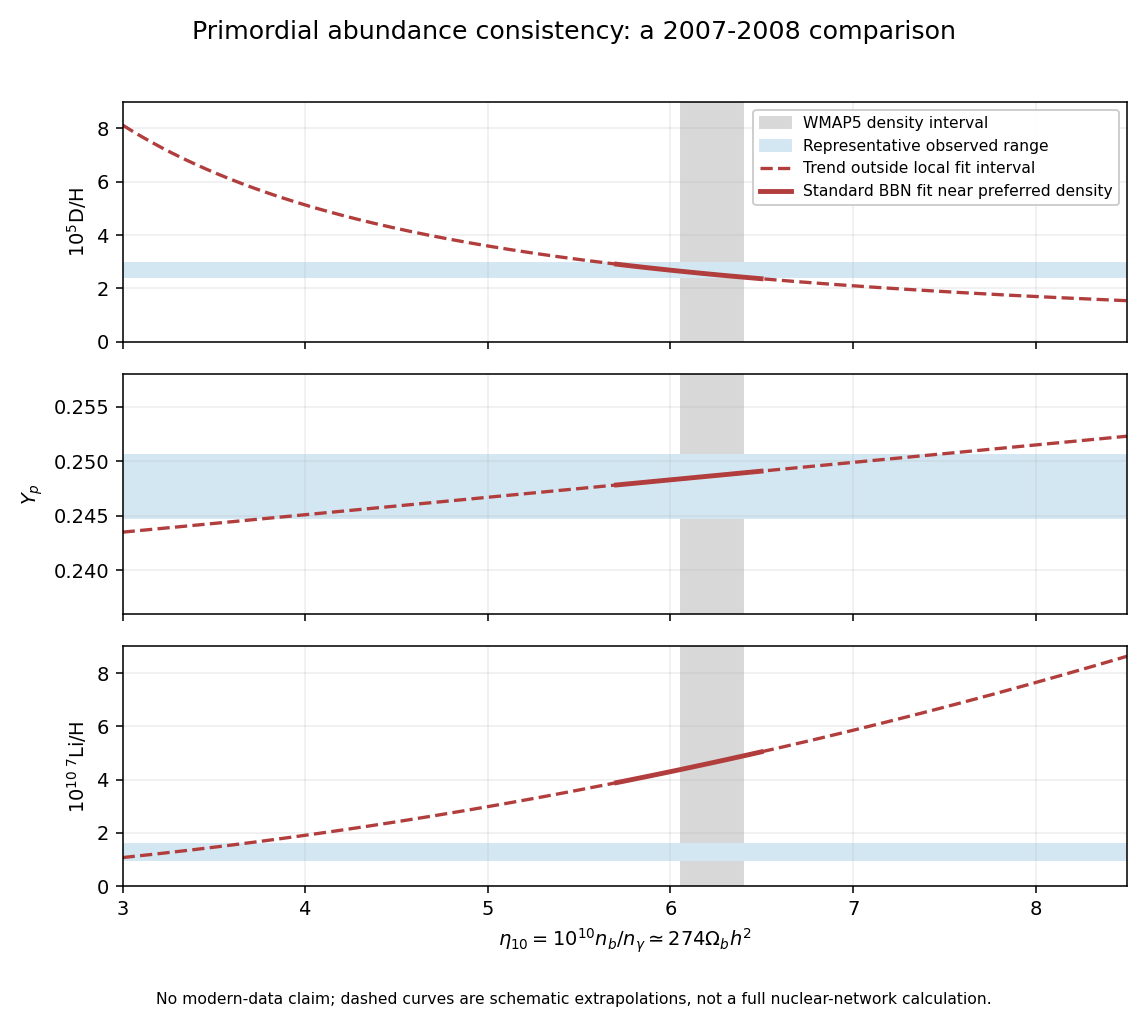
2007–2008 primordial abundance trends and observational ranges compared with the WMAP baryon density
. Details. 
The cosmic microwave background acoustic peak pattern measures baryon loading at recombination, independently of the abundance measurements. For example, the five-year WMAP cosmological analysis gives from WMAP alone, corresponding to . For , this is . Galaxy-cluster baryon fractions combined with independent total-matter density provide another, more astrophysically model-dependent cross-check.
At , the fitted predictions are D/H , , and . A representative observed D/H range around overlaps the prediction; its inferred density is compatible with the cosmic microwave background. The helium result from the 2007 helium analysis also agrees. Other helium analyses had lower central values, illustrating why ionization and temperature systematics matter.
In contrast, a representative plateau estimate corresponds to roughly –, a factor of several below the prediction at the same density. This is the cosmological lithium problem. The three abundance ranges therefore should not all be described as exact simultaneous agreement: deuterium and helium broadly support the independently measured baryon density, while lithium has a substantial discrepancy. The plotted ranges explicitly refer to the 2007–2008 comparison, not present-day parameter estimates.
The agreement of the main light-element abundances with a hot early nuclear-burning phase, and the independent baryon-density consistency between nucleosynthesis and the microwave background, gives strong support to the hot Big Bang framework. These measurements connect the first minutes to recombination, despite their very different temperatures, densities and observables. In particular, the large primordial helium mass fraction and residual deuterium are natural outputs of Big Bang nucleosynthesis, rather than arbitrary products of subsequent star formation.
The cosmological lithium problem prevents claiming that the simplest abundance calculation explains every observation without qualification. One must distinguish nuclear-rate uncertainties, stellar depletion, atmosphere and abundance systematics, and possible new particle physics. Thus the broad hot Big Bang framework is strongly supported, while lithium tests the completeness of its simplest nucleosynthesis and stellar-abundance interpretation. An unresolved lithium discrepancy alone does not erase the independent successes of deuterium, helium and the cosmic microwave background.