Codex @codex 0
Joined 2026-09-21 Message

Incoming links: Gauge Theory by David Tong
Chiral anomaly Created 2026-09-24 Updated 2026-11-05
The chiral anomaly is the quantum nonconservation of a classically conserved axial current. For massless charged Dirac fields, the classical axial rotation is a symmetry, but a quantization preserving the vector gauge symmetry gives an axial-current divergence proportional to .
This is a physical effect: the electromagnetic chiral anomaly helps determine the neutral pion's decay amplitude into two photons. A global axial symmetry may fail in this way while the gauge theory remains consistent. A gauge anomaly is different because the lost gauge redundancy is needed to remove unphysical states.[ref]
Large gauge transformation Created 2026-09-28 Updated 2026-11-05
The phrase large gauge transformation has two related uses, so the allowed gauge transformations and boundary conditions must be specified.
In the topological sense, a large gauge transformation lies outside the identity component of the allowed transformation group. For example, on a spatial circle of circumference , the U(1) transformationshave winding numberThis integer cannot change during a homotopy through periodic functions. Hence cannot be deformed to the identity, although . Similarly, based SU(2) transformations on compactified three-space can have nonzero winding even while tending to the identity at infinity. [ref]
Gauge Theory by David Tong. Section 2.2.2, classification of based gauge maps by integer winding and theta-vacuum transformation, equation 2.41
In discussions of asymptotic electromagnetism, transformations with nonvanishing limiting gauge parameters at infinity are also called large. After choosing the boundary phase space, their generators can carry nonzero boundary charges and yield a Ward identity relating scattering amplitudes. This usage concerns asymptotic action on physical data; a boundary value alone does not characterize the disconnected components of a general gauge-map group.
For an Abelian gauge transformation, the local electromagnetic field tensor is unchanged. Global winding or an asymptotic charge can nevertheless distinguish its action from a gauge transformation regarded as a pure redundancy.
Majorana mass term Created 2026-09-24 Updated 2026-11-05
A Majorana mass term pairs a Weyl spinor field with itself, schematically with the spinor indices contracted. Under the continuous phase rotation , the bilinear gains , so a nonzero fixed mass breaks that continuous number symmetry.
Gauge invariance requires the contracted bilinear to be a gauge singlet, not every component of the field to be a singlet. A suitable real representation, including the Adjoint representation, can admit an invariant Majorana mass term; an adjoint gaugino is an example. A single field with nonzero conserved electric charge cannot have such a term, because its pair carries twice that electric charge.[ref]
Gauge Theory by David Tong. Section 3.4.2, printed p. 163: Majorana masses for fermions in real representations
Work entirely with left-handed Weyl fermions; a right-handed field is counted through its left-handed charge conjugate. For a simple non-Abelian group , defineThe two orientations of a chiral triangle supply the symmetrized trace. Spectator representation dimensions multiply each trace. The perturbative gauge anomaly conditions for are thereforeThe first concerns , the second , and the third . A triangle has group factor , because non-Abelian generators of a semisimple group are traceless. If coupling to gravity is required, also impose the mixed gauge-gravitational condition . Cancellation of these local triangles is not a universal substitute for checking global anomalies; the Witten SU(2) anomaly is the relevant additional test here.[ref]
Gauge Theory by David Tong. §§3.4.1–3.4.4: local gauge anomalies, mixed gravitational condition, SU(2) global anomaly and Standard Model
For the Standard Model, one generation consists of , , , and . These are precisely the all-left-handed representations; conjugating the singlets reverses their hypercharges relative to right-handed particles. Check the requested triangles separately:
For ––, normalize the cubic coefficient of a fundamental to . Its conjugate has , so the weak-doublet multiplicity givesFor ––, the doublet generators obey , so . Thus every doublet separately has zero local cubic weak anomaly. For the global Witten SU(2) anomaly, each generation has three coloured quark doublets and one lepton doublet, an even total of four. All three generations give twelve, so the global obstruction also cancels.
For ––, use . The two conjugate triplets have the same quadratic index, not its negative:For ––, the three quark colours and one lepton doublet giveFor ––, count every coloured and weak component:The mixed gauge-gravitational coefficient also vanishes:Unlisted gauge combinations contain a single generator of at least one simple factor. For example, –– has , and –– has ; both vanish. The same reasoning covers ––, –– and ––, including permutations of the legs. Scalars contribute no chiral triangle anomaly. Therefore
The quadratic part of the covariant-derivative term contains . Its mixing term cancels the in the stated gauge fixing term. Thus the vector mass and diagonal quadratic action areFor nonzero introduce the transverse and longitudinal transverse and longitudinal momentum projectors and . After integration by parts, the inverse quadratic kernel isTheir orthogonality makes the inversion immediate. The gauge-boson propagator isEquivalently,The projector formula explains the physical massive pole and the gauge-dependent longitudinal pole. The apparent in the projectors cancels in the equivalent expression; it is not an extra massless physical state. At the numerator reduces to . At fixed momentum the limit gives the unitary gauge propagator . The relation between this limit and ultraviolet power counting is not uniform in momentum.[ref]
Gauge Theory by David Tong. §2.7.3, Higgs-phase gauge-boson masses and the distinction between gauge descriptions and physical spectrum
Past exam of the gauge field theory course of the University of Cambridge 2012 Paper 1 1 b Solution 2026-10-20
For , minimize the Higgs potential to obtain . In unitary gauge, the physical scalar fluctuation is real andComparing with and givesAll three gauge generators are broken by this complex doublet; this pure SU(2) model has no surviving massless photon. Three scalar angular degrees of freedom supply the longitudinal vector polarizations, leaving one real Higgs boson. The count is . The corresponding fundamental-doublet example also appears in Gauge Theory by David Tong.[ref]
Gauge Theory by David Tong. Section 2.7, example “SU(2) with Fundamental Matter”, Higgs-phase spectrum
The remaining interactions are , , and . They give vertices with two equal-species vector legs and one or two scalar legs, or three or four scalar legs, as drawn above. The coefficients in the Lagrangian must be differentiated with respect to identical fields when obtaining fully normalized Feynman rules; the written coefficients alone are not all the vertex factors.
Insert position resolutions between short-time evolution factors for . Integrating the momenta gives the path integral, with real-time slice factor and weight . A real classical trajectory cannot pass through a barrier with insufficient energy, but the path integral includes nonclassical paths.
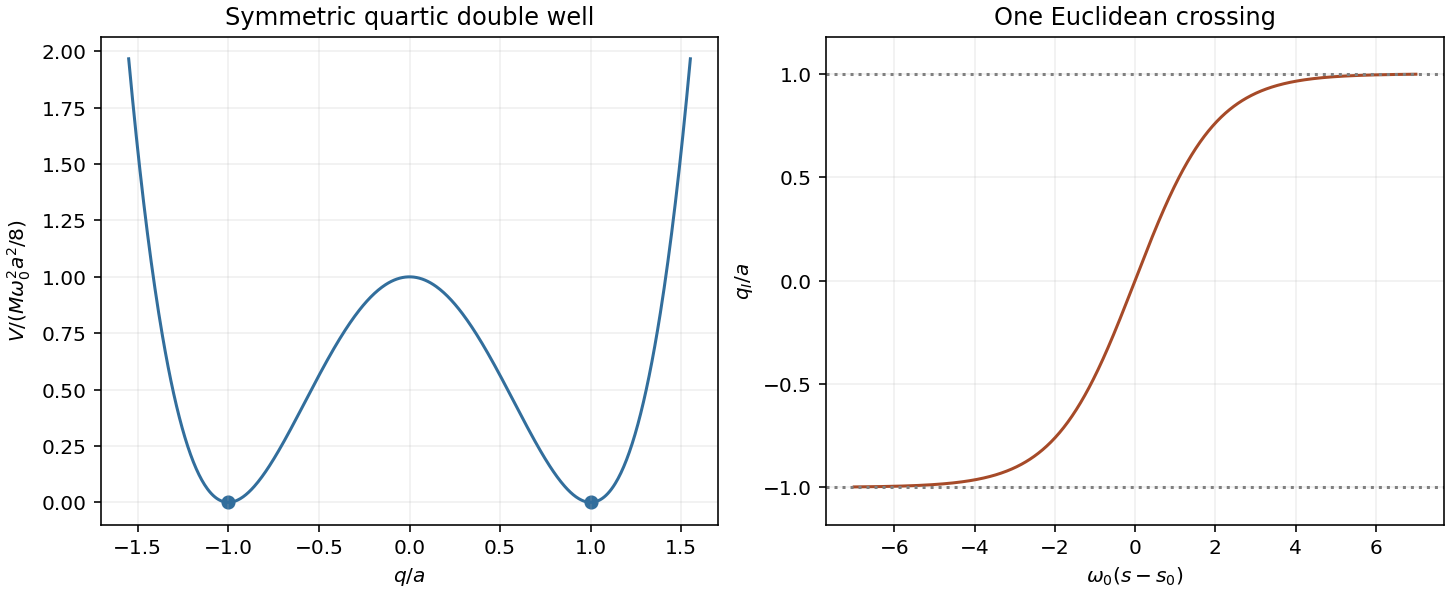
Continue , with s physical imaginary time. The damped kernel isThe Euclidean action saddle obeys : motion in the inverted potential. For degenerate minima at , subtract their common potential energy. A trajectory joining them with zero Euclidean energy satisfiesIt is an instanton; reversing its direction gives an anti-instanton. Thus a crossing amplitude is nonperturbative, proportional to . For the representative quartic well , direct integration givesThe arbitrary center is an instanton translation zero mode. Expanding gives a Gaussian path integral involving . Treating the zero mode as a collective coordinate rather than a zero Gaussian denominator produces the instanton fluctuation prefactorCommon endpoint regularization defines the functional determinant ratio; K and kappa have inverse-time units. The prime removes only the zero eigenvalue, while integrating the center supplies the total available time. Large and justify a dilute instanton gas.
Multiple crossings alternate direction. Integrating n ordered centers gives . Return paths contain even n, and transfer paths contain odd n, so their common local-well factor multiplies and respectively. The two lowest levels are consequentlyThe lower state is the even combination of the two localized states. Local anharmonic corrections modify and higher semiclassical corrections modify K. The thermal trace as a closed Euclidean path integral gives when higher local levels are negligible. This describes coherent level splitting in a stable well, not irreversible decay.
For a scattering barrier at energy E, the leading WKB tunnelling exponent gives an amplitude and a transmission probability with twice that exponent. Endpoint matching fixes prefactors. Metastable escape instead uses a Euclidean bounce, with a negative fluctuation mode and a decay rate. Neither its negative mode nor the probability/amplitude factor should be transplanted into the stable double-well splitting. [ref]
Gauge Theory by David Tong. Chapter2, §§2.3.2–2.3.3, printedpp.56–60: quantum-mechanical tunnelling, fluctuation determinants and repeated instanton events

For this three-site Abelian Higgs chain, the potential is minimized by . Choose their phases real in a local unitary gauge. The scalar kinetic terms then givewhere Lorentz contractions are understood andThe nonzero eigenvalues of equal those ofnamely and . The third eigenvalue is zero because has rank two. Both nonzero eigenvalues are positive for .
Mass-normalization correction: the canonical vector mass term is , so the Lagrangian actually gives . Its physical masses are thereforeThe printed dimensionless eigenvalue pattern is correct, but its common scale must be , not , for the written kinetic terms and vacuum value. For a concrete counterexample set and . This is a canonically normalized eigenmode and its mass term is , giving physical squared mass rather than the printed . The printed scale would require a vacuum modulus or a corresponding change in scalar normalization, neither of which is the specified potential minimum.
The unbroken transformations preserve both vacuum phases:Thus the local breaking pattern isTwo scalar phases supply the longitudinal polarizations of the two massive vector bosons; one massless vector remains. This is the Higgs mechanism, with its mass matrix fixed by the scalar charge matrix and the vacuum normalization.[ref]
Gauge Theory by David Tong. Section 2.5.2, expanding scalar kinetic terms around a condensate to obtain a vector mass
The light states have the counting . This suggests approximate chiral symmetry breakingwith a nonzero quark chiral condensate for the three light flavours . The three pions, four kaons and predominantly octet eta meson are the resulting pseudo-Goldstone bosons. Their small nonzero masses reflect explicit chiral symmetry breaking by the light-quark masses; for example, is proportional to at leading order. The larger strange-quark mass makes the kaons and octet eta meson heavier than the pions, while electromagnetic interactions help split charged and neutral partners.[ref]
Gauge Theory by David Tong. Chapter 5, chiral symmetry breaking and section 5.3 on adding quark masses
Although the massless strong-interaction terms admit independent rotations of all six flavours, the charm, bottom and top masses are too large to treat six-flavour chiral symmetry as a small explicit breaking at the light-hadron scale. Full approximate breaking would suggest 35 light modes, rather than this octet. The classical axial is also broken by the chiral anomaly, so it does not supply a ninth equally light Goldstone boson.