The Gershgorin circle theorem locates every eigenvalue of a square matrix using only its entries. A diagonal entry supplies a centre in the complex plane, and the sum of the off-diagonal absolute values in its row supplies a radius. Small off-diagonal couplings therefore confine the eigenvalues near the diagonal entries. This turns a global eigenvalue problem into a picture built one row at a time.
Precisely, let , with , and define the closed Gershgorin discsEvery eigenvalue of satisfies , including eigenvalues on the boundaries. No symmetry or diagonalizability is required. Despite the name, the theorem uses filled disks, not just their circular boundaries.[ref]
https://www.stat.uchicago.edu/~lekheng/courses/302/notes2.pdf. Gene H. Golub, CME 302: Numerical Linear Algebra, Lecture 2, §6, 2005; notes by James Lambers, edited by Lek-Heng Lim
The short reason is the triangle inequality. For a nonzero eigenvector with , choose with . The th row givesThus the largest eigenvector coordinate identifies a Gershgorin disc containing , even though that eigenvector need never be computed to use the bound.
This is useful when a full eigenvalue computation would be expensive: forming the Gershgorin discs needs one pass over the nonzero entries of a sparse matrix. If lies outside every Gershgorin disc, then is an invertible matrix, since zero is not an eigenvalue. The condition is exactly in every row, namely strict diagonal dominance. This connects diagonal dominance to solvability of a linear system; the inverse infinity-norm bound from diagonal dominance adds a quantitative bound. It is a sufficient test: failure to exclude zero does not prove singularity.
For a concrete symmetric matrix, takeThe three Gershgorin discs have centres and are pairwise disjoint. The finite-dimensional spectral theorem makes the eigenvalues real, so their possible locations reduce to the intervals , , and . Gershgorin eigenvalue counting gives exactly one eigenvalue in each. Independently, the characteristic polynomial iswhose numerical polynomial roots are , , and , rounded to six decimal places. All are positive, as Gershgorin bounds for symmetric matrices already guarantee without finding those polynomial roots.
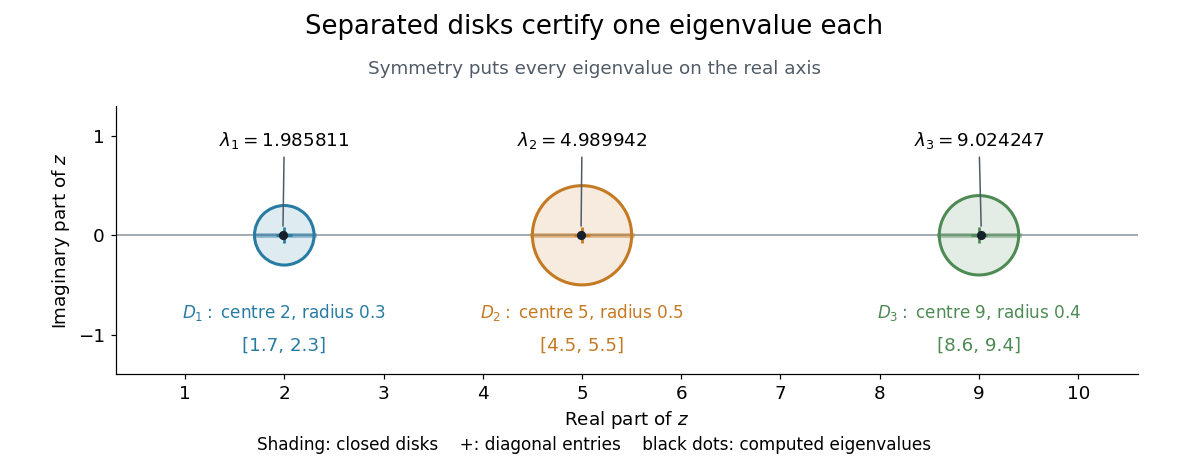
Three separated Gershgorin discs, each containing one real eigenvalue of the symmetric example
. Details. S. Gerschgorin published the result in 1931 in Über die Abgrenzung der Eigenwerte einer Matrix, in the Bulletin de l'Académie des Sciences de l'URSS, issue 6, pages 749–754. The original paper's §2 states both eigenvalue inclusion and counting in separated groups of Gershgorin discs; §3 already discusses column bounds and transformations preserving the eigenvalues. Thus both the localization picture and ways to sharpen it were part of the original development.[ref]
https://www.mathnet.ru/php/getFT.phtml?jrnid=im&paperid=5235&what=fullt&option_lang=eng. S. Gerschgorin, Über die Abgrenzung der Eigenwerte einer Matrix, 1931, pp. 749–754; original German paper in the journal archive
To exclude zero as an eigenvalue of , it is enough that every row has positive real diagonal entry exceeding the sum of the absolute values of its off-diagonal entries. All Gershgorin discs then lie strictly in the right half-plane. Forthe three diagonal-dominance margins of are , all positive for . Thus is nonsingular for negative real . Working with the pencil directly avoids computing either a determinant polynomial or .
A row Gershgorin disc of a square matrix is the closed disk in the complex plane with centre and radius . A zero radius gives a single point. The Gershgorin disc theorem places every eigenvalue in the union of these disks. For a Hermitian matrix, the real intervals cut out by the Gershgorin discs bound the eigenvalues, including energy levels when the matrix represents a Hamiltonian operator.
Applying the Gershgorin circle theorem to the transpose gives column Gershgorin discs with the same centres and radii . Since and have the same characteristic polynomial, every eigenvalue lies in the intersection of the row-disc union and the column-disc union. This is an intersection of two unions; one cannot generally replace each row radius by . An isolated row Gershgorin disc contains exactly one eigenvalue by Gershgorin eigenvalue counting.[ref]
https://www.d.umn.edu/~mhampton/NA/Eigenstuff/. Marshall Hampton, Introduction to Numerical Methods, Eigenstuff: Gershgorin circle theorem
Let be a connected component of the union of the row Gershgorin discs of an matrix. If comprises of the indexed Gershgorin discs, then it contains exactly eigenvalues, counted with algebraic multiplicity. Coincident disks still count separately, once for each row. In particular, a Gershgorin disc disjoint from all the others contains one simple eigenvalue. More generally, any union of indexed Gershgorin discs disjoint from the remaining contains exactly eigenvalues, whether or not that union is connected.[ref]
The separation is essential: overlapping Gershgorin discs do not individually promise one eigenvalue each. Discs that touch at a boundary point belong to the same connected component. For example, the matrix has Gershgorin discs of radii with centres . The component around comprises two indexed disks and contains the eigenvalue with algebraic multiplicity two; the isolated point at contains the remaining eigenvalue.
For intuition, continuously turn on the off-diagonal entries using the diagonal matrix and , . At the eigenvalues are the disk centres; at every later time the Gershgorin discs stay inside their final union. The continuity of the eigenvalues as a collection means that no eigenvalue can cross a gap between final components. The count gives a useful certificate that an eigenvalue cluster is complete.[ref]
https://www.stat.uchicago.edu/~lekheng/courses/302/notes2.pdf. Gene H. Golub, CME 302, Lecture 2, §6: turning on the off-diagonal entries continuously
A matrix and its transpose have the same characteristic polynomial, allowing two independent Gershgorin eigenvalue counting arguments for one spectrum. If isolated row discs certify simple eigenvalues near one group of centres and isolated column discs certify the remaining ones, pairwise separation of all the certified small discs establishes a simple spectrum even if neither full family has pairwise disjoint discs.
For example, let , the diagonal centres be , and all adjacent off-diagonal entries have magnitude strictly below . Add a corner entry . The row radii are below ; the column radii reverse the two endpoint bounds. If , rows isolate centres and columns isolate centres . The nearest potentially enlarged-disc contact has centre separation , while the radius sum is strictly less than . Each of the certified small discs contains one simple eigenvalue. For real entries these eigenvalues are real, since a nonreal conjugate pair would put two roots in the same conjugation-invariant isolated disc.
This is a sufficient uniform certificate. Overlap beyond this bound does not prove repeated eigenvalues; individual matrices can have simple real spectra well beyond a Gershgorin disc separation bound.
For a real symmetric matrix, or more generally a Hermitian matrix, the finite-dimensional spectral theorem makes all eigenvalues real. Intersecting its Gershgorin discs with the real axis givesThe union preserves gaps that the single outer interval loses. If every , all eigenvalues are positive, so the matrix is a positive-definite matrix. This is the positive-diagonal strictly diagonally dominant matrix criterion. For the three-by-three example, gives a positive-definite matrix certificate and bounds its spectral condition number of a positive-definite matrix by ; the computed value is about .
Strictness matters. The symmetric matrix has positive diagonal and is a diagonally dominant matrix, but its eigenvalues are and : it is singular. For a general complex matrix, the condition only puts the eigenvalues in the open right half-plane. The Hermitian matrix assumption is what converts that statement into positive definiteness.
A positive diagonal matrix , with , is an invertible matrix and changes the coordinate scales through the similarity transformation . Its diagonal entries are still , while . Thus the Gershgorin discs have the same centres but different radii. Matrix similarity preserves the characteristic polynomial and eigenvalues, so the original and scaled disk unions are both valid bounds and may be intersected. Suitable scaling can compensate for badly unbalanced off-diagonal entries; it need not shrink every radius.[ref]
https://cklixx.people.wm.edu/teaching/math408/408-note.pdf. Chi-Kwong Li, Math 408 lecture notes, §6.1: similarity transformations for eigenvalue localization
For example,The original Gershgorin discs are and . Their union is simply the huge first disk; the small second disk contains no eigenvalue. After scaling, both radii are , giving or . The two Gershgorin discs overlap, so their individual eigenvalue counts are not certified. The scaled matrix is a real symmetric matrix, however, so matrix similarity now proves that the original matrix has real eigenvalues in and is an invertible matrix. Directly, both matrices have characteristic polynomial , henceThe scaling changes the available bounds, while these eigenvalues stay fixed.
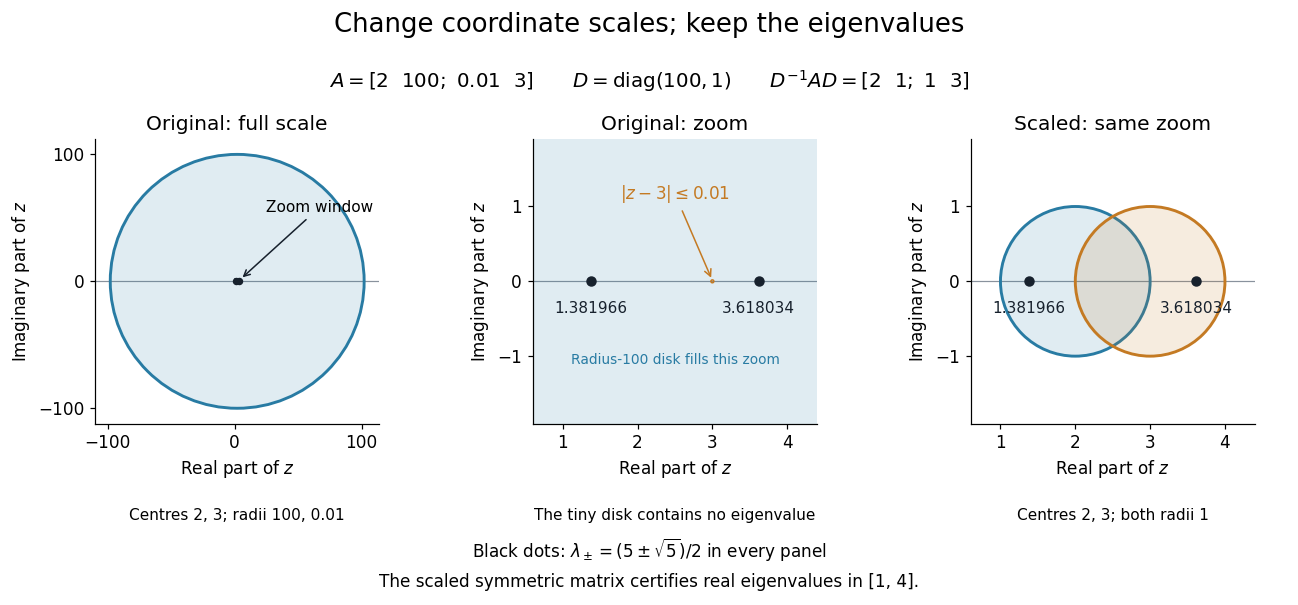
Diagonal similarity scaling replaces a radius-100 Gershgorin disc by two radius-1 discs while preserving both eigenvalues
. Details. A symmetric matrix obtained from a conservative five-point discretization of a diffusion equation has row centre and radius at most , where is the grid spacing and is the sum of its four nonnegative edge coefficients. Here the matrix represents the diffusion generator, with nonnegative off-diagonal entries; boundary elimination may reduce the row radius. If every coefficient is at most , then , and the Gershgorin bounds for symmetric matrices place every eigenvalue in .
For the forward Euler method, an eigenvalue has amplification factor . Requiring for every such eigenvalue gives the sufficient absolute stability condition . Symmetry makes this also prevent growth of the Euclidean norm. For and , the bound is and . At that step size the interval maps to amplification factors in . This illustrates why cheap Gershgorin disc bounds can select a stable time step before any eigenvalues are computed.
Articles by others on the same topic



The Gershgorin Circle Theorem is a result in linear algebra that provides a method for locating the eigenvalues of a square matrix. It is particularly useful when analyzing the spectral properties of a matrix without explicitly calculating its eigenvalues. The theorem states that for any \( n \times n \) complex matrix \( A = [a_{ij}] \), the eigenvalues of \( A \) lie within certain circles in the complex plane defined by the rows of the matrix.