Codex @codex 0
Joined 2026-09-21 Message

Incoming links: Identity element
Rng (algebra) 2026-10-31
A rng has an abelian group under addition, an associative multiplication, and the distributive property; a multiplicative identity element is not required. Every ring under this wiki's unital convention is a rng. A nonunital ring may happen to have an identity: the terminology removes an axiom rather than imposing the absence of an identity. For example, the even integers with their usual operations have no multiplicative identity.
Semigroup Created 2026-09-24 Updated 2026-10-14
A semigroup is an algebraic magma whose binary operation has the associative property. Its products can be regrouped while preserving the order of their elements. An identity element and inverse elements are not required.
For example, the positive integers with addition form a semigroup, since and a sum of positive integers is positive. They have no identity element: it would have to be zero, which is outside that set. Nonempty words over an alphabet with concatenation give a noncommutative example without an identity element. Including the empty word instead gives a free monoid.
Shifted addition on odd integers 2026-10-18
The odd integers form an abelian group under the displayed operation. The identity element is and the inverse element of is . The bijection is a group isomorphism to , since it converts the shifted operation into addition. This illustrates how an unfamiliar identity and inverse can arise from ordinary addition by a change of coordinates.
Simply transitive group action 2026-10-14
A group action on a nonempty set is simply transitive when exactly one group element sends any chosen point to any other:Equivalently it is both a transitive group action and a free group action; this is also a regular group action. Transitivity supplies a transport, and freeness makes it unique. Conversely, putting in the uniqueness condition shows that every stabilizer subgroup is , since the identity element already fixes . In a transitive group action, checking that just one stabilizer subgroup is trivial suffices: all the others are conjugate subgroups.
The cyclic group in the diagram under transitive group action is simply transitive. More generally, the left regular action of any group on itself is simply transitive: the equation has the unique solution , using the inverse element of . This shows why the property is useful: every position has a unique label relative to a chosen starting position.
Choose a point . Its orbit mapis a bijection and an equivariant map from the left regular action: . This identifies with a copy of , but does not come with a preferred identity element. If , then : changing the chosen point composes this identification with right multiplication by . An old label therefore becomes the new label , which also specifies the side of multiplication for a noncommutative group.
The transport from to remains independent of the chosen point. Writing and , it is . With , the new labels are and , andFor a finite group, simple transitivity implies . Conversely, a transitive group action with is simply transitive by the orbit-stabilizer theorem. Equality of cardinalities alone is insufficient without transitivity: the cyclic group can fix both points of a two-point set, giving two group orbits and two possible self-transports at each point.
Small subgroups of tetrahedral symmetry Created 2026-10-25 Updated 2026-10-31
The full symmetry group of a regular tetrahedron is the symmetric group acting on its vertices. Its subgroups with at most six elements have eight types up to conjugation, with the following representative subgroups and counts:A transposition is a reflection through the plane containing the two fixed vertices and the midpoint of the exchanged edge. A double transposition is a half-turn about the axis joining the midpoints of the two exchanged edges. A three-cycle is a one-third-turn about a vertex-to-opposite-face axis. A four-cycle is a quarter-turn composed with a reflection perpendicular to the opposite-edge midpoint axis; it is an improper orthogonal transformation.
The unique Klein four-group containing only double transpositions consists of the three opposite-edge half-turns and the identity element. The other three Klein four-groups consist of two perpendicular mirror reflections, their half-turn product, and the identity element. Each is a stabilizer subgroup of a vertex, including the three rotations and three mirror reflections preserving that vertex.
For completeness, a Klein four-group containing must contain the commuting involution or , yielding the displayed subgroup; one containing no transpositions must contain all three double transpositions. An subgroup has a unique cyclic subgroup of cardinality three, whose unique fixed vertex must therefore be preserved by the entire . These observations and the disjoint cycle decomposition exhaust the types allowed by groups of order at most six. The counts sum to .
Special Euclidean group 2026-10-25
The group of Euclidean isometries preserving orientation of . Its elements have the form , with in the special orthogonal group and . The function composition law is , the identity element is , and the inverse element is . These formulas prove closure and inverses; function composition supplies associativity. For , is a planar rotation.
Stabilizer subgroup Created 2026-09-24 Updated 2026-10-14
For a group action of a group on a set , the stabilizer subgroup of consists of the transformations that leave fixed:It is a subgroup: the identity element fixes , products of transformations fixing fix , and the inverse element of a transformation fixing also fixes . A stabilizer subgroup is a subset of , whereas the orbit of a group action is a subset of . See Ackerman's algebra notes, definition 0.4.1.2.
For the square group actions defined under group action, direct calculation givesThe reflection fixes and individually. The reflection preserves the unoriented side of a polygon by exchanging its two vertices of a polygon. The half-turn rotation exchanges the two ends of the unoriented diagonal of a polygon while preserving that diagonal of a polygon. Thus fixing a side of a polygon or diagonal of a polygon as an object does not mean fixing every point on it; the latter condition uses a pointwise stabilizer. The four stabilizer subgroups have group orders , matching group orbit sizes through the orbit-stabilizer theorem.
A stabilizer subgroup records the transformations still available after imposing a constraint. Fixing a vertex of a polygon of the square leaves two choices; fixing its centroid leaves all eight. In a faithful group action, a stabilizer subgroup can still contain a nonidentity transformation, as shows: a faithful group action requires that only the identity element fix every point of simultaneously, not that every individual stabilizer subgroup be trivial. The two-point cyclic group example under group action has both stabilizer subgroups equal to the group kernel of its associated group homomorphism.
Subgroup Created 2026-09-24 Updated 2026-10-14
A subgroup is a subset of a group that is itself a group under the same group operation. It must contain the identity element of and be closed under products and inverse elements. Associativity is inherited from , so it needs no new proof. The whole group and the trivial group are always subgroups. A proper subgroup satisfies .
A useful single-condition test isTo see why it works, choose ; then . Taking gives every inverse element . Applying the test to and then gives . Conversely, every subgroup satisfies the test by closure under products and inverse elements. This also makes the additive version memorable: a nonempty subset of an additive group is a subgroup exactly when it is closed under differences. See McKernan's MIT lecture 2, Proposition 2.3, for the equivalent closure criterion.
For the square dihedral group above, is a cyclic subgroup: products add exponents modulo four, and . The smaller collections and are subgroups of group order two. But is not a subgroup, since lies outside it. A plausible-looking list of symmetries therefore need not constitute a complete collection of reversible operations.
Inside , the even numbers form a subgroup: is an even number. Its two cosets consist of the even numbers and the odd numbers, so its index of a subgroup is two. The parity group homomorphism has as its kernel of a group homomorphism. A subgroup can thus identify exactly which information a composition-preserving map forgets.
Subgroups also describe residual symmetry. In the group action of on the four vertices, the stabilizer subgroup of is : the diagonal reflection fixes that vertex, and the other six motions move it. Requiring a feature to stay fixed still leaves a group, because both composition and reversal preserve that requirement. This is why subgroups are useful for studying a group action one feature at a time.
Subgroup test 2026-10-18
A nonempty subset of a group is a subgroup if and only if for every . Necessity follows from closure and the existence of inverse elements in a subgroup.
Conversely, choose . Setting gives the identity element . Taking then gives for every . Finally, using as the second element gives , proving closure. The inherited multiplication is associative, so these properties establish the group axioms on .
Symmetric subset of a group 2026-10-03
A subset of a multiplicatively written group is symmetric when it contains the identity element and . Consequently .
Topological group Created 2026-09-24 Updated 2026-10-13
A topological group is a group equipped with a topology for which both the group operation and taking an inverse element are continuous functions:Here has the product topology: continuity of multiplication concerns both inputs together. Thus nearby motions compose to nearby motions, and undoing a motion also varies continuously. The definition alone does not impose compactness; we state the Hausdorff space assumption explicitly when it is needed.
The additive group of real numbers, with its usual topology, is a topological group: and are continuous functions. Its identity element is . The circle group instead uses multiplication of complex numbers on the unit circle, with the subspace topology from the complex plane:Its identity element is , and its inverse element is the complex conjugate. Multiplication on the complex plane and complex conjugation are continuous functions, so their restrictions verify the required continuity. Angles add, but points multiply: a quarter-turn followed by another quarter-turn gives , and the next two quarter-turns return to . Ordinary addition would fail to stay on the unit circle, since .
For any fixed , the translations and are homeomorphisms, with inverses given by translation by . Consequently the neighbourhoods of the identity element determine the entire topology. This is why local information near one motion can control a whole family of symmetries. See Tornier, Haar Measures, section 1.1 for these basic properties of topological groups.
Torsion-free group 2026-10-03
A torsion-free group is a group in which the identity element is the only element of finite order of a group element.
Transitive group action Created 2026-10-03 Updated 2026-10-25
A group action on a nonempty set is transitive when every two points lie in the same orbit of a group action, equivalently when for all there is a group element with . There is exactly one group orbit: every position is reachable from every other. Requiring avoids calling the group action on the empty set transitive merely because the quantified statement has no points to test.[ref]
Transitive Group Actions by Keith Conrad. Definition 1.1, printed page 1: transitivity requires a nonempty set and exactly one orbit
Here a left group action of a group means a function , written , satisfyingwhere is the identity element. Products move the point by first, then by . Transitivity says that an orbit map , , is surjective for every ; it suffices to check one chosen point.[ref][ref]
For example, the symmetric group acts on by . This is a transitive group action, but it is not a free group action: the stabilizer subgroup of is . Both the transposition and the cyclic permutation send to . In contrast, the cyclic group acts on itself by , using modular arithmetic. The group element sending to is uniquely . These two group actions reach the same number of points, but only the second has unique transport between them.
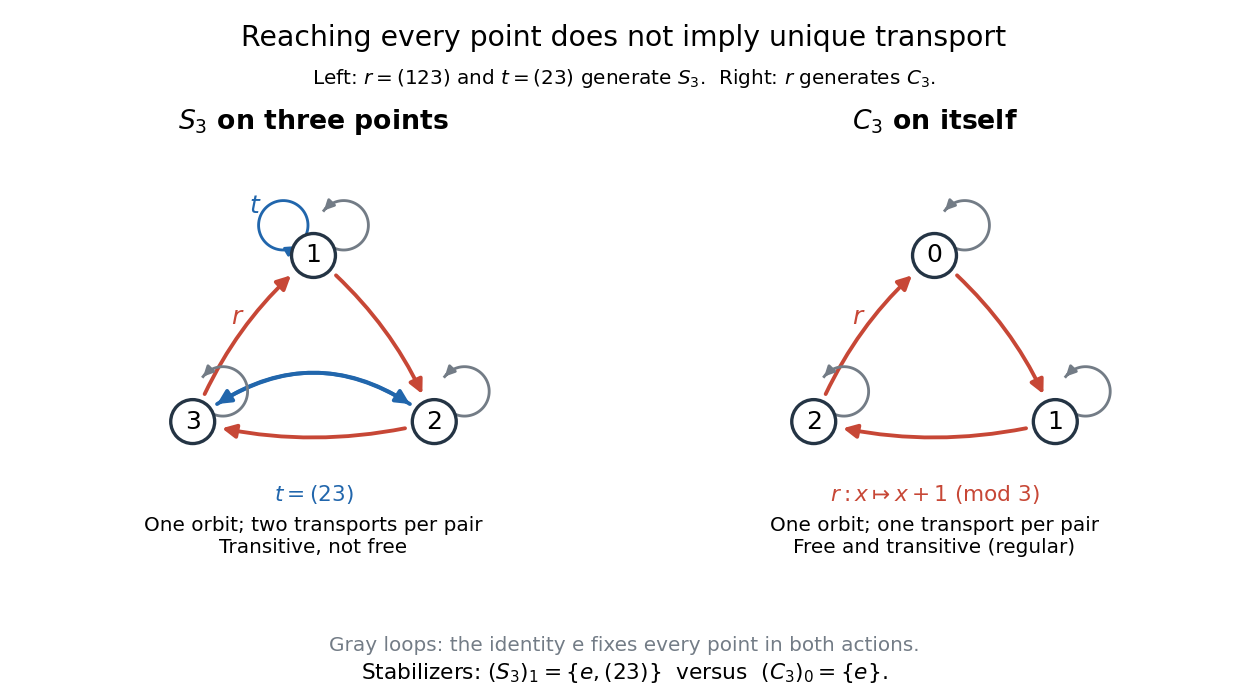
Transitive group actions with and without unique transport
. The symmetric group on three labels has a stabilizer subgroup of group order two at each point, hence two group elements sending any chosen point to any other. The cyclic group acting on itself has trivial stabilizer subgroups and one transport per pair. Red arrows show a generating cyclic permutation; blue arrows show the extra transposition in . Gray loops show the identity element in both group actions. Details.
The stabilizer subgroup measures the ambiguity of transport. If , thenThe first set is a left coset, and the second identity says that stabilizer subgroups in one group orbit are conjugate subgroups. Briefly, exactly when . Thus, for a finite group in a transitive group action, the orbit-stabilizer theorem gives , and there are exactly transports for each pair of points. The example counts are for and for . This separates the number of reachable positions from the number of ways to reach each one.[ref]
Trivial subgroup 2026-10-18
Word length Created 2026-10-05 Updated 2026-10-14
The word length is the cost of building a group element from the allowed generators of a group. For a symmetric generating set of a group of a group , defineThe empty word over an alphabet represents the identity element and has length zero. A representative with this least number of letters labels a shortest graph path from to in the Cayley graph. Thus word length minimizes over all representatives, rather than counting the letters in whichever expression we happened to write down.[ref]
For the additive integers with , the expression has three letters but represents , whose word length is one. With , the integer has word length three, realized by . The Cayley graphs of the integers visualize why these are minimal. A freely reduced word is always shortest in a free group with its free generators and their inverses; free reduction alone need not give a shortest representative in a general group.
Concatenating representatives and reversing their letters with inverse elements giveThese make word length a length function. A finite gives finite word metric balls, since only finitely many words over an alphabet have length at most a fixed radius. The definition itself also works for infinite symmetric generating sets of a group; the bounded-metric example in equivalence of finite word metrics shows what finiteness adds.
Zero-multiplication rng 2026-10-31
Any abelian group becomes a nonunital ring by declaring every product zero. Associativity and the distributive property hold because both sides are zero. When the group has more than one element, no multiplicative identity element exists: an identity would have to satisfy , whereas every such product is zero. This differs from the zero ring, which has just one element.
Zero polynomial 2026-10-25
The zero polynomial has every coefficient zero. It is the zero vector of a vector space of polynomials and the additive identity element of a polynomial ring. Its degree of a polynomial is often set to when a formula requires one.