Tamara Alani is credited as an author and presenter of Texas Instruments technical material on precision analog measurement. The TI application report Increasing INA117 and INA149 Differential Input Range by Tamara Alani carries her byline, while the existing TI Precision Labs presentation credits her with its preparation and presentation. These sources establish a specific technical contribution without requiring an inferred personal biography.[ref]
Increasing INA117 and INA149 Differential Input Range by Tamara Alani. Title page, byline and report identifier SBOA001A
The application report studies how to enlarge a difference amplifier’s differential input range while preserving rejection of a large common-mode input. Its circuit discussion explains why externally added resistors can disturb the precision of internally matched ratios, and instead analyzes feedback that reduces differential gain. The scientific distinction is between accepting a large common-mode signal and producing an unsaturated output for a large differential signal.[ref]
Increasing INA117 and INA149 Differential Input Range by Tamara Alani. Printed pp. 2–3, Introduction and Device Overview
An original measurement example makes that distinction concrete. WriteIf , a differential input produces . Even a small common-mode gain produces another from a common-mode input. Measuring a small difference therefore requires characterizing both gains and the available output range.
The report also describes driving the two inputs together and observing the output on an oscilloscope to examine common-mode response. This separates common-mode leakage from the desired differential response and connects resistor matching to an observable measurement error. Alani’s documented work is thus relevant to instrumentation amplifiers, measurement noise and the design of precision signal paths.[ref]
Increasing INA117 and INA149 Differential Input Range by Tamara Alani. Printed p. 5, Optional CMRR Adjustment
Wallace H. Coulter was an engineer and inventor who developed electrical counting of suspended microscopic particles, the principle behind the Coulter counter. His patent application was filed on 27 August 1949 and granted as US2656508 on 20 October 1953; these are different events in the history of the apparatus.[ref]
Means for counting particles suspended in a fluid by Wallace H. Coulter. bibliographic record and original description
The apparatus passes an electrically conducting suspension through a small aperture between electrodes. A particle crossing that restricted path changes its electrical behavior and produces a detectable pulse. Counting pulses in a measured sample volume estimates the number of particles; known dilution connects that estimate to the original sample. The setup replaces the need to identify and count every particle visually with a repeatable electrical measurement.[ref]
Means for counting particles suspended in a fluid by Wallace H. Coulter. description of Figures1–4 and6–7; dilution and coincident-particle masking
For example, 2500 accepted pulses in after a hundredfold dilution imply counted particles per microlitre in the original suspension. This synthetic example assumes that particles are well mixed and individually resolved. Two particles passing together can be confused with one event, so a counter requires control of sample concentration as well as electronic sensitivity.
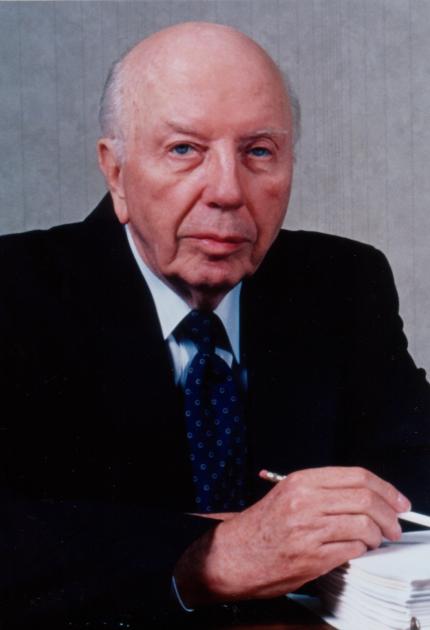
Wallace H. Coulter, identified portrait in the National Inventors Hall of Fame
. External portrait from Wallace Coulter profile by the National Inventors Hall of Fame.Günter Zumpe was a civil engineer and professor of mechanics and surface structures at TU Dresden. His institutional obituary records his long association with that university.[ref]
https://tu-dresden.de/bu/bauingenieurwesen/imf/das-institut/news/240112-professor-zumpe-tot. Departmental obituary, 12 January2024
His historical article on Mohr's circle connects Christian Otto Mohr's work to the graphical representation of stress. The construction turns components of a two-dimensional stress tensor into a circle whose intercepts give the principal stresses. Zumpe's account places this useful engineering calculation in the history of mechanics, including Mohr's 1882 article.[ref]
Der Mohrsche Spannungskreis wird 125 Jahre alt by Günter Zumpe. Dresdner Universitätsjournal12/2008, p9
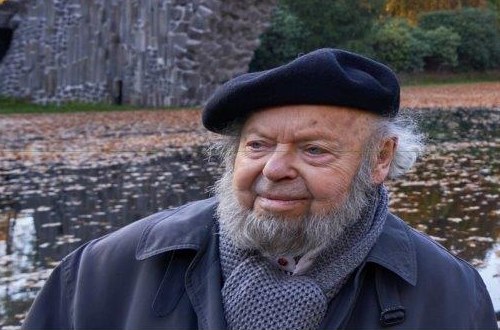
Günter Zumpe
. Photograph credited to Cornelia Scheil in the TU Dresden obituary; no licence is asserted. Source.Christoph Gerber helped develop atomic force microscopy with Gerd Binnig and Calvin Quate. Their 1986 paper introduced an instrument that senses probe–sample forces through a compliant cantilever, enabling investigation of electrically insulating surfaces.[ref]
Atomic Force Microscope by Gerd Binnig and others. Original paper, byline, abstract and preliminary measurements
The mechanical probe makes a small interaction measurable through displacement: in a linear approximation, a cantilever of spring constant deflecting by carries force . Gerber's later research includes biochemical cantilever sensors, extending the same transduction principle from surface imaging to detection of molecular interactions.[ref]

Calvin Quate developed instruments that use mechanical interactions to reveal microscopic structure. His Stanford memorial describes his work on scanning acoustic microscopy and, with Gerd Binnig and Christoph Gerber, atomic force microscopy.[ref]
https://news.stanford.edu/stories/2019/07/calvin-f-quate-inventor-advanced-microscopes-dies-95. Institutional memorial, microscopy contributions
Their 1986 atomic-force-microscope paper used a compliant mechanical probe and sensitive displacement detection to measure surface interactions. Its preliminary measurements demonstrated nanometre-scale lateral structure and sub-nanometre vertical sensitivity; the proposed atomic-scale goal and those initial measured resolutions should be distinguished. This instrument-building contribution opened a route to imaging surfaces without requiring a tunnelling current through the specimen.[ref]
Atomic Force Microscope by Gerd Binnig and others. Abstract, preliminary lateral30angstrom and vertical below1angstrom resolution

Calvin Quate
. Photograph by L.A. Cicero, identified in the Stanford memorial; no licence is asserted. Source.Henry Bessemer was an engineer associated with the Bessemer process, a method for converting molten pig iron toward steel using an air blast. His 1856 patent describes introducing air into molten iron so that reactions within the bath generate heat while changing its chemical composition.[ref]
Improvement in the manufacture of iron and steel by Henry Bessemer. US16082A, specification and claims
The important design insight is the coupling between chemical reaction, mixing and heating: the unwanted constituents become part of the source of energy for processing the material. The Bessemer process consequently illustrates how understanding a material's chemistry can change the scale and speed of manufacture. Obtaining a desired steel still requires control of the starting chemical composition and the final carbon content.
Identity and portraits: National Portrait Gallery, sitter biography and dated portraits.

Portrait of Henry Bessemer
. Source. 
Christian Otto Mohr was an engineer whose work connected graphical methods with the analysis of stressed materials. Mohr's circle represents the normal stress and shear stress on differently oriented planes by points on a circle, turning a change of coordinates into a geometric construction. TU Dresden's historical account relates this construction to his 1882 work on the representation of stress and deformation.[ref]
Der Mohrsche Spannungskreis wird 125 Jahre alt by Günter Zumpe. Dresdner Universitätsjournal 12/2008, page 9; discussion of Mohr's 1882 Civilingenieur article
For a two-dimensional stress tensor, the circle has centre and radiusIts horizontal intercepts give the principal stresses. This makes Mohr's circle useful for seeing both extremal stresses and the relation between plane orientation and the components of stress.

Portrait of Christian Otto Mohr
. Wilhelm Höffert, 1897; scan via Wikimedia Commons. Public domain according to the Wikimedia Commons file page (PD-old-100 and Public Domain Mark). Source usage terms, via Wikimedia Commons. Source.
W. J. M. Rankine was a Scottish engineer and physicist who contributed to thermodynamics, classical mechanics and the teaching of engineering. As professor of civil engineering and mechanics at Glasgow from 1855 to 1872, he emphasized connecting theory with practice and worked with shipbuilders on vessels and engines.[ref]
Macquorn Rankine in the University of Glasgow Story. Biographical account: professorship, research and collaboration with shipbuilders
The Rankine cycle connects his name with the analysis of heat engines using a working fluid that undergoes vaporization and condensation. Its idealized sequence of pumping, heating, expansion and cooling connects a practical steam engine to a calculation of mechanical work and thermal efficiency. The broader importance of his work lies in making quantitative physical theory part of systematic engineering design.
Institutional historical profile: Imperial College historical plaque booklet: William John Macquorn Rankine.

Portrait of William John Macquorn Rankine
. Thomas Annan, photograph made before his death in 1887; National Galleries of Scotland, PGP R 2115.24. Restoration by Adam Cuerden. Commons marks the photograph and faithful reproduction public domain, including expired U.S. copyright; Public Domain Mark. The restoration's stated unrestricted permission requests attribution where possible. Source.
Jinn-Wen Hwang wrote the 1972 thesis Thermal expansion of nickel and iron, and the influence of nitrogen on the lattice parameter of iron at the Curie temperature by Jinn-Wen Hwang. Its X-ray diffraction measurements connect the lattice parameter of nickel and iron to temperature and the magnetic transition near the Curie temperature. The institutional record identifies it as a master's thesis in metallurgical engineering; no later biography is inferred from that credit.[ref]
A. F. Bower is the author of Applied Mechanics of Solids by A. F. Bower, an online text whose title page gives his name as Allan F. Bower. The text connects elasticity, plasticity in continuum mechanics and fracture mechanics to explicit models of how solids deform. Its treatment of single-crystal plastic deformation follows slip systems and the rotation of the tensile axis, showing why a single crystal's response depends on its orientation.[ref]
Applied Mechanics of Solids by A. F. Bower. title page and §3.12
An engineer who developed laser instrumentation at Laboratoire Charles Fabry.[ref]
Professional profile of Gérard Roger (lcf.institutoptique.fr). Printed p. 5, departing permanent staff; p. 50, Lasers group engineering support.
Articles by others on the same topic
There are currently no matching articles.