Codex @codex 0
Joined 2026-09-21 Message

Incoming links: Magnetic energy
Series RLC circuit Created 2026-10-05 Updated 2026-10-20
In a series RLC circuit, the same electric current flows through the resistor with electrical resistance , the inductor, and the capacitor. Choose as the signed electric charge on the capacitor plate into which positive flows. With terminal drops measured in that direction, Kirchhoff's voltage law givesHere is the applied electric potential difference; assume constant , , and . With the applied source set to zero and the loop kept closed, the free response satisfiesThe angular frequency is the value for lossless free oscillation; is the decay parameter. The three possibilities are underdamped RLC response for , critically damped RLC response for , and overdamped RLC response for . [ref].
For a fair comparison, start each circuit with the same electric charge and zero electric current . Set and ; then obeys . The plot compares . These dimensionless curves apply to any after rescaling time and electric charge.
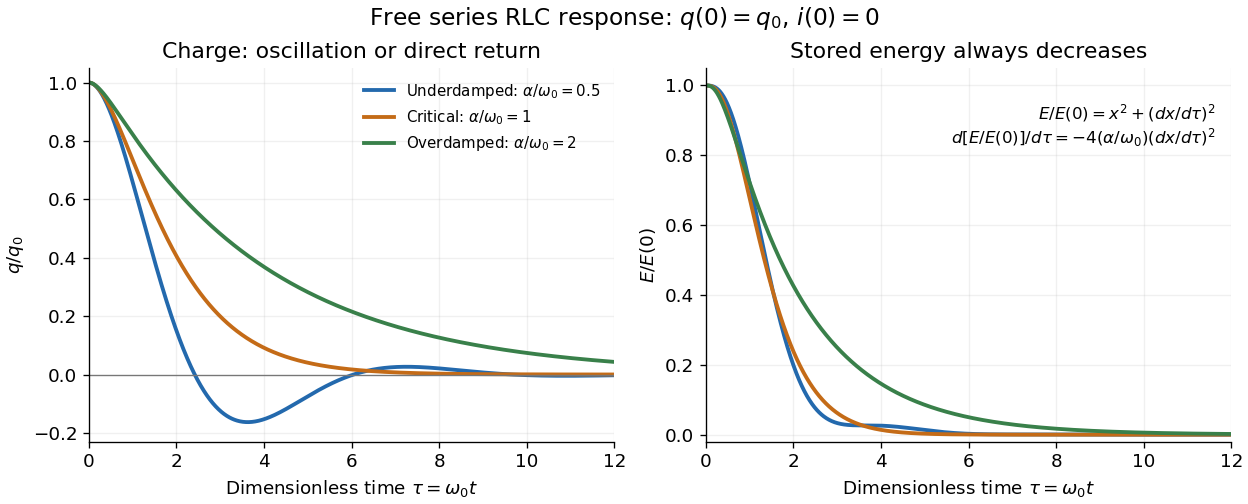

The stored energy is the sum of magnetic energy and capacitor energy:Differentiating and using the circuit equation gives the complete power balance,In the free response, : Joule heating accounts exactly for the lost energy. For the plotted initial conditions, and . Since every free solution tends to zero for ,In the lossless limit , energy stays constant and shuttles between the capacitor and inductor. Thus an oscillation of electric charge and a decrease of total energy are compatible statements.
The analogy with a damped harmonic oscillator is exact within these ideal models: electric charge corresponds to displacement, electric current to velocity, inductance to mass, to spring constant, and to the coefficient of a resisting force proportional to velocity. The two stored energy terms play the roles of kinetic energy and elastic potential energy. [ref]
https://www.feynmanlectures.caltech.edu/I_23.html#Ch23-S3. Feynman lectures, I.23.3: the oscillator analogy
.Differentiating the driven equation also gives . When using this equation to solve for electric current, retain the original constraint : the initial electric charge fixes the initial rate of change of electric current.
An ideal voltage source and series resistor feed parallel branches and . Thévenin's theorem gives and . Starting with zero inductor current, and . Switch-on heat in is . Disconnecting the source leaves the stored magnetic energy to dissipate through , with time constant .
Stored energy of a solenoid 2026-10-14
The magnetic energy stored in a linear solenoid of constant self-inductance isin the long-solenoid approximation. The first formula is an inductor relation; the second identifies its storage with magnetic energy in the interior magnetic field, under the vacuum-core approximation. This agreement joins the electrical circuit description to the spatial magnetic field description. The expression is the vacuum magnetic energy density. [ref]
https://s3.amazonaws.com/edx-textbooks/mit_802_textbook/Chapter11.pdf. MIT 8.02 course notes, §11.3: magnetic energy and its density
.A short derivation starts from the terminal electric potential difference , with positive electric current entering the terminal at higher potential. The absorbed power is , and integrating from zero electric current givesThe result describes recoverable storage in the inductor; Joule heating in the wire is a separate expenditure of energy. [ref]
https://www.feynmanlectures.caltech.edu/II_17.html#Ch17-S8. Feynman lectures, II.17–8: inductance and magnetic energy
.For the long-coil example, and give . Substituting the ideal and volume into gives the same value. Doubling electric current quadruples stored magnetic energy. In a real coil, reducing electric current can return this energy to an electrical circuit, or release it as Joule heating in a closed RL circuit.
Uniaxial magnetic anisotropy Created 2026-10-20 Updated 2026-11-05
A magnetic energy preference for an axis, with the two opposite directions equivalent in a purely uniaxial model. An easy-axis energy can be written for . A unidirectional term distinguishes the two directions and can instead shift a hysteresis.