Source paper: www.whatdotheyknow.com/request/physics_past_papers_21/response/3037379/attach/2/FOI%20202505%20441%20Response.pdf?cookie_passthrough=1. The held cover dates this paper to 12 June 2018. We use , consistent with the source's momentum quantization, and take the pairing parameter real so that the Hamiltonian is Hermitian.
With no pairing, the Hamiltonian is diagonal in the fermionic occupation numbers. The Pauli exclusion principle allows each momentum mode to be either empty or occupied once. Without a fixed fermion number constraint, occupying a mode lowers the energy precisely when its single-particle energy is negative. Therefore, with the Fock vacuum, a ground state isChoose a fixed ordering of the fermionic creation operators; changing it alters only the overall phase. Any zero-energy modes may be occupied or empty without changing the ground-state energy.
To identify the occupied modes, complete the square:Here is the dispersion parameter, not inverse temperature. If , every mode has positive energy and the unique ground state is the Fock vacuum, with . If , there are still no negative-energy modes, but have zero energy if they lie on the allowed momentum grid. Each such mode doubles the ground-state degeneracy.
For , defineBoth are positive, and the occupied Fermi sea consists of the two intervals . With , the requested finite-size ground-state energy is explicitlyThe factor two counts opposite momenta. Endpoints are excluded from this sum because they have zero energy; when an endpoint is allowed, its optional occupation adds ground-state degeneracy. A narrow negative-energy interval can contain no allowed finite-size momenta, in which case the sum is empty. The zero-momentum mode is always empty since .
For real angles write and . For one independent pair , the transformation and its conjugate readUsing the canonical anticommutation relations for the modes givesThe remaining anticommutators vanish for independent momentum pairs. The displayed two-by-two matrix is unitary and its inverse is obtained by changing to .
When the same formula is indexed over both signs of momentum, its first row at must agree with the conjugate of its second row at . Thus a consistent global convention requiresThis is the odd-momentum fermionic Bogoliubov angle convention. If one checks only the first-row formulas, their cross anticommutator is ; its vanishing gives the condition modulo , with possible signs absorbable in the modes. Requiring both rows to describe the same operators fixes the convention above. Merely checking a separate unitary matrix at each momentum misses this redundancy: choosing in both first rows would give .
At , the annihilation operator and its conjugate belong to one mode. The full displayed formula is consistent only with ; choose and . This mode is not a two-mode pair.
Group the nonzero modes into independent pairs . For one pair set , and introduce the Nambu spinor . Normal ordering using givesThis exactly contains both kinetic terms and the pairing terms once; there is no additional factor of one half because only is summed.
Insert , where and is the Bogoliubov transformation matrix. Direct matrix multiplication yieldsChoose the diagonalizing branchThen the off-diagonal terms vanish and the upper diagonal entry is . Extend the angle to negative momenta as in part b; the sine relation just written applies to the positive representative of each pair. The BCS coherence factors can be chosen asHere denotes , and denotes ; these expressions are nonsingular because and . The minus sign of for positive is fixed by the pairing phase in this Hamiltonian.
A second use of the canonical anticommutation relations givesThe zero-momentum term was never paired and is simply . HencewithThe constant is the ground-state energy. At fixed , its ultraviolet tail converges: in one dimension. Replacing by would incorrectly pair a spinless mode with itself.
Since every quasiparticle energy is positive, the ground state is the vacuum of all the annihilation operators, including . Its zero-momentum mode is therefore empty. For each positive momentum, the inverse Bogoliubov transformation givesBoth annihilate the normalized pair state . For example, applying produces the two cancelling terms . ThusThe factors have even fermion parity and commute for disjoint momentum pairs. Each normalized factor is a superposition of zero and two fermions, whose pair-occupation probability is . ThereforeThere is no zero-mode contribution. For fixed , the sum converges since .
A normalized simple excited state is for . Its excitation energy is , and its total momentum is : both terms in add momentum . Acting on the pair givesThe affected pair now contains exactly one fermion instead of mean number ; all other pairs are unchanged. ConsequentlyThis is the fermion number of a Bogoliubov excitation. Its change in mean fermion number lies between zero and one for , with the value one at . The Bogoliubov quasiparticle coherently mixes adding a fermion and removing the opposite-momentum fermion; it is not an eigen-excitation of the original fermion number operator. Indeed,so fermion number is not conserved when , while fermion parity is conserved. The generally noninteger change is an expectation value in a coherent paired background, rather than a fractional eigenvalue of the fermion number operator. In the weak-pairing limit at fixed , it tends to one, as expected for an ordinary added fermion.
Let and use the two spin values as row and column labels. Define the spin-chain transfer matrixIt is a real symmetric matrix because ; every entry is strictly positive for finite bond energies at . The Boltzmann factor of a spin configuration factorizes into the product . Summing the intermediate spin labels is exactly matrix multiplication, and the final closure imposes periodic boundary conditions. ThusWriting , its eigenvalues areA positive-entry matrix need not have two positive eigenvalues; can be negative. The Perron–Frobenius theorem ensures here. Therefore the Helmholtz free energy is , and its value per spin in the thermodynamic limit is .
For an open chain there are bonds, with both endpoint Ising spins independently summed. Retain the same spin-chain transfer matrix, but replace the trace by endpoint vectors. With ,This follows directly by expanding the product of Boltzmann factors. If are orthonormal eigenvectors of the symmetric matrix , the equivalent spectral decomposition isFixed endpoint Ising spins replace the corresponding by a basis vector; extra endpoint energies replace its entries by the corresponding Boltzmann factors. The leading bulk Helmholtz free energy per spin agrees with the periodic result, because the boundary changes only subextensive terms. In particular, gives , as required for one free Ising spin.
Let , so that the total number of Ising spins is . Write and group each triangle's two base spins and its apex into one cell. The Ising chain with alternating triangular decorations has a triangle bond followed by an undecorated connecting bond. Summing an apex Ising spin first gives a decorated-bond Boltzmann weightThe undecorated bridge has Boltzmann weight . In the basis ,Each cell contributes , so periodic boundary conditions giveThe two matrices have common normalized eigenvectors and , expressing spin inversion symmetry. Their respective eigenvalues areConsequently the cell transfer matrix has eigenvaluesand the finite-size partition function isFor , and , so only survives in the thermodynamic limit. Divide the Helmholtz free energy by , the number of sites rather than the number of cells or base spins:As a counting check, gives , , hence , exactly the number of independent Ising spin configurations. This model has separated decorated bonds and should not be confused with the corner-sharing sawtooth Ising chain, which has a different site count.
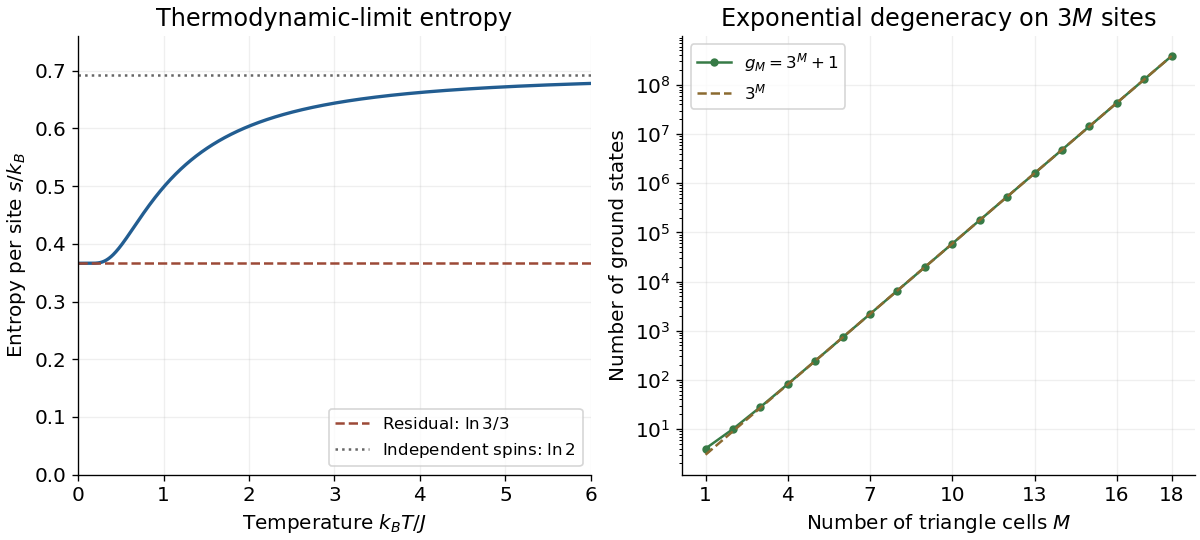
For low temperature, factor out the largest Boltzmann factor from the dominant eigenvalue:Thus the Helmholtz free energy per site has the expansionDifferentiate at fixed , remembering that . The entropy per site isThe nonzero residual entropy comes from an exponentially large ground-state degeneracy, generated by geometrical frustration. A triangle with antiferromagnetic energy has minimum energy : if , the apex must have the opposite sign; if , either apex sign is permitted. The two all-equal configurations instead have energy . Thus exactly one of a minimum-energy triangle's bonds is frustrated. The bridge can simultaneously minimize its energy at by requiring , where is the next cell's first base spin.
For fixed and , the number of allowed apex choices is therefore two when and one when . The zero-temperature counting transfer matrix on successive first base spins isThe eigenvalues of are and . Dividing by the sites and taking the thermodynamic limit gives , independently confirming the derivative calculation. This does not assert a unique ordered ground state: the extensive choice of frustrated bonds is precisely what leaves entropy at zero temperature. At high temperature, all Ising spins become independent and per site.

Articles by others on the same topic
There are currently no matching articles.