Each simple pendulum moves in the vertical plane containing the pivots. Ignoring contact between the ideal rods and point masses, each rod can turn through a full circle. Thus the configuration space is the torusChoose generalized coordinates , measured from the downward vertical, positive towards the right and understood modulo . These angles are local coordinates on the torus, rather than a single globally one-to-one real coordinate chart. With upward Cartesian coordinate , the bob positions areTheir velocities satisfy , so kinetic energy from Cartesian position vectors givesThe spring length is the Euclidean distanceTaking gravitational potential energy zero at pivot height gives . The spring potential energy is , since is its natural length. Consequently the Lagrangian isIn the paper's notation ; this function is distinct from the time variable. This is the exact Lagrangian of two spring-coupled pendulums.
One alternative Lagrangian isIt corresponds to setting gravitational potential energy zero at the downward position. The constant disappears from every Euler-Lagrange equation. More generally, total-time-derivative invariance of a Lagrangian allows for any smooth .
Set . At the spring has , so its potential energy has zero gradient: . The gravitational potential energy has there. Zero velocities therefore satisfy the Euler-Lagrange equations, proving this is an equilibrium.
For fixed , let and . The Taylor series giveThus, near the downward equilibrium, the horizontal separation is positive andIn particular, and . Dropping the additive constant and terms beyond quadratic order gives the harmonic approximationFor physical spring constant , the quadratic potential energy is a positive-definite quadratic form. The downward position is therefore a stable equilibrium in Lagrangian mechanics, and its nearby motion admits small oscillations.
The Euler-Lagrange equations of the quadratic Lagrangian areThe mechanical mass matrix is the identity. A normal mode therefore satisfies the eigenvalue problem . Direct multiplication givesThese are normal modes of two spring-coupled equal pendulums. The corresponding normal mode coordinates and obey and .
For the in-phase normal mode, the bobs undergo identical displacements, leaving their separation exactly . The spring stays at its natural length and exerts no force, so this angular frequency is independent of . The value is the individual simple pendulum angular frequency in the chosen units.
Write . The initial conditions on the normal mode coordinates are and . Solving the two harmonic oscillator equations and recovering the original angles gives the exact solution within the harmonic approximation:Their angular velocities are and , which verify all four initial conditions.
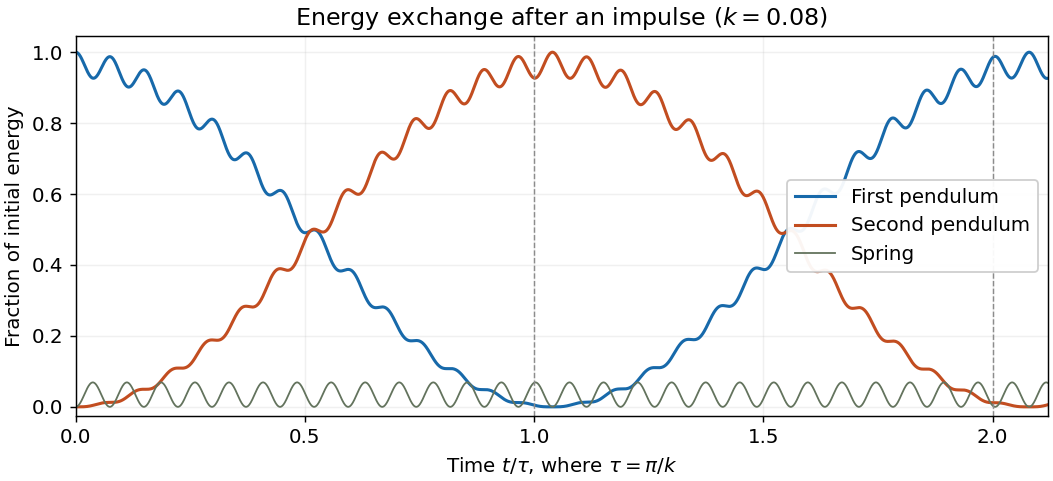
To expose the beat, define and . Replacing by changes each angle by uniformly in time. The sum-to-product identities then giveThe displayed angular velocities are exact in the linear system. The absolute and signed beat envelopes have leading amplitudes and . Because , at we have and . HenceThe first simple pendulum has negligible oscillation amplitude. Its kinetic energy is , while the second has . Thus, to the retained order, all instantaneous kinetic energy belongs to the second simple pendulum. The fast phase can make that kinetic energy small: the whole initial energy is transferred as the second simple pendulum's combined kinetic energy and gravitational potential energy, sinceThis is energy transfer after an impulse in two weakly coupled oscillators. It does not require .
At , , so the beat has returned the oscillation to the first simple pendulum:The energy localization returns, although the fast oscillation phase need not equal its initial phase. The exact first minimum of the leading beat envelope is at , whose leading value is . Keeping the slow phase is essential: expanding at fixed and then using would lose the energy exchange. Although angles are retained only to order , their leading energies are of order .

Articles by others on the same topic
There are currently no matching articles.