Use as shorthand for the tensor product of two total-isospin-one states with third components . A total-isospin-zero state must have total third component zero, so write . Applying the total raising operator givesAn isospin singlet must be annihilated by this operator; hence and . Normalization gives the two-isovector singletIt is also annihilated by the total lowering operator. A raising or lowering action changes the third-component label by one; the unchanged output label in the PDF's preliminary ladder formula is a typographical omission, not the action used here.
Exchange commutes with the total isospin operators. The displayed singlet is symmetric. The multiplet has symmetric highest state ; applying the symmetric total lowering operator preserves that exchange symmetry. The symmetric square of a three-dimensional space has dimension six, exactly , while its antisymmetric square has dimension three. The remaining multiplet is therefore antisymmetric. Thus the Clebsch-Gordan decomposition isPions have zero intrinsic spin and form an isospin triplet. Bose-Einstein statistics requires the complete two-pion state to be symmetric under exchange. Its relative orbital state changes by , so odd orbital angular momentum requires antisymmetric isospin: an odd- two-pion state has . This statement treats the charge components as states of the same isospin multiplet, rather than ignoring exchange when their charges differ.
For the decay, let . The stated commutator with gives . More decisively, the commuting raising operator givesThe kaon doublet cannot be raised twice. An component would survive two raisings, so it is excluded. Meanwhile a spinless kaon decaying into two spinless pions has by conservation of total angular momentum, independently of whether parity is conserved by the decay. The exchange condition excludes . This proves the highest-weight weak-isospin selection in kaon decay: the two-pion final state has .
In a consistent pion phase convention, the singlet's charge components have the structureThe normalized symmetric charged channel has coefficient and the neutral channel coefficient . Thus, in the isospin limit with equal pion masses and matching two-body phase space,Equivalently, ordered charged and neutral amplitudes have equal magnitudes, but neutral identical particles contribute the phase-space factor . This is the same counting expressed in another basis, and must not be included a second time after using the normalized charge-channel coefficients. Small pion-mass and electromagnetic effects can modify the ideal ratio.
The Kronecker delta is the identity map on the defining representation. Its transformation is . For the alternating Levi-Civita symbol, the determinant identity givesThe lower-index alternating tensor transforms with three inverse matrices and acquires instead. Thus , and are invariant tensors of SU(3). These identities use unimodularity; unitarity identifies the dual representation with the complex-conjugate defining representation.
For a mixed SU(3) tensor representation , the matrix trace is invariant. HencegivesThe trace is the singlet. The traceless matrix transforms by conjugation, so it is the adjoint representation of SU(3). It is irreducible: an invariant complex subspace is invariant under commutators with the complexified algebra , and would be an ideal in that simple Lie algebra. Only the zero and full traceless-matrix spaces are possible.
For the cubic tensor, define its symmetric and antisymmetric first-pair parts byand let be its completely symmetric part. This has independent components and transforms as the symmetric cubic representation of SU(3). Its irreducibility can be seen in the homogeneous cubic-polynomial realization: the simultaneous highest-weight conditions and leave only . A finite-dimensional unitary representation is completely reducible, and each irreducible summand has a highest-weight vector, so this single highest-weight line implies a single irreducible summand. Lowering generates all ten monomials.
Remove this fully symmetric part from , putting . DefineIts trace vanishes because is symmetric in its first two indices. Invariance of makes transform as one upper and one lower index. The inverse map isIndeed contraction with gives . The inverse has the required first-pair symmetry and zero completely symmetric part. Thus this eight-dimensional remainder is another adjoint representation of SU(3).
For the antisymmetric part, defineNow decompose , with traceless. The first term supplies a second independent octet; the trace supplies a singlet proportional to . With , the explicit cubic SU3 tensor projections reconstruct the entire tensor:All projections commute with the SU(3) action because they use permutations and invariant tensors. Their inverse maps and the dimension count establishThe two octets are equivalent as group representations but distinct subspaces in this decomposition; one comes from the first-pair symmetric sector and the other from the first-pair antisymmetric sector. General permutations can mix these equivalent copies.
In the quark model, the up quark, down quark and strange quark form the defining triplet of approximate flavor symmetry. Three-quark baryons therefore have precisely these possible flavor representations. The fully symmetric decuplet corresponds to the observed spin- baryon decuplet: the four Delta baryons, three states, two states and the Omega baryon. Their strangeness rows have flavor hypercharge and isospin ; and occupy the extreme and weights.
The observed spin- baryon octet contains the nucleons, three Sigma baryons, the Lambda baryon and two Xi baryons. In its row, and share the same third-component/hypercharge weight but have different total isospin. Approximate flavor symmetry explains multiplet organization, not exact equality of all their masses: the strange-quark mass and electromagnetic interactions break it.
The two octet copies in the flavor tensor do not require two identical ground-state octets. A three-quark colour singlet is antisymmetric in color; for a symmetric ground-state orbital wavefunction, the Pauli exclusion principle requires a symmetric combined spin-flavor state. The mixed flavor octet tensors combine with the mixed spin- tensors to supply that symmetry. The symmetric flavor decuplet combines with symmetric spin . Together they form the symmetric spin-flavour SU6 representation, with spin-flavor states. A completely antisymmetric flavor singlet cannot appear in this spatial ground state because three spin- indices have no fully antisymmetric spin state: . Three-quark flavour singlet configurations instead require a suitable excited spatial/spin symmetry. Flavor SU(3) here is distinct from the exact color gauge symmetry; treating them as the same group action would misidentify the physical multiplets.
For a Cartan-Weyl basis, the Jacobi identity givesThus the bracket has joint Cartan weight . If , it belongs to the zero-weight space, which is the Cartan subalgebra, and so is a linear combination . If is a nonzero root, its root space is one-dimensional and the bracket is proportional to . If that nonzero sum is not a root, the bracket vanishes. This proves the asserted forms without assuming every pair of roots has a root sum.
With the stated normalization, put . The commutators becomeThe adjoint relations make , , the usual SU(2) Lie algebra generators. Hence every finite-dimensional SU(2) irreducible component has eigenvalues , with an integer. Therefore has integer eigenvalues , including in the finite-dimensional Adjoint representation. Algebraically this is the sl2 subalgebra associated with a root.
If , another use of the Jacobi identity givesThe bracket is therefore zero or lies in the eigenvalue- space. Within one irreducible SU(2) ladder it is proportional to the next chosen vector . If the full eigenspace has multiplicity, the weight statement is the general one; proportionality to one named vector presupposes the ladder choice. Similarly lowers this eigenvalue by two, and the ladder weights run from to in steps of two.
For a root vector , its weight isThe adjoint SU(2) ladder therefore provesFor nonparallel , raising and lowering move its joint Cartan weight through the root string . The finite irreducible ladder has weights symmetric about zero. Starting at , reaching its partner requires . The corresponding nonzero vector lies in the root space of , proving the Weyl reflection property:There is no zero joint root in this string when are nonparallel. Its one-dimensional root spaces prevent two irreducible ladders with the same weight parity from overlapping, so the ladder argument applies to the entire string. For , reflection simply interchanges the two opposite roots, which already exist by the adjoint relation.
For angle and length restrictions, set and . These Cartan integers have the same sign when nonzero and obeyFor nonparallel, nonorthogonal roots, is an integer strictly between zero and four. The possibilities are consequently:
Orthogonal roots have and . Parallel roots have ; the integer pairs would allow only length multiples . The stated reducedness condition excludes the latter two, so parallel roots are equal or opposite, with angles zero or and equal lengths. ThusNot every root system realizes every listed angle.
The orthogonal pair alone gives no ratio through . To finish the length restriction for a simple Lie algebra, use irreducibility of its root system. Let span the Weyl group orbit of . Both and are invariant under the orthogonal root reflections. If a root had nonzero projections in both, reflection of its projection in would have a nonzero component, violating invariance. Hence every root is entirely in one of these subspaces. A proper nonzero would split the root system into two orthogonal parts, contradicting irreducibility. This proves that the Weyl orbit spans an irreducible root space.
In particular, some orbit root is nonorthogonal to any chosen , and . Applying the previous integer-pair restriction to therefore also handles orthogonal :There can be at most two different root lengths: three lengths would have ratios two and three relative to the shortest, but then the longest-to-middle squared-length ratio would be , which is forbidden. A reducible collection of orthogonal rank-one factors could have independently chosen scales; the simple-algebra assumption excludes that exception.
Choose a generic linear functional to define positive roots. The simple roots are those positive roots which cannot be written as sums of two positive roots; they form a basis in which all root coefficients are integers of one sign. Distinct simple roots have nonpositive inner product: if their inner product were positive, their root string would contain their difference, and whichever difference is positive would decompose one of them. In rank two, irreducibility excludes the orthogonal case. The allowed simple-root angles are therefore , giving the three irreducible diagrams in the classification of rank-two root systems: A2 root system, B2 root system and G2 root system. Reflections in the two simple roots generate their respective six, eight and twelve roots.
Here are explicit simple-root choices and positive roots; adding their negatives gives each complete diagram.
- For A2 root system, take and . The positive roots are ; all have squared length one.
- For B2 root system, take the long and short . The positive roots are . These give the four axis roots and four diagonal roots, with squared lengths one and two. The rank-two Lie algebra is isomorphic to this one; changing the long/short ordering changes its Cartan presentation.
- For G2 root system, take short and long . The positive roots are . They give two hexagons rotated by , with squared lengths one and three.
The nonnegative coefficients in each positive-root list verify the chosen simple roots explicitly. The orthogonal four-root system is rank two but reducible, so it is not a diagram for the simple algebra assumed here.
Define the Cartan matrix in the column-coroot convention:Using the ordered roots above givesThe alternative row-coroot convention transposes these matrices. Stating the convention and root ordering avoids a spurious disagreement in the unequal-length cases.
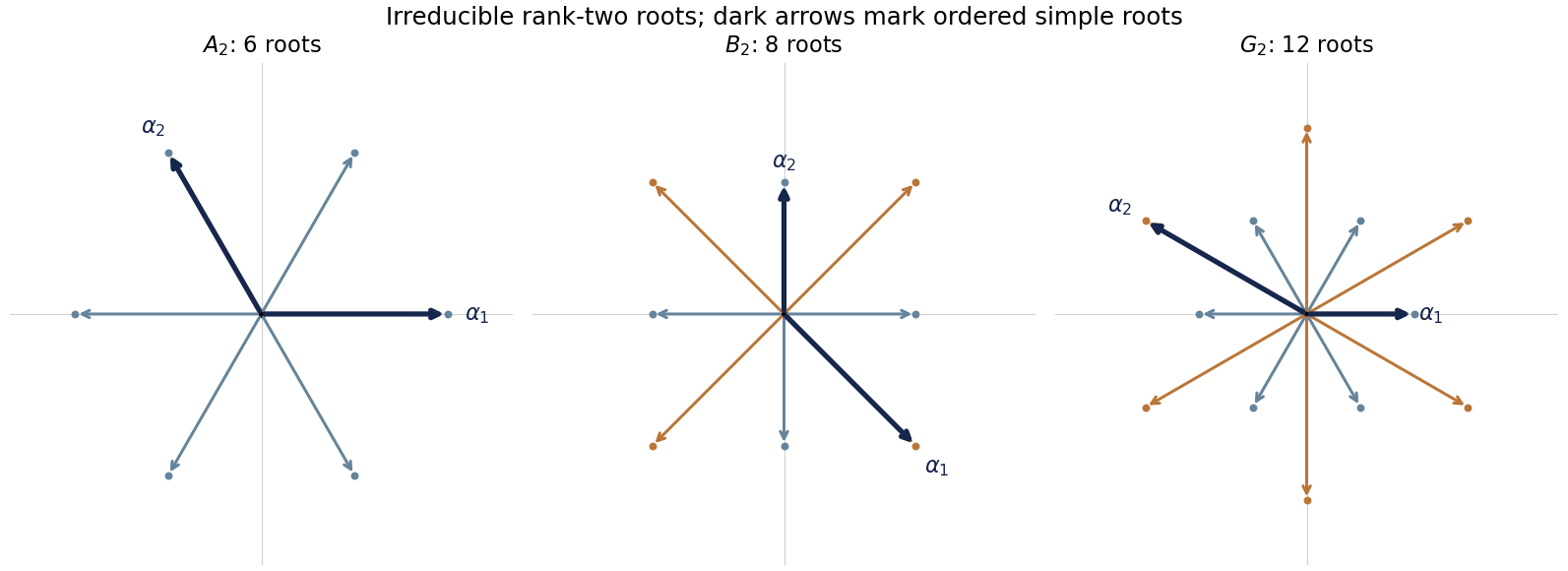
The irreducible rank-two root systems A2, B2 and G2, with long and short roots and explicit ordered simple roots highlighted
. Details. 
The Adjoint representation of a Lie algebra acts on the algebra itself: . In the basis , its matrices areFor any algebra element , the Jacobi identity givesTherefore the matrices satisfy the same Lie bracket relations:This construction does not require that the algebra be simple or that the adjoint action be faithful.
For the field calculation, write and . In the derivative-plus-connection convention the Yang-Mills field strength isThe sign of the parameter here is the negative of the matter-field parameter in the usual gauge transformation in the derivative-plus-connection convention. Work with the stated throughout. Expanding the variation givesThe second derivatives cancel by commutativity of partial derivatives, and all remaining derivatives of cancel by antisymmetry of the Lie bracket. The Jacobi identity makes the last two terms . HenceUnlike the connection, the curvature has no inhomogeneous derivative term: it transforms in the Adjoint representation.
The quadratic form is the Killing form. Its symmetry follows from cyclicity of the matrix trace. Using the just-proved adjoint commutators,ThusEquivalently, each adjoint generator is skew with respect to this invariant bilinear form. This invariance holds even when the Killing form is degenerate; no inverse form is needed here.
The spacetime metric used to raise Lorentz indices is unaffected by the internal gauge transformation. Since , invariance givesTherefore the Killing-form contraction of the field strengths is gauge invariant, as required for the internal contraction in a Yang-Mills action.
Articles by others on the same topic
There are currently no matching articles.