Put and . In the Unscaled Papkovich–Neuber representation, take the harmonic potentials and . Differentiating gives the Stokeslet velocity and its pressure:Indeed, writing ,The antisymmetric first two terms cancel in the rate-of-strain tensor, whereas their curl supplies the vorticity. ThusThe rate-of-strain tensor has zero trace, as required by incompressibility. The stress is ; integrating its traction with normal over a sphere gives . This fixes the force normalization of the Stokeslet.
For a sphere in a uniform straining Stokes flow, write the ambient velocity as , where is symmetric and trace-free, and set . Symmetry gives zero translation and rotation of the centred force-free, torque-free sphere. Seek a decaying disturbance using the Unscaled Papkovich–Neuber representation withThe components of are derivatives of , and is a trace-free harmonic quadrupole, so both potentials satisfy Laplace's equation outside the sphere. Direct differentiation yieldsThe no-slip boundary condition at requires the coefficient of to be and that of to vanish: , . Hence , , andThis disturbance cancels the ambient velocity at , decays at infinity, and has a leading stresslet proportional to .
For the two-sphere hydrodynamic interaction, let point from the forced sphere to the second sphere. The first sphere's leading far field is the Stokeslet with . Its incident rate-of-strain tensor at the second sphere isThe force-free sphere translates with the local uniform incident flow, and the torque-free sphere rotates with half the incident vorticity. Those parts cause no leading Stokeslet or rotlet disturbance. The remaining incident strain produces the stresslet just calculated. At displacement from the second sphere its velocity isThe first sphere translates in this returned incident flow. Finite-size sampling and higher incident multipoles enter only beyond the retained reflection order. Thus the stresslet reflection between two force-free and forced spheres givesThe factor makes explicit the velocity scale implicit in the printed remainder.
The resulting input power, equal to the viscous dissipation, isIt decreases at fixed force. The Minimum-dissipation theorem for Stokes flow instead compares admissible fields at fixed first-sphere velocity: extending a two-sphere field rigidly into the second sphere gives an admissible one-sphere field, so the extra rigid inclusion can only increase the minimum resistance. Allowing the second sphere to choose its translation and rotation minimizes over its rigid motions, producing zero force and couple there. An increase of this effective hydrodynamic resistance matrix decreases its inverse hydrodynamic mobility matrix, and hence decreases fixed-force power. The negative mobility correction is therefore consistent with minimum dissipation.
If the second sphere is prevented from rotating, its angular velocity relative to the incident fluid becomesUse the rotating sphere in Stokes flow at . The additional reflected rotlet givesAdding this rotation-clamped reflection between two spheres to the strain reflection,The holding couple supplies no power because the held sphere's angular velocity is zero.
Take downslope and normal to the plane. To leading order in the lubrication approximation, Newtonian gravity gives the hydrostatic pressure . The downslope Stokes equation is therefore . Imposing the no-slip boundary condition at and the stress-free boundary condition at givesHere is the kinematic viscosity; is the downslope velocity. Applying mass conservation to this lubrication gravity-current flux,For typical thickness and length , the transverse velocity is by incompressibility. Both convective terms are then , while transverse viscous acceleration is . Thus the inertia criterion for an inclined viscous film is , in addition to . With evolution time the same condition controls unsteady inertia. If a faster time is independently imposed, also require . Estimating from the velocity profile gives the two requested limits:
At long times, and the ratio of hydrostatic-gradient forcing to downslope Newtonian gravity in the bulk is . Put ; the bulk conservation law is . The finite-volume gravity-driven thin-film current scales as , . More explicitly, writing , , givesThe constant of integration is zero for the zero-flux dry tail. ConsequentlyThe reduced bulk solution is zero outside this interval. Its thin nose region is resolved below. Integrating to impose the conserved area,The bulk front height is , with . Differentiation of the front law givesEquivalently, this is the Rankine-Hugoniot condition for the bulk shock wave, whose speed is flux divided by height.
In moving coordinate , the full thin-film equation becomes . A nose thickness and slope give axial scale . Since , the explicit time derivative is smaller than translation by that ratio. The travelling front of a gravity-driven thin film is therefore quasisteady. Integrate once with dry-tip flux zero to obtain , orWith , separation of variables and the convention at giveThe nose approaches exponentially far behind its tip, then falls to zero with a vertical tangent in this small-slope model. The requested sketch shows this monotone profile:
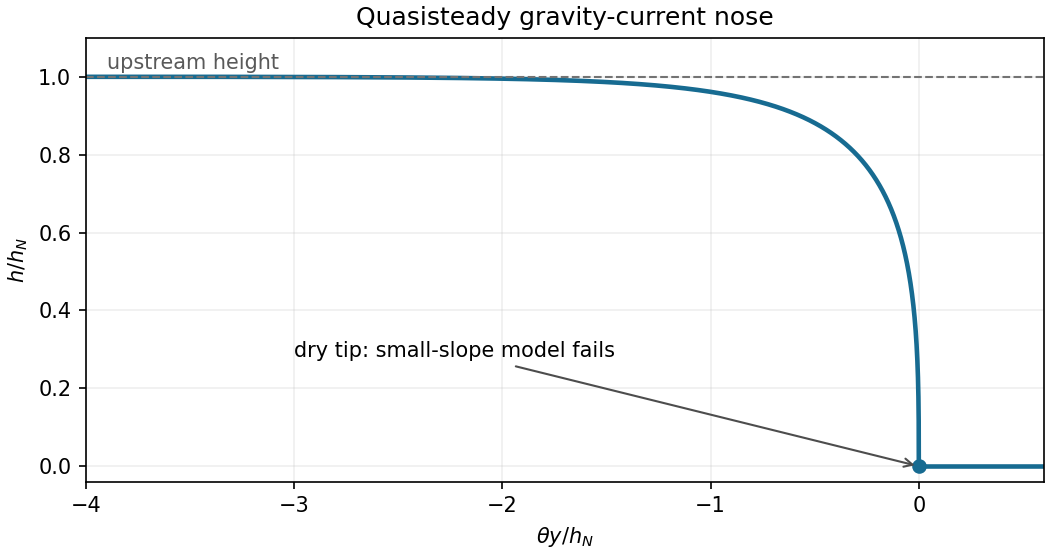
Expanding the inverse hyperbolic tangent, , so . Its slope has magnitude near the tip. The small-slope breakdown at an inclined-current nose occurs at , which givesFinally, surface tension produces a pressure-gradient scale , whereas downslope Newtonian gravity gives . Their ratio is . Thus surface tension changes the principal nose length whenThis is a bulk-nose crossover; capillarity and contact-line physics can already affect a smaller region very close to the dry tip even when the bulk nose is Newtonian gravity dominated.
Let and be two Stokes flows in the same fluid domain, with equal dynamic viscosity and zero body force. The Lorentz reciprocal theorem for Stokes flow isTo prove it, use the symmetric Newtonian fluid stress tensor and . Incompressibility removes the pressure contraction, while symmetry removes the antisymmetric velocity gradient. ThereforeThe divergence theorem proves the boundary identity. It applies to an exterior domain by a limit at infinity; the boundary integral there vanishes for decaying rigid-body Stokes flows.
Use a normal directed outward from the fluid, into the rigid body. Then and are the force and couple exerted by the body on the fluid. If and , inserting the rigid boundary velocity into the Lorentz reciprocal theorem for Stokes flow givesArbitrary rigid velocities imply . A separate integration by parts, using the Stokes equation, givesEquality requires zero rate-of-strain tensor everywhere. Such a velocity is a rigid motion in the connected exterior fluid; decay at infinity forces it to vanish, and the no-slip boundary condition then forces . Hence the resistance matrix is symmetric positive definite. Defining force as fluid-on-body would reverse its sign, so the positive convention matters.
For the rods, choose body axes along , , and their normal. On the first rod, for , and the slender-body force density isOn the second rod, , andIntegrate the force densities and the moments , using , , and . For example, , , and . In the ordering , the full right-angle two-rod resistance matrix isThe planar subsystem isInverting this symmetric matrix gives the hydrodynamic mobility matrixThe upper-right entry is positive, as printed in the PDF; the negative sign in the converted TeX would violate both this inversion and reciprocity.
Let laboratory point along the initial and laboratory point upward. At body angle , and . The gravitational load, balanced by body-on-fluid resistance, has body componentsThe last expression follows by taking moments of the two endpoint weights about . Substitution into the hydrodynamic mobility matrix givesFor , the initial condition persists, and , : vertical descent without rotation. For , throughout , and the zero of at is stable. A simple zero is approached only as , so increases monotonically to . For , it decreases monotonically through and toward the next stable zero: , not .
The laboratory horizontal velocity of isFor , divide by the angular equation to eliminate time:At both limiting orientations the sine and cosine are equal, so the sedimentation drift of a weighted two-rod body isFor the initial drift is negative. It reaches at , reverses, crosses its starting horizontal position at , and ends to the right. At exactly there is no horizontal displacement; the infinite-time displacement is discontinuous there because the rotation time diverges as .
Let . Incompressibility makes the transverse velocity . In the axial Navier-Stokes equation, transverse viscous stress scales as , longitudinal viscous stress as , and convective inertia as . Thus lubrication theory requiresUnsteady inertia is also negligible if ; this coincides with the preceding condition when . The transverse pressure variation is smaller than this pressure scale by , and viscous normal stress at the free surface is similarly smaller. Consequently pressure is uniform across the film to leading order, while axial viscous shear balances its axial gradient. These estimates justify the lubrication approximation with small surface slopes and a slowly varying rigid wall.
Write the physical cylindrical-film thickness as , so that , and use for dimensional coordinates. For a surface of radius , its outward mean curvature, with the convention giving cylindrical curvature , isThe Young–Laplace equation gives . With local normal coordinate measured from the rigid cylinder, the axial velocity solves , with no-slip boundary condition at and stress-free boundary condition at . ThereforeThe factors of circumference in axisymmetric mass conservation cancel at leading thin-film order, giving . IntroduceThis produces the capillary instability of a thin film on a rigid cylinder governed byThe curvature term destabilizes long waves; the axial-curvature term smooths short waves.
Linearize about using with small . The linear equation is , soThe growth rate is positive for , zero at , and negative for . Its derivative is , givingThe requested sketch is even in :
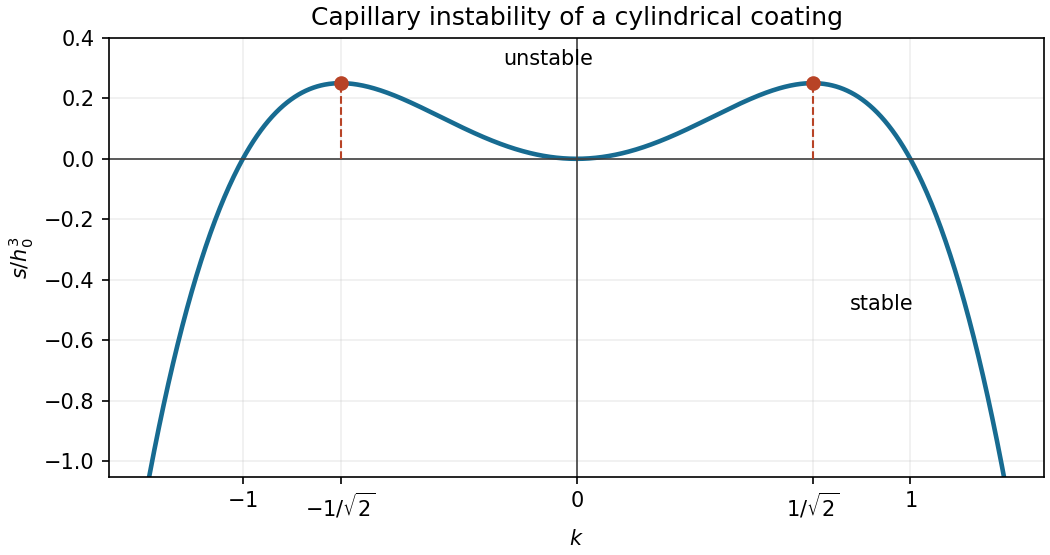


For the Rayleigh–Plateau instability of an entire liquid cylinder in the purely viscous limit with negligible exterior viscosity, the fastest mode tends to infinite wavelength. The rigid-wall coating instead selects a finite wavelength. The difference comes from the flow resistance: a coating must shear across its thickness, so its long-wave growth vanishes as ; a free liquid cylinder can undergo nearly plug-like axial extension. For example, the long-wave free-cylinder balances and give , which does not vanish as . This comparison is for the creeping-flow, negligible-exterior-viscosity limit; finite inertia or exterior viscosity changes the wavelength selection. The full free-cylinder dispersion relation is discussed in Plateau-Rayleigh Instability of a Cylinder of Viscous Liquid.
The collar is a quasisteady sliding collar on a coated cylinder. It must slowly grow as well as translate: an exact travelling wave would obey , whereas its stationary uniform far films have and would require . Thus the stipulated unequal films require the stated slow evolution of the collar amplitude. In its core, and the volume flux is small, so the leading pressure gradient vanishes: . Integration gives a constant plus sine and cosine terms. Choose the collar centre at its maximum to remove the sine term, and parameterize its edge height as . ThenThe core is a local capillary equilibrium. In the moving frame, swept-up volume minus deposited volume gives the growth rate . Its leading excess volume is , and for constant ,Thus the printed rate is the rate of collar volume, or an order-of-magnitude amplitude rate; interpreted as an exact equation for , it lacks . This slow change is smaller than the translational core terms by the small far-film thickness and does not alter the leading local matching below.
Near either edge , let denote the adjacent film thickness, at the rear and at the front. Across the short transition region the collar's slow growth is higher order, so local mass conservation integrates to . The axial third derivative dominates the first derivative in the capillary flux, givingFor collar-to-film capillary matching, chooseThe two sides become and respectively, and henceThe resulting transition length is small compared with the core length: the matching relations below imply , so for an order-one core amplitude.
To count admissible branches, put and linearize. The characteristic equation is , with rootsAt the rear, decay as permits only . For the nontrivial branch growing into a positive collar, ; translation rescales , leaving one orbit. This branch has positive . It exists for all forward , since for , and once , grows at least quadratically. Then , so successive integrations give a quadratic asymptote with a finite constant term; translation removes the linear term. The constant solution is not a rear-to-collar match. On the downward branch, gives while and are initially negative; the slope remains negative and reaches zero, so it cannot match a positive collar. Uniqueness here refers to the positive, nontrivial rear matching branch, modulo translations.
At the front, decay as permits the two real amplitudes inTranslation removes one degree of freedom, leaving one parameter . These oscillatory branches account for the small capillary ripples ahead of the collar. This local stable manifold count gives the family of front branches; admissible global branches must also remain positive and reach a parabolic core asymptote. It does not, by itself, prove the global uniqueness of the matching parameter supplied in the question.
Write the rear and front core asymptotes, after translation removes their linear terms, as and . Expanding the outer collar near either edge giveswhereas the inner expansion givesMatching the constant and quadratic coefficients therefore yieldsEliminate to obtain . Using the specified selected root and writing , ,The physical branch has , as required by . No numerical values of these universal matching coefficients are needed for the requested relations.
Finally, the energy source is decreasing capillary surface energy, not Newtonian gravity. This can be checked through the volume-constrained capillary energy of a cylindrical coating. The exact liquid volume per axial length is , and the free-surface area is . Expanding the latter and eliminating with fixed exact volume gives the nonconstant quadratic partApart from its positive dimensional factor, this is the surface energy . Its variational derivative is , and the thin-film equation is a conserved gradient flow. With periodic or zero-energy-flux boundaries, integration by parts givesFor an isolated collar between unequal infinite films, use the corresponding local energy balance, including far-film fluxes and subtracting background energies; the unsubtracted total energy is infinite. Collecting film into the growing collar lowers surface energy, which supplies the viscous dissipation sustaining its slow motion.
Articles by others on the same topic
There are currently no matching articles.