For a Lie algebra , write for the linear span of brackets with one argument in each indicated subspace. The three definitions areThese are respectively an Abelian Lie algebra, a solvable Lie algebra and a nilpotent Lie algebra. The second and third sequences are the derived series of a Lie algebra and the lower central series of a Lie algebra.
An Abelian Lie algebra has , and a nilpotent Lie algebra is a solvable Lie algebra: induction gives . Thus all the implications are generated byNone of the reverse implications holds. The Heisenberg Lie algebra with basis and , all other basic brackets zero, is nonabelian but has , . The two-dimensional affine Lie algebra of the line with has and , but for every . It is solvable and neither nilpotent nor abelian. These two examples answer all six ordered-pair comparisons.
The Lie theorem says that a finite-dimensional Lie algebra representation of a finite-dimensional solvable Lie algebra over an algebraically closed field of characteristic zero has a common eigenvector whenever its representation space is nonzero. Equivalently it admits an invariant complete flag, or simultaneous upper triangularization. Here the field may be taken to be ; these hypotheses are essential.
To prove the common-eigenvector assertion, induct on . The zero algebra is immediate. Since is nonzero and solvable, its derived algebra is proper. Choose a codimension-one Lie algebra ideal containing it, and write . The Lie algebra is solvable, so induction supplies and a linear functional with .
Consider the finite-dimensional cyclic subspace . Until the first linear dependence, these powers form a basis. The identityand show by induction, simultaneously for all , that is -invariant and that is upper triangular on it with every diagonal entry . It is also -invariant by construction. HenceThe trace of a commutator is zero, and characteristic zero gives .
The simultaneous eigenspace is nonzero and -invariant, sinceOver an algebraically closed field, has an eigenvector, which is therefore a common eigenvector for all of . This finishes induction. Apply the same assertion to the quotient representation by its invariant line, and then to successive quotients. A basis adapted to the resulting complete flag gives the stated simultaneous triangularization of a Lie algebra representation, completing the proof of the Lie theorem.
A nilpotent Lie algebra is a solvable Lie algebra, so the inclusion satisfies the Lie theorem and is upper triangular in a suitable basis, for finite-dimensional complex .
This is insufficient to prove the Engel theorem. Its matrix version starts with a Lie subalgebra of nilpotent endomorphisms and concludes that they are simultaneously strictly upper triangular; its abstract version concludes nilpotence from nilpotence of every Adjoint representation endomorphism. Merely upper triangular matrices can have nonzero diagonal entries: the one-dimensional algebra is an Abelian Lie algebra and a nilpotent Lie algebra, but acts by a nonnilpotent identity matrix. This is nilpotent Lie algebras need not act nilpotently. Moreover, in the abstract Engel theorem nilpotence of the algebra is a conclusion, so assuming it first to invoke the Lie theorem would be circular. Abstract nilpotence and nilpotence of each representing matrix are different conditions.
The Weyl complete reducibility theorem states that every finite-dimensional Lie algebra representation of a finite-dimensional complex semisimple Lie algebra is a direct sum of Irreducible Lie algebra representations. Equivalently, every invariant vector subspace has an invariant complement.
We use the permitted Casimir operator properties in the following precise form. There is a central quadratic operator commuting with the action on every module; it is zero on the trivial Lie algebra representation, and on every nontrivial finite-dimensional Irreducible Lie algebra representation it is a nonzero scalar . This follows from the Schur lemma and the Casimir eigenvalue , using the Killing form normalization. We also use the permitted one-dimensional-representation fact: a complex semisimple Lie algebra has only trivial one-dimensional representations. Equivalently, it is a perfect Lie algebra, , so a character annihilating brackets must vanish. Neither fact assumes complete reducibility of the module being proved reducible.
First prove that every finite-dimensional short exact sequencewith trivial quotient splits. If is nontrivial irreducible, the Casimir operator has image in and restricts to there. Consequently is a one-dimensional invariant complement to . If is trivial irreducible, has a basis in which every action is . The Lie algebra representation identity makes , so the one-dimensional-representation fact gives and again the sequence splits.
For general , induct on . Choose an irreducible submodule . The induced sequence with kernel and middle term splits by induction. The inverse image of its invariant complement is a submodule fitting into . The irreducible-kernel case gives an invariant line in mapping isomorphically to the quotient. It is also an invariant complement to in . The case starts this induction. This proves splitting of a trivial quotient for a semisimple Lie algebra, including kernels that are not assumed completely reducible.
Now let be any invariant subspace. On the Hom representation the action isLet consist of the maps whose restriction to is a scalar multiple of . This is a submodule, and restriction givesThe right-hand map is surjective because an ordinary linear projection exists; its quotient action is trivial because a commutator with is zero. The splitting just proved supplies an invariant with . Thus intertwines the actions, , andThe cases and are immediate. Choosing an irreducible submodule and repeating this complement construction proves the Weyl complete reducibility theorem. This last step is invariant complement from an equivariant projection.
Dropping finite dimensionality gives an example with the complex simple Lie algebra . Its Verma module of highest weight zero has a basis withwhere . These actions obey , , . The span of is a proper submodule and the quotient is trivial. It has no invariant complement: such a complement would be a trivial line, while is injective on the entire module. Thus a simple Lie algebra can have an infinite-dimensional representation that is not completely reducible, even over .
Use Dynkin labels for the highest weight of the complex special linear Lie algebra . The A2 root system has and in these coordinates. In the drawings, and have equal lengths and angle ; a label at a point records its weight multiplicity, not a further copy at a different position.
The defining fundamental representation has the three weightsFor , lower from its highest weight by the simple roots, retaining multiplicities. One convenient way to calculate them is the sl3 interlacing character formula: for shape the integer patterns satisfy , , , and contribute the weightEnumerating these patterns gives the weight diagramIts dimension is . The diagram below draws all twelve distinct positions, with the three inner multiplicities equal to two. The extra panel gives the symmetric square used in the calculation.
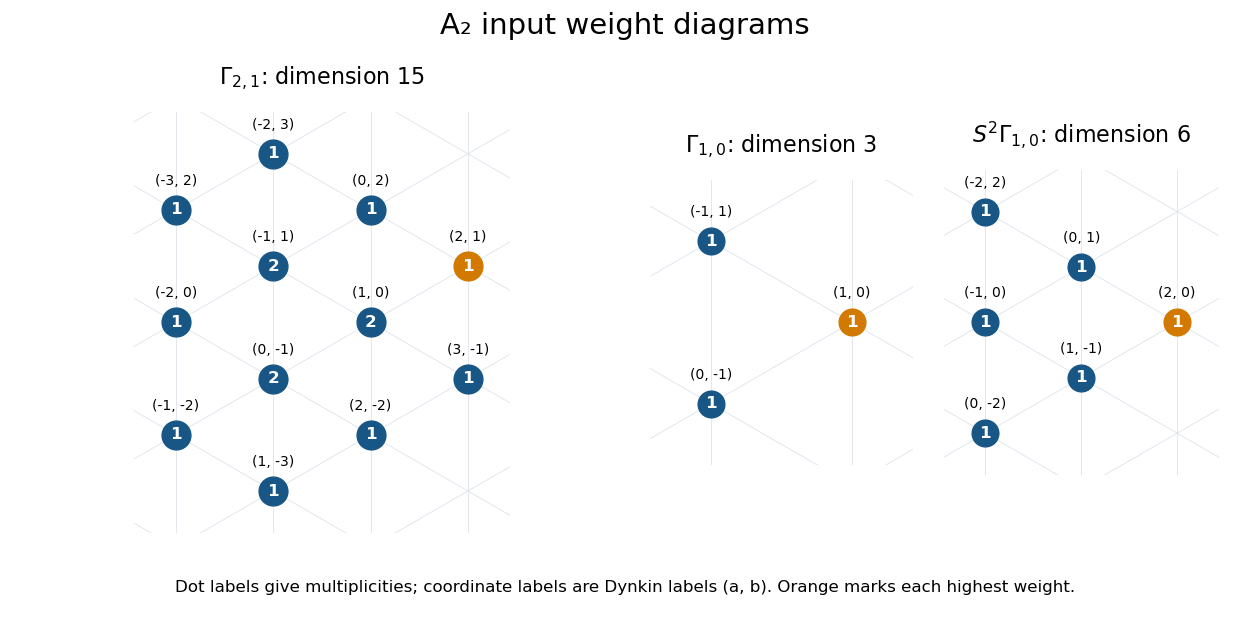
A2 weight diagrams for Gamma(2,1), the defining Gamma(1,0), and its symmetric square, with every weight multiplicity
. Details. 
The six symmetric monomials in the defining basis give , with weightseach occurring once. Thus the tensor product has dimensionIn a tensor product of Lie algebra representations, weights add and their multiplicities multiply. In terms of formal characters, . Consequently , summing over the six weights just listed. To show the indicated dominant multiplicities explicitly, the contributions in that order areThe tensor-product weight diagram below includes every position, and highlights these dominant weights. It also records the zero-weight multiplicity nine; that multiplicity is not a count of trivial summands.
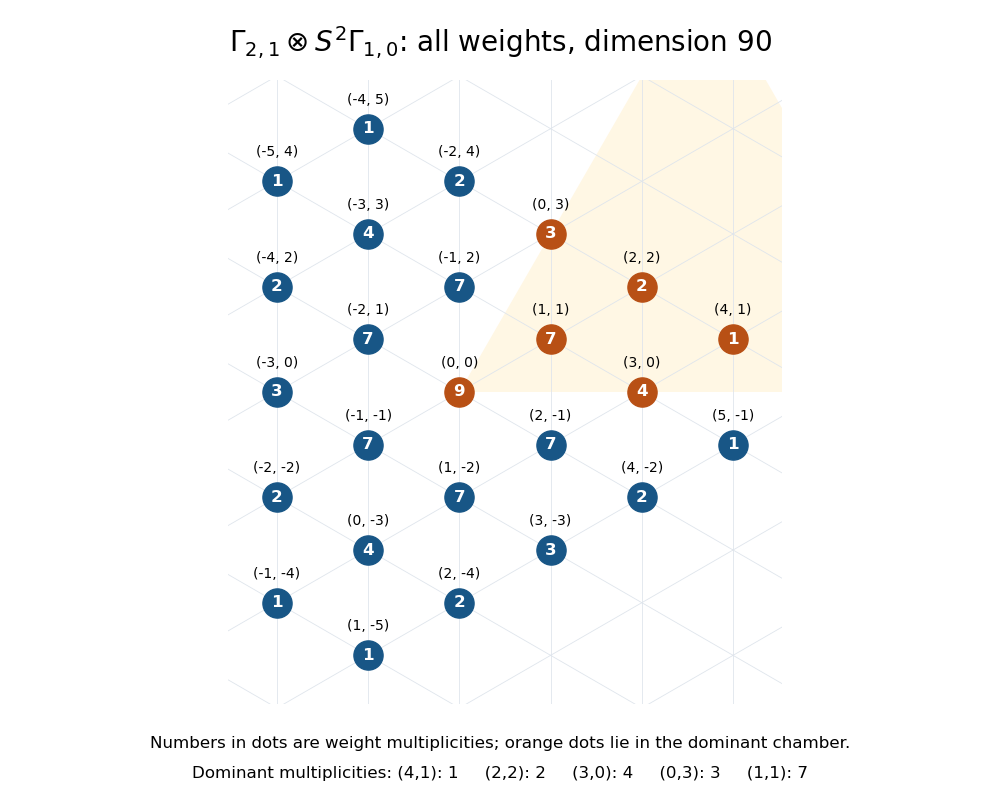
All weights of the ninety-dimensional sl3 tensor product Gamma(2,1) tensor Sym2 Gamma(1,0), with dominant weights highlighted and multiplicities labelled
. Details. 
Apply the Weyl complete reducibility theorem and subtract irreducible formal characters in decreasing dominance order. The multiplicities at these five dominant positions in the potential summands areThese entries can be obtained by the same interlacing enumeration or by weight strings. Starting with , subtracting leaves ; subtracting leaves ; then the two ten-dimensional modules leave a single copy of the dominant weight . This is highest-weight character subtraction. ThereforeEvery summand occurs once. The Weyl dimension formula gives , exhausting the dimension of and ruling out further irreducible summands. Computing the complete formal character also leaves no residual weight multiplicities.
The appropriate abstract object is a finite reduced crystallographic root system in a real inner product space . Its axioms are: is finite, spans , and does not contain zero; for , ; each root reflectionpermutes ; and every Cartan integer is an integer. The restriction to a reduced root system and crystallographic integrality distinguishes roots of complex semisimple Lie algebras from more general reflection configurations.
For any two roots of a root system, the Cauchy-Schwarz inequality givesIf the inner product is zero, both Cartan integers vanish. Otherwise their signs agree, and the absolute value of each is a positive integer. Dividing their product by an integer of absolute value at least one provesFor nonproportional roots the product is strictly less than four. In a reduced root system, proportional roots are just and have Cartan integers , so the printed bound is intentionally looser than the resulting bound of three.
A fundamental system of a root system is a basis of made of roots, such that each root is an integer combination of with either all coefficients nonnegative or all nonpositive. Its members are the simple roots. Suppose distinct had . Thenhas a positive coefficient of and a negative coefficient of , contradicting the defining sign condition. Thus . Distinct simple roots are linearly independent, so their Cartan-integer product is strictly less than four. Combining integrality and the sign condition givesHere nonpositive is the intended sense of the printed convention that includes zero among “negative” numbers; orthogonal simple roots really do give zero.
To form a Dynkin diagram, place a vertex at each simple root. Join two vertices by bonds, hence zero, one, two or three. A multiple bond has an arrow toward the short root. Indeed determines the squared length ratio, and the diagram with the Cartan matrix reconstructs the angles and relative lengths. A single bond joins equal-length roots.
The connected finite Dynkin diagrams are the following. The descriptions include bond multiplicities and arrow directions, so distinguish dual diagrams:
- An Dynkin diagram, for : a chain of vertices with only single bonds.
- Bn Dynkin diagram and affine extension, for : a chain whose last bond is double, with its arrow toward the terminal short root; all earlier bonds are single. Only its finite diagram is used here.
- Cn Dynkin diagram, for : the same chain with the double-bond arrow toward the penultimate short root and away from the terminal long root. and describe the same rank-two type after relabelling.
- Dn Dynkin diagram, for : a simply laced tree with one trivalent vertex and arms of lengths , counting edges.
- En Dynkin diagram, : simply laced trees with a trivalent vertex and arms of lengths respectively , , .
- F4 Dynkin diagram, : a chain of four vertices, with a double central bond and two single outer bonds. Two consecutive vertices are long and two are short; the arrow goes from the long pair toward the short pair.
- G2 Dynkin diagram, : two vertices joined by a triple bond, with arrow toward the short root.
There are no other connected finite Dynkin diagrams. Low-rank conventions also identify and ; is disconnected, so introduces no further connected type. Affine diagrams are outside this finite classification.
Finally suppose the underlying graph contained a cycle on distinct simple roots . Put . Any bonded pair hasand all other distinct pairs have nonpositive inner products. The cycle contributes at least bonded pairs, soBut the simple roots, and hence these normalized vectors, are linearly independent, making the displayed sum nonzero. Positive definiteness gives a contradiction. Thus the underlying graph of a finite Dynkin diagram has no cycle. This acyclicity of a finite Dynkin diagram argument also excludes cycles with extra chords or multiple bonds; multiple bonds themselves are not treated as two-edge cycles.
Let be a finite-dimensional Lie algebra representation. The form denoted isIt is the Trace form of a Lie algebra representation; the Killing form without a subscript is specifically the case , . The distinction matters: the form of the trivial representation cannot detect whether the algebra is semisimple.
Linearity of and trace proves bilinearity, and cyclicity of the trace gives symmetry. With , and , the representation identity givesThus it is an invariant bilinear form on a Lie algebra, and in particular the Adjoint representation preserves the Killing form.
The Cartan solvability criterion has two useful formulations. For a finite-dimensional complex Lie algebra ,Its matrix version says that a Lie subalgebra is solvable precisely when for all and . We prove the matrix version first, with ordinary trace in .
If is solvable, the Lie theorem makes all its matrices upper triangular. Their commutators are strictly upper triangular, so multiplying such a matrix by an upper triangular one still has zero diagonal and hence zero trace. This proves the easy direction.
Conversely assume the trace-orthogonality condition and fix . We show that all eigenvalues of vanish. Use its Additive Jordan decomposition with . On the generalized eigenspace of , define an auxiliary endomorphism to be . This need not be in ; we only need control of its commutator with .
On , acts by and by . Choose a polynomial with and at the finitely many distinct differences. Polynomial interpolation supplies it because equal differences have equal conjugates. Therefore .
The adjoint compatibility of additive Jordan decomposition identifies as the semisimple part of . Elementary Jordan–Chevalley decomposition gives for a polynomial with . Hence is a polynomial in with zero constant term. Since maps into and preserves that Lie algebra ideal, we obtainNo assumption that , or belongs to was made.
Write with . Cyclicity and the assumed orthogonality now giveOn the other hand the nilpotent parts have zero trace on each generalized eigenspace, soThus all are zero and is a nilpotent endomorphism. This is the Conjugate-spectrum proof of Cartan solvability.
The permitted Engel theorem, in the form needed here, states: a finite-dimensional Lie subalgebra of endomorphisms in which every element is nilpotent has a nonzero vector annihilated by all its elements, and iteration on quotients makes every element simultaneously strictly upper triangular. Apply it to . The strictly upper triangular algebra is nilpotent, so is a nilpotent Lie algebra and therefore solvable. Since is abelian, the derived series of a Lie algebra of terminates too. This proves the matrix criterion.
Apply it to . The condition on is exactly the matrix condition on . Thus is solvable. The kernel of is the center of a Lie algebra, which is abelian, so is solvable as well: once the derived series maps to zero it is central, and its next term vanishes. Conversely a solvable has solvable adjoint image, proving the abstract Cartan solvability criterion in both directions.
A finite-dimensional Lie algebra is a semisimple Lie algebra when it has no nonzero solvable Lie algebra ideal, equivalently its solvable radical is zero. Let . Invariance makes an ideal. For , induces zero on , and the block trace gives , where is the adjoint Killing form of itself. The Cartan solvability criterion therefore makes solvable. If is semisimple, .
Conversely suppose is a nondegenerate bilinear form. If a nonzero solvable ideal existed, its last nonzero derived term would be an abelian ideal of . For and , the operator has image in and is zero on , so its square and its trace are zero. Thus , contradicting nondegeneracy. This is Abelian ideals lie in the radical of the Killing form. We conclude the Cartan criterion for semisimplicity:
A real Lie group is a group equipped with a finite-dimensional real smooth manifold structure, conventionally Hausdorff and second countable, for which multiplication and inversion are smooth.
Its tangent space at the identity is defined by smooth curves through : two curves represent the same tangent vector when their derivatives in a local chart agree at zero. For , left translation determines the left-invariant vector fieldThe commutator of these derivations on smooth functions is another left-invariant vector field, so define the Lie bracketThis construction supplies the Lie algebra structure. In a Matrix Lie group, and differentiating the two fields gives .
For the special linear group, differentiate the determinant along a curve through . Expansion of the determinant, or its differential , givesThe determinant differential is surjective at , so the level set has tangent space equal to its differential's kernel. Equivalently, every tangent matrix has zero trace, and every zero-trace matrix supplies a curve of determinant . Hencewith the matrix commutator bracket. The same calculation over gives the complex special linear Lie algebra ; as a real group, the complex group has that space viewed as a real Lie algebra.
The matrix exponential is the everywhere-convergent serieswhose inverse matrix is . The matrix logarithm is locally defined near byThese maps are inverse on suitable neighbourhoods of zero and , giving a logarithmic chart of a matrix Lie group. A logarithm is not a globally single-valued inverse of the exponential.
Every invertible complex matrix nevertheless has at least one matrix logarithm. Put it in Jordan normal form. For a block , and , choose any complex scalar logarithm of and setThe finite logarithm and exponential identities in the nilpotent variable give . Combine the blocks and conjugate back. Thus the exponential map is surjective on , by existence of a logarithm for every invertible complex matrix.
A connected counterexample is . It is connected: polar decomposition of an invertible real matrix writes each element as , with and positive definite symmetric of determinant one; is connected and is connected to through .
But belongs to this group and is not for any real . Such an would commute with . Since has two distinct real eigenvalues, direct commutation makes a real diagonal matrix. Its exponential has positive diagonal entries, a contradiction. ThereforeThis is an exponential-surjectivity obstruction from distinct negative eigenvalues; connectedness does not eliminate the obstruction.
Articles by others on the same topic
There are currently no matching articles.