Invertibility is stable under sufficiently small perturbations, and inversion is continuous. Let be the identity of the complex unital Banach algebra , with its submultiplicative algebra norm. For , completeness makes the Neumann seriesconverge in . Multiplying either side of the partial sums by gives , which tends to , proving that the sum is a two-sided inverse.
Fix , the group of invertible elements of a Banach algebra. If , thenso the Neumann series makes invertible. This proves that is open. It also gives a local boundWe retain here so the estimate does not silently assume a normalized identity. The inverse identitythen impliesThis proves continuity of inversion in a Banach algebra.
For a unital Banach algebra, the spectrum of an element isFor a nonunital Banach algebra, use its unitization of an algebra with multiplication and normIt is a unital Banach algebra, with identity , and define . In this nonunital convention, belongs to the spectrum: the scalar coordinate of is zero, so it cannot be invertible in .
The spectrum is nonempty and compact. It suffices to work in a nonzero unital Banach algebra, since unitization reduces the other case to this one. The group of invertible elements of a Banach algebra is open, so the complement of the spectrum of an element is open. For , the Neumann series givesThus is closed and lies in , hence is compact.
For nonemptiness of the Banach-algebra spectrum, suppose that were defined on all of . At any , factoring gives a locally convergent power seriesFor every bounded linear functional , the scalar function is therefore entire. The bound at infinity makes it bounded outside a disk, while continuity makes it bounded on the disk. By the Liouville theorem, it is constant; since it tends to zero at infinity, it is identically zero. The version of the Hahn-Banach theorem used here says that bounded linear functionals separate points of a normed vector space: if , there is with . Consequently for every , contradicting . This proves the assertion.
Every nonzero complex unital normed division algebra is algebraically and topologically isomorphic to . This is the Gelfand-Mazur theorem; completeness is not needed in its statement. Let be a normed division algebra, and take its completion of a normed space using the algebra norm to obtain a unital Banach algebra . Submultiplicativity extends multiplication continuously to the completion, and the original identity remains its identity.
For , the spectrum of an element of in contains some . If in , the division-algebra assumption supplies an inverse in , which is still an inverse in . This contradicts . Therefore . The map is a bijective complex algebra homomorphism, andIt and its inverse are continuous; when , it is an isometry.
A complete algebra norm on a function algebra dominates the supremum norm, even before continuity of point evaluations is known. Let be the given algebra of functions. Form the same artificial unitization even if already has an identity. For each , the algebraic mapis a unital multiplicative complex linear functional. No continuity has been assumed. Since , the element cannot be invertible: applying to an inverse equation would give . Hence , and the spectrum bound already proved yieldsTaking the supremum proves the supremum bound for a complete function-algebra norm:In particular every is bounded, and every point evaluation is a bounded linear functional of norm at most . This is an instance of automatic continuity of characters: a character of an algebra on a Banach algebra is bounded because its value at any element belongs to that element's spectrum.
For a convex subset of a Banach space, weak closure equals norm closure. The Mazur theorem states that for every convex set ,Since every bounded linear functional is norm-continuous, the weak topology is weaker than the norm topology, giving .
For the reverse inclusion, use this form of the Hahn-Banach separation theorem: if is a nonempty norm-closed convex set in a real normed vector space and , there is a continuous real-linear functional such thatApply it to . In a complex Banach space, use the underlying real space; every continuous real-linear is the real part of the complex bounded linear functional . The separating strict inequality gives a neighbourhood open for the weak topology of disjoint from , so . The empty set case is immediate. This proves the Mazur theorem.
A weakly null sequence has disjoint convex blocks converging to zero in norm. If , then for every starting index ,The Mazur theorem places in the norm closure of that tail convex hull. Thus a finite convex combination of vectors from any tail can have norm less than any prescribed .
Choose the convex blocks recursively. After selecting the previous terminal index , let , and choose a finite convex combination from with norm less than . Choose beyond its largest used index, padding the intervening coefficients and the final coefficient with zero. This ensures the printed strict condition as well as . Setting unused coefficients to zero yieldsTherefore in norm. The recursive tail selection is what makes these convex blocks, rather than merely unrelated convex combinations.
Next suppose is separable and is bounded. Use the canonical embedding into the bidual , where . If , then . The Banach-Alaoglu theorem makes this ball compact in , and weak-star metrizability of the dual ball makes it metrizable because its predual is separable. A compact space that is a metric space is sequentially compact, so some subsequence satisfiesThe limit need not belong to ; it is precisely the use of the bidual space that supplies compactness without assuming reflexivity.
For a convex block , every satisfiesBoth and tend to , soThis is the useful convex-block cancellation of a weak-star limit; it does not require the limit to be a vector in .
The quotient sequence has approximate lifts in that are weakly null after passing to a subsequence. Let be the quotient map, with the quotient norm. Since , choose such thatThis uses the infimum defining the quotient norm and does not assume that it is attained. By the preceding compactness argument, pass to a subsequence with a common weak-star limit in . Its quotient images form a weakly null sequence.
Apply the convex block construction to in the quotient Banach space. Using the same coefficients on gives convex blocksSet . The convex-block cancellation of a weak-star limit proves , whileThus the approximate weakly null lifting through a quotient is achieved with the required bound:
The Radon-Nikodym theorem for positive measures says: if and are sigma-finite measures on the same measurable space, and is absolutely continuous with respect to , then there is a nonnegative measurable function , unique -almost everywhere, such thatHere sigma-finiteness means that the space is a countable union of measurable sets of finite measure; absolute continuity of measures, written , means that implies . The function is the Radon-Nikodym derivative. For a finite signed or complex measure of finite total variation norm of a measure, absolutely continuous with respect to a sigma-finite , the corresponding density belongs to . This follows by applying the positive theorem to the positive and negative parts of the real and imaginary parts of .
For every measure space and , is isometrically , where . We use the complex-linear pairingWith the convention , the same identification is conjugate-linear in . By Hölder's inequality, is a bounded linear functional with . If , setinterpreting the numerator as zero where . The identity gives and . ThusIt remains to represent an arbitrary , rather than merely produce functionals from .
We prove Lp duality on an arbitrary measure space without imposing sigma-finiteness on . Write . For every measurable set with , define a complex measure on byIt is countably additive: for disjoint , the partial sums of their indicator functions tend in to , because the measure of the omitted tail tends to zero. It is absolutely continuous with respect to , since indicator functions of null sets represent zero in .
Its total variation norm of a measure is finite. For any finite measurable partition , choose scalars of modulus with . ThenTaking the supremum over partitions gives the variation bound. Since is finite, the Radon-Nikodym theorem supplies with . By uniform approximation with simple functions,for every bounded measurable supported in .
To improve from to , test with the bounded functionIf , thenThus when , and the same bound is trivial when it is zero. The monotone convergence theorem givesIf both have finite measure, the densities agree almost everywhere on : their integrals over every measurable subset of the intersection equal the same functional value. This is uniqueness in the Radon-Nikodym theorem.
We now perform support localization of an Lp functional. SetChoose finite-measure sets whose displayed integrals tend to , and let , . If , take . Compatibility allows us to define a measurable function on by taking on the disjoint measurable sets , and put off . It agrees almost everywhere with on every . Moreover,Indeed each integral is at most , and it is at least the integral over , which tends to .
For any finite-measure set , compatibility on the disjoint union givesLetting forces almost everywhere. For an arbitrary finite-measure set , compatibility on and the preceding conclusion on show that almost everywhere on . Consequently for every simple function supported on a finite-measure set.
Those simple functions are dense in even for this arbitrary measure space. To see the needed finite-support property, for the sets have finite measure, bounded by . First truncate to such sets and to bounded values, then approximate by simple functions; the discarded integral tends to zero. Continuity of and Hölder's inequality therefore extend the representation to every .
We have constructed with , and the previously proved norm identity gives . It also proves uniqueness: if , then . This completes the isometric duality of Lp spaces.
The dominated sequence actually converges to zero in norm, and hence weakly. The assumptions give and almost everywhere. The dominated convergence theorem yieldsFor every , . Therefore
The definitions in a unital C-star algebra areThus a Hermitian element of a C-star algebra is self-adjoint, a Unitary element of a C-star algebra has inverse , and a Normal element of a C-star algebra commutes with its adjoint. We derive the needed C-star algebra facts directly from , as required.
First gives , andgives ; applying the same argument to gives equality. Thus the involution is an isometry. For a Unitary element of a C-star algebra ,The general Banach algebra spectrum bound gives for . Such a is nonzero, and the inverse spectral mapping theorem gives , so also . Hence
If , the convergent exponential series and the isometric involution give . These commuting exponentials multiply to , so is unitary for real . By the exponential spectral mapping theorem, if then . Taking gives , soOnly general Banach algebra spectral mapping theorem and the defining C-star identity were used.
Now prove spectral permanence for C-star algebras. Let be the norm-closed C-star subalgebra with the same identity. The algebraic inclusion always gives . For , both spectra lie in . If , choose nonreal . Since , each belongs to . By continuity of inversion in a Banach algebra, these inverses converge in to , which belongs to because is closed. Thus , proving equality for hermitian elements.
For the requested normal , suppose is invertible in . The element is hermitian and invertible in , so the equality just proved places in . ConsequentlySince already has a two-sided inverse in , multiplying by that inverse gives . Hence its inverse belongs to , and
We need one more elementary consequence of the C-star identity: the spectral radius norm equality for normal elements. If , then . If is normal, commutativity of givesEvery power of is a Normal element of a C-star algebra. Induction gives . The general spectral radius formula therefore implies
The continuous functional calculus is the unique unital -homomorphism taking the coordinate function to . For bounded linear operators on a Hilbert space, the adjoint identity gives . ThereforeThis proves the C-star identity for directly; completeness and submultiplicativity come from the operator norm. LetBecause is a normal operator, this is a commutative unital C-star algebra. Every element of is a Normal element of a C-star algebra, so the preceding norm identity says its Gelfand transform is isometric:Here is the compact character space from the general Gelfand representation theorem for commutative Banach algebras.
Each algebra character preserves the involution. Indeed, write with hermitian; and similarly for , so . Therefore the continuous mapis injective: its value determines and hence its value on all the dense polynomials. It is surjective because the general character description of the spectrum gives , and spectral permanence for C-star algebras identifies this with . A continuous function that is a bijection from a compact space to a Hausdorff space is a homeomorphism, so we identify with .
Under this identification, the Gelfand transform sends to and to . Its image is an isometric, and therefore closed, unital self-adjoint subalgebra of . It separates points because it contains . The complex Stone-Weierstrass theorem makes the image dense, hence equal to all of . Inverting the Gelfand transform and including into givesan isometric unital C-star homomorphism with .
To prove uniqueness without assuming automatic continuity of C-star homomorphisms, let be any other such map. Since every is normal, is normal. A unital algebra homomorphism preserves inverses, soUsing the normal-element norm identity yields . Thus is contractive. It agrees with on polynomials in , since both send them to the same polynomials in . These polynomials are dense by the Stone-Weierstrass theorem, so continuity proves . This establishes the continuous functional calculus with no unproved theorem specific to C-star algebras.
A disconnected spectrum gives a nontrivial closed invariant subspace. Write with nonempty and both open and closed in . The indicator function is continuous on , even though no such continuity is needed across the gap outside . Let . The continuous functional calculus givesIts isometry gives and , so . The linear projection has closed range . Its range is nonzero and proper, and proves invariance. Since it also commutes with , the same subspace is reducing. This proves disconnected spectrum gives a reducing subspace.
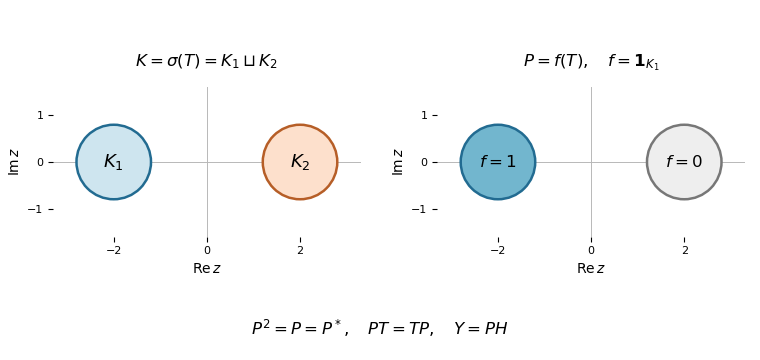
A disconnected spectrum and its continuous indicator, which produces a nontrivial reducing projection
. Details. 
The figure can be realized without any eigenvalues: take , where is planar area on the two closed disks, and let multiply by . Its adjoint multiplies by , so it is a normal operator. An eigenvector for would be supported on the area-zero singleton , hence would be zero in . Outside , multiplication by is a bounded inverse to . For , normalized indicator functions of have , excluding a bounded inverse. Thus its spectrum is exactly . The linear projection in the figure multiplies by , and its range consists of functions supported on the left disk.
Use the canonical embedding into the bidual . It is an isometry by the Hahn-Banach theorem. The weak-star topology , restricted to , is exactly the weak topology : both are determined by the same scalar evaluations . Therefore if is a weakly compact set, is compact in the Hausdorff weak-star topology of , and hence is closed for the weak-star topology. This explains the first assertion without treating the whole embedded space as weak-star closed.
For a bounded linear operator , its Banach-space adjoint isFor each , the scalar evaluation is weak-star continuous on . These are exactly the defining evaluations of the weak-star topology on , so is weak-star-to-weak-star continuous. Equivalently, if , then for every .
The Goldstine theorem states that is dense in for , where the balls are closed unit balls. The Banach-Alaoglu theorem states that for any normed vector space , the closed dual unit ball is compact for . Neither assertion claims norm compactness or, in general, sequential compactness.
For the weakly compact operator equivalences below, identify and with their canonical images only when stated. In particular, the range condition means . We shall prove , . The key identities, obtained by evaluating on , are
Weak compactness forces the second adjoint to take values in . Suppose is weakly compact in . By the first observation, is closed for the weak-star topology in . The second adjoint is weak-star-to-weak-star continuous, by the adjoint-continuity argument applied to .
Thus is closed for the weak-star topology in . The identity makes it contain . The Goldstine theorem therefore givesScaling any into the closed unit ball provesThis is the forward direction of the bidual characterization of weakly compact operators.
The bidual range condition implies both weak compactness and the stronger continuity of . First assume . The Banach-Alaoglu theorem makes weak-star compact, and is weak-star continuous. Hence its image is compact for the weak-star topology in . Because it lies in , it corresponds to a weakly compact subset under .
The identity gives . A weakly compact set in a Hausdorff space is closed for the weak topology, so is also norm-closed and contains the norm closure of . That closure is a convex set closed in the norm topology, hence weakly closed by the Mazur theorem. It is therefore a weakly closed subset of the weakly compact , and is a weakly compact set. This proves .
For , fix . By the range assumption there is with . For every ,The right side is a defining weak-star continuous evaluation on . Since the weak topology on is determined by all , every scalar coordinate of for that topology is weak-star continuous. Therefore
Weak-star-to-weak continuity of the adjoint implies its weak compactness. By the Banach-Alaoglu theorem, is compact for the weak-star topology. Under the assumed continuous map , its image is weakly compact in .
This image is closed for the weak topology, and hence for the norm topology, because the weak topology is Hausdorff and weaker than the norm topology. Thus its norm closure is the same weakly compact set. By the definition of a weakly compact operator, is weakly compact, proving .
Weak compactness of the adjoint forces weak compactness of the original operator. Assume is weakly compact. Apply the already proved to this operator, rather than assuming the adjoint equivalence in advance. It givesTake annihilating , so for every . Write for some . For every ,Hence and . It follows thatfor every annihilating .
The vector subspace is closed in the norm topology in because is complete and is an isometry. The Hahn-Banach theorem says that any point outside a closed linear subspace can be separated from it by a bounded linear functional vanishing on that subspace. Applying this in shows that an element annihilated by all such must belong to . Therefore for every , proving . The reverse implications above now establish all four equivalences, including weak compactness of an operator and its adjoint:
Finally, if is a reflexive Banach space, every is for some , and . If is a reflexive Banach space, , so the same range condition holds automatically. In either case, proves
Articles by others on the same topic
There are currently no matching articles.