Use natural units and the Minkowski metric throughout. An Abelian gauge transformation is . For a sufficiently regular , commuting the partial derivatives gives , so the Maxwell Lagrangian is invariant pointwise.
Vary the action with respect to the electromagnetic four-potential, using variations of compact support or vanishing on the boundary. The antisymmetry of the electromagnetic field tensor givesAfter integration by parts, . The principle of stationary action therefore gives the source-free Maxwell equations,In the Lorenz gauge, , this becomes with . The PDF's name “Lorentz gauge” denotes the usual Lorenz gauge, named after Lorenz. Residual gauge transformations preserve it when ; this condition is not itself a complete removal of the gauge freedom.
Write . The additional gauge fixing variation is . Integration by parts gives the Euler-Lagrange field equation , hence . This equation follows from the gauge-fixed density without imposing as a separate operator identity.
Direct differentiation of the density as printed gives the canonical momentum components conjugate to the lower-index fields:There is a boundary-term convention to reconcile with part (c). The Feynman-gauge Maxwell kinetic density after a boundary-term subtraction isIt has the same Euler-Lagrange field equations, but its canonical momentum components are . The mode expansion supplied in part (c) is the expansion of these latter momenta. Thus it is valid after the stated boundary-term subtraction; it is not the direct derivative of the original density. For example, a time-independent spatially varying with gives but .
The boundary-term shift of canonical field momenta is a canonical transformation. If spatial boundary terms vanish, , and . This explains why the two conventions have the same dynamics while their momentum formulas differ.
Use the supplied oscillator expansion, with the boundary-term convention for momentum stated in part (b). Use a real polarization vector basis, as in the supplied unconjugated polarization completeness relation. Raise its second field index to obtainThe mixed commutator contains only the annihilation-creation and creation-annihilation terms. Their signs are both positive after combining the minus sign in the momentum expansion with the negative Minkowski metric oscillator commutator. Setting and using the momentum Dirac delta distribution givesHere the last equality is the Fourier representation of the Dirac delta function. Similarly,because the integrand is odd under . The momentum-momentum commutator is proportional to the same odd difference, now weighted by , and also vanishes. Therefore the equal-time canonical commutation relations areThese are identities of operator-valued distributions, understood after smearing. The extra indices in the TeX polarization relation are transcription defects; the PDF has the ordinary two-polarization completeness contraction used above. The direct momenta of part (b) also satisfy the canonical commutation relations after their boundary-generated shift, although they do not have the unmodified mode expansion printed here.
The oscillator-generated covariant photon Fock space has an indefinite Hermitian form, not a positive Hilbert space inner product. For a normalizable one-photon wave packet of polarization , its squared norm is proportional to . Thus gives a negative-norm photon state. The divergent of an unsmeared momentum eigenstate is a separate normalization issue, avoided by the wave packet.
Choose contravariant polarization vectors , , and two with for . The third spatial polarization is longitudinal polarization; the first two are transverse polarization. The timelike photon polarization is distinct from the longitudinal one.
The Gupta-Bleuler quantization condition sets the divergence of the positive-frequency part of a quantum field to zero on physical states:Restore the factors to the annihilation terms. Since and , Fourier transform gives the equivalent conditionIts sign depends on the chosen sign of the longitudinal polarization vector; the covariant condition does not.
To see its content for a general Fock state, temporarily discretize momentum and decompose one unphysical oscillator sector as , where . The temporal oscillator obeys , while . The condition therefore becomesEquivalently, the allowed finite-particle states use the transverse creation operators and only in the unphysical sector. Indeed the constraint acts on a polynomial of the two unphysical creation operators as , whose kernel consists of polynomials in their difference. Also , and a state containing is orthogonal to every constrained state because annihilates every such state. This argument applies mode by mode and extends by smearing to continuum momentum.
For one photon, is constrained only when , producing a null state. The Gupta-Bleuler null-state quotient removes these null directions. The condition excludes negative-norm physical states; quotienting its null states leaves the two positive-norm transverse photon polarizations. The condition alone gives a positive semidefinite Hermitian form, not yet a positive definite Hilbert space.
The gamma matrices represent the spacetime Clifford algebra. With the Minkowski metric convention above,The braces denote the anticommutator. Consequently , , and distinct gamma matrices anticommute. The identity matrix is essential: the right side is a matrix equality, not a scalar equality. These signs agree with the explicit Dirac representation of the gamma matrices in the next part.
Write every displayed block identity as . Direct block multiplication in the Dirac representation of the gamma matrices givesThus their mixed anticommutator is zero. For two spatial indices,Using the Pauli matrix multiplication law givesThese exhaust all time-time, time-space and space-space cases of the Clifford algebra. No special choice of individual Pauli matrices beyond their stated anticommutator is needed.
A Dirac-to-Weyl gamma-matrix similarity transform with the required signs isIt is a unitary matrix, with . Multiplication givesThe matrix commutes with every : their common block structure uses the same antisymmetric block matrix, and the scalar blocks of commute with each Pauli matrix. Hence , exactly the spatial matrices specified in the Weyl representation of the gamma matrices. A similarity transformation preserves every Clifford algebra relation, so no new consistency check is needed for the transformed representation.
Use the Clifford algebra to write . The Lorentz generator from gamma-matrix commutators is thereforeThis also checks the diagonal case , where because . The metric term in the printed expression is understood to multiply the identity matrix. The generators are antisymmetric in their two spacetime indices.
The commutator with the scalar metric term vanishes. Reorder the third gamma matrix using the Clifford algebra twice:Subtract the last term and multiply by to obtainThis is the infinitesimal vector transformation law implemented by the Spinor representation of the Lorentz group. The first contraction is as printed in the PDF; the TeX conversion's is erroneous and would fail, for example, when : the actual commutator is zero.
Apply the commutator derivation identity and the preceding gamma matrix transformation identity. Keeping the matrix order unchanged givesThusThe order of the gamma matrices matters, since they generally do not commute. The PDF has the four ordinary metric contractions shown here; the conversion's stray powers such as are not mathematical expressions to retain.
Since , apply the commutator derivation identity to this commutator and insert part (ii):This is exactly the printed Lorentz algebra relation, including its final two signs; their alternative appearance in other formulas comes from . Therefore the matrices S form a representation of the Lorentz algebra. Their definition contains no extra factor of , so the spatial rotation generators below are represented by skew-Hermitian matrices. Adding a factor of would change the convention for the Lie algebra structure constants and cannot be done silently.
For the stated matrix exponential parametrization in the connected proper orthochronous Lorentz group, use the corresponding Spinor representation of the Lorentz group:The spacetime argument is inverse-transformed because this is an active transformation of the field at a fixed coordinate . Equivalently, with , . The identity integrates to , which ensures covariance of the Dirac equation.
Strictly, depends on a lift to the Spin group, not just on the final Lorentz transformation: two lifts differ by sign. The specified generator exponential chooses a lift along its continuous path from the identity. This qualification is essential for the full-rotation comparison in part (g).
In either the displayed Dirac representation of the gamma matrices or the displayed Weyl representation of the gamma matrices, the spatial blocks giveThe Pauli matrix commutator identity therefore yieldsThe Levi-Civita symbol is normalized by . The constant is , consistent with rotation generators represented by skew-Hermitian matrices under the chosen Lorentz algebra convention. For both sides vanish automatically.
Insert and the result for into the Spinor representation of the Lorentz group. The contraction of two Levi-Civita symbols givesThe matrix exponential of this block diagonal matrix is the stated , so . The plus sign in its exponent follows from both minus signs above; it is tied to the rotation-parameter convention in the PDF.
For a rotation through about , the Pauli matrix has eigenvalues , hence . The spacetime rotation is the identity, whileThis is the spinor sign under a full spatial rotation. A vector returns to itself already at . The comparison concerns the exponentiated Lorentz group representations: a Lie algebra by itself has no distinguished element called a rotation. The sign records the nontrivial lift of this rotation loop to the Spin group.
Use a local first-derivative Lagrangian density with sufficient differentiability, and let variations have compact support or vanish at the spacetime boundary. If the phrase “a function of the field” were read literally as forbidding derivatives, the equation below would reduce to ; a propagating field requires derivative dependence. Varying the action givesIntegration by parts and arbitrary interior variations yield the Euler-Lagrange field equation,The boundary condition is part of this derivation; if boundary variations are allowed, their separate boundary equations must also be imposed.
A variational symmetry of a Lagrangian density is an infinitesimal field change for which off shell. Equality to zero is sufficient but is not necessary: a divergence changes only the boundary contribution to the action. For fixed-coordinate field variations,Equating the two expressions proves the scalar-field form of the Noether theorem:Thus every differentiable one-parameter variational symmetry gives a conserved current, and its Noether charge is constant when the spatial boundary flux vanishes. This is the Noether current for a first-derivative scalar field; the same identity applies to several real components by summing over them. Identically conserved improvement terms can change its local expression without changing the charge under the same boundary assumptions.
For an active spacetime translation, and . If the Lagrangian density has no explicit coordinate dependence, , so . The Noether current is , whereThese four translation currents are the canonical stress-energy tensor, also called the energy-momentum tensor. The sign in follows from the chosen active translation; the translation charges themselves can be labelled by .
For the free real scalar field, take the standard kinetic term and mass term. Its Lagrangian density and Klein-Gordon equation areHere , so . Raising the charge index gives the four-momentum of a free real scalar field,The first is total energy, and the three components of the second are physical spatial momentum. With signature , ; this explains the opposite sign if the conserved quantities are instead written with lower spatial indices. For example, a plane wave proportional to has momentum density along , confirming the sign. All charges require convergence of the integrals and vanishing boundary flux, or periodic boundary conditions in a finite box.
For the complex scalar field, treat and as independent variables when varying, equivalently use their two real components. The global phase symmetry of a complex scalar field is , for constant . Both the kinetic term and are invariant. This is a global internal symmetry of a classical field theory with circle group ; a spacetime-dependent phase would require a gauge connection.
Choosing this orientation for the phase parameter gives the Noether charge of a complex scalar field:To check conservation directly, the Euler-Lagrange field equations are and their complex conjugates, assuming a real differentiable potential. Hence . Reversing the phase-parameter orientation reverses the current and charge, which is merely a convention. For a scalar carrying electric charge , the physical electric charge is after electromagnetic coupling. In a neutral theory the same global charge can instead label an internal conserved quantum number; the density alone does not identify it automatically with electricity.
For ordinary bosonic operators at distinct times, time ordering places the later operator to the left:Equivalently, multiply these two products by the corresponding Heaviside step functions. For two odd fermionic operators the second product receives a minus sign; more generally a graded interchange has sign . This sign is the fermionic sign convention for time-ordered field products, not a minus sign for arbitrary bosonic operators. No equal-time convention is needed for the two distinct times in this clause.
For , the interaction picture has andThe trial solution works for arbitrary initial states precisely whenFor , the Dyson series writesIt is also : the cube consists of ordered simplexes with the same time-ordered integrand. Differentiating the nested integrals makes the latest operator the leftmost factor, leaving the -fold integral. Thus and at every nonconstant term vanishes. This proves the differentiation of the Dyson time-ordered exponential identity without incorrectly treating the generally noncommuting Hamiltonians as scalars.
For a Hermitian Hamiltonian operator, , so the initial condition makes a unitary operator. Evolution backwards in time is its inverse, with anti-time ordering. For bounded norm-continuous the series converges in operator norm and the differentiation is justified by the factorial estimates. In quantum field theory, unbounded operators and products of fields require domain or regulator assumptions; this computation is the formal perturbative identity unless those analytic assumptions are supplied.
With the mode normalization given, the oscillator canonical commutation relations are , with the other two commutators zero. Let and . The convention compatible with the requested numerator iswithout an additional factor of outside the vacuum expectation value. Put and . The Fock vacuum is annihilated by , so only contributes to the two Wightman functions. Consequently,In the second term we changed to give the same spatial exponential.
Now perform the energy contour integralHere the residue step uses ; the massless zero-momentum point is interpreted through the smeared distribution limit, not as an isolated normalized oscillator. The Feynman i-epsilon prescription puts the positive-energy pole below the real axis and the negative-energy pole above it: and . For , close in the lower half-plane, clockwise; the residue theorem gives times the residue , hence . For , close in the upper half-plane, counterclockwise; the negative-energy residue is , again giving a positive . These are exactly the two time-ordered terms. Restoring the spatial integral proves the scalar Feynman propagator pole prescription:The prescription in this formula supplies the pole convention left unspecified in the printed display; an unprescribed ordinary real-axis integral would not be well-defined. It is a distribution limit after smearing, not an absolutely convergent four-dimensional integral. With this normalization the derivative jump of a free scalar time-ordered two-point function gives , an independent check of both the numerator and the sign.
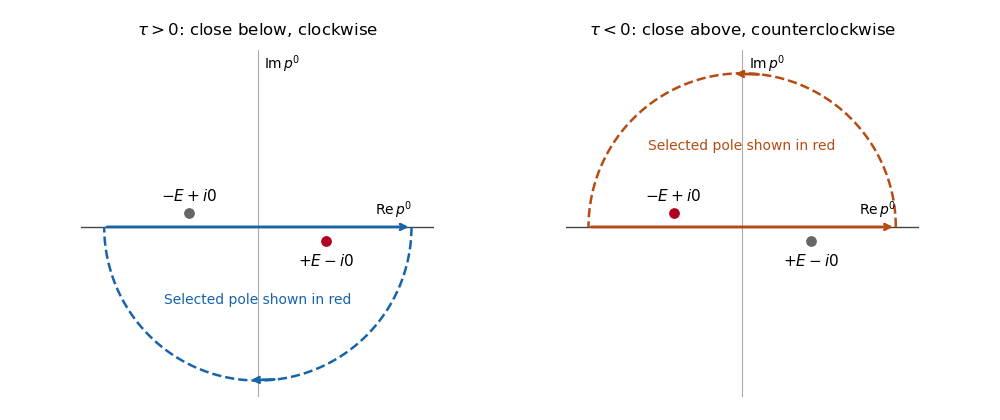
Feynman propagator integration contours and displaced poles
. Clockwise and counterclockwise contour integrals for the Feynman i-epsilon prescription. Details.
The pole displacement is exaggerated in this original schematic. The contour orientation and selected pole reproduce the time ordering of the Feynman propagator.
Articles by others on the same topic
There are currently no matching articles.