Evidence for quarks comes from several kinds of observation that test different aspects of their interpretation. The light meson and baryon spectra organize into approximate flavour multiplets with the charges and strangeness expected for and . In particular, the baryon octet and baryon decuplet encode the three light quark flavours and their spin couplings. This is an economical account of hadron quantum numbers, but spectroscopy alone would not establish that the constituents behave as localized scattering centers.
Deep inelastic scattering supplies that second test. In energetic electron–proton scattering the outgoing lepton measures the energy and momentum transferred through a virtual photon, while the broken-up target is summed over. Approximate Bjorken scaling means the structure functions depend primarily on rather than varying rapidly with the resolving momentum scale . It indicates nearly pointlike constituents. In the leading spin-half parton model,The charge-squared weights and the second relation test the constituents' fractional charges and spin-half nature. Scaling violations reflect quark and gluon radiation rather than a failure of the constituent picture.[ref]
Review of Particle Physics by Particle Data Group (2022). Structure Functions, §§18.1–18.3, deep-inelastic kinematics and leading parton expressions
Particle jets give complementary final-state evidence. A high-energy quark produces a collimated spray of hadrons because confinement prevents it from emerging as an isolated particle. Back-to-back jets fit quark–antiquark production; three-jet events show hard gluon radiation. Their angular correlations test a spin-one radiated parton. This distinguishes constituents of hadrons from a literal observation of free fractional-charge particles.
Three independent arguments identify an additional threefold colour degree of freedom. First, the spin-aligned state of a ground-state would have symmetric space, spin and flavour factors. The Pauli exclusion principle requires an antisymmetric additional factor. The three-quark colour singlet supplies it. The same construction accommodates the spin-aligned state of the without altering its measured quantum numbers.
Second, the inclusive hadronic R ratio, away from thresholds and narrow resonances, is at leading electromagnetic orderEach quark flavour has distinguishable colour final states. With , the predicted plateaux for three, four and five accessible flavours are , and ; without the factor three they would be a third as large. The measured inclusive normalization is therefore a colour-counting test, with radiative and threshold corrections included in precision comparisons.[ref]
Review of Particle Physics by Particle Data Group (2022). Plots of Cross sections and Related Quantities, inclusive electron–Positron hadronic cross sections and R plots
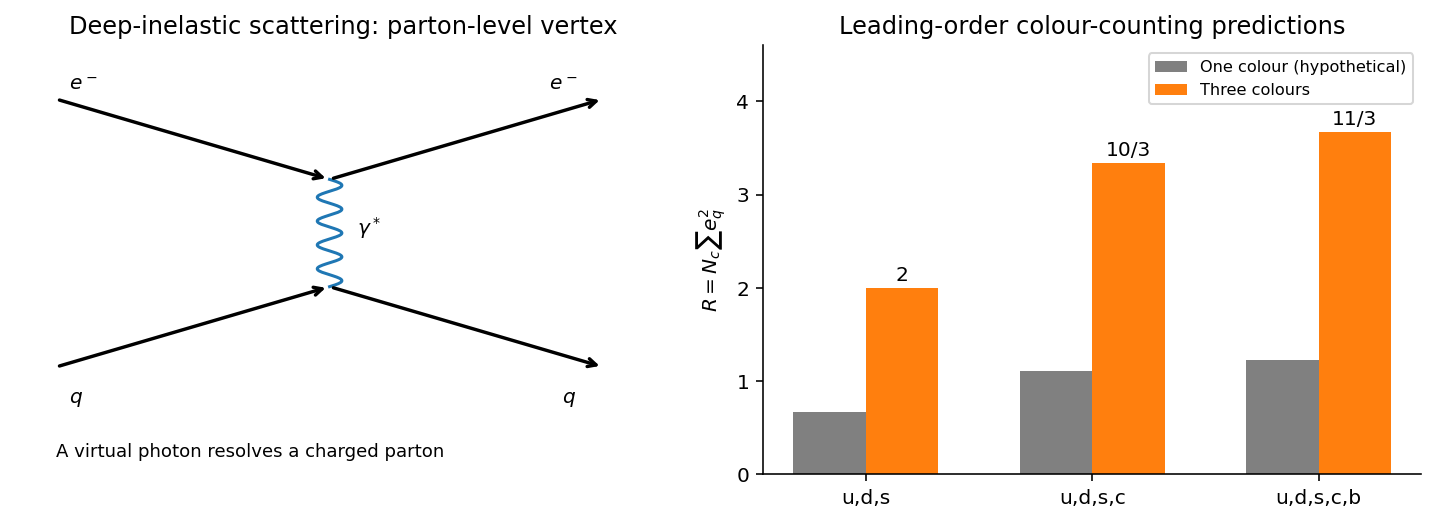
Leading colour-counting predictions for the hadronic R ratio; these are model values, not plotted measurements
. Details. 
Third, the neutral pion's two-photon amplitude contains a quark-loop colour sum, proportional to ; its rate and the other evidence are consistent with three colours. Quantum chromodynamics identifies this degree of freedom as a gauge charge, with eight gluons. Observed hadrons are colour singlets; the evidence for colour is its quantitative and symmetry consequences, not visible colours or isolated coloured quarks.
The common energetic principle behind nuclear fission and nuclear fusion is the nuclear binding energy. If the products are more tightly bound in total than the reactants, their smaller rest mass releasesThe two binding-energy expressions assume that the same numbers of protons and neutrons are counted on both sides; emitted free nucleons have zero nuclear binding. The energy appears mainly as product kinetic energy, with radiation and subsequent decays contributing according to the reaction.
The binding energy per nucleon rises rapidly through light nuclei, has a broad maximum in the iron/nickel region, and decreases more slowly for heavier nuclei. Combining suitable light nuclei can therefore increase their total binding, whereas splitting a sufficiently heavy nucleus into moderately heavy fragments can do the same. This is an energy comparison, not a rule that every fusion or fission channel is exothermic: the actual nuclear masses fix the sign of .
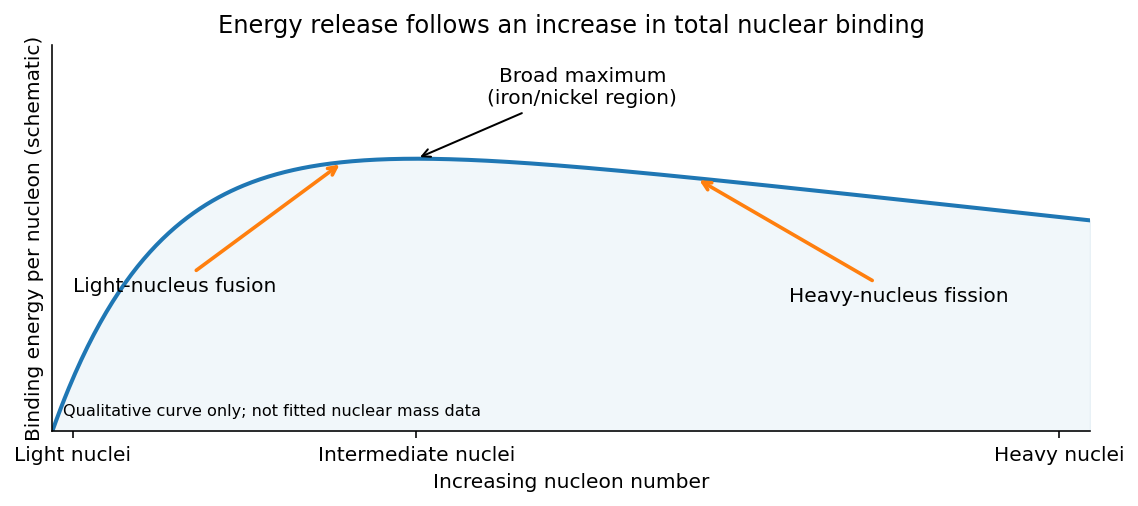
Schematic binding-energy trend explaining why light-nucleus fusion and heavy-nucleus fission can release energy
. Details. 
In nuclear fission, the liquid-drop model illustrates the competition between attractive short-range nuclear cohesion and long-range proton repulsive Coulomb interaction. Deformation increases surface area and costs surface energy, but separating the charge can reduce nuclear Coulomb energy. Their competition creates a fission barrier. An excited nucleus may pass over the barrier; spontaneous fission can occur through quantum tunnelling. The resulting fragments are often excited and neutron-rich, so they may emit prompt neutrons and photons and undergo later beta decay. The typical total energy released by a heavy-nucleus fission is of order a few hundred MeV, rather than an electronic-scale energy. Its size follows from an approximately MeV-per-nucleon binding gain summed over a heavy nucleus. A neutron from one fission can induce another; a nuclear chain reaction is the repeated physical process, distinct from the energy-release condition for one event.
In nuclear fusion, the initial charged nuclei repel one another. Exothermicity does not remove this entrance Coulomb barrier. A reaction requires sufficient overlap of their wavefunctions, achieved by energetic encounters and quantum tunnelling. For nonresonant low-energy charged-particle fusion, a useful separation isThe astrophysical S factor isolates the nuclear part from much of the rapidly varying Coulomb penetration probability. In a thermal population, the competition between the decreasing high-energy population and increasing penetration produces the Gamow peak. This explains how fusion can proceed below the classical barrier without requiring the mean thermal energy to equal its height.
Both processes conserve total energy, charge, baryon number and angular momentum. Their very different entrance barriers and mass ranges explain why a favorable value by itself does not specify a reaction rate. Short-range attraction gives approximately saturated nuclear binding, while surface, Coulomb, symmetry and pairing terms account for the broad trend and its isotope-dependent departures.
The deuteron is the bound proton–neutron system. Its ground state has and isospin , with binding energy approximately and no excited bound state. The small binding compared with characteristic nuclear energy scales produces an extended tail. With reduced mass , the asymptotic radial wavefunction decays as , whereThe decay length is not a sharp deuteron radius or the force range. It illustrates weak binding outside the region of strong attraction.
The observed total spin is consistent with aligned nucleon spins, , and a predominantly spatial state, . A central attraction identical in both spin–isospin channels would not distinguish this channel from a spin-singlet proton–neutron channel. In fact the triplet channel binds while the corresponding singlet channel does not. A realistic nuclear force must therefore distinguish these spin–isospin channels, for example through a term , whose eigenvalues are and in triplet and singlet states. The absence of a bound dineutron and diproton reinforces the need to distinguish channels; proton–proton Coulomb repulsion is an additional effect, not a complete explanation of the singlet nuclear interaction.
The clearest evidence against a purely central force is the nonzero electric quadrupole moment. A pure isotropic S-wave charge distribution would give zero. The deuteron quadrupole evidence for a tensor force instead points to a nuclear tensor force,It depends on how the spins point relative to the line joining the particles. It preserves total but couples orbital angular momenta differing by two, producingBoth terms have , and their interference permits a quadrupole moment. The 1939 theoretical analysis explicitly connected the measured quadrupole moment with such directional dependence.[ref]
The nuclear magnetic moment provides a second check. A pure aligned-spin S wave would give approximately , close to but larger than the observed deuteron value approximately . The discrepancy is consistent with non-S-wave structure and interaction-current corrections; it is not by itself a model-independent measurement of a D-state probability. The deuteron D-state admixture depends on the adopted Hamiltonian and electromagnetic current. The magnetic moments and mass differences used for these scales are tabulated physical constants.[ref]
A useful schematic interaction therefore contains central, spin-dependent and tensor terms, and possibly spin–orbit terms in other channels. Long-range one-pion exchange naturally supplies a tensor component, with its finite range set by the pion mass. The deuteron establishes an attractive triplet channel and a noncentral tensor interaction; a spin-independent central potential is insufficient.
Articles by others on the same topic
There are currently no matching articles.