For a neutral atom, count both the nucleons and the electrons. Protons, neutrons and electrons are all fermions, and exchanging two identical intact atoms produces the sign from exchanging their fermionic constituents. An odd number gives a composite fermion; an even number gives a composite boson, consistently with the Spin-statistics theorem.
A lithium atom has three protons and three electrons. Lithium-6 also has three neutrons, giving fermionic constituents; lithium-7 has four neutrons, giving . ThereforeThe composite statistics of neutral atoms cannot be inferred from the mass number alone: counting only nucleons would classify the nuclei and give the opposite answers here. The atom's total spin includes its electrons as well as its nucleus.
The infinite square well has energy levels , with . The longest absorption wavelength corresponds to the smallest available energy difference from the ground state, namely . Its position matrix element is nonzero because the two states have opposite parity about the center of the well, so it is an allowed electric dipole transition.
Equating the photon energy to this gap givesHere the photon gap is approximately , not the ground-state energy itself.
In the orthonormal eigenbasis , the spin one-half operator is . An eigenvector with eigenvalue obeys and . A nonzero vector requires . Choosing normalized quantum phases givesThese spin eigenstates are orthogonal and have unit norm because and do.
Substitution in the moment of inertia givesFor independent errors interpreted as standard uncertainties, logarithmic differentiation and propagation of uncertainty giveConsequentlyThis is a statistical precision requirement. If “accuracy” instead means hard bounds whose worst cases must be guaranteed, first-order absolute errors add: , giving to first order. For an exact symmetric hard bound about the nominal values, the upper extreme is slightly more restrictive: gives , or . The question does not distinguish a statistical uncertainty from a worst-case tolerance, so the convention matters.
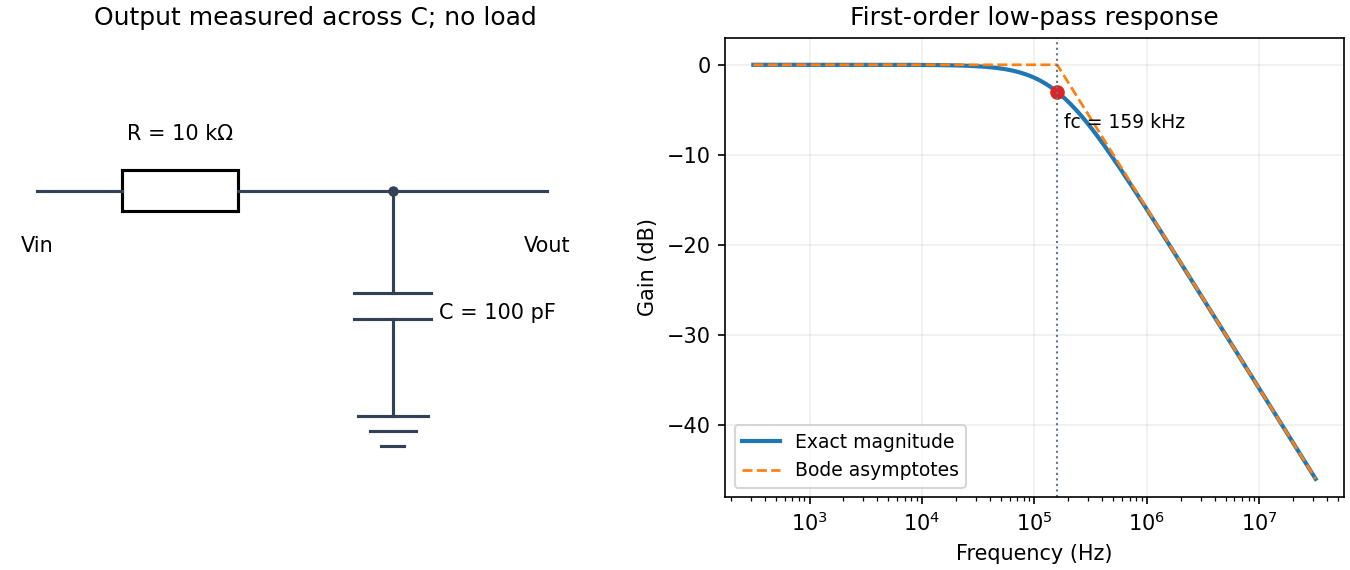
Use an unloaded RC low-pass filter: a series resistor between the source and the output node, with a capacitor from that node to ground, and measure the output across the capacitor. The components are ideal in this first-order model; “ideal” here does not mean a brick-wall frequency response.
The time constant is , henceThe capacitive electrical impedance gives the transfer function , soOn the magnitude Bode plot, . The gain approaches for , is at , and falls with slope per decade for . These results assume negligible source resistance beyond the specified and a sufficiently large load impedance.

Articles by others on the same topic
There are currently no matching articles.