The vorticity of a fluid velocity field is . A vortex line is an integral curve tangent to that vector, not generally a particle path or streamline. Since , vorticity flux through successive cross-sections of a vortex tube is equal; a regular line cannot simply end inside the fluid. By Stokes's theorem, the tube strength is the circulationFor an inviscid barotropic fluid with conservative body force, Kelvin's circulation theorem conserves circulation around a material circuit. Under those assumptions vortex tubes move with the fluid. In three-dimensional incompressible ideal flow,stretching a material tube raises its vorticity as its cross-section shrinks. In two-dimensional incompressible flow there is no such stretching, so scalar vorticity is materially conserved. Constant viscosity adds a diffusion term ; baroclinicity and boundaries can also generate vorticity.
An ideal line vortex has and zero ordinary vorticity for , with its circulation concentrated in the singular core. Circular trajectories therefore do not imply nonzero local vorticity everywhere. A finite physical core removes the velocity singularity.
A freely rotating rigid body with no external torque conserves its inertial angular momentum and kinetic energy. In body-fixed principal axes, the Euler equations includeand cyclic permutations. The body can still change its orientation relative to its fixed angular-momentum vector; zero torque does not require every principal axis to remain fixed.
For a symmetric top, , . The axial rate is constant, and rotates in body coordinates with signed frequency . In space,Thus the symmetry axis precesses about fixed at rate and constant inclination. This body-frame and space-frame frequencies of free symmetric-top precession distinction avoids confusing two different frame-dependent rates. A sphere has no dynamically distinguished symmetry axis even though a chosen body marker rotates.
For a general body, rotations about the largest and smallest principal inertias are stable to small perturbations, while rotation about the intermediate inertia is unstable. With and rotation , linearization gives , showing exponential growth. This is torque-free motion, distinct from the gravity-driven precession of a supported gyroscope.
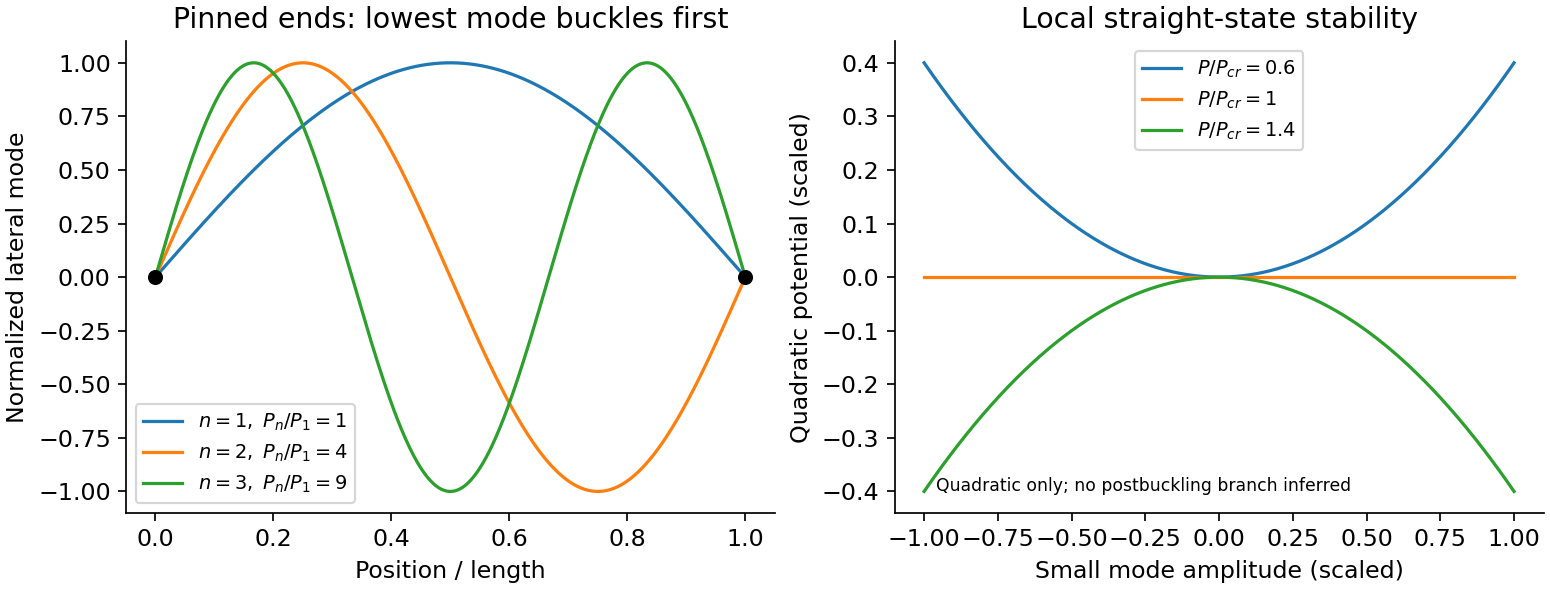
An Euler strut is a slender initially straight elastic column under axial compression. For a uniform bending stiffness and a small transverse displacement , the second-order potential energy under a conservative compressive load isThe bending term is positive; shortening releases load potential. Stationarity yields . Pinned ends impose and zero end bending moments, . Substitution of givesThe straight configuration loses stability first in the longest admissible bending mode. The second moment of area is geometric, not a mass moment of inertia. Boundary conditions matter: a fixed-free column has effective length , while fixed-fixed ends have effective length , changing the threshold by factors and . Slenderness, elastic material response, alignment and the weak bending direction must be checked. Imperfections produce bending before the ideal threshold, and a short column can yield or crush first. Linear buckling theory does not predict an unlimited deflection or a complete postbuckling curve.

The Reynolds number is , comparing inertial stress with viscous stress . Nondimensionalizing an incompressible Newtonian flow with velocity , length and pressure givesAt small Reynolds number inertia is negligible and a creeping-flow balance applies. At large Reynolds number the outer flow may be approximately inviscid, but thin no-slip boundary layers can still govern drag, separation and dissipation. A high Reynolds number permits turbulent motion without guaranteeing it; transition depends on geometry, disturbances and roughness.
Dynamically similar model experiments need matching geometry and relevant dimensionless parameters, including Reynolds number. If gravity, compressibility or surface tension matters, Froude, Mach or capillary-related parameters must also be matched. Testing linear pressure-flow or force-speed relations while varying , , viscosity and temperature is more informative than assigning one universal transition value to all apparatus.
Articles by others on the same topic
There are currently no matching articles.