Write the plate area as and separation as , so the original capacitance is . Neglect edge fields. The greatest capacitance occurs when each material occupies half the plate area and spans the full separation. These two regions are capacitors in parallel, sharing the same electric potential difference:The least capacitance occurs when a dielectric layer of thickness covers the whole area, leaving a vacuum layer of the same thickness. The two layers are capacitors in series: the normal electric displacement field is continuous and the voltage drops add. Their individual capacitances are and , givingThe arithmetic-harmonic bounds for dielectric capacitance show that these are genuine extrema over other arrangements of the same two volumes, within the ideal parallel-plate model. A uniform trial electric field in the fixed-voltage energy principle bounds above by the arithmetic mean of the two permittivities; a uniform trial electric displacement field in the fixed-charge principle bounds it below by their harmonic mean. The two layer arrangements attain those bounds. Both reduce to when .
In steady rigid rotation of the liquid about its vertical axis, centrifugal acceleration is outward. Hydrostatic pressure balance in the rotating frame givesThe free surface is at constant atmospheric pressure, so its slope obeysCompare this parabolic free surface of a rigidly rotating liquid with . For focal length ,Either sense of rotation gives the same shape. The result assumes the liquid has reached rigid rotation before solidifying and that surface-tension and solidification distortions can be neglected.
Use , to recognize the planar quadrupole potential, . Its electric field is minus the gradient:or, in cylindrical coordinates,For , arrows point toward the origin along the axis and away from it along the axis. The off-axis electric field lines satisfyThe axes themselves are the separating field lines; the origin is a field null. Reversing reverses every arrow. The field is independent of , and has units .
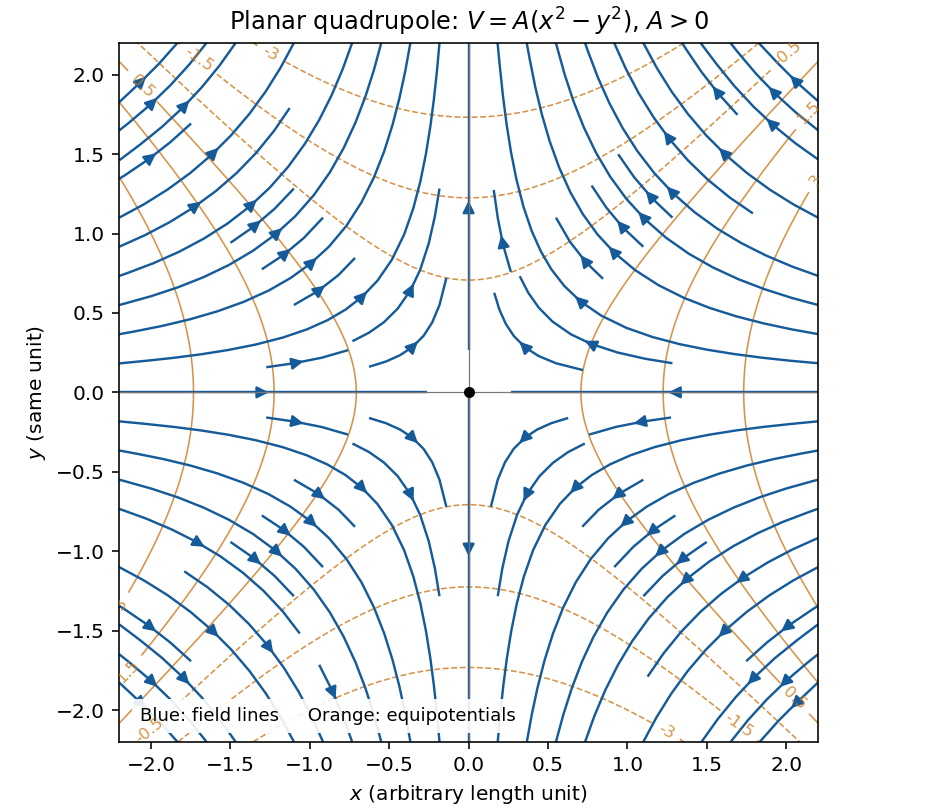
Original calculated electric-field lines and equipotentials for the planar quadrupole with positive A; arrows approach along x and leave along y
. Details. 
First estimate the excess pressure as weight divided by contact area:For the equilibrium estimate, use the Clapeyron equation for melting. The specific volume change on melting is , and the latent heat of fusion gives . Thus the common-pressure melting-point slope isTake and the usual rounded water density , in addition to the supplied and . ThensoThe sign is negative because ice contracts on melting. This is a linear equilibrium estimate treating the load as a common local pressure on coexisting ice and water. The actual contact stress is nonuniform, and frictional heating, deformation and drainage also affect skating; the estimate is not a complete account of the lubricating water film.
Cold air is denser than room air at approximately the same pressure. The ideal gas law gives a fractional mass density contrast of order . The initial outflow is therefore a gravity current driven by reduced gravityFor an illustrative refrigerator height , room temperature and temperature difference , this gives . Balancing the released potential energy with kinetic energy gives . The buoyancy exchange time of a cold-air enclosure is consequentlyUsing constant acceleration over height gives , consistent at this level. Warm air enters as cold air leaves, so unrestricted vacuum free fall is not the right acceleration model. No dimensions or temperatures are specified in the source, so an order-of-magnitude estimate with explicit representative values is the appropriate result; shelves and mixing can delay complete replacement.
Articles by others on the same topic
There are currently no matching articles.