The force law separates into two identical harmonic oscillator equations:For positive , the general real solution isSince by Euler's formula, these are exactly the stated real parts of complex exponentials. The amplitudes and phases are fixed by the four initial position and velocity components. This is two-dimensional isotropic harmonic oscillator flow: the same angular frequency acts in every direction.
Put . If both coordinate amplitudes are nonzero, eliminate the common phase to obtainFor , this is an ellipse centred at the origin. The following special cases exhaust the possible nontrivial shapes:
- or gives straight-line simple harmonic motion, including an axis-aligned line if one coordinate amplitude vanishes.
- gives an axis-aligned ellipse; if additionally , it is a circle traversed in one of the two orientations.
- Other phase differences give tilted ellipses.
The degenerate zero-amplitude solution is the stationary origin. There are no general multi-loop patterns here because the two angular frequencies are equal. Another useful description is , the image of a circle under a linear map.
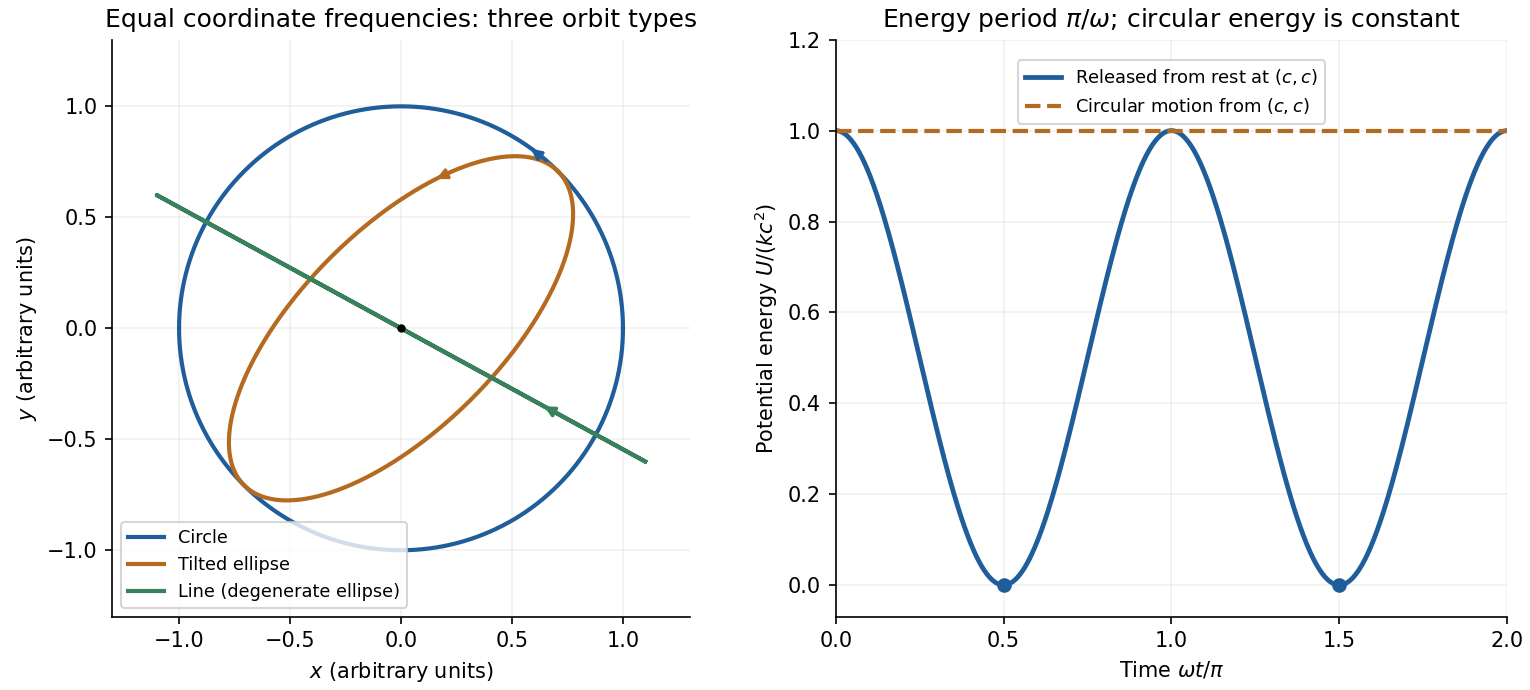
Undamped planar harmonic oscillator trajectories and potential energy for the two specified initial conditions
. Details. 
The force is conservative, with and potential energy zero at the origin:Released from rest at , the trajectory has , givingThe right panel of the figure shows this nonnegative oscillation: it starts at a maximum , reaches zero at , and repeats after . Its frequency is twice the coordinate frequency. Conservation of mechanical energy gives , so the missing potential energy is kinetic energy, not an energy loss.
The starting radius is . In uniform circular motion, the required centripetal acceleration has magnitude . The initial velocity must be tangent to the starting radius, with the orientation chosen anticlockwise:The resulting trajectory isIt has constant , soThis is the horizontal line in the right panel of the figure. The kinetic energy also equals , giving total mechanical energy , twice that for release from rest at the same point.
Write and , where is the undamped angular frequency. The linear drag gives the vector damped harmonic oscillator equationFor the original circular initial conditions, and , the exact underdamped solution isUsing , and givesThis exact potential energy is useful because it satisfies the prescribed initial conditions, including . In the stated weak-damping limit , and the square bracket differs from one by a small oscillatory term. The leading approximation is thereforeThe radius is approximately , so the trajectory is approximately a shrinking logarithmic spiral. The exactly exponential result would require slightly adjusted initial velocity; with the specified undamped circular velocity, the small modulation above is real. This is the initially circular damped planar oscillator.
The parameters giveThe coordinate expressions for the initially circular damped planar oscillator areThe damped oscillation period gives almost four anticlockwise turns in four seconds. The radius envelope falls by . Substitution into the exact coordinates givesThe left panel annotates the initial tangent, time marks and endpoint. Because is an unspecified starting coordinate, the axes are normalized by rather than assigned numerical lengths.
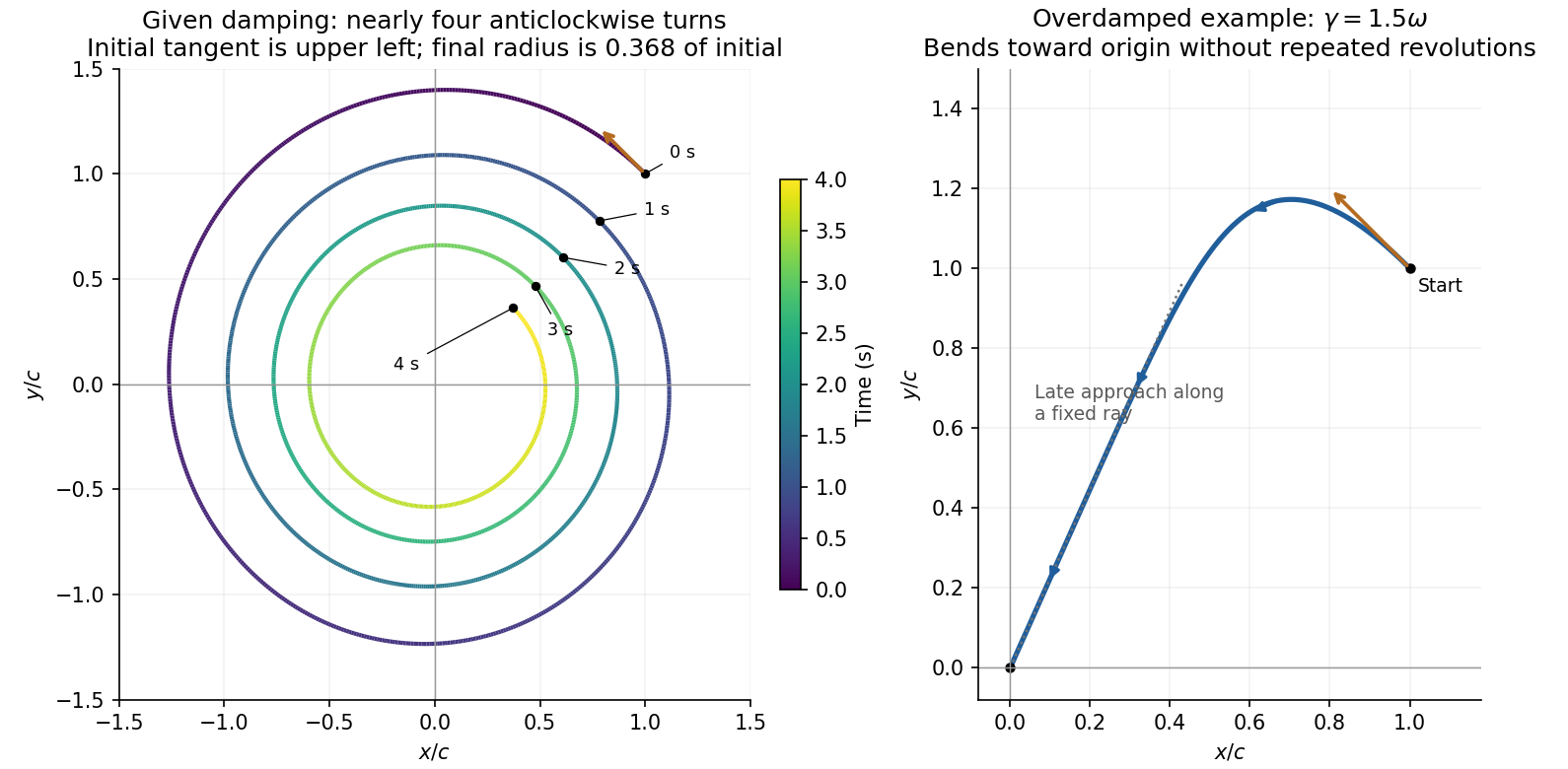
Exact underdamped trajectory over four seconds and a representative overdamped trajectory for the same initial circular velocity
. Details. 
For overdamping, . Put . Both characteristic roots are negative real numbers. Replacing trigonometric functions by hyperbolic functions gives the exact trajectoryIt starts from with tangent , bends anticlockwise toward the origin, and approaches it without repeated revolutions. The right panel gives a representative choice ; the paper does not specify one particular value of in this regime.
One can make the qualitative shape precise. In radial and tangential directions relative to the initial radius, the angle turned from the starting direction obeysFor , both coordinates stay positive, and the approach is along the fixed ray with . The initial velocity is tangential, so an immediately straight radial return would be incorrect. The absence of oscillatory characteristic roots prevents repeated revolutions. This is a non-spiralling overdamped central oscillator trajectory.
Articles by others on the same topic
There are currently no matching articles.