The probability density is proportional to , not to the complex amplitude itself. For equal small intervals approached from inside the support,
Wavefunction normalization cancels in the ratio of integrals:A normalized version of the specified wavefunction is on its support.
For an elastic eccentric impact of a thin disc, take upward velocity as positive and let be the short upward impulse. The disc's moment of inertia about a horizontal diameter is . With impact offset ,The contact point has upward velocity . Unit restitution against the fixed post requires that velocity to be , soSince , and the centre's instantaneous speed is zero. The disc rotates with ; its rotational kinetic energy equals the entire initial energy. Gravity's impulse during the impact is neglected. Using the polar-axis moment of inertia would describe the wrong rotation axis.
Treat the repeated angles as independent measurements of one fixed angle. Their sample mean, sample standard deviation and standard error of the mean areFor , uncorrelated standard uncertainties giveInterpreting the stated 1% amplitude accuracy as a standard uncertainty,Use radians in the derivative. This is uncertainty in the result using the mean angle, not the spread of individual angle measurements; the latter convention would use and give about . An accuracy bound or systematic angular calibration error would require a different uncertainty model.
The photon wavelength is . The exact half-period zone radii for incident plane waves are chosen so that the path to the axial focus increases by per zone:Transmit alternate zones and block the others, with . For , . The number of zones is a design choice: 100 zones give outer radius and outermost width about . Adjacent open zones then arrive in phase at the principal focus.
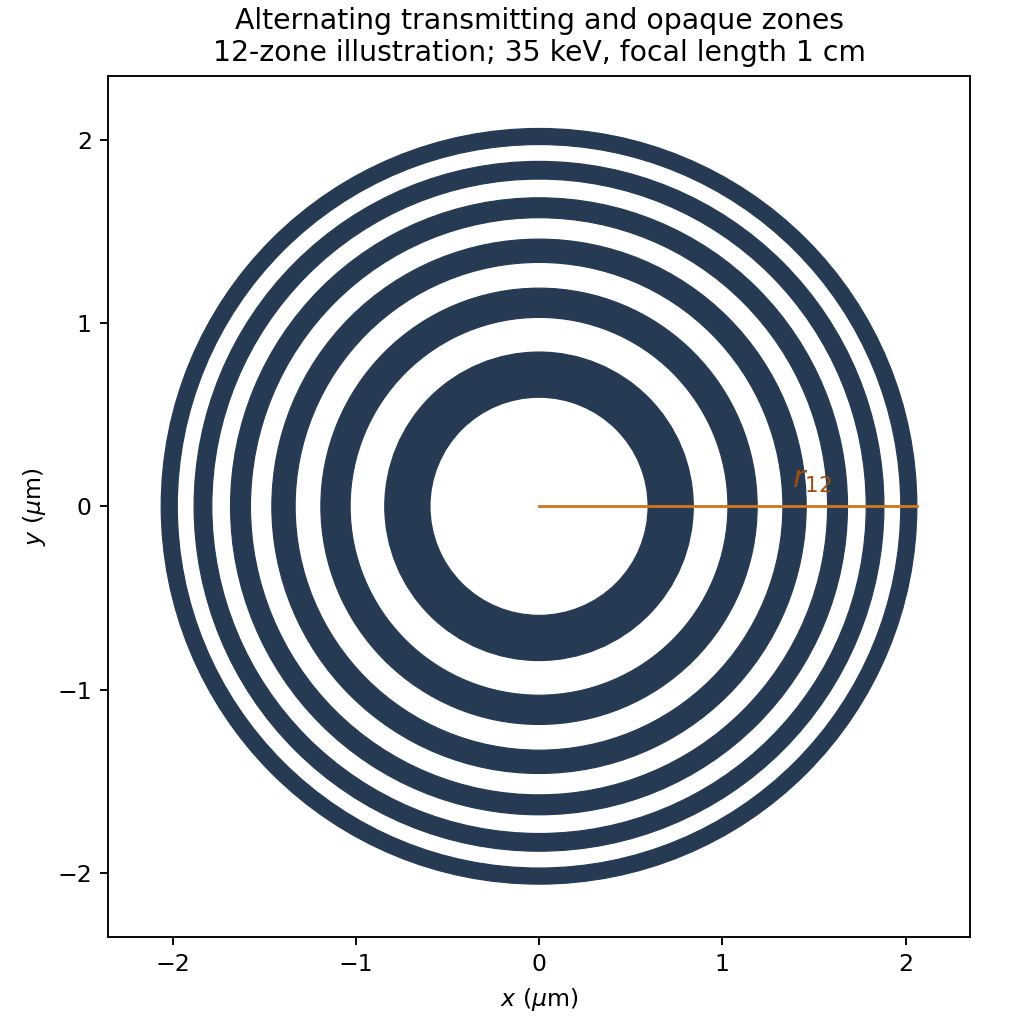

The blocking material must be sufficiently opaque at 35 keV; no attenuation coefficient or fabrication thickness is specified. A binary amplitude plate also has zero-order transmission and other odd-order foci, so an aperture/order stop may be needed. The principal focal length is chromatic, varying as for fixed radii.
The geostationary gravitational clock gain uses only the potential contribution, as requested. In the weak field, and . The geostationary radius follows from . Taking with , and sidereal day gives .The satellite clock gains time because it is at higher gravitational potential. This is not the combined gravitational-plus-kinematic correction; the orbital and surface rotational velocities are deliberately outside the requested potential contribution.
For a reversible refrigerator, zero net entropy production gives . ThusThe necessary work is . Irreversibility increases the heat dumped to the surroundings; is the minimum work, not the requested rejected heat.
For the usual nonrelativistic dispersion, the three-dimensional density of states is . Filling all states through the Fermi energy givesDegeneracy factors cancel. More generally gives ; an ultrarelativistic gas would give . The nonrelativistic result is the standard massive ideal-gas interpretation.
Prefer molecular rotational spectroscopy or rovibrational spectroscopy, because nuclear masses enter their reduced mass directly. For an isotopologue with nuclear reduced mass ,Isotope substitution therefore produces appreciable shifts and distinct sets of lines, assuming the same electronic potential and approximately unchanged bond length and force constant. A suitable heteronuclear molecule can provide electric-dipole rotational/vibrational spectra; other molecules may require Raman spectroscopy.
Atomic electronic energies instead depend on the electron-nucleus reduced mass , whose fractional change is suppressed by . High-resolution atomic spectroscopy can still detect isotope shifts, including nuclear-size and many-electron mass effects; it is not intrinsically incapable of identifying isotopes. Molecular spectra generally offer the stronger mass sensitivity for this purpose.
The vacuum wave equation gives . The cutoff frequency is . In a lossless empty guide, energy travels at group velocity,The larger phase velocity is not the speed of energy transport.
For a cylinder of radius in unbounded two-dimensional incompressible potential flow, a velocity potential is . It givesOn the surface . The points nearest the banks are the sides perpendicular to the stream, , hence the speed is at each. This is the inviscid outer-flow speed; a real no-slip boundary layer has zero velocity at the material surface. The small-radius/wide-river assumption neglects bank effects.
Articles by others on the same topic
There are currently no matching articles.