A junction field-effect transistor has a conducting channel between source and drain, with gate regions forming reverse-biased p-n junctions to that channel. In an n-channel device, a more negative gate-source electric potential difference increases the reverse bias and widens the depletion region. The conducting cross-section shrinks, reducing the drain electric current. The gate ideally draws only a small leakage electric current, giving a high input resistance; the source-drain supply provides the controlled output power. Carrier motion in a p-channel device reverses the relevant polarities.
At small positive , the channel conducts approximately as a resistor. As the potential rises from source to drain, the local gate-channel reverse bias increases toward the drain. The depletion layers are therefore thicker there. For a symmetric n channel of half-thickness , uniformly doped at density , the one-sided depletion approximation giveswhere is the depletion width from each side and the built-in junction potential. The neutral channel closes locally when . Define the positive geometrical depletion electric potential difference . The approximate drain-end pinch-off condition isMore negative gate bias makes this saturation occur at a smaller drain electric potential difference.
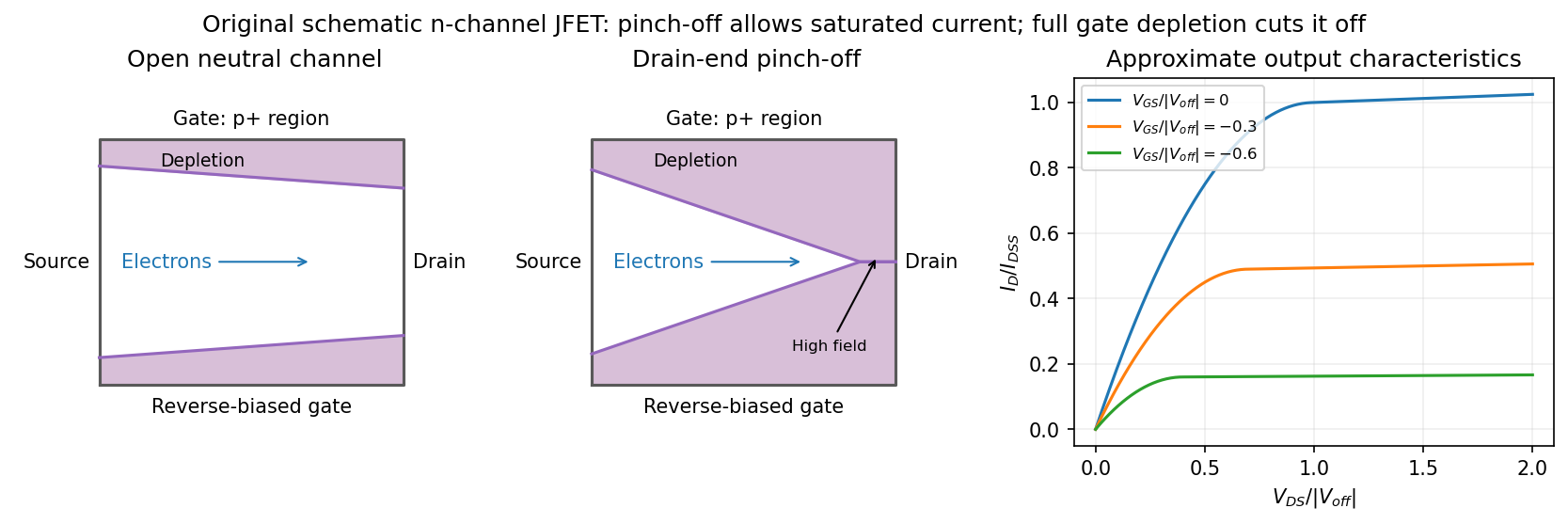
Gate depletion, drain-end pinch-off and approximate current saturation in an n-channel JFET
. Details. 
Pinch-off in a junction field-effect transistor does not mean that the drain electric current vanishes. Electrons arriving through the remaining neutral channel are swept across the high-field depleted region into the drain. Further increases in mostly fall across that region, so the electric current changes only weakly: this is the saturation regime used for amplification. Channel shortening gives a finite output slope in real devices. Excessive reverse electric potential difference eventually causes breakdown, beyond the normal saturation model.
A sufficiently negative gate electric potential difference can instead deplete the entire channel from the source end and produce cutoff. In the simplified geometry its threshold is . A commonly used approximate transfer law in saturation isHere is the saturated drain electric current at zero gate-source bias. The square law is a useful device approximation, not an exact result for arbitrary channel profiles. It connects field control of depletion to a measurable transfer characteristic while keeping drain-end pinch-off distinct from complete gate cutoff.
Direct exchange is a quantum-mechanical spin-dependent energy arising from the Coulomb interaction and the required antisymmetry of a two-electron state. It requires spatial overlap of the relevant orbitals. It is not the classical magnetic dipole force between two small magnets, and it can be much stronger than that force.
For an explicit fixed-orbital illustration, take orthonormal spatial orbitals . Orthonormality means ; it does not require their spatial densities to occupy disjoint regions. The normalized spatial states areThe symmetric spatial state combines with the antisymmetric spin-one-half singlet state, and the antisymmetric spatial state combines with a symmetric spin-one-half triplet state, so that the complete fermionic state is antisymmetric.
For Coulomb potential , distinguish the direct electrostatic integral and exchange integral:The Coulomb exchange splitting of two orbitals givesThe repulsive Coulomb potential makes in this model. Thus the triplet is favored when the orbitals have nonzero exchange overlap. Its antisymmetric spatial wavefunction suppresses close Electron encounters and reduces their repulsion. Since the Coulomb interaction contains no explicit spin operator, the spin dependence enters through the allowed spatial symmetry.
For dimensionless spin operators , whose pair eigenvalues are in the triplet and in the singlet, the same splitting is represented byThis explicitly states the sign convention: positive here favors parallel spins. A convention would instead have .
In a crystal, direct exchange therefore depends sensitively on orbital extent, overlap and interatomic spacing. It often decreases rapidly as localized orbitals separate. The fixed-orbital example does not prove that every material must be ferromagnetic: orbital rearrangement and competing kinetic or virtual-hopping processes alter the singlet-triplet balance. In particular, antiferromagnetic superexchange through an intermediate ligand is a different mechanism and should not be confused with direct overlap exchange.
A magnetic field quantizes a charged carrier's cyclotron motion into Landau levels. For an isotropic parabolic band, neglecting spin splitting,The degeneracy of each orbital level per unit perpendicular area is per spin. Increasing the field changes both the level spacing and the number of states in each level. Successive levels cross the Fermi energy, producing an oscillatory density of states and hence quantum oscillations in thermodynamic and transport quantities.
For a general closed semiclassical orbit, Onsager quantization relates its wavevector-space area to field:Setting this area to an extremal Fermi-surface cross-section gives successive inverse-field crossings separated byA typical oscillatory contribution is proportional to . The oscillations are periodic in , not in . In three dimensions, extremal cross-sections dominate because contributions from other longitudinal momenta cancel by phase averaging. Rotating the field therefore maps the shape of the Fermi surface.
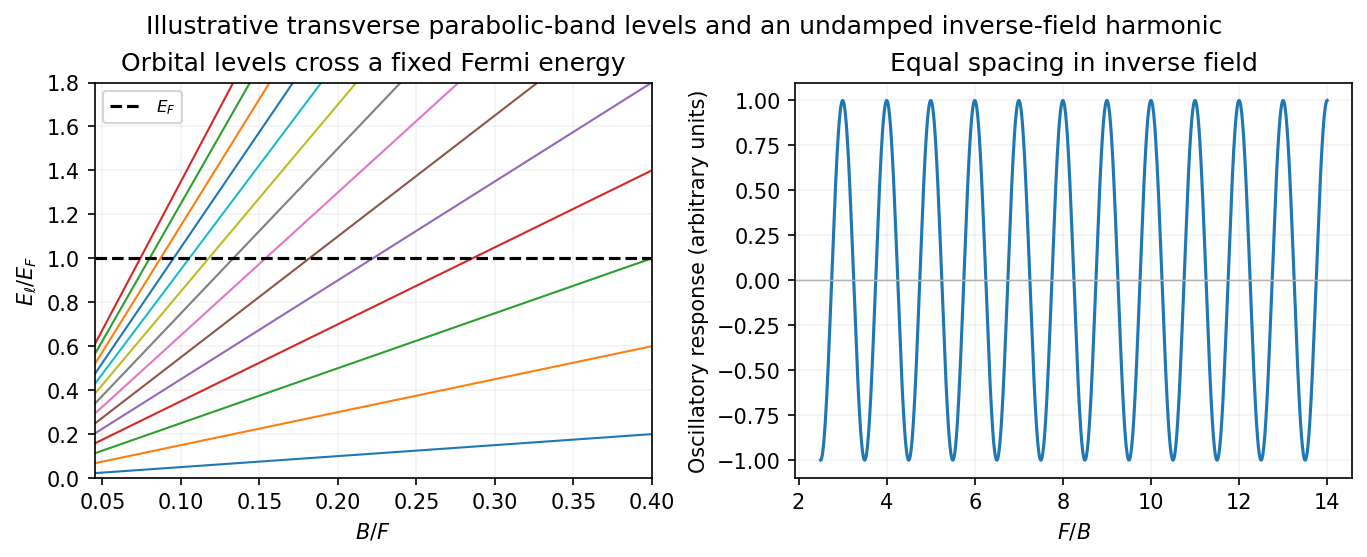
Quantized orbital crossings and their periodicity in inverse magnetic field
. Details. 
Oscillations in magnetization are the de Haas-van Alphen effect; oscillations in longitudinal electrical resistivity are the Shubnikov-de Haas effect. They are most readily observed in clean samples at low temperature. The thermal damping factor isand a common first-harmonic disorder factor is . Thus the Landau spacing must be sufficiently large compared with thermal broadening and disorder broadening, approximately and , with the displayed factors giving the quantitative suppression.
The temperature dependence measures the cyclotron effective mass, and the field-dependent damping probes the quantum lifetime . That lifetime need not equal the momentum relaxation time controlling electrical conductivity: small-angle scattering can broaden Landau levels while relaxing electric current inefficiently. Spin splitting can generate further modulation or resolved spin structure. Oscillations are not the same as the ordinary smooth magnetoresistance or cyclotron resonance; they probe quantized orbital state counting near the Fermi energy.
Articles by others on the same topic
There are currently no matching articles.