A high-numerical aperture objective focuses a laser to a steep intensity gradient. For a transparent particle with higher refractive index than its surroundings, refraction transfers photon momentum to the particle, giving a optical gradient force towards the intensity maximum. A forward scattering force pushes along the beam; a stable single-beam optical trap requires the restoring axial optical gradient force to exceed that push. In the small-particle limit, the same result follows from the induced-dipole potential energy, proportional to minus the local squared electric field. Close to the trap centre,An optical tweezers experiment can attach a bead to one end of a DNA molecule, hold the other end fixed, and obtain its force-extension relation from the bead displacement and calibrated trap stiffness. The measurement must distinguish the restoring force from Brownian motion and account for heating or optical damage.
Fx≃−kx,U(x)≃21kx2.
Take an overdamped particle with viscous drag coefficient γ, so its deterministic drift in the harmonic potential U=kx2/2 is x˙=−kx/γ. The one-dimensional Fokker-Planck equation has probability currentAt thermal equilibrium, J=0 and the Boltzmann distribution is p(x)=Z−1e−kx2/(2kBT), with p′/p=−kx/(kBT). Inserting this into the zero-current condition givesThe result is the Einstein diffusion relation between diffusion and mobility. It assumes a bath at one temperature, linear drag and thermal equilibrium. The same Gaussian probability density gives ⟨x2⟩=kBT/k, providing an independent calibration of trap stiffness.
J=−γkxp−Ddxdp.
0=kxp(−γ1+kBTD),D=γkBT.
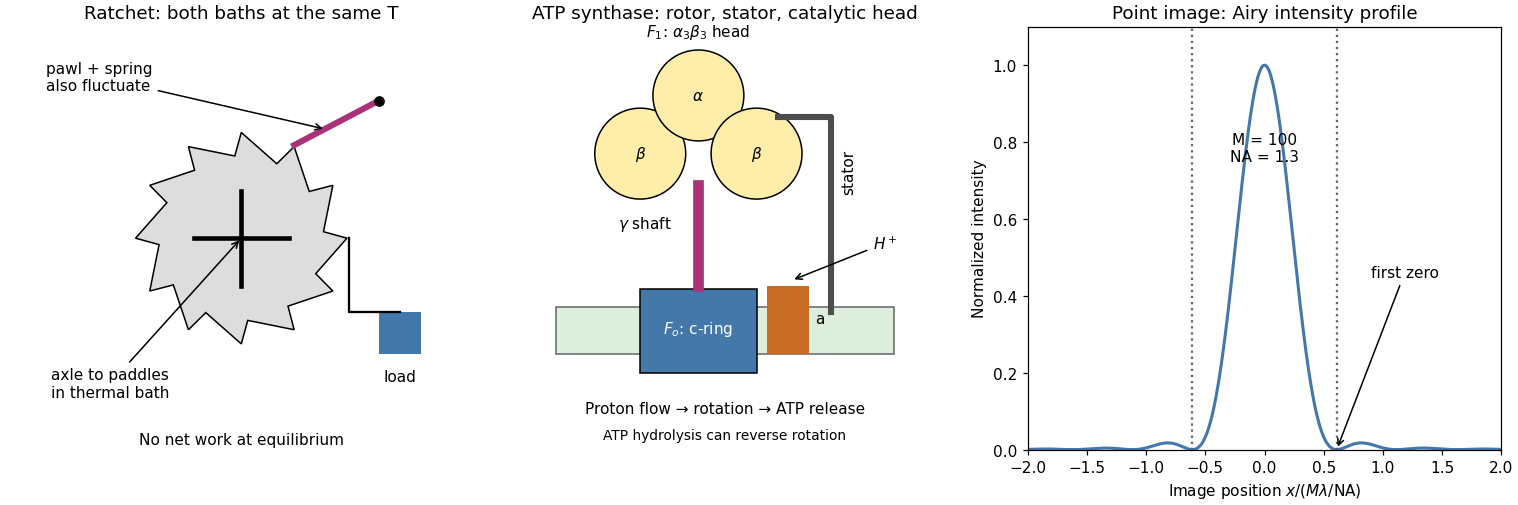
The left panel below shows paddles in a bath connected by an axle to an asymmetric toothed wheel, a spring-loaded pawl and a load. A naive argument lets random paddle kicks turn the wheel in one direction while the pawl blocks reverse motion, apparently extracting work from a single bath. The missing ingredient is the pawl's own thermal fluctuations. At the same temperature, it sometimes lifts and allows reverse slips. Correct forward and reverse transition rates obey detailed balance, so no sustained directed rotation can do work at single-bath thermal equilibrium. The device illustrates, rather than disproves, the Second law of thermodynamics.
A macroscopic shaken ratchet is driven far from thermal equilibrium: imposed shaking supplies organized mechanical energy, and friction or inelastic collisions dissipate it. Its kilogram-scale parts are not moved appreciably by molecular thermal fluctuations. Rectification requires broken spatial symmetry from the teeth or pawl and appropriate dynamical coupling: the shaking must sometimes disengage or drive the pawl over a tooth while contact and dissipation prevent equal reverse motion. The load must remain below the available mean driving torque. Isotropic, aperiodic shaking can satisfy these conditions because the asymmetric mechanism breaks directional symmetry; without the external energy supply, a working rectifier and dissipation, there is no guaranteed directed motion.

Ancestors (10)
- S12
- 2019
- Past exam of the short options paper shared by Parts A and B of the physics course of the University of Oxford
- Short options paper shared by Parts A and B of the physics course of the University of Oxford
- Physics course of the University of Oxford
- Undergraduate course of the University of Oxford
- Course of the University of Oxford
- University of Oxford
- List of universities
- Home
Discussion (0)
New discussionThere are no discussions about this article yet.
Articles by others on the same topic (0)
There are currently no matching articles.