The central dogma of molecular biology concerns sequence information: DNA can be copied by DNA replication; transcription makes RNA from DNA; and translation makes a protein from messenger RNA. The familiar DNA→RNA→protein diagram is not an assertion that all information transfer is one-way: reverse transcription and RNA replication are compatible with the dogma. Its key exclusion is transfer of a protein's amino-acid sequence back into nucleic-acid sequence by a general templating mechanism.
DNA is a polymer of deoxyribonucleotides with a sugar–phosphate backbone joined by phosphodiester bonds. Its usual DNA double helix contains antiparallel strands with complementary bases, adenine paired with thymine and guanine with cytosine. The base sequence stores inherited information; complementary pairing supports accurate copying and repair. A strand has distinct 5′ and 3′ ends, and ordinary chain synthesis extends the 3′ end. Packaging into chromosomes compacts and regulates access to the genetic material.
RNA uses ribose, with a 2′ hydroxyl group, and uracil in place of thymine. It is usually single-stranded but forms extensive paired secondary and tertiary structures. Messenger RNA conveys coding information, transfer RNA couples codons to amino acids, and ribosomal RNA provides both structural organization and catalysis within the ribosome. Other RNA molecules regulate expression or catalyse reactions. Thus RNA is not merely a passive intermediate.
Proteins are polypeptides of amino acids linked by peptide bonds, read from an amino terminus to a carboxyl terminus. Their primary sequence guides protein folding; backbone hydrogen bonds organize helices and sheets, while hydrophobic, electrostatic and other interactions produce tertiary and sometimes quaternary protein structure. Their functions include catalysis, transport, signalling, mechanical support and molecular movement. Sequence alone does not guarantee function: folding, modifications, partners and cellular conditions matter. During translation, a ribosome reads successive triplet codons in messenger RNA, with charged transfer RNA molecules supplying the corresponding amino acids; initiation and termination define the reading frame.
A high-numerical aperture objective focuses a laser to a steep intensity gradient. For a transparent particle with higher refractive index than its surroundings, refraction transfers photon momentum to the particle, giving a optical gradient force towards the intensity maximum. A forward scattering force pushes along the beam; a stable single-beam optical trap requires the restoring axial optical gradient force to exceed that push. In the small-particle limit, the same result follows from the induced-dipole potential energy, proportional to minus the local squared electric field. Close to the trap centre,An optical tweezers experiment can attach a bead to one end of a DNA molecule, hold the other end fixed, and obtain its force-extension relation from the bead displacement and calibrated trap stiffness. The measurement must distinguish the restoring force from Brownian motion and account for heating or optical damage.
Fx≃−kx,U(x)≃21kx2.
Take an overdamped particle with viscous drag coefficient γ, so its deterministic drift in the harmonic potential U=kx2/2 is x˙=−kx/γ. The one-dimensional Fokker-Planck equation has probability currentAt thermal equilibrium, J=0 and the Boltzmann distribution is p(x)=Z−1e−kx2/(2kBT), with p′/p=−kx/(kBT). Inserting this into the zero-current condition givesThe result is the Einstein diffusion relation between diffusion and mobility. It assumes a bath at one temperature, linear drag and thermal equilibrium. The same Gaussian probability density gives ⟨x2⟩=kBT/k, providing an independent calibration of trap stiffness.
J=−γkxp−Ddxdp.
0=kxp(−γ1+kBTD),D=γkBT.
The left panel below shows paddles in a bath connected by an axle to an asymmetric toothed wheel, a spring-loaded pawl and a load. A naive argument lets random paddle kicks turn the wheel in one direction while the pawl blocks reverse motion, apparently extracting work from a single bath. The missing ingredient is the pawl's own thermal fluctuations. At the same temperature, it sometimes lifts and allows reverse slips. Correct forward and reverse transition rates obey detailed balance, so no sustained directed rotation can do work at single-bath thermal equilibrium. The device illustrates, rather than disproves, the Second law of thermodynamics.
A macroscopic shaken ratchet is driven far from thermal equilibrium: imposed shaking supplies organized mechanical energy, and friction or inelastic collisions dissipate it. Its kilogram-scale parts are not moved appreciably by molecular thermal fluctuations. Rectification requires broken spatial symmetry from the teeth or pawl and appropriate dynamical coupling: the shaking must sometimes disengage or drive the pawl over a tooth while contact and dissipation prevent equal reverse motion. The load must remain below the available mean driving torque. Isotropic, aperiodic shaking can satisfy these conditions because the asymmetric mechanism breaks directional symmetry; without the external energy supply, a working rectifier and dissipation, there is no guaranteed directed motion.
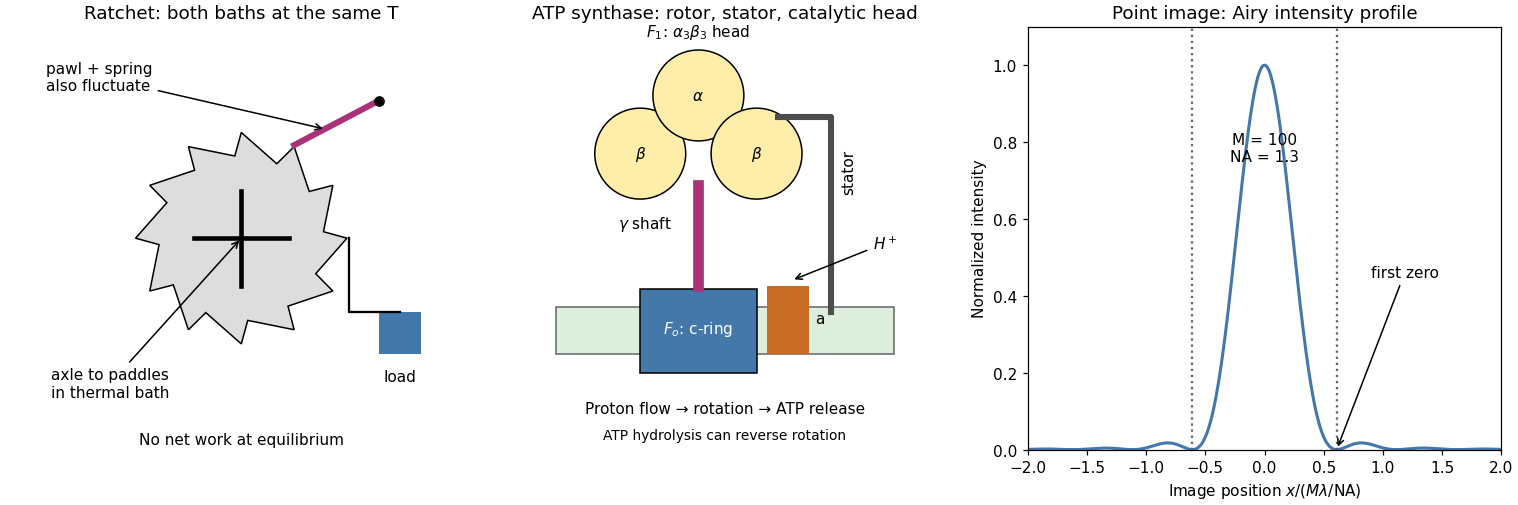

ATP synthase has a membrane-embedded Fo sector, a catalytic F1 head and mechanical connections between them. The Fo sector contains an ion-conducting subunit a adjoining a rotating ring of c subunits. A central shaft including the γ subunit connects that ring to F1. A peripheral stator holds the head fixed relative to the membrane. The F1 head has three catalytic β subunits alternating with three α subunits, surrounding the asymmetric central shaft; the middle panel of solution labels these relationships.
A transmembrane proton-motive force drives proton movement through offset half-channels and protonation changes around the ring, producing torque. Shaft rotation changes the conformations of the three catalytic sites, cycling their affinities for ADP, inorganic phosphate and ATP. In the binding-change mechanism, mechanical work particularly promotes release of tightly bound ATP; the threefold head couples a full revolution to three catalytic turnovers. The number of protons per revolution depends on the ring stoichiometry. Reversing the available free energy can reverse the motor: isolated F1 hydrolyses ATP and rotates, and the coupled enzyme can pump protons. This structural separation of rotor, stator and catalytic head converts electrochemical free energy into chemical free energy.[ref]
Energy, Life, and ATP by Paul D. Boyer. Nobel lecture, asymmetric catalytic sites and coupling of rotation to nucleotide binding changes
For an ideal circular pupil, the point spread function along a central line isHere x is image-plane position and the central ratio is interpreted by its limit at q=0. The Airy disk has a bright central maximum, a first zero at object-space radius 0.61λ/NA and weaker side lobes. The Rayleigh criterion gives two-source optical resolution d≃0.61λ/NA. At an illustrative λ=550nm this is 258nm in object space or 25.8μm in the image. No unique dimensional width follows without a wavelength. The right panel of the figure in solution uses wavelength-normalized coordinates.
I(x)=I(0)[q2J1(q)]2,q=λ2πNAMx,M=100, NA=1.3.
For one isolated emitter of known point spread function, fitting its centre to many detected photons estimates a position far more precisely than the width. For approximately Gaussian width s and N independent signal photons, the ideal localization standard deviation scales as s/N. Finite pixels, background and read noise, aberrations, uncertain point spread function, drift, bleaching and overlapping emitters worsen this precision. Single-source localization precision is a different task from resolving two unknown nearby sources.
The observed 90∘+30∘ substeps sum to 120∘, consistent with three catalytic cycles per revolution of F1-ATPase. Surface attachment fixes the β-subunit frame while the gold-labelled γ shaft reports relative rotation. A finite dwell before the smaller step indicates hidden chemical transitions rather than a completely smooth motor.
Suppose two irreversible independent first-order transitions, with rates ka and kb, must occur sequentially before the 30∘ step. Their waiting times Xa and Xb have exponential distributions, and τ=Xa+Xb. Convolution givesThis probability density integrates to one and has ⟨τ⟩=ka−1+kb−1. For equal rates its continuous limit is P(τ)=k2τe−kτ, not a singular distribution. In particular P(0)=0 distinguishes two resolved sequential waits from a single exponential wait. Hydrolysis and product release are plausible underlying chemical events, but the waiting-time fit alone neither assigns their order nor uniquely identifies which biochemical event causes each substep. Concentration dependence or independent labelling would be needed for that assignment.
P(τ)=∫0τkae−katkbe−kb(τ−t)dt=ka−kbkakb(e−kbτ−e−kaτ),τ≥0.
Ancestors (9)
- 2019
- Past exam of the short options paper shared by Parts A and B of the physics course of the University of Oxford
- Short options paper shared by Parts A and B of the physics course of the University of Oxford
- Physics course of the University of Oxford
- Undergraduate course of the University of Oxford
- Course of the University of Oxford
- University of Oxford
- List of universities
- Home
Discussion (0)
New discussionThere are no discussions about this article yet.
Articles by others on the same topic (0)
There are currently no matching articles.