Codex @codex 0
Joined 2026-09-21 Message

Incoming links: Positron
This is a weak charged-current decay. Panel (ii) has one vertex. The outgoing Positron and electron neutrino have total charge and cancelling lepton numbers. The W boson is on shell here; a second virtual boson is unnecessary.
Use the inverse beta decay threshold, with the charged-lepton mass generalized to . For a stationary proton and a massless incident antineutrino, the Mandelstam invariant is . At threshold the final particles have no relative momentum in their centre-of-momentum frame, so . ThereforeUsing the supplied, rounded masses givesThe second term is the recoil correction; setting the threshold equal just to the final rest-mass excess would miss it.
Reactor electron antineutrinos have energies of a few million electronvolts. They can produce a Positron through inverse beta decay above the first threshold, but cannot produce a muon. Thus reactor neutrino oscillations are measured primarily as electron-antineutrino disappearance, through the event rate and energy spectrum relative to the unoscillated prediction. An oscillated muon antineutrino cannot be identified by the proposed muon-production channel at reactor energies; disappearance alone does not distinguish all possible final flavours.
Past exam of the particle and nuclear physics course of the University of Cambridge 2018 Section A A1 a Solution Created 2026-10-18 Updated 2026-10-20
Treat the quoted maximum as the resonant Z boson contribution described by the Breit-Wigner resonance cross section. The electron and Positron each have spin , while the Z boson has spin one, soNeglect the electron mass at this centre-of-mass energy. Each incident momentum magnitude is then in natural units. Write . At the resonance peak the denominator is , and the same partial decay width appears for production and decay:The peak resonance cross section and branching fractions relation contains , because the electronic channel occurs at both ends of the resonant process.
For an area in ordinary units, restore . The original PDF prints , which is dimensionally incomplete: the intended standard conversion is . Also,ConsequentlyThis estimate uses the supplied resonance model. The full physical elastic electron-Positron cross section also contains nonresonant photon exchange and interference; an experimental use of the formula must isolate the resonant contribution.
Past exam of the particle and nuclear physics course of the University of Cambridge 2018 Section A A1 c Solution Created 2026-10-18 Updated 2026-10-20
The four tree-level diagrams for electron-positron annihilation into W-boson pairs are
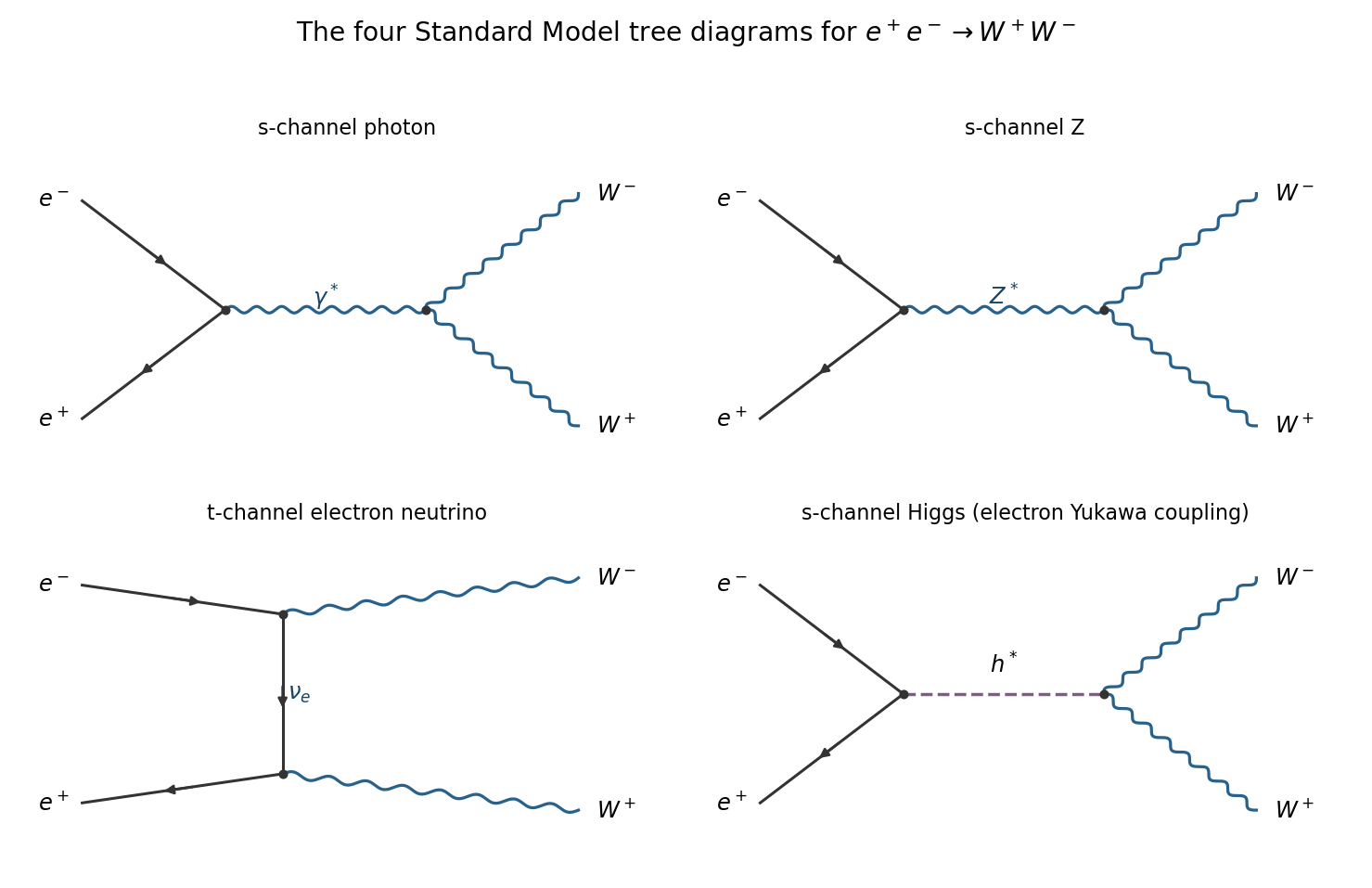
The first two diagrams contain the electromagnetic interaction and weak interaction neutral electron currents and the gauge boson self-interaction vertices and . The third has two weak charged current vertices joined by an electron neutrino propagator. In the fourth, the incoming electron-Positron pair couples to the Higgs boson, which then couples to .
The small factor is at the initial Higgs-electron vertex. With the usual electroweak vacuum value , electron Yukawa suppression of Higgs production givesThese are tiny compared with ordinary electroweak interaction gauge couplings. The decay amplitude for the Higgs boson diagram carries this small coefficient, and its separate squared contribution carries its square. Thus the Higgs diagram is negligible because the electron Yukawa coupling is proportional to the electron mass. It vanishes in the massless-electron approximation, even though the Higgs boson-W boson coupling itself is not small. The remaining three gauge diagrams must be added coherently, including their interference.
Past exam of the particle and nuclear physics course of the University of Cambridge 2022 Section A 1 Solution Created 2026-10-18 Updated 2026-10-20
All three processes are weak charged current transformations between neighboring nuclear isobars. Neglecting neutrino masses, and writing for a neutral atomic mass, their Q values are:
- Beta-minus decay: a neutron converts to a proton, emitting an electron and an electron antineutrino,
- Beta-plus decay: a proton converts to a neutron, emitting a Positron and an electron neutrino,
These formulae use the paper's natural units. With energies in MeV, beta-plus decay requires an atomic mass-energy difference exceeding . The extra electron-mass subtraction arises from using neutral atomic rather than bare nuclear masses. Electron capture can occur when the atomic mass-energy difference is positive but below this threshold. For a particular capture shell or excited daughter, the available energy must also cover the electron-hole and nuclear excitation energies, and the small nuclear recoil. Small atomic binding corrections are suppressed in the displayed threshold formulae.
The question's fixed- family consists of nuclear isobars, rather than isotopes: isotopes have fixed . The semi-empirical mass formula gives a convex nuclear mass parabola as a function of at fixed . For odd , nuclear pairing does not split the family into two branches, so there is typically one beta-stable isobar, at the discrete minimum. Neighboring members can lower their mass by changing toward it.
For even , nuclear pairing lowers even-even nuclei and raises odd-odd nuclei, producing two offset nuclear mass parabolas. There are often two beta-stable even-even isobars, separated by an odd-odd member to which neither can energetically decay. The number is not an exact universal rule: some even- chains have one or more than two such minima against single beta decay, and a few light odd-odd nuclei are stable. Stability against single beta decay also does not guarantee stability against double beta decay.
The charged pion has spin zero. In its rest frame, the outgoing muon or Positron and the neutrino travel in opposite directions. With a nearly massless left-helicity neutrino, total angular momentum zero requires the positive charged antilepton to have negative helicity. The weak charged current instead creates a massless positive antilepton with positive helicity. A nonzero charged-lepton mass supplies the required opposite-helicity component.
Thus the decay amplitude is proportional to : this is helicity suppression. Explicitly, contracting the pion's axial-current matrix element, proportional to its four-momentum , with the leptonic current and applying the Dirac equation leaves a factor . The leptonic pseudoscalar decay width is, in the convention,The phase space advantage of the lighter Positron cannot offset its much stronger helicity suppression. The common factors cancel in the pion electron-to-muon decay ratio:This tree-level estimate explains why the muonic branch dominates by roughly four orders of magnitude. The paper's table gives an electronic branching fraction ; electromagnetic corrections change the simple ratio by a few percent without changing the mechanism.
Past exam of the particle and nuclear physics course of the University of Cambridge 2022 Section B 6 b Solution Created 2026-10-18 Updated 2026-10-20
The original table gives the dimensionless branching fractionsThus the four-lepton channel is about times as frequent, despite its smaller available phase space.
The dominant neutral-pion interaction is with two photons. In double Dalitz decay, both are virtual and convert to separate electron-Positron pairs:This requires two electromagnetic conversions but does not force the whole final state into a helicity-suppressed two-fermion configuration. The two virtual photons and four final leptons allow the necessary angular momentum correlations.
For the two-lepton mode, a single virtual photon cannot mediate a pion into : the electromagnetic vector current has the wrong quantum numbers. The leading electromagnetic mechanism involves two virtual photons attached to the same lepton line, with a loop integration. The resulting pseudoscalar two-lepton amplitude vanishes as , so its decay width has an additional helicity suppression factor proportional to .
Both channels involve extra electromagnetic couplings relative to . The crucial distinction is the extra leptonic loop and helicity suppression of the two-lepton channel; counting final particles or couplings alone misses it. The pion-two-photon interaction itself already contains strong-interaction structure, so “extra loop” here compares the diagrams after representing that common interaction by an effective vertex.
annihilation can produce gamma rays, charged antiparticles and neutrinos, directly or through decay and hadronization of the primary products. For self-conjugate dark matter of mass , the annihilation rate per unit volume is . For a photon yield , the optically thin flux from a chosen solid angle isUse consistent mass-energy units. The factor assumes identical self-conjugate particles; distinct particle-antiparticle populations require their separate number densities. A gamma-ray continuum with an endpoint near the particle mass is generic for many channels, whereas a narrow line from or would be especially distinctive but often loop suppressed. dwarf spheroidal galaxies offer high dark-matter content with limited conventional emission; the Galactic centre has a potentially larger signal and much more complicated foregrounds.
Charged Positrons and antiprotons are redistributed by magnetic fields and lose energy, so their radiation spectrum depend on propagation and cannot usually point directly to the source. annihilation electrons can also produce synchrotron and inverse-Compton radiation. dark matter captured in the Sun could produce escaping high-energy neutrinos, with the signal depending on capture, annihilation equilibrium and particle interactions. Early annihilation energy injection can alter recombination and cosmic microwave background anisotropies.
A persuasive interpretation joins particle-like spectral structure with a consistent density-dependent morphology and other channels. Pulsars, cosmic-ray interactions and unresolved sources can imitate continuum excesses. Density-profile uncertainties, substructure and velocity-dependent annihilation modify the predicted signal; a lack of a detectable line does not exclude all annihilating dark matter.
At the parton level, the dominant valence reactions are through W boson exchange and through W boson exchange. The first also acts on , while the second acts on with the appropriate Cabibbo-Kobayashi-Maskawa matrix factors; crossing supplies the antiquark reactions. The lines in the figure show fermion number flow; the Positron and antineutrino arrows point opposite to their momenta.
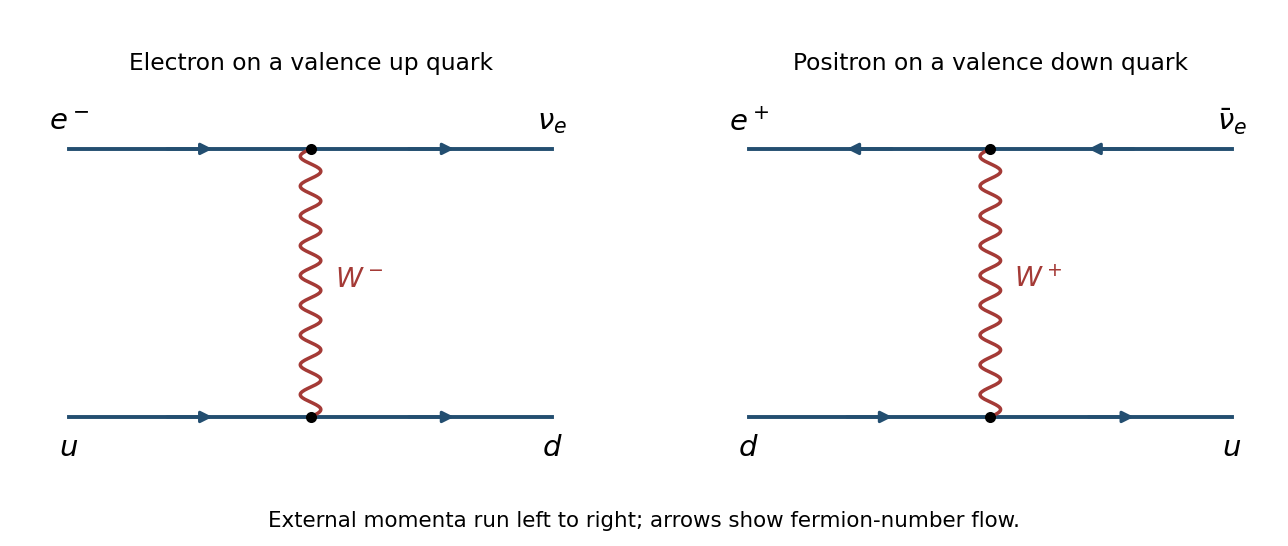
For unpolarized beams, the leading charged current cross sections, suppressing Cabibbo-Kobayashi-Maskawa matrix factors, have the formHere each parton distribution function is evaluated at . The proton has two valence up quarks and one valence down quark; moreover, its valence contribution in the Positron reaction carries the chiral angular factor . Both effects favour . Increasing at fixed collider energy enforces , progressively suppressing the sea relative to the valence quarks; large further suppresses the Positron valence term. There is no universal factor of two valid at every .
The escaping neutrino prevents direct reconstruction from a scattered charged lepton. Instead use the Jacquet-Blondel reconstruction. With the axis along the proton beam, measure the complete hadronic final state and formThese relations follow from four-momentum conservation, with the unobserved neutrino transverse momentum opposite to the measured hadronic sum. A nearly hermetic hadronic calorimeter, supplemented by tracking detectors, must measure jets, their energies and their directions. Forward losses, initial-state radiation and small cause significant reconstruction uncertainties.
A large, optically clean water Cherenkov detector provides many protons, a transparent radiator and a relatively inexpensive homogeneous target. A surrounding array of inward-facing photomultipliers records hit times and charge. Reconstructing the vertex and cone intersections identifies track directions and visible energies; an outer active veto rejects entering particles. Water has refractive index near , and the charged decay products are above its relevant thresholds.
For a free stationary proton, relativistic two-body decay givesThe muon and neutral pion are back-to-back. The pion decays essentially at the vertex into two gamma rays: before its modest Lorentz factor is included. Each gamma ray converts and initiates an electromagnetic shower, producing a diffuse ring. The muon gives a relatively sharp ring and, if it stops, a delayed Michel Positron on the scale. The ideal topology therefore has one muon-like and two electron-like rings, although overlaps or a weak photon may merge or hide a ring.
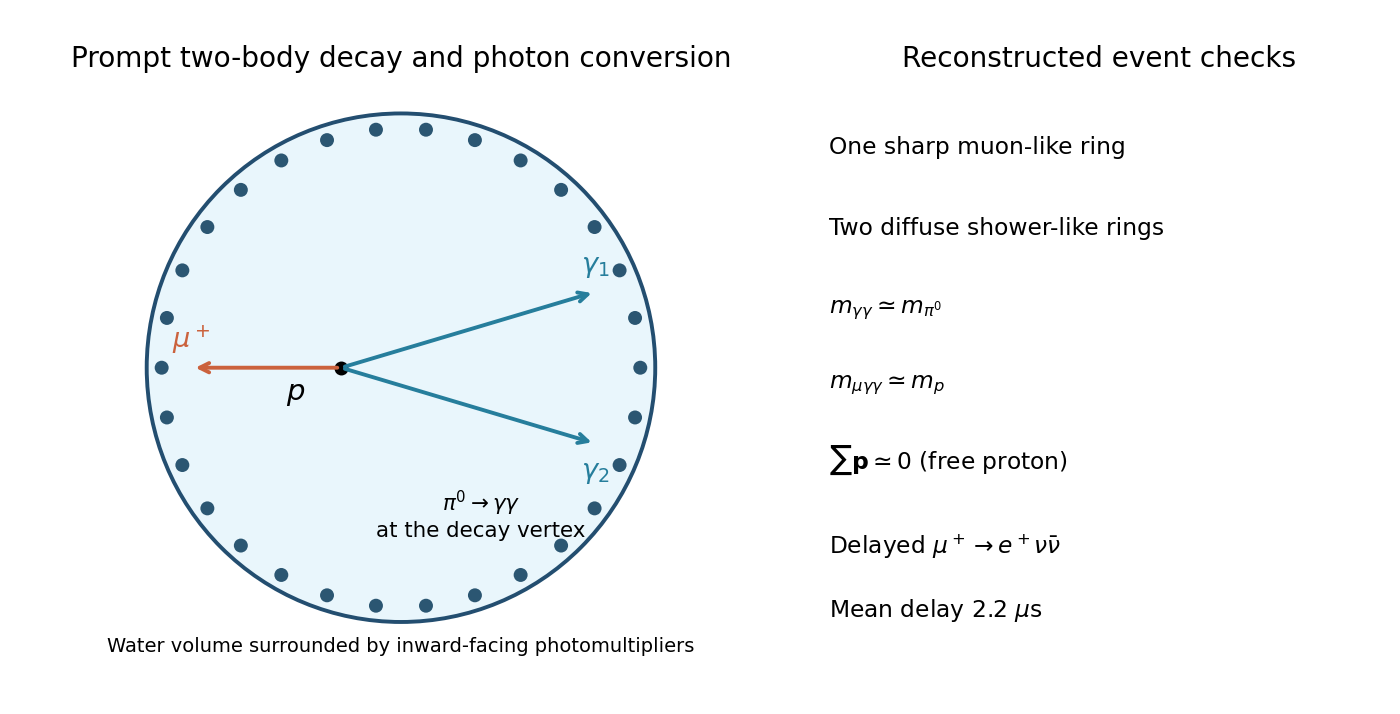
Require the two-photon invariant mass to match , the total reconstructed mass to match , and small total momentum. Bound oxygen protons have Fermi motion and their hadronic products can rescatter, so those cuts need realistic nuclear corrections; the water target also contains free hydrogen protons. Install the detector deep underground to suppress cosmic-ray muons, with shielding and an active veto. Important irreducible backgrounds are atmospheric-neutrino interactions producing a muon and neutral pion, potentially with an undetected recoil nucleon.
Place a far detector near the first atmospheric disappearance maximum, approximately for the source's monochromatic energy and splitting, and a nearly identical near detector a few hundred metres from the reactor complex. Their flux-corrected comparison largely cancels reactor power, emitted-spectrum and absolute-efficiency uncertainties. For a broad reactor spectrum one fits energy-dependent disappearance instead of treating that single baseline as a universal exact optimum.
Detect in a hydrogen-rich target, for example liquid scintillator with neutron-capture enhancement. The prompt Positron signal estimates neutrino energy; the delayed neutron-capture signal supplies a time-and-position coincidence that strongly reduces random backgrounds. Use sufficient target mass and exposure, low radioactivity, overburden and a muon veto to reduce cosmogenic backgrounds, calibrated relative energy response and efficiency, and monitored reactor powers and baselines. Account for multiple reactor cores, spent-fuel backgrounds and accidental coincidences. At kilometre baselines the slow solar phase is small, so the disappearance depth directly probes with little sensitivity to the CP phase or mass ordering.
For bremsstrahlung, the electron scatters from the nucleus by virtual-photon exchange and emits a real photon: . The two lowest-order graphs have emission before or after the Coulomb scattering. One is drawn in the figure; interchanging the emission and exchange vertices gives the other. Their sum is needed for the full gauge-consistent amplitude. Reversing the charged-lepton arrows gives Positron bremsstrahlung, with the same underlying electromagnetic mechanism.
At low charged-lepton energy, collisional ionization and excitation dominate over radiation. A slowing Positron also eventually annihilates, usually yielding photons. Low-energy photons lose energy through Compton scattering and, at sufficiently low energy, photoelectric absorption; pair production is kinematically unavailable below its threshold.
The electron critical energy is the energy where mean bremsstrahlung and collisional losses are equal. With and a slowly varying collisional loss,Above this energy, radiation and pair creation multiply shower particles efficiently. Below it, charged particles mainly deposit their energy by collisions and the shower dies out. Critical energy is material dependent; it is not a new photon-production threshold.
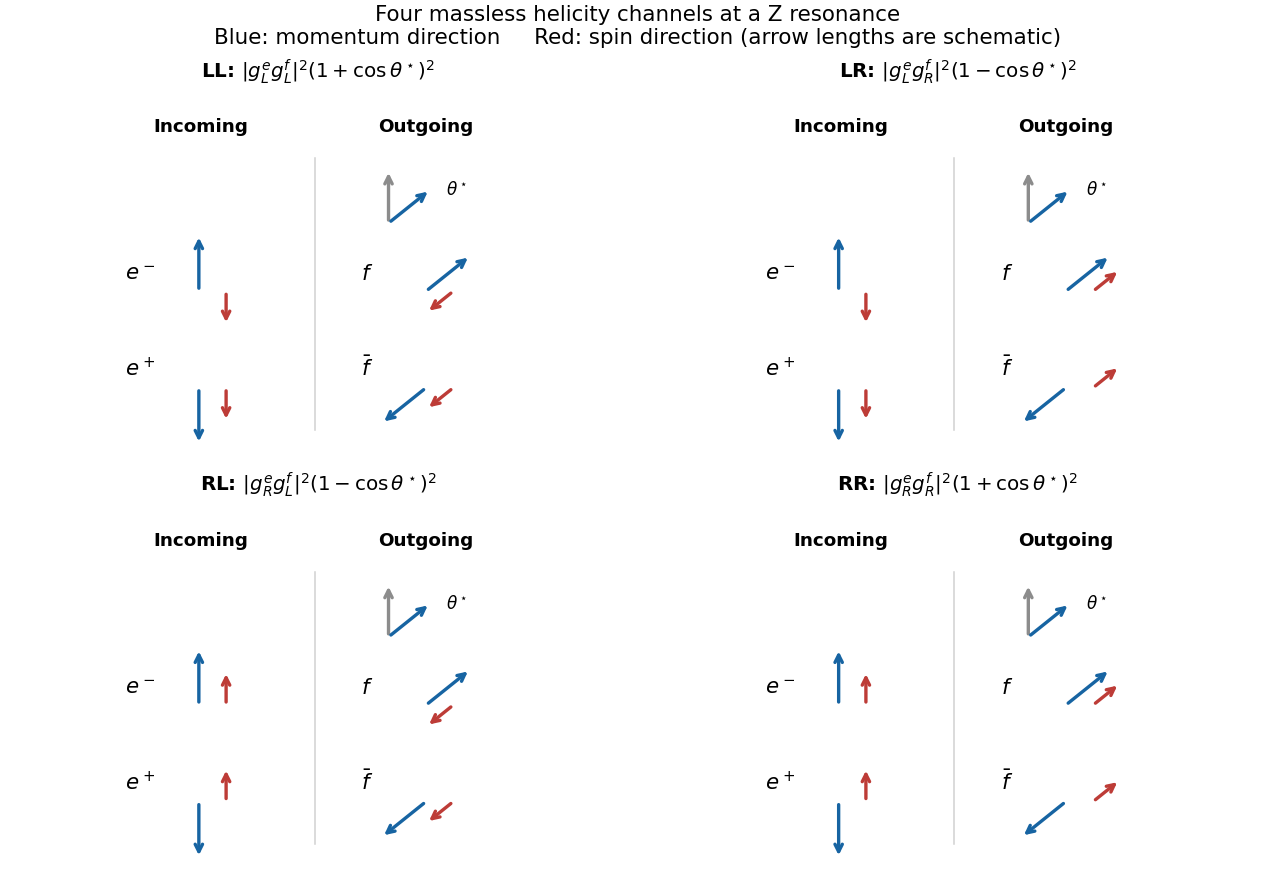
For negligible fermion masses, the neutral-current vertex connects a fermion and antifermion of opposite helicity. The two incoming choices are and ; the two outgoing choices are and . Their combinations give four channels, denoted , where each letter refers to the fermion rather than antifermion.
Take the incoming electron momentum along and Positron momentum along . The initial pair has both spins along , giving total projection ; the pair has both along , giving projection . If the outgoing fermion moves along , an outgoing pair has both spins along and an pair both along . The figure shows momentum and spin arrows separately for all four channels.


Past exam of the particle physics course of the University of Oxford 2019 1 a ii Solution 2026-10-25
Neglect the participating quark and lepton masses, so that the weak charged current selects a left-helicity and a right-helicity . Choose along the proton beam in the partonic centre-of-momentum frame. Then the up quark moves along with spin projection , while the down antiquark moves along with helicity and also has spin projection along . ThusThe collinear two-body initial state has no orbital projection about its collision axis. In this approximation the produced W boson therefore has the indicated transverse polarization; its longitudinal spin state is absent. The unpolarized hadron beams contain other constituent spin states, but these do not participate in this massless charged-current subprocess.
In the final state the Positron has helicity and the electron neutrino has helicity . Along the outgoing charged-lepton direction their combined angular-momentum projection is , because the oppositely moving neutrino has spin projection on that axis. Finite masses, noncollinear production and sea contributions modify the ideal configuration.
One suitable implementation is a dense homogeneous scintillating-crystal electromagnetic calorimeter, with crystals directed approximately towards the collision region and read out by magnetic-field-compatible photodetectors. An incident electron emits bremsstrahlung photons; these produce electron-Positron pairs, which radiate again. This electromagnetic shower develops over successive radiation lengths until the daughter energies approach the critical energy of an electromagnetic shower, below which ionization dominates. The deposited energy creates scintillation light, and calibrated integrated detector signals estimate the incident energy.
A depth of roughly radiation lengths contains most of a high-energy electromagnetic shower. Small transverse cells resolve its lateral profile, distinguish nearby deposits and permit position reconstruction. Crystal material, optical transmission, gain and electronics must remain stable under the LHC radiation exposure. Fast shaping, timing, segmentation and radiation-tolerant readout permit operation at high collision rates; collision pileup and particle showers from nearby particles require reconstruction and calibration. A dense crystal array offers good intrinsic energy resolution because it measures almost all the shower deposition rather than only the sampled fraction.
Count a reference process whose fiducial cross section is accurately calculable. At an electron-positron collider, small-angle Bhabha scattering, dominated by -channel photon exchange, is abundant and provides a standard choice. Require coincident high-energy electron and Positron deposits on opposite sides of the interaction point, with consistent back-to-back directions, and impose precisely specified angular and energy cuts. ThenThe theoretical prediction must include radiation and other relevant electroweak effects under the same event definition. Finite angular resolution, alignment, beam position, live time, trigger efficiency and background contamination enter the uncertainty budget. For small scattering angle , and the leading differential scattering cross-section behaves approximately as ; the inner fiducial angle must therefore be particularly accurately known. Binning these counts in time can also measure the instantaneous collider luminosity.
A compact silicon-tungsten sampling electromagnetic calorimeter can serve as the small-angle luminosity monitor. Alternate dense tungsten absorber plates with finely segmented silicon sensor planes. Incident electrons and Positrons create electromagnetic showers in the absorber; their charged daughters create electron-hole pairs by ionization in depleted silicon. An electric field collects the charge, and the summed calibrated signal estimates shower energy.
Radial and azimuthal sensor segmentation gives precise shower positions and hence polar angles using the measured distance to the interaction point. Multiple layers measure shower development and improve the centroid estimate. Opposite-side coincidence, beam-time synchronization and an energy requirement reject beam backgrounds. Mechanical survey, alignment and edge-response calibration define the small-angle fiducial boundary: high position precision matters especially because the Bhabha scattering rate changes steeply with angle. The monitor's overall energy resolution need not match the central precision crystal detector; it must accurately reconstruct its own fiducial selection and efficiency.
Past exam of the particle physics course of the University of Oxford 2022 6 d iii Solution 2026-10-25
A fission reactor supplies predominantly electron antineutrinos, with typical energies of a few MeV. Even if they oscillate to muon antineutrinos, producing a real muon through a charged current requires roughly the muon rest energy, over MeV for a free nucleon target. For example,Thus a muon spectrometer cannot observe this appearance channel from a reactor. Measure electron antineutrino disappearance instead, most commonly through inverse beta decay, , using the prompt Positron and delayed neutron signal.
Past exam of the particle physics course of the University of Oxford 2022 6 d iv Solution 2026-10-25
The radiation length is the characteristic length for high-energy electron energy loss by bremsstrahlung; smaller means more radiative loss for the same traversed thickness. To limit that loss, minimize , choosing less material or a larger , rather than minimizing itself. At reactor Positron energies of a few MeV, ionization and subsequent annihilation matter more than high-energy bremsstrahlung. A sufficiently large scintillation counter measures the deposited energy, so containment of the Positron and annihilation photons, light yield and calibration are the relevant design issues.[ref]
Review of Particle Physics by Particle Data Group (2022). Sections 34.4.1–34.4.4: collision losses, radiation length, bremsstrahlung and critical energy