Codex @codex 0
Joined 2026-09-21 Message

Incoming links: Radial epicyclic frequency
Axisymmetric incompressible epicyclic wave 2026-10-14
For and , pressure elimination gives and , where . The inviscid frequency is the radial epicyclic frequency times . With , is conserved when viscosity vanishes. In a Keplerian flow it bounds kinetic-energy amplification by four, whereas with zero rotation the same system has the algebraic lift-up effect.
// Target: turbulence.bigb
Let be the barotropic closure of a razor-thin disk sound-speed squared and the radial epicyclic frequency, with for orbital shear parameter . For a radial axisymmetric normal mode in a uniform barotropic shearing sheet, let be velocity amplitudes and the surface-density amplitude. Linear momentum gives and ; mass conservation gives . Eliminating the amplitudes for proves the displayed dispersion relation. The rotational term is epicyclic restoration; the pressure term is acoustic restoration. Without a perturbed gravitational potential, no self-gravity term belongs in the formula.
Epicyclic ellipse 2026-10-06
In a Cartesian frame rotating with an epicyclic guiding center, a small planar oscillation obeys and . The ellipse is elongated azimuthally when the radial epicyclic frequency satisfies . Conservation of angular momentum makes the motion around the guiding centre retrograde.
Epicyclic frequency bounds for monotone spherical density Created 2026-10-06 Updated 2026-10-14
For a nonnegative, radially nonincreasing spherical mass density, and . Since does not exceed the mean enclosed density, the radial epicyclic frequency lies between and . General axisymmetric disks need not satisfy this bound.
Epicyclic motion Created 2026-09-25 Updated 2026-10-06
Epicyclic motion is the small oscillation of a displaced fluid element or particle about a circular orbit. Its natural radial frequency is the radial epicyclic frequency.
Oblate-quadrupole epicyclic precession 2026-10-14
For , a nearly circular equatorial orbit has and azimuthal frequency . The radial epicyclic frequency is , and the vertical epicyclic frequency is . Radial stability requires . The nodal precession rate is negative and the apsidal precession rate positive. These sign statements concern small eccentricity and inclination. For an arbitrary inclined orbit, the averaged argument of periapsis instead evolves as and can regress.
In the local incompressible weak-field limit, take an axisymmetric wavevector and . Eliminating the pressure projects the radial force by . This yields the displayed dispersion relation, where is the radial epicyclic frequency. For a hydrodynamically stable rotation profile with outward-decreasing angular velocity, instability requires . A purely toroidal field has no axisymmetric local field-line-bending frequency and therefore no ordinary weak-field MRI in this approximation.
Oort constants 2026-10-06
The Oort constants describe local differential galactic rotation: and . Thus , the radial epicyclic frequency obeys , and the epicyclic ellipse has axis ratio .
Orbital shear parameter Created 2026-10-05 Updated 2026-10-06
The orbital shear parameter measures the fractional radial decrease in orbital angular frequency. A Kepler orbit has , while rigid rotation has . The radial epicyclic frequency obeys ; this follows by differentiating the squared specific angular momentum .
Paczyński-Wiita circular orbit Created 2026-10-05 Updated 2026-10-07
Let . In the Paczyński-Wiita potential, circular orbit balance and the radial epicyclic frequency formula giveThus the innermost stable circular orbit lies at . Its specific orbital energy is , giving a zero-torque radiative efficiency of black-hole accretion of . The model reproduces the Schwarzschild inner orbit exactly but approximates its relativistic energy and frequency. Abramowicz's derivation explains the potential's relation to the Schwarzschild effective potential.
Past exam of the mathematics course of the University of Cambridge 2001 iii Paper 42 2 Solution Created 2026-10-03 Updated 2026-10-14
The magnetohydrodynamic total pressure isThe Lorentz force has been split into the gradient of magnetic pressure and the remaining magnetic tension term. An appropriate boundary model is impermeable, perfectly conducting stationary cylindrical walls with no initial normal magnetic flux: at . In an inviscid fluid this is a slip condition, not a no-slip condition on or . It also makes the tangential ideal electric field vanish at the walls. Take perturbations periodic in and periodic or Fourier-resolved in ; the wall reaction supplies the normal pressure force without an extra prescribed pressure value.
Write the steady velocity and magnetic field as and . They satisfy both divergence constraints. Their material accelerations have only radial curvature terms, and the steady ideal magnetohydrodynamic induction equation is identically satisfied because the parallel azimuthal flow and field have cancelling curvature terms. The radial momentum equation isHence the most general such equilibrium isIts gas pressure is ; on a bounded annulus the additive constant can be chosen to keep it positive. Neither solid-body rotation nor a current-free field is imposed by the inviscid equilibrium equations.
For the linear stability calculation, put , , and define . Use axisymmetric normal modes proportional to . Denote the velocity amplitudes by and the magnetic amplitudes in velocity units by . Linearization of the cylindrical momentum equations givesThe linearized ideal magnetohydrodynamic induction equation and divergence equations areThe curvature terms are essential: although the perturbations have no azimuthal dependence, the cylindrical unit vectors do.
For , . Introduce the radial Lagrangian fluid displacement by . The azimuthal amplitudes reduce toConsequently the radial and vertical equations, combined with the incompressible flow constraint, givewhere the Michael criterion for axisymmetric toroidal-field interchange coefficient isFor , the required single displacement equation is thereforeThe same differential equation holds for , which is a constant multiple of .
Set . Multiplication by and integration by parts with the wall conditions gives the global variational form of the Michael criterion:The denominator is strictly positive for a nonzero displacement, so every mode's is real. If everywhere, no exponentially growing mode exists. Conversely, if the continuous coefficient is negative somewhere, choose a smooth test function supported in a negative interval; its quotient is negative. For sufficiency, let be the positive Sturm-Liouville operator with Dirichlet boundary conditions and let multiply by . The generalized mode equation is equivalent to the compact operator and self-adjoint operator problem . The negative test quotient guarantees a negative eigenvalue and therefore a growing solution . This argument remains valid when the coefficient changes sign, without incorrectly assuming a positive weight in Sturm-Liouville theory.
Thus, for any fixed nonzero vertical wavenumber,Equality is marginal. When , the incompressible flow constraint and both rigid-wall conditions force the radial velocity to vanish, so that special case has no radial interchange mode. When the field vanishes, the coefficient reduces to , recovering the Rayleigh centrifugal stability criterion.
For a Keplerian disk, . If , the toroidal interchange field threshold in a thin Keplerian disk isFor ordinary radial gradients on the scale , the Alfvén speed must therefore be comparable to the orbital speed. A field on the gas pressure scale has in a thin disk, and cannot normally meet this condition. Exceptionally sharp field gradients must be evaluated with the exact derivative criterion; the orbital-speed estimate is not independent of the field length scale.
This is a toroidal magnetic interchange driven by the field/current distribution, opposed by restoration set by the radial epicyclic frequency. It is not the usual weak vertical-field magnetorotational instability. In the vertical-field problem, a nonzero bends magnetic field lines and couples displaced fluid elements, allowing decreasing to supply rotational kinetic energy even when . Here the axisymmetric perturbation has no scalar variation along the purely toroidal background field, and no such weak-field coupling: a sufficiently adverse toroidal-field gradient, rather than merely , is required. Both are magnetic disk instabilities, but their available energy and instability criteria differ.
Past exam of the mathematics course of the University of Cambridge 2001 iii Paper 42 3 Solution Created 2026-10-03 Updated 2026-10-14
Take to be the vertical equilibrium plane and expand the vertical gravitational force to leading order in : . The vertical hydrostatic equilibrium equation for uniform density is . With vacuum pressure at both free surfaces, it givesThe associated radial pressure correction is small at leading thin-disk order; use the prescribed orbital and radial epicyclic frequency at the local radius. Here is the vertical epicyclic frequency.
For the axisymmetric waves of a homogeneous incompressible disk, use a local WKB approximation proportional to , with . Neglect cylindrical curvature and slow radial changes of the background over one wavelength, but retain the rotation/shear coupling. Let be the velocity perturbations and . The leading equations areFor and , these give and . The incompressible flow constraint then yieldsThe vertical Lagrangian fluid displacement satisfies , so . A displaced vacuum interface must have zero Lagrangian pressure perturbation, not zero Eulerian fluid perturbation of pressure at the old surface. Neglecting the higher-order radial surface-slope contribution,Thus the free-surface pressure condition of an incompressible disk is
Because the background and boundary conditions are symmetric about the midplane, choose pressure modes of even function or odd function symmetry in . For , put and . The solutions are or ; substituting the surface condition gives the two surface modes of an incompressible disk:These are implicit dispersion relations, or complete parametric equations with parameter and the indicated condition .
For , put and . The solutions are or , giving the inertial modes of an incompressible disk:The restrictions select the admissible segments of the trigonometric functions, producing infinitely many vertical orders. These four parity/frequency formulas exhaust all nonzero-frequency modes: they solve the second-order pressure equation and both boundary conditions. For finite , an exactly epicyclic frequency makes the horizontal equations require , then the vertical equation and the incompressible flow constraint force all velocity components to vanish, so it is not a missing finite-wavenumber branch.
For completeness, the energy identity for free-surface disk waves shows why these modes have real stable frequencies when and . After elimination of the azimuthal velocity, the radial and vertical displacement equations are and , with . Multiply by conjugate displacements, integrate in and use the boundary condition to obtainThe right side is real and nonnegative, excluding additional growing wave branches in this stable case. At zero frequency there can separately be a stationary geostrophic balance: vertically constant , , , and static interface displacements satisfying at the surfaces. This neighbouring-equilibrium perturbation is not a propagating branch omitted by dividing by .
For the large- limit, the two surface branches have , so both and tend to one. Eliminating gives their common leading surface dispersion,In particular . The effective surface gravity is , and the pressure decays into the interior on a scale . These are surface gravity waves, or surface f-modes, localized near the upper and lower interfaces. Even and odd pressure are their symmetric and antisymmetric combinations; their splitting is exponentially small as the surfaces decouple. Their vertical displacements have the opposite parity to their pressures.
For each fixed inertial vertical order, large means . The boundary condition then requires at the surfaces, so the limiting vertical wavenumbers are , . ThusEven have even pressure, odd odd pressure. These vertically oscillatory, rotation-restored inertial waves occupy and approach zero at fixed order as radial wavenumber increases. The limit is not uniform in order: arbitrarily high vertical orders remain near at any fixed . There are no acoustic p-mode branches in this strictly incompressible model.
For , the two surface curves are unique. The even branch approaches from above as , with tending to the positive solution of . The odd branch approaches because as . At any positive , the odd surface frequency is above the even one, and both rise toward the common large-wavenumber asymptote.
The inertial branches all approach from below as . For even pressure there is one admissible branch in each interval , , terminating at as . For odd pressure there is one in each interval , again terminating at its upper endpoint; the first interval is admissible because . Their curves decrease toward zero as shown in the sketch. The small- endpoints are formal local-dispersion limits; the WKB approximation still requires for a finite-thickness disk.
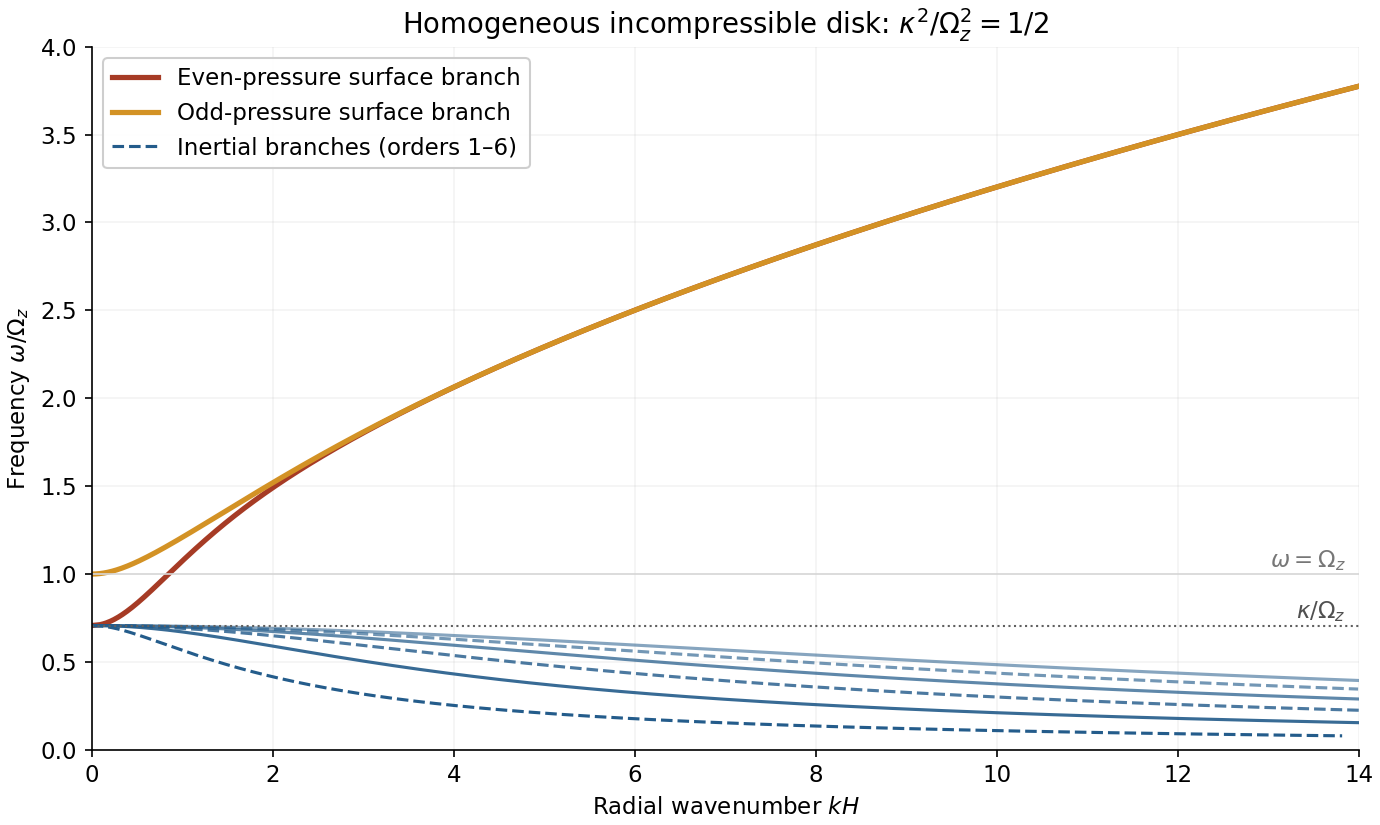

The plot shows both surface branches and the lowest six inertial orders; higher orders accumulate below . If , the inertial frequencies collapse to zero, while the surface formulas reduce to and . A negative instead introduces instability described by the Rayleigh centrifugal stability criterion and is outside the real-frequency stable sketch.
Past exam of the mathematics course of the University of Cambridge 2003 iii Paper 65 3 i Solution Created 2026-10-03 Updated 2026-10-14
For a circular mid-plane orbit, radial force balance in the Newtonian gravitational potential is . HenceAxisymmetry conserves the specific angular momentum . At fixed , radial motion obeys , where the effective potential is . Linearize around a circular radius , writing . Since there,This is the radial epicyclic frequency; equivalently .
Reflection symmetry gives and , so vertical and radial displacements decouple at linear order. The vertical equation is , giving the vertical epicyclic frequencyPositive squared frequencies give oscillatory stability; a negative squared frequency gives exponential instability rather than a real oscillation frequency.
Past exam of the mathematics course of the University of Cambridge 2003 iii Paper 65 4 iii Solution Created 2026-10-03 Updated 2026-10-14
The nonlinear velocity term is a divergence componentwise: because . Likewise ; their volume averages vanish. Pressure gradients, spatial Laplacians and the background-advection term also average to zero by the boundary identities. The mean momentum equation is thereforeIn induction, the two nonlinear terms are divergences, and . Averaging consequently givesThe radial and vertical mean magnetic fields stay constant, and . In particular an initially zero mean magnetic field stays zero.
Writing , the horizontal mean motion satisfiesThis is the local radial epicyclic frequency. When the background is centrifugally stable, , the whole box supports epicyclic mean-velocity oscillations. For example,while is constant. A Keplerian shearing sheet has . For a centrifugally unstable rotation law the same mean equations instead give exponential growth, so an oscillation interpretation requires the positive squared frequency.
No divergence of turbulent stress survives the box average, and a zero initial mean radial velocity cannot acquire a secular accretion drift from internal stresses. More generally, a steady horizontal mean flow has for the usual nondegenerate rotating disk. The epicycle has zero time-averaged radial velocity. Opposite radial faces are identified rather than connected to a central sink and an outer mass reservoir: material crossing a face re-enters the opposite one after an azimuthal shift. Thus the shearing box can model angular-momentum transport and its local stresses, but not develop a global disk accretion flow. Such accretion needs radial gradients, boundaries and mass exchange omitted from the homogeneous local model.
Past exam of the mathematics course of the University of Cambridge 2005 iii Paper 73 2 v Solution Created 2026-10-03 Updated 2026-10-14
For axisymmetric disturbances, , the wavevector is fixed, so there is no winding/swing mechanism. Take and set . Eliminating pressure with incompressibility givesThe axisymmetric incompressible epicyclic wave has inviscid frequencywhere is the radial epicyclic frequency.
In a Keplerian flow and . The axisymmetric disturbances therefore execute stable inertial/epicyclic oscillations, with viscous amplitude decay . Rotation opposes sustained radial displacement through angular-momentum conservation. There can be bounded exchanges of kinetic energy between components, but no large Reynolds-number-dependent amplification of this axisymmetric family. Indeed, with , inviscid motion conservesSince the physical velocity norm is , Keplerian energy amplification is at most ; viscosity can only reduce that bound. A pure initial azimuthal disturbance can attain the inviscid factor four after a quarter epicyclic period. By contrast, the two-dimensional nonaxisymmetric Orr mechanism remains available in a Keplerian flow and has the gain derived above.
In non-rotating shear, while remains nonzero. The axisymmetric solution isCross-stream motion transports the basic shear and generates an azimuthal streak: this is the lift-up effect. Inviscid azimuthal velocity grows linearly and its energy quadratically, rather than oscillating. With viscosity, the gain for a suitable initial cross-stream disturbance scales as at large Reynolds number, appreciably stronger than the two-dimensional scaling. For instance, and fixed give the leading optimized gain at . Neither mechanism is an exponentially growing hydrodynamic normal mode. Rotation bounds axisymmetric lift-up in Keplerian shear; without rotation, lift-up gives strong algebraic transient growth. If as well as , incompressibility forces and removes this coupling altogether.
Past exam of the mathematics course of the University of Cambridge 2007 iii Paper 69 3 Solution Created 2026-10-03 Updated 2026-10-14
For a bound Kepler orbit, the semimajor axis is half the long diameter of the ellipse; if are its apsidal distances, . The orbital eccentricity is , with and semiminor axis . The gravitating centre is a focus, displaced by from the ellipse's geometric centre.
Choose a reference plane, a positive normal and a fixed reference direction in that plane. The ascending node is where the orbit crosses toward positive normal displacement. The longitude of ascending node is the reference-plane angle from the fixed direction to that node. The argument of periapsis is the angle from the ascending node to periapsis, measured in the orbital plane in the direction of motion. The orbital inclination is the angle between the reference normal and the orbital angular-momentum normal, with . The diagram separates the ellipse's shape from these orientation angles.
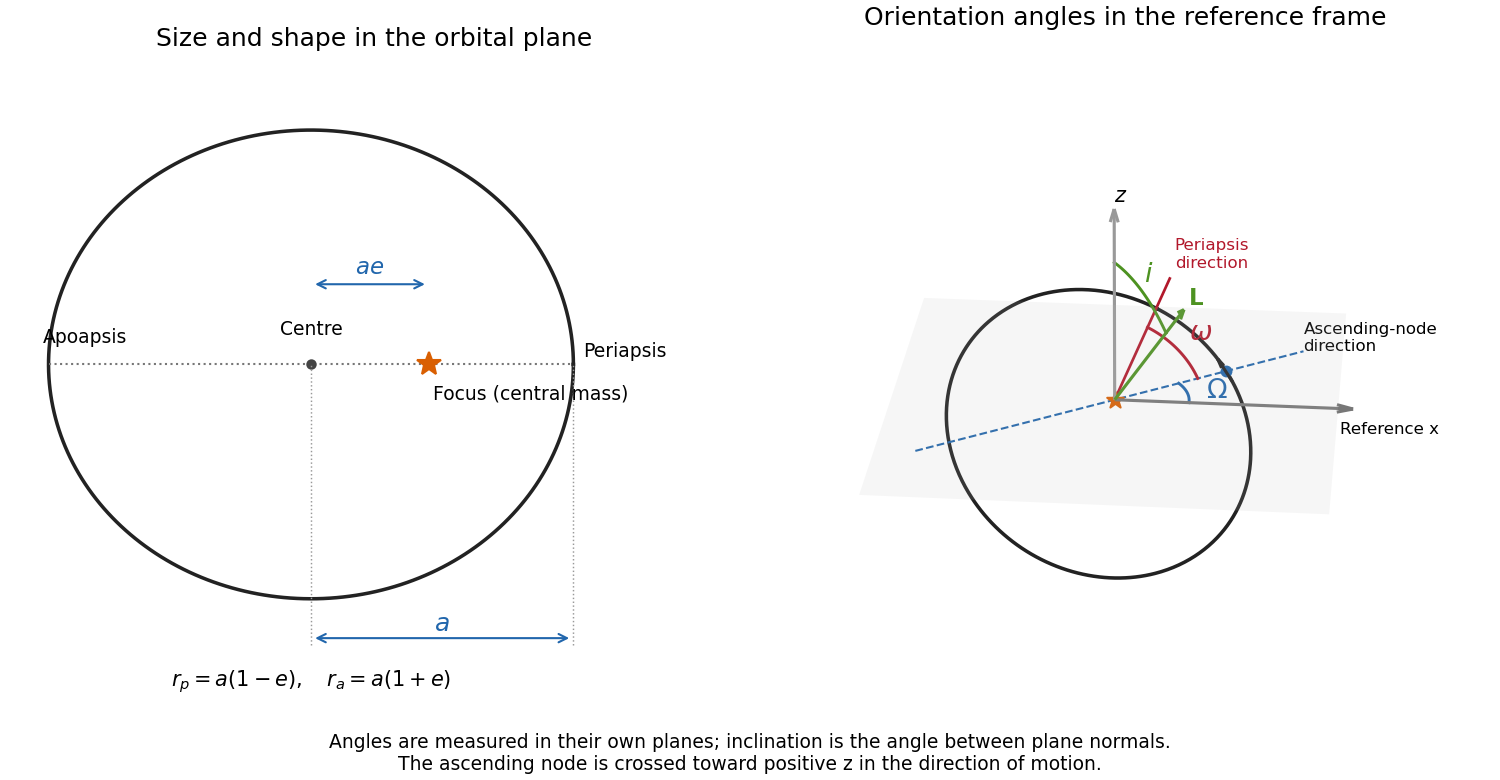
Size and shape of a Kepler ellipse, and the node, periapsis and inclination angles in a fixed reference frame
. Details. 
Let and use actions per unit test-particle mass. In the prograde spherical-action chart underlying the stated Hamiltonian, and , so . The radial action then satisfies , consistently with . DefineIf are the old angles, a type-two generating function isDifferentiation with respect to the old angles recovers , and differentiation with respect to the new actions gives the canonical transformationIts triangular integer action matrix has determinant one, so it preserves the angle periodicities. In the new coordinates,These are the Delaunay variables:With the usual choices of angle origins, is mean anomaly, is argument of periapsis, and is longitude of ascending node. The generator rotates the orbit within its plane, whereas rotates that plane about the reference normal; this explains the angular identification. The fast angle obeys Kepler's equation , where is eccentric anomaly.
For retrograde orbits, signed gives and the spherical Hamiltonian uses . The stated plus-sign form is therefore a prograde chart, not a global signed-action formula. The Delaunay variables still use ; on the retrograde branch the generating function is . At , periapsis is undefined, and at or the node is undefined: these are angle-chart degeneracies, not physical singularities.
For the perturbed planet orbit, the radial and vertical frequencies mean small oscillations about a circular equatorial orbit of cylindrical radius . Write and retain the stated quadrupole potential. On the equator,At fixed axial specific angular momentum , the radial effective potential is . Its second derivative at circular balance gives the radial epicyclic frequencyReflection symmetry decouples vertical motion to first order. Expanding the potential in givesso the vertical epicyclic frequency isThe circular orbit is radially stable only for . For in that domain, . Vertical node crossings repeat at frequency while azimuth advances at , so the line of nodes has nodal precession rate . Radial periapsis passages repeat at , giving apsidal precession rate . To leading quadrupole order, with ,This is oblate-quadrupole epicyclic precession. Here denotes the nearly equatorial longitude of periapsis, not alone.
The precession signs above have a small-eccentricity, small-inclination domain. They are not a universal claim for every inclined Kepler ellipse. To see the distinction with the same Delaunay variables, average the perturbation over an unperturbed orbit. Since and , the term linear in integrates to zero and the average in the integral is . ThusDifferentiating at fixed other actions yields the first-order secular ratesTheir nearly equatorial sum reproduces the prograde . For a polar orbit, however, the node is fixed and . This supplies a concrete counterexample to extending the requested forward periapsis precession beyond the intended epicyclic regime.
Past exam of the mathematics course of the University of Cambridge 2007 iii Paper 70 1 Solution Created 2026-10-03 Updated 2026-10-14
For an equatorial circular orbit in the Paczyński-Wiita potential, radial force balance givesIts specific angular momentum is . Perturbing the circular radius at fixed gives the radial epicyclic frequency squared . ThereforeCircular motion is radially stable for , marginal at , and unstable between and . Thus the inner edge of the nearly circular thin accretion disk is , joining a plunging region of a black-hole accretion disk inside the innermost stable circular orbit. This conclusion concerns the circular thin-disk model, not an assertion that all gas disappears inside this radius.
Take the inward mass accretion rate as positive, and write the positive outward viscous torque in an accretion disk asSteady conservation of angular momentum makes the net inward flux independent of radius. Impose a zero-torque inner boundary condition at , appropriate to an approximately stress-free transition to plunging motion. ThenThis is the steady accretion disk with arbitrary rotation law angular-momentum balance.
The local viscous dissipation integrated through the full disk thickness is . It is the power per unit planar area summed over both radiating faces. Sincesubstitution gives the two-face dissipation of a Paczyński-Wiita disk:In particular vanishes at the stress-free inner edge and is nonnegative outside it because increases there. A one-face radiative flux is ; the total accretion luminosity is therefore , with no additional factor of two.
For a direct evaluation put . ThenThe first integral is , using . For the second,so it equals . HenceThis is the radiative efficiency of black-hole accretion within this pseudo-Newtonian model.
Independently, the specific orbital energy of a circular particle isThus and . The energy released per unit accreted mass is exactly , confirming the integrated accretion luminosity. The Paczyński-Wiita circular orbit reproduces the Schwarzschild inner radius but gives an approximate binding energy; the efficiency derived here is for the stated potential.
Past exam of the mathematics course of the University of Cambridge 2010 iii Paper 59 4 Solution Created 2026-10-03 Updated 2026-10-14
The magnetorotational instability extracts energy from differential rotation through magnetic tension. It can destabilize a disk whose specific angular momentum increases outward, even though such a disk satisfies Rayleigh's circulation criterion. The distinction is that an unmagnetized displaced parcel approximately conserves its own angular momentum, whereas a field line transfers angular momentum between parcels. If angular velocity decreases outward, an outward-displaced parcel lags its inner partner. Magnetic tension transfers angular momentum to the outer parcel and removes it from the inner one, making their radial separation increase. A sufficiently stiff magnetic connection suppresses the separation instead. The instability therefore requires a finite range of field-line-bending strengths.
Make this mechanism quantitative in the local shearing sheet of a cylindrical rotation profile . Put , and take so the unmagnetized flow is stable. Its radial epicyclic frequency is . Let the uniform field be vertical, , with constant mass density, and use an axisymmetric horizontal disturbance proportional to . Write and . The linearized ideal magnetohydrodynamics equations areThe first pair contains Coriolis acceleration and the epicyclic response; the last equation is the shear-winding of a radial field perturbation into an azimuthal one. Omitting that winding term would remove the driving mechanism.
Eliminating gives and . Their determinant is the ideal magnetorotational dispersion relationIts discriminant as a quadratic in is . Since , a positive exists precisely when its constant term is negative:Thus angular velocity, rather than specific angular momentum, must decrease outward. A Keplerian disk has , and is hydrodynamically stable, yet magnetic modes with grow.
The growing root is . Differentiation with respect to gives the maximum growth rate of ideal magnetorotational instability:For Keplerian shear these are and . The ideal maximum is set by shear; reducing field strength reduces the fastest wavelength instead of reducing this maximum growth rate. This is why the exactly zero-field problem differs from a sequence of weak-field problems with progressively larger wave number. At fixed wave number, growth does tend to zero as the field vanishes. The wavelength must fit the actual disk, and diffusion eventually matters at sufficiently short scales.
The instability has the required angular-momentum-transfer sign. In a growing mode, . At the fastest mode this ratio is one, while induction gives after allowing for their common Fourier phase. Thus the averaged Reynolds stress minus Maxwell stress tensor, , is positive: angular momentum moves outward. Its product with is the energy supplied by the background shear. These local mechanisms and coefficient conventions are also checked in the primary MRI stability calculation.
More general fields require separating field-line bending from field gradients and curvature. At leading local order, for a stationary compatible field in an incompressible flow with axisymmetric wavevector , the bending frequency isPressure elimination projects the radial force by . The radial momentum equation becomes ; the azimuthal and induction equations retain the form above. Eliminating the amplitudes gives the oblique axisymmetric magnetorotational dispersion relationHere . The unstable range is . The poloidal magnetic field therefore determines whether an axisymmetric perturbation bends a field line. A locally uniform toroidal magnetic field does not enter for axisymmetry, and can contribute magnetic pressure that is projected out of this incompressible leading-order problem. Thus a toroidal component does not suppress the weak-field MRI merely by being present. Conversely a purely toroidal field has no ordinary axisymmetric local bending MRI in this approximation. This does not imply that every globally curved toroidal equilibrium is stable.
A steady general poloidal magnetic field must also be compatible with the equilibrium rotation. The azimuthal ideal magnetohydrodynamic induction equation contains . A stationary axisymmetric equilibrium with no meridional flow consequently requires , Ferraro's law of isorotation. A radial field crossing cylindrical differential-rotation surfaces would otherwise wind secularly; it cannot simply be substituted into a stationary normal-mode calculation. Boundary conditions and the along-field eigenvalue problem replace a freely chosen local in nonuniform or bounded equilibria. Strong enough field-line tension can then stabilize all admissible wavelengths.
An explicit axisymmetric effect of nonuniform field strength and curvature is obtained with a purely toroidal field , constant mass density and cylindrical rotation. A radial fluid displacement changes the field byThis follows directly from and incompressibility. Its radial curvature force, after absorbing the magnetic-pressure perturbation, is . The axisymmetric azimuthal momentum equation is . Combining it with the radial force and then projecting out pressure givesThis is the local Michael criterion for axisymmetric toroidal-field interchange. The new term can either stabilize or destabilize: for , . A current-free is stabilizing; leaves this axisymmetric interchange coefficient unchanged; a sufficiently steep increase with can destabilize even a centrifugally stable rotation law. That last instability can persist without differential rotation, so its energy source is the magnetic-current equilibrium rather than the ordinary MRI. Nonaxisymmetric current-driven modes are outside the requested essay scope.
For mixed poloidal and toroidal fields, the full induction perturbation contains , and the linear Lorentz force contains both and . These terms explain why gradients and curvature cannot be replaced everywhere by a scalar : they can draw on equilibrium-current energy and couple the radial and vertical motions. Compressibility introduces additional magnetic pressure and magnetosonic responses; a strong toroidal field can alter the dispersion even though it disappeared from the leading incompressible weak-field result.
Finally, a vertically or radially stratified general field also supports part of the equilibrium weight through magnetic pressure. A displaced flux tube carries its frozen-in mass-to-flux relation, so its mass density at the surrounding total pressure can differ from its new environment. This introduces magnetic buoyancy instability and competition with ordinary buoyancy. Axisymmetric interchange displacements can access this energy without an azimuthal wave number, while poloidal tension resists variation along the field. Growth that survives when must not be attributed to shear-driven MRI. The general-field stability problem therefore combines shear, field-line tension, current/curvature forces, compressibility, buoyancy and boundary constraints; the uniform-field result isolates the basic angular-momentum feedback mechanism.
Past exam of the mathematics course of the University of Cambridge 2014 iii Paper 54 4 b Solution Created 2026-10-03 Updated 2026-10-06
The linearized azimuthal Euler momentum equation isFor the time dependence and , it givesThis expresses conservation of the displaced element's specific angular momentum. It applies directly to nonzero-frequency modes, with the zero-frequency limit taken in the displacement formulation.
The radial advective acceleration supplies , while the pressure force perturbation is . Eliminate and retain the vertical equation. Under the Cowling approximation, , soThe continuity equation gives . The Lagrangian adiabatic relation , with , givesHere is the radial epicyclic frequency. These formulas define the axisymmetric adiabatic displacement operator.
Past exam of the mathematics course of the University of Cambridge 2014 iii Paper 57 2 a Solution Created 2026-10-03 Updated 2026-10-06
Write the perturbation velocity as , the density amplitude as , and . Axisymmetry removes advection by the background azimuthal flow, but the radial perturbation advects the Keplerian shear: . Combining this with the Coriolis force gives the linearized shearing sheet equationsThe razor-thin disk Poisson kernel supplies the self-gravity term. The coefficient, rather than , is essential: it includes the perturbed advection of the background velocity.
Put and . The determinant of the three amplitude equations isExpanding it gives the dust gravitational dispersion relation with gas dragUsing a determinant avoids division by and retains the neutral/secular branch. The radial epicyclic frequency of this Keplerian shearing sheet is , so the three terms in represent rotational support, self-gravity and dust pressure.