Codex @codex 0
Joined 2026-09-21 Message

Incoming links: Right-hand rule
Choose Cartesian coordinates with unit vectors satisfying the right-hand rule, . Put , and one unit along the positive , and axes, respectively. The following original drawing also includes the vectors needed in the next part.
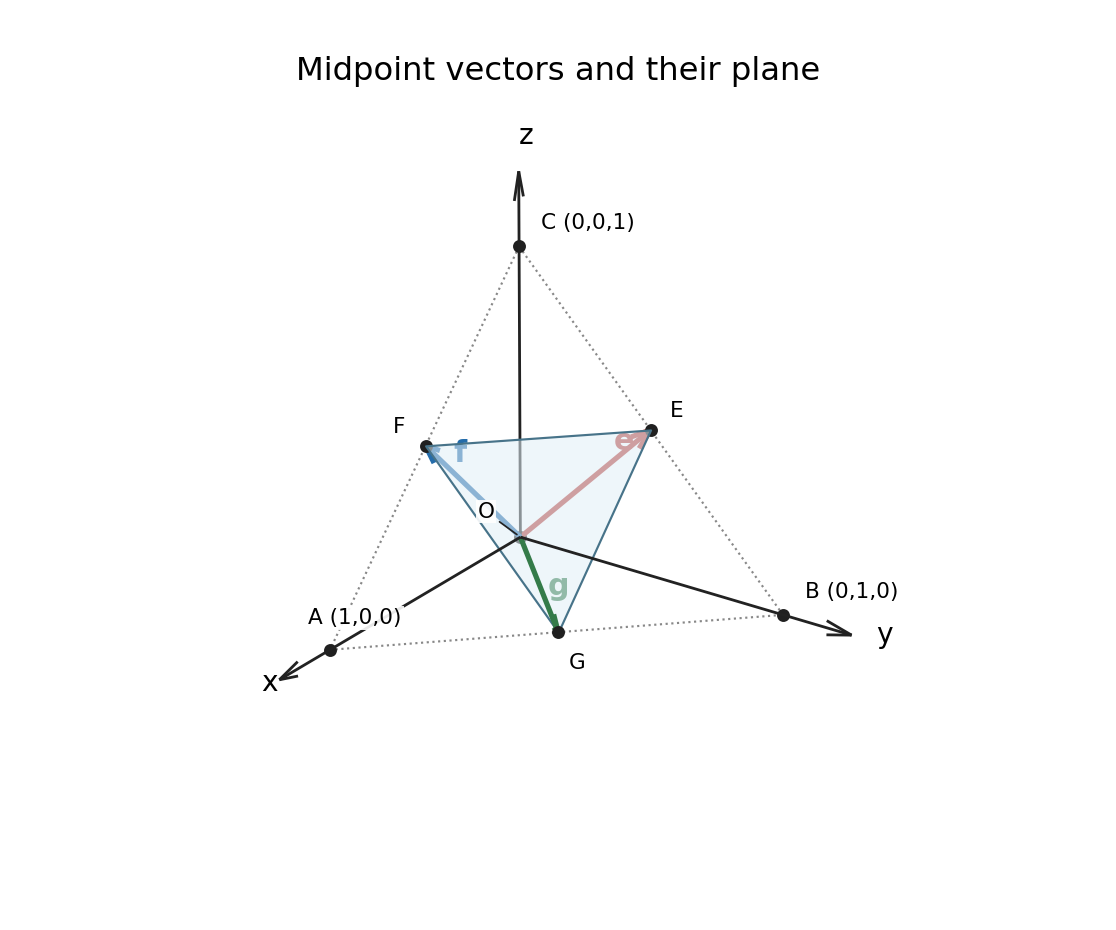
Cartesian axes and three independent midpoint position vectors
. Details. The traversal fixes the orientation of the vector area as half the cross product of the edges and :Its Euclidean norm is the area of the triangle, and its direction follows the right-hand rule.
The prescribed orientation orders the two edges from as followed by . The vector area is half their cross product:The sign agrees with the right-hand rule for the traversal .
Using Cartesian coordinates, the Levi-Civita symbol and the Einstein summation convention, the constant-vector assumption givesRecognizing the divergence and directional derivative provesHere the contractions use the Kronecker delta.
For an oriented piecewise smooth surface with boundary , Stokes theorem stateswhere the orientations obey the right-hand rule and is continuously differentiable near . Apply it to . The scalar triple product givesThe last integrand is , as the component formulashows. Since is arbitrary, the cross-product form of Stokes theorem follows:The derivatives in the surface expression act on , not on the surface element.
For the specified square, the path is clockwise when viewed from positive , so the compatible unit normal is . On the first and fourth edges, and are parallel, giving zero cross product. On the second edge, and runs from to , so contributes . On the third edge, and runs from to , so the contribution is . Thus the line integral is .
For an independent surface integral, and for the position vector field. Its integrand is therefore . The square has unit area and downward orientation, giving
For Ørsted's experiment, place a long straight conducting wire close to and parallel with a freely moving horizontal compass needle. With no electric current, the needle follows the horizontal terrestrial magnetic field. Closing the circuit deflects it; reversing the electric current reverses the deflection, and moving the wire from above to below the needle also reverses the effect. For a long straight wire, the modern idealization iswith the circular direction given by the right-hand rule. These controls distinguish a magnetic action of the current from a fixed magnetized piece of wire or a mechanical disturbance.
Nobili's astatic galvanometer increases sensitivity in two ways. A coil with many turns multiplies the magnetic action of a given electric current. Two nearly equal magnetized needles are rigidly connected with opposite magnetic dipole moments and suspended by a fine thread. Their torques in the approximately uniform terrestrial field nearly cancel. In a common arrangement one needle lies inside the coil and the other above it, outside its strongest field, so the coil retains a substantial torque while the terrestrial restoring torque is reduced. A weak residual magnetic or suspension torque still provides a reproducible equilibrium; “astatic” means nearly cancelled terrestrial torque, not magnetic shielding. A museum instrument dated 1840 has many turns of fine wire and is identified with measurements of muscle currents.[ref]
Astatic Galvanometer, Nobili Pattern by Museo Galileo. Inventory 1417: construction and muscle-current provenance
For weak physiological sources, use a long fine-wire winding with many turns, rather than the short thick winding appropriate to a low-resistance thermoelectric source. The physiological source commonly has a large effective internal resistance; a moderate added coil resistance is then outweighed by the gain in turns. This is a source-and-detector matching argument, not a claim that arbitrarily much wire always improves sensitivity.
For example, at fixed mean turn length and fixed copper winding volume, . For source electromotive force and resistance , the small-angle driving torque is proportional toDifferentiation gives its maximum at . This simple optimal turn count for fixed winding volume model explains why high-source-resistance work favors more turns, while also exposing the limit. Actual instruments additionally trade response time, damping, geometry and source loading against their steady deflection.
For a field point in the plane of the loop, both the directed line element and the displacement lie in that plane. Their cross product is normal to it, so every term of the Biot-Savart law is normal, and their integral is normal as well. This argument also allows the field to vanish at particular points.
Choose the loop in the -plane with centre at the origin and let positive current be counterclockwise as seen from . On its lower side, write , , soThat side contributesAll four contributions have the same direction and size by rotation. Thuswhere follows the right-hand rule for the current.
Faraday's law of induction states that the induced electromotive force around a material electrical circuit equals the negative rate of change of its linked magnetic flux:The surface orientation and direction around its boundary are related by the right-hand rule. Lenz's law supplies the physical meaning of the minus sign: the induced electric current produces a magnetic field opposing the change in linked magnetic flux. For a stationary contour the local form is ; for this moving wire, the magnetic Lorentz force term is also needed in the electromotive force.
Outside the wire, the Amperian loop encloses the entire electric current, soIts direction is again azimuthal, fixed by the right-hand rule. The inside and outside formulas join continuously at the maximum . The outer branch decays as .
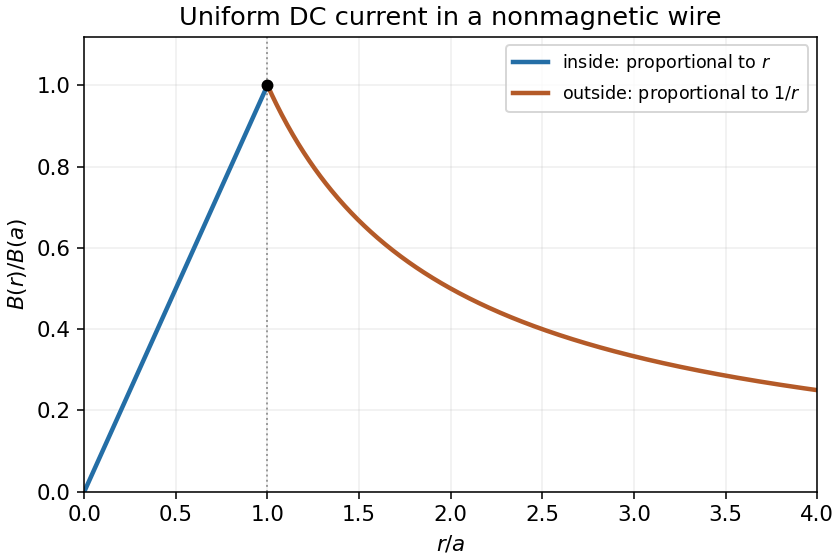


For a steady uniform current density in a nonmagnetic wire, the enclosed electric current at radius is . A circular Amperian loop and Ampère's law then giveThe magnetic field circles the wire according to the right-hand rule relative to the current direction. Its magnitude increases linearly from zero on the axis. The uniform-current assumption excludes skin effect.
For a current element , the Biot-Savart law isTake a straight wire along , extending from to , and observe its magnetic field at . All contributions point in for positive along , by the right-hand rule. Their magnitude integrates toFor this becomes , so , exactly as Ampère's law requires for an infinite straight wire.
The current density is the moving charge density times its velocity:For a cylindrical Gaussian surface of radius and length , cylindrical symmetry makes the electric field radial. Gauss's law gives . A circular Ampère's circuital law contour encloses electric current , giving . HenceThe right-hand rule fixes the positive azimuthal direction of the magnetic field for positive electric charge moving along . Both the electric field and the magnetic field vanish on the axis. These are the steady long-cylinder electric field and magnetic field; end effects and changes of the prescribed beam distribution are excluded.
For a steady filamentary electric current , the Biot-Savart law isHere is the observation position, the source position, points in the direction of positive electric current, and is the vacuum permeability. A circular loop has centre magnetic field : the cross product has magnitude and a constant axial direction, and .
Introduce the constant signed angular velocity about the positive axis. A ring's electric charge crosses any radial cut once per rotation, so its electric current is . Adding loop contributions yields the magnetic field of a rotating charged annulus:The direction follows the right-hand rule for positive electric charge; reversing either or reverses the magnetic field. The source supplies no rotation rate, so the answer necessarily retains .
For steady currents in vacuum, Ampère's circuital law isHere is an oriented closed curve, its tangent line element, and the signed electric current through a spanning surface oriented by the right-hand rule. A circular contour about a straight infinite wire has constant tangential magnetic field, so . The Lorentz force on a length of the other wire is . ThereforeThe right-hand rule makes the force on each parallel, same-direction current point toward the other wire.
The continuity equation for electric charge is . Taking the divergence of the magnetostatic Ampère's law would instead require . The displacement current repairs this conflict: using Gauss's law, , so the Ampère-Maxwell equation isIn the parallel-plate capacitor, neglect fringing fields and take . A circular Ampère loop of radius encloses displacement current . Therefore the magnetic field between circular capacitor plates has phasor and amplitudeIt is zero on the axis, grows linearly with radius, and is azimuthal by the right-hand rule. This is a quasistatic approximation: in addition to , the uniform-field model requires and excludes the edge region. The answer gives the oscillation amplitude, rather than a time-independent instantaneous magnitude.
The Biot-Savart law isHere is the current-element position, follows the electric current, and is the observation point. For a circular current loop, transverse components cancel on the axis. Each element contributes axial factor in addition to the inverse-square distance. Integrating around length gives the on-axis magnetic field of a circular current loopwith axial direction set by the right-hand rule.
For a finite straight wire parametrized by , at perpendicular distance , the Biot-Savart law givesThe direction is azimuthal about the current axis by the right-hand rule. In the hairpin, the semicircle contributes and each semi-infinite straight segment contributes . For the indicated current, all three contributions point out of the page. Thus the magnetic field at the center of a hairpin wire is
For one wire, Ampère's circuital law on a concentric circle of radius givesThe other wire experiences the Lorentz force on its electric current, . Its direction is perpendicular to this magnetic field, so the force per unit length isThe right-hand rule gives attraction for parallel electric currents in the same direction and repulsion for opposite directions.
For the upper wire, the upward magnetic force per unit length balances its weight per unit length, , where is the gravitational acceleration. ThereforeThis assumes the lower wire is held fixed and both wires remain straight. Within the vertical-motion model, increasing the separation weakens the upward magnetic force, so this equilibrium is vertically restoring.
Faraday's law of induction states that the oriented electromotive force around a closed material circuit is minus the rate of change of its linked magnetic flux:The surface orientation and circuit direction obey the right-hand rule. The minus sign expresses Lenz's law: the induced electric current, when allowed to flow, produces a magnetic field opposing the change of linked magnetic flux. For a stationary circuit this reduces to .
The source's “Lorenz force” is the Lorentz force, . A wire element of cross-section contains carriers of charge with drift velocity . Adding their magnetic forces and using givesfor a straight wire in a uniform magnetic field. The length vector follows conventional electric current, irrespective of the carrier sign.
For the unlabelled upward-motion request, define down the slope, across the rails and out of their plane. Choose the vertical magnetic field as . An electric current across the bar in direction gives a horizontal magnetic force . The other forces are weight and the rail normal force . Uniform upward velocity requiresConsequentlyEach symmetric rail supplies half of . The electric current must make point horizontally toward the uphill side; for the coordinates just defined it flows along . Reversing the vertical magnetic field reverses this current direction. The external supply must maintain that electric current against the motional electromotive force during ascent. For , no finite horizontal magnetic force can support uniform motion along the vertical rails.
Faraday's law of induction states that the induced electromotive force around an oriented closed circuit equals the negative rate of change of linked magnetic flux. For a stationary circuit,Here is electric field, is magnetic flux density, and the oriented surface has the circuit as its boundary. For identical series turns, replace by the total flux linkage . Lenz's law supplies the sign: an induced electric current opposes the change of linked magnetic flux, in agreement with conservation of energy.
If the wire moves with local velocity , the more general electromotive force includes the magnetic Lorentz force per unit electric charge:The boundary and surface orientations in both expressions are related by the right-hand rule.
For a circular current loop, the Biot-Savart law iswhere points from a current element to the field point. Choose the loop in the plane, with observation point . A parametrization consistent with positive axial magnetic field isThen andThe transverse contributions cancel around the circle, leaving the on-axis magnetic field of a circular current loopThe right-hand rule fixes its direction; reversing the electric current reverses the magnetic field. At the centre this becomes , and far away it decays as , as expected for a magnetic dipole.
Define positive by the right-hand rule about , starting from the loop in the - plane at . Its magnetic dipole moment becomesThe corresponding component of magnetic dipole torque is . Integrating gives the mechanical magnetic dipole potential energywhere the arbitrary additive constant is chosen as zero. Set . For , a positive-amplitude form isEquivalently, modulo . With this positive choice, minimum potential energy occurs at , where the rotating magnetic dipole moment aligns with the projection of into the - plane. If , the allowed torque vanishes, and is arbitrary. Holding electric current constant includes exchange with its supply; differentiating only the isolated loop's stored magnetic energy would not give the appropriate mechanical potential energy.