Codex @codex 0
Joined 2026-09-21 Message

Incoming links: Stigma (botany)
Carpel 2026-10-14
Flower Created 2026-10-14 Updated 2026-10-14
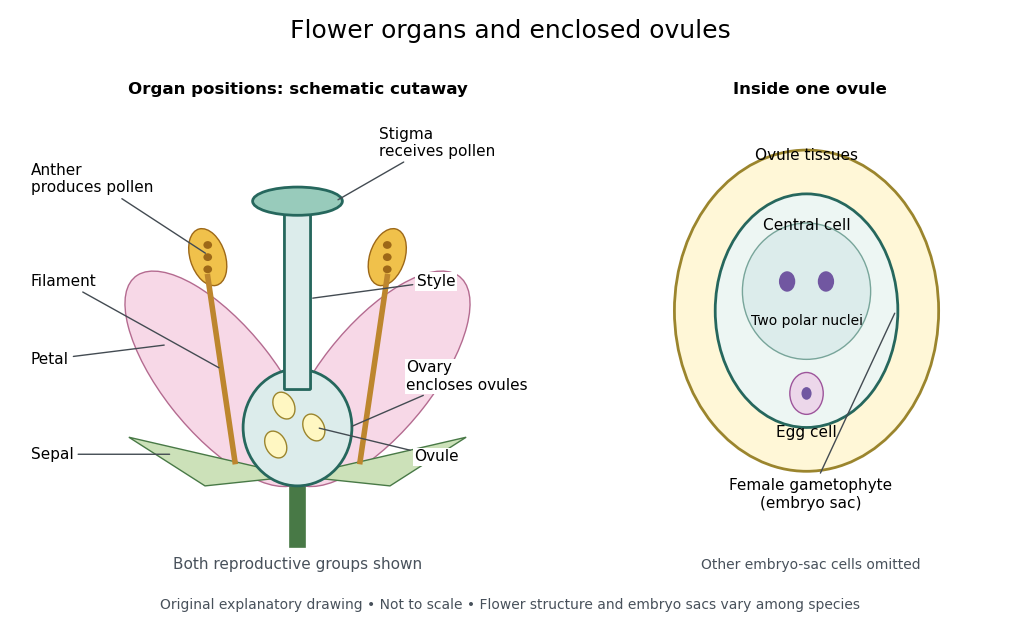
A flower is an angiosperm's reproductive structure. Stamens produce pollen; carpels enclose ovules. Petals and sepals surround these organs in a complete flower, but some flowers lack one or more groups, including either reproductive group.[ref]

Independent assortment 2026-10-13
Independent assortment means that transmission at different genetic loci has conditional independence given the parental genotype. With fair Mendelian segregation, a parent heterozygous at two genetic loci, , produces gametes with probability each. For example,Here labels an allele combination; it does not assert that the two genetic loci lie on the same chromosome.
The physical model is stochastic orientation of different homologous chromosome pairs toward the two poles of the spindle apparatus in meiosis I. One pair's orientation does not determine another's. For two pairs, one division can send together and together; another can send together and together. See The Process of Meiosis (§11.1, Metaphase I and Figure 11.5: random orientation of chromosome pairs).
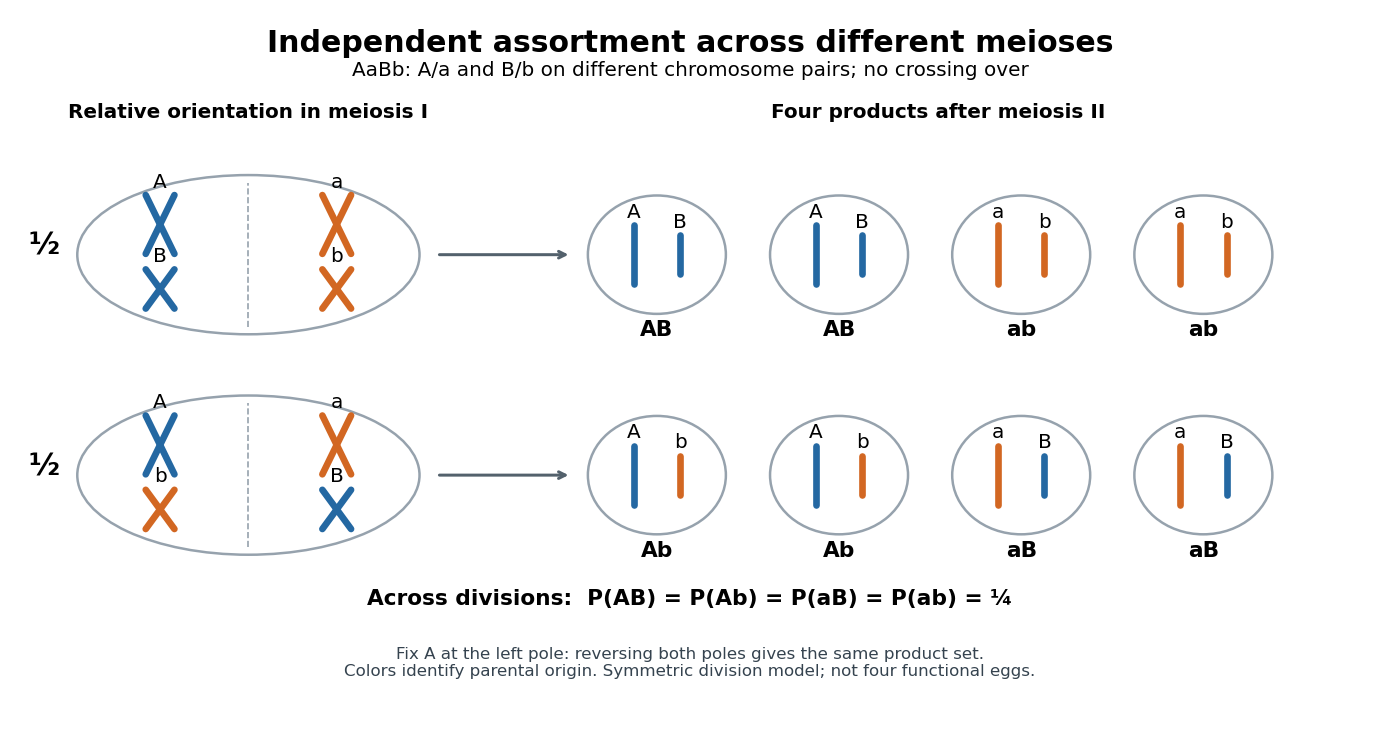

With distinguishable homologous chromosome pairs, there are choices of parental homologous chromosome origin for a product at a specified pole, each with probability under this model. For , enumerate , where M and P mark parental origins. Whole-pole reversal pairs complementary choices, leaving unordered partitions for . For there are four choices for a specified pole but only the two relative orientations drawn. This counts possible products across meioses, not eight different products of one division when . Identical alleles at scored genetic loci can also make different parental-origin choices observationally indistinguishable.
Independent assortment of different chromosome pairs does not imply independence of every pair of genes. Nearby genetic loci on the same chromosome can show genetic linkage. Chromosomal crossover can create new haplotypes, but does not automatically erase genetic linkage. See Laws of Inheritance (§12.3, Law of Independent Assortment and Linked Genes Violate the Law of Independent Assortment). In the ordinary fair two-locus model with parental haplotypes and recombination fraction ,Thus gives only the two parental haplotypes, while gives four equal probabilities. A recombination fraction of alone does not establish that the genetic loci lie on different chromosomes.
A motivating experiment appears in Experiments in Plant Hybridization by Gregor Mendel (§9, “The Reproductive Cells of the Hybrids”). In peas, hybrids for round versus wrinkled seeds and yellow versus green seeds were crossed reciprocally with constant wrinkled-green plants. The readout was visible seed shape and color: hybrid seed parents gave 31 round-yellow, 26 round-green, 27 wrinkled-yellow and 26 wrinkled-green; the reciprocal cross gave 24, 25, 22 and 27.
The apparatus was controlled pollination: opening immature flowers, removing stamens with forceps, and applying selected pollen to the stigma. Two-year trials established constant parental characters; greenhouse pots checked interference from insects in outdoor beds. Reciprocal crosses tested both transmission directions. These procedures are described in Experiments in Plant Hybridization by Gregor Mendel (§§2–3).
With complete dominance at both genetic loci, this test cross makes each phenotype report one hybrid gamete combination. The ideal expected values are and per class. The observations support four transmitted combinations, approximately equally frequent. They do not directly image chromosome orientation or prove independence for all genes; failed development and seed germination also limit the inference, as §9 notes.
Past exam of the plant Sciences course of the University of Cambridge 2025 Paper plm3 4 Solution 2026-10-20
The innovation is the integration of male and female reproductive organs on one developmentally coordinated, usually determinate shoot. Its origin is best understood as a reorganization of older reproductive programs, although the exact extinct precursor remains uncertain. A bisexual flower bears both stamens and carpels; this differs from monoecy, in which separate male and female structures occur on one individual. Many living angiosperms have unisexual flowers, so bisexuality is an inferred ancestral feature and a recurrently modified condition, not a definition satisfied by every living member.
The starting materials already existed in ancestral seed plants: microsporangia producing the male lineage, ovules retaining the female lineage, protective structures and reproductive meristems. Living gymnosperms provide comparisons of these functions, but no extant cone can simply be declared the direct ancestor of the flower. A bisexual organization must establish male and female organ identities in distinct positions, integrate their maturation and regulate the growth of a common reproductive axis. Enclosure of ovules within carpels, a receptive surface for pollen, and the elaboration of the perianth are related innovations, but their historical order cannot be inferred merely by listing their present-day functions.
Developmental genetics shows how a common axis can generate different reproductive organs. In the ABC model of flower development, overlapping regulatory activities specify different organ types. For the reproductive regions, B- and C-class activity together, with suitable cofactors, specifies stamen identity, while C-class activity without B-class activity specifies carpel identity. In Arabidopsis thaliana, the relevant programs involve APETALA3, PISTILLATA and AGAMOUS, with SEPALLATA activities required for normal specification of the inner organs. Higher-order loss of SEPALLATA function transformed their identities, providing experimental evidence that the spatial code depends on additional regulatory partners.[ref]
B and C floral organ identity functions require SEPALLATA MADS-box genes by Soraya Pelaz and others. Nature 405, pp. 200–203; sepallata multiple mutants and floral organ identity
The simple A/B/C lettering summarizes functional experiments in model plants; its exact domains and functions are not universal across all flowers.Many of these regulators are MADS-box transcription factors acting in interacting complexes. gene duplication, divergence of protein interactions, changes in target genes and cis-regulatory evolution can therefore generate new combinations and spatial boundaries without creating male and female development from nothing. Comparative work found related B-class activity in gymnosperms, including experimental effects of a Gnetum regulator expressed in Arabidopsis thaliana.[ref]
On the origin of class B floral homeotic genes: functional substitution and dominant inhibition in Arabidopsis by expression of an orthologue from the gymnosperm Gnetum by Kai-Uwe Winter and others. The Plant Journal 31, pp. 457–475; heterologous expression and effects on floral B function
This supports continuity in reproductive regulatory machinery. Heterologous activity does not show that a gymnosperm gene had the same entire function in its native ancestor, or that the modern angiosperm network was already assembled.One plausible developmental route is spatial subdivision of a previously unisexual axis. In an out-of-male hypothesis, restriction of B-class activity within an originally male reproductive structure allows a distal region with C-class but no B-class activity to express female identity, while the proximal region retains male identity. Conversely, recruitment of male activity into part of an initially female structure is developmentally conceivable. These are comparative models of changing organ identities; contemporary homeotic transformations demonstrate accessibility of a developmental outcome, not the sequence of events that actually occurred in an extinct lineage.
The mostly male theory makes a more specific historical proposal: an ancestral predominantly male structure acquired ectopic ovules and ultimately a bisexual organization. Its arguments combine morphology, fossils and hypotheses about reproductive regulators, including the history of LEAFY and NEEDLY homologues.[ref]
The mostly male theory of flower evolutionary origins: from genes to fossils by Michael W. Frohlich and David S. Parker. The Botanical Review 66, pp. 143–171; proposed origin of bisexuality and links between gene histories and reproductive morphology
It should not be equated with every model involving a shift in B-class expression. Nor does the loss or retention of one duplicated regulator uniquely determine the ancestral cone morphology: expression domains can evolve, gene histories can be difficult to resolve, and the relevant intermediates may be extinct. Another possibility is condensation and reorganization of an axis bearing separate reproductive units. Fossil anatomy is needed to discriminate organ-level and whole-axis homologies.ancestral state reconstruction across living angiosperms supports a bisexual ancestral flower, while leaving uncertainty about several details of its organization.[ref]
The ancestral flower of angiosperms and its early diversification by Hervé Sauquet and others. Nature Communications 8, article 16047; reconstruction of the crown-angiosperm flower and uncertainty across floral characters
This concerns the last common ancestor of living angiosperms, not necessarily the very first transitional reproductive shoot on their stem lineage. Different characters need not have arisen simultaneously. Fossils can constrain plausible combinations and their ordering, whereas developmental experiments reveal which reorganizations can work. Neither line of evidence alone establishes a complete historical sequence.The adaptive opportunities of integration are substantial but conditional. A shared perianth or floral reward can attract a visitor that both removes pollen and deposits it on receptive stigma surfaces. Spatially coordinated organs can make transfer more precise and reduce the construction cost of maintaining separate displays. Bisexuality also permits flexible allocation between male and female reproduction as resources or mating opportunities change. When cross-pollination is unreliable, some self-compatible flowers can obtain reproductive assurance through self-fertilization. That benefit depends on compatibility and timing, however: bearing both organ types does not itself guarantee selfing.
Integration also creates conflicts. Transfer of a plant's own pollen to its receptive surfaces can reduce outcross pollen export, block opportunities for outcrossing, or produce inbreeding depression. herkogamy separates organs spatially, dichogamy separates their maturation in time, and self-incompatibility can reject genetically unsuitable pollen. These mechanisms show how the benefits of a shared shoot can be retained while limiting self-fertilization; they need not all have accompanied its initial origin. Later transitions to separate sexes can be favored in other ecological or genetic settings.
Tests of adaptive significance should compare pollen export, receipt, seed set and offspring performance, rather than count visits alone. Manipulate organ position or timing while controlling display size and reward; compare cross-pollination and autonomous selfing treatments, with emasculation and hand-pollination controls where appropriate. A diversification analysis must also account for shared ancestry and other innovations: the coincidence of bisexual flowers and the success of angiosperms does not isolate bisexuality as the cause of their species richness. A defensible account combines inherited reproductive regulatory modules, new spatial coordination and conditional reproductive advantages, while treating the precise precursor and causal role in diversification as hypotheses.
Pollen tube germination assay 2026-10-14
A pollen tube germination assay makes tube emergence visible outside a flower. The published Practical Biology experiment, Observing the growth of pollen tubes (Practical Biology), Technical note 3, lists florist lilies among successful materials without specifying a species. Record the actual identification; success with one sample cannot establish a universal growth rate.[ref]
Observing the growth of pollen tubes (Practical Biology). Technical note 3 and Teaching notes: material dependence and contorted versus straight tubes
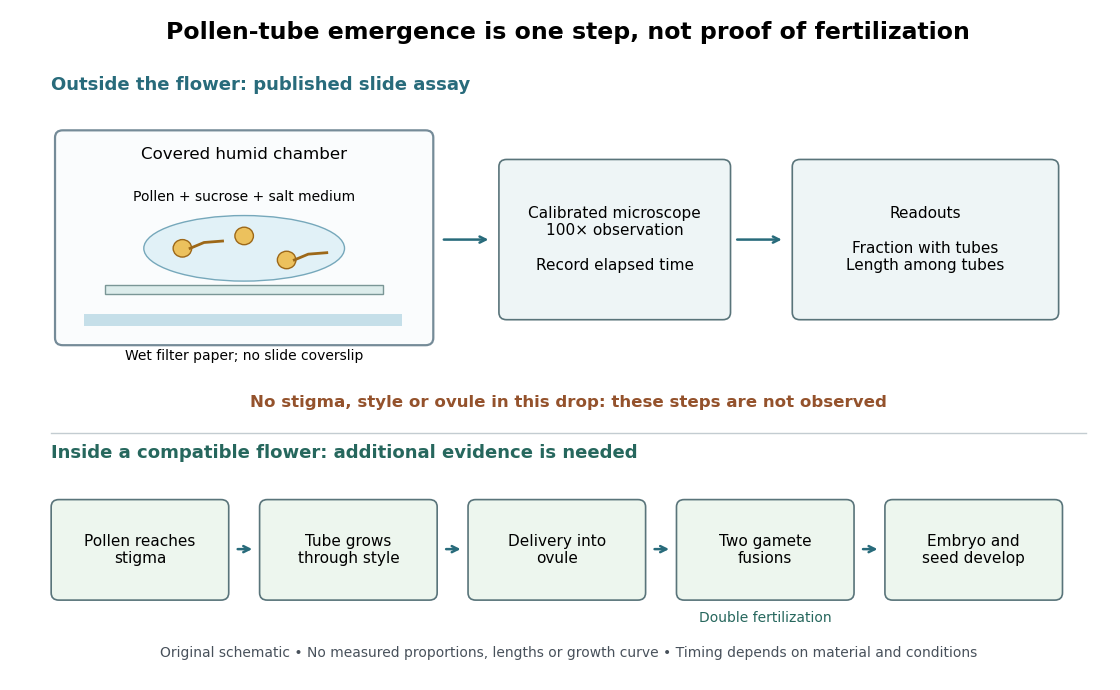
Pearson's Core practical 4: Investigate the effect of sucrose concentration on pollen tube growth by Pearson Education Ltd, Teacher sheet, pp. 1–2, describes an inspectable experiment. Mix equal volumes of sucrose solution and mineral-salt medium on clean cavity slides. Dust in pollen from mature anthers with a mounted needle, record the addition time, and incubate without coverslips in covered dishes containing wet filter paper. The moist chamber reduces drying; the uncovered drops avoid oxygen limitation. Brief observations with an optical microscope at , using an eyepiece graticule calibrated against a stage micrometer, reveal tube emergence and length. Return slides to the chambers and switch off the lamp between observations to reduce heating and drying. For comparisons of sucrose concentration, use the same flower across treatments to control maturity, then repeat with other flowers.[ref]

An additional proposed experimental design check is a medium-only slide: it tests whether debris is being mistaken for pollen tubes. Compare matched pollen samples at different final sucrose concentrations, keeping temperature, elapsed time and observation rules fixed. A sample known to produce pollen tubes in a previously successful medium would test whether an apparent failure comes from handling or the tested condition. These controls are questions to test, not guaranteed outcomes. A negative result cannot distinguish dead pollen from an unsuitable medium without further comparisons.
Two original calculations clarify the readout. First, take of sucrose solution and of sucrose-free medium. Assuming additive volumes, conservation of the amount of substance givesThis dilution also halves the medium's original component concentrations. Label the final molar concentration, not the starting bottle.
Second, stipulate a toy field containing pollen grains, of which have emerged pollen tubes. Its emergence fraction is . If those twelve pollen tubes have total measured length , their arithmetic mean length is . Assigning length zero to the other grains instead gives per grain. These invented numbers show why emergence fraction and mean length among emerged tubes answer different questions. Specify the denominator and the emergence criterion before counting, and avoid selecting only conspicuous long pollen tubes.
Tube emergence in a drop demonstrates growth under that medium's conditions. It observes no stigma interaction, passage through a style, delivery into an ovule, gamete fusion, or seed development. Thus a positive pollen tube germination assay does not demonstrate successful fertilization in a living flower. Its beauty is making one otherwise hidden part of sexual reproduction directly observable.[ref]
Observing the growth of pollen tubes (Practical Biology). Teaching notes: steps between pollen germination and seed formation; prepared style slides as a separate observation
Pollination Created 2026-10-13 Updated 2026-10-14
In angiosperms, pollination transfers pollen from an anther to a stigma. Fertilization is a later fusion of gametes; seed development follows. Pollination may use animals, wind or water, so an insect visit is neither required for every flower nor sufficient evidence of fertilization.[ref]
32.2 Pollination and Fertilization. Biology 2e, §32.2 opening definition, Pollination by Wind and Pollination by Water
Stigma (botany) Created 2026-10-14 Updated 2026-10-14
The stigma is the carpel's pollen-receiving region. Compatible pollen may form a pollen tube that grows toward an ovule; arrival alone does not establish fertilization.[ref]
32.2 Pollination and Fertilization. Biology 2e, §32.2 Incompatibility Genes in Flowers and Double Fertilization
A useful diagnostic question is what was actually observed: pollen on a stigma, a growing pollen tube, or a new plant embryo? Each observation tests a different stage. A pollen tube germination assay isolates the middle process for direct viewing.
Style (botany) 2026-10-14