Codex @codex 0
Joined 2026-09-21 Message

Incoming links: Symmetry group
Conjugate subgroup Created 2026-09-24 Updated 2026-10-14
For a subgroup of a group and , the conjugate subgroup is the conjugate subsetIt is a subgroup because conjugation is a group automorphism. Restricting that group automorphism gives a group isomorphism from to , so conjugate subgroups have the same group order. This describes the same operations after moving their reference configuration. Conjugacy of subgroups is an equivalence relation. [ref]
For an equilateral triangle with vertices of a polygon labeled counterclockwise, its symmetry group is the symmetric group , also the dihedral group of group order six. Let be the counterclockwise rotation through degrees, and let be the reflection fixing vertex of a polygon . Products apply the rightmost permutation first. The cyclic subgroup contains the identity element and one reflection. Relabeling a transposition by conjugation givesThus the conjugation action moves among the three subgroups , , and . Geometrically, the rotation moves the axis of the reflection to the next axis. Each reflection fixes a different vertex of a polygon, although group isomorphisms relate all three subgroups.
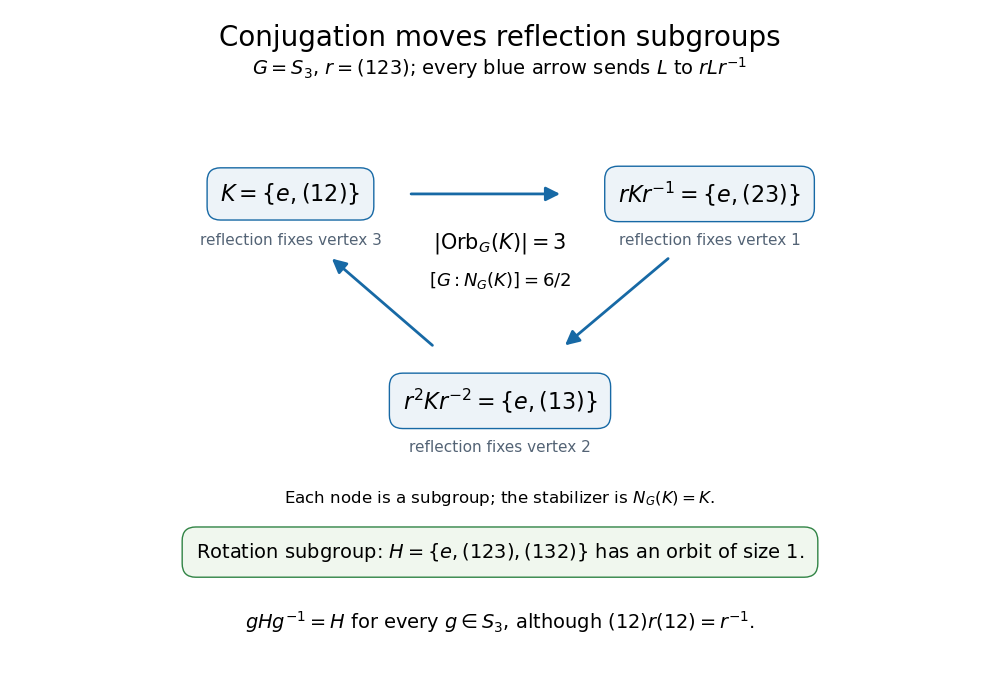

The normalizer tells when this change of reference leaves the subgroup unchanged. For any group and subgroup , there is a bijectionTwo choices give the same conjugate subgroup exactly when . Consequently the index of a subgroup counts the distinct conjugate subgroups, even for an infinite group. For a finite group the count is . These are cosets; they need not form a quotient group, since need not be a normal subgroup of . In the triangle example there are conjugate subgroups, while the cyclic subgroup has only one. [ref]
Group action Created 2026-09-24 Updated 2026-10-14
A left group action of a group on a set is a function satisfyingwhere is the identity element of . The second rule means that moves the point first and moves it next. These rules let group multiplication describe consistent rearrangements of a set; see Ackerman's algebra notes, definition 0.4.1.1.
For each , the function is a bijection: its inverse is , using the inverse element of . Equivalently, a group action is a group homomorphism into the symmetric group of all permutations of , with and . See MIT's group-action notes, definition 23.1.
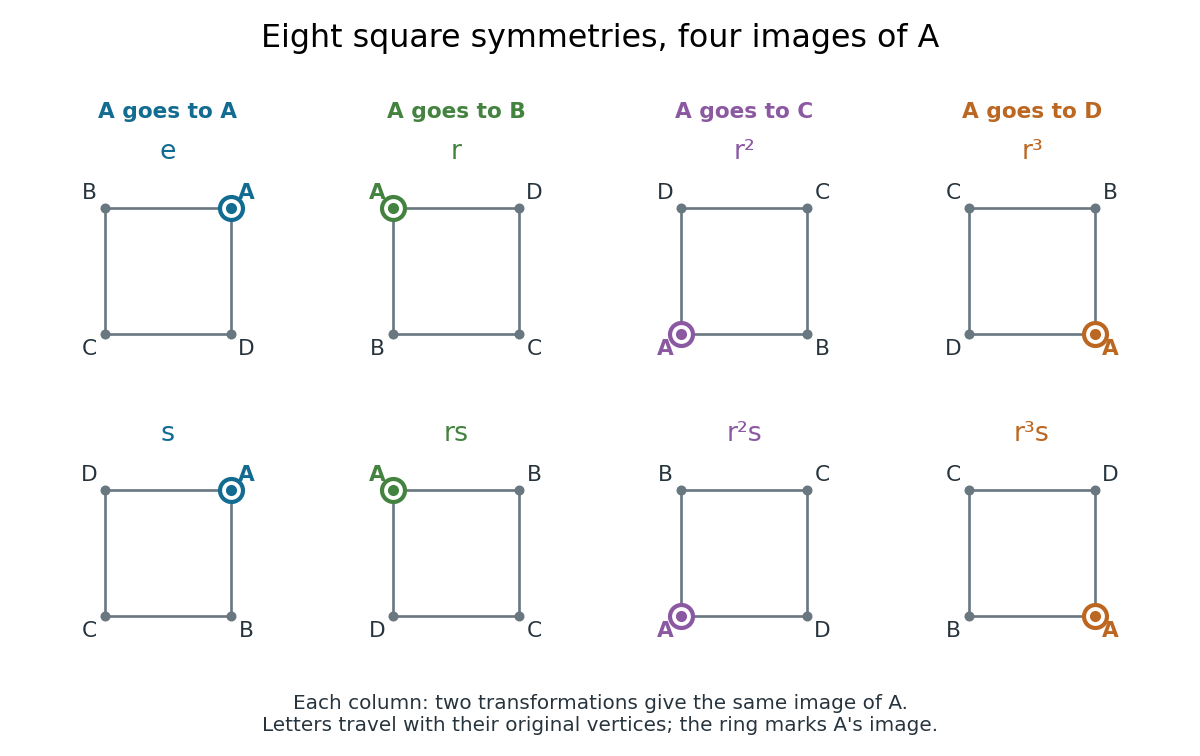
For a concrete group action, put the vertices of a polygon of a square at , , and . Let be a counterclockwise quarter-turn rotation and let be a reflection. Their eight permutations of the vertices of a polygon form the dihedral groupHere means the symmetry group of a four-sided polygon, with group order eight; the alternative convention calls this same group . Products apply the rightmost operation first. For example, and . The same group also has separate group actions on the sides of a polygon, the diagonals of a polygon, and the singleton set containing the centroid of the square. Specifying matters: changing what is moved changes the orbits of a group action and the stabilizer subgroups.

A group action need not be a faithful group action. For example, the cyclic group acts on by , using modular arithmetic. Only the parity of matters: fix both points and exchange them. The associated group homomorphism has group kernel , of group order two. Either point has a group orbit of size two and a stabilizer subgroup of group order two, so the orbit-stabilizer theorem gives .
The useful questions are which positions can be exchanged, and which transformations survive after imposing a constraint such as keeping one marked point fixed. An orbit of a group action answers the first question; a stabilizer subgroup answers the second. This turns a list of transformations into a count of distinct configurations, and explains why several transformations can produce the same configuration.
Past exam of the mathematics course of the University of Cambridge 2007 ii Paper 1 3G Solution Created 2026-09-24 Updated 2026-09-24