helium changes cavity stability and ductility; void swelling changes bulk volume and component dimensions. These effects interact, but a helium bubble and a vacancy-rich void are not interchangeable descriptions.
neutron reactions produce helium from alloy constituents and impurities. For example, capture by boron-10 can produce helium through ; the production per displacement dose depends on composition and neutron spectrum. Retained helium has low solubility and is trapped at defects or in bubbles. Bubble nucleation and growth at grain boundaries can assist intergranular cavitation, lowering tensile ductility and creep-rupture resistance, particularly when temperature permits the relevant transport. This is important even before a large bulk void swelling is measurable. A primary study linked high-temperature ductility loss to observed bubbles and grain-boundary weakening in irradiated stainless steel.[ref]
displacement damage continuously creates vacancies and self-interstitials. Their different capture efficiencies at dislocations and other sinks can leave a vacancy supersaturation available to cavities. A stable cavity grows when its net vacancy uptake exceeds vacancy emission and interstitial absorption. helium can help stabilise small nuclei, but the later volume increase is not simply the volume of gas inserted into an unchanged matrix. Changing helium content can also change cavity number, size and competition for point defects; a universal proportionality between helium concentration and void swelling is not justified.
For nuclear fuel cladding, void swelling can enlarge the diameter, alter the fuel–nuclear fuel cladding gap, reduce clearances and distort reactor coolant channels or nearby structures. Nonuniform void swelling generates additional stresses. Bubble-assisted embrittlement and stress-dependent creep then affect the ability of the wall to contain the fuel and internal pressure. The relevant measurements combine density or volume change, dimensional strain, cavity microscopy and mechanical tests. Pressurised-tube experiments explicitly separated void swelling, creep, plastic strain and precipitation strain; void swelling itself was approximately isotropic in that study.[ref]
void swelling has a temperature window, rather than increasing monotonically with irradiation temperature. At sufficiently low temperature, vacancy migration and cavity growth are slow. At intermediate temperature, mobile defects, stable nuclei and unequal sink capture can support rapid cavity growth. At higher temperature, increased vacancy emission, recombination and changing sink populations can reduce the vacancy supersaturation and net void swelling. The precise peak depends on alloy, spectrum, dose rate and starting microstructure; lower void swelling at high temperature does not mean that creep or helium embrittlement is harmless there.
Distinguish void swelling from its slope. With displacement dose , a simple schematic description is
where represents incubation and an approximately constant post-transient slope over a limited range. Real nucleation and sink evolution make the transition smooth; neither nor is a universal material constant. At larger dose, microstructural or compositional evolution may change the slope again.
neutron fluence is an integrated exposure, . Under an unchanged spectrum it can track displacement dose, but equal fluence does not necessarily imply equal damage or helium production. Even equal dpa can give different void swelling at different dose rates because recombination and transport compete in real time. Thus compare specimens at specified temperature, spectrum, dose rate and metallurgical condition; do not transfer one void swelling curve using fluence alone.
Delay cavity nucleation and prevent a large sustained vacancy flux to growing cavities. Select an austenitic alloy composition and heat treatment demonstrated to have low void swelling in the intended spectrum and temperature range; modest composition changes can alter precipitation, segregation and sink evolution. The grade label alone is insufficient.
cold working supplies a dislocation population that can alter defect capture and extend the low-swelling transient. Stable fine precipitates or other engineered sinks can promote defect removal, but capture bias matters as well as sink count. Irradiation and thermal recovery can erase the starting microstructure, so an initially favourable state must be checked at relevant dose. Controlled impurity and helium-producing constituent contents can reduce harmful gas effects, subject to corrosion resistance and phase-stability requirements.
Operating outside a strong-swelling regime, reducing accumulated exposure or replacing components before their qualified limit are complementary measures. Each trades against other constraints such as corrosion, creep, ductility and heat removal. “More cold working” or “more sinks” is not an unlimited prescription. Measurements must separate void swelling from creep; reducing one does not establish that the other was reduced. The pressurised-tube study is a particularly useful control because, after separating stress-enhanced void swelling, its derived creep strains were similar for annealed and cold-worked specimens.[ref]
Both terms concern time-dependent strain under stress. Here radiation-enhanced creep means irradiation accelerating a mechanism that also operates thermally, whereas radiation-induced creep emphasises deformation driven by irradiation-specific defect fluxes. The literature sometimes uses irradiation creep as an umbrella, so identifying the mechanism is more informative than treating the names as mutually exclusive experimental categories.
radiation-enhanced diffusion maintains mobile point-defect concentrations above their thermal equilibrium values. Under a load, this can accelerate diffusion-mediated deformation or dislocation climb and thereby enhance a creep mechanism. The effect depends on temperature, defect production, recombination and sinks; simply raising the specimen temperature by radiation heating is a different explanation and must be controlled.
radiation-induced creep can remain important where unirradiated creep is small. stress-induced preferential absorption gives differently oriented dislocations unequal capture of irradiation-produced defects, producing directional climb. Climb can also enable further glide by relieving obstacles. A schematic low-stress relation is
with a condition-dependent compliance , not a universal constitutive law. Coupling to void swelling and evolving sinks can add further terms.
Compare stressed and unstressed specimens in and out of irradiation at matched actual temperature, and resolve longitudinal, transverse and volumetric strains. Unstressed irradiation growth or void swelling is not itself evidence of creep, and stress-enhanced void swelling must not be included automatically in a fitted creep strain. These controls distinguish a mechanical response to irradiation defects from ordinary creep or a different dimensional-change mechanism.
A useful fuel combines neutronic suitability, heat removal, containment and dimensional stability. A sufficient fissile inventory and acceptable neutron economy permit the intended power and exposure, while unnecessary parasitic absorption wastes neutrons. These requirements are reactor-specific rather than a recommendation for one universal composition.
A high melting margin and stable phases help preserve geometry. Good thermal conductivity reduces the centre-to-surface temperature rise and associated thermal stress; heat capacity helps moderate transient temperature changes. Chemical stability and compatibility with reactor coolant and nuclear fuel cladding reduce corrosion and reactions at the interface with nuclear fuel cladding. Oxygen chemistry and other composition variables can affect both transport and interface reactions.
Under irradiation the fuel should tolerate displacement damage, restructuring, radiation-induced swelling and fission gas accumulation without unacceptable cracking, gap closure or pressure. Retention of radionuclides and controlled release of fission gas support the nuclear fuel cladding's containment function. Predictable creep can relieve stress, but excessive deformation may compromise geometry. Fabrication reproducibility, inspectable microstructure, resource availability and the practicability of subsequent waste management also matter.
uranium dioxide illustrates the compromises: it is a chemically robust, high-melting ceramic fuel, but its relatively limited thermal conductivity, irradiation-dependent microstructure and gas behaviour require explicit thermal and mechanical design margins. A desirable individual property does not establish the performance of the coupled nuclear fuel and nuclear fuel cladding system.
plutonium introduces decay heat, self-irradiation and composition-sensitive thermochemical behaviour, as well as demanding radiological handling and material accountancy. isotopic composition affects heat and neutron production, so total plutonium mass alone does not specify the handling environment. The elemental metal also has inconvenient allotropic and thermal behaviour; using an appropriate stable ceramic fuel form avoids treating bare metal as a straightforward substitute for uranium oxide.
In mixed oxide fuel, plutonium dioxide and uranium dioxide form the engineered ceramic system. Important challenges are composition uniformity, thermal conductivity and melting margin, oxygen chemistry, restructuring and fission gas behaviour, and compatibility with nuclear fuel cladding. A local composition variation can produce a local power or temperature variation. During service, actinide redistribution can change the initial spatial distribution; its direction cannot be inferred from the temperature gradient alone. Autoradiographic examination of irradiated mixed-oxide pins directly investigated the competing transport effects.[ref]
Mitigation is to use a characterised fuel form and isotopic inventory, qualify composition and microstructure uniformity, retain suitable thermal margins, and establish irradiation performance and interface compatibility. radioactive material confinement, remote or protected handling and waste management address the accompanying contamination and exposure problems. These are materials requirements and verification objectives; no plutonium preparation, separation or fuel-manufacturing procedure is needed to answer them.
glass accommodates a chemically diverse waste inventory without requiring every constituent to fit one specific crystal site. A borosilicate network can incorporate many constituents while producing a dense monolithic waste form. An established melt-and-pour approach permits remote processing and a reproducible package geometry; suitable formulations combine useful waste loading with low aqueous release rates. The absence of crystalline grain boundaries also removes one possible preferential path, although cracks or other heterogeneity can still occur.
The flexibility has limits. Some constituents have limited solubility or can separate into undesired phases, and increasing waste loading can impair processability or durability. Melting can release volatile constituents that require capture and generate secondary wastes. Cooling stresses may crack the product and enlarge its accessible surface; devitrification or phase separation can change chemical durability. Heat and radiation can change density, bonding or microstructure even though the starting glass is already noncrystalline.
Most importantly, glass is an immobilisation medium, not an assertion of zero reaction with water. Durability depends on composition, temperature, solution chemistry and the evolution of alteration products. A low initial leach rate does not alone demonstrate long-term behaviour, and an amorphous structure does not make the material inert. Container and repository barriers complement rather than duplicate the glass's role. A suitable choice therefore balances processing, composition tolerance, radiation response and aqueous durability instead of maximising only one property.
Write for the exposed glass area. If is the blank-corrected dissolved mass concentration of element , its initial mass fraction in the glass and the leachate volume, then
The numerator is the released element mass measured in solution. Dividing by converts this to an equivalent mass of the original glass, while dividing by expresses that mass per exposed area. With in and in , has units of glass-equivalent release. The fraction must be used as a fraction, not an unconverted percentage.
These corrections allow comparison of specimens of different size and composition without confusing a lower concentration with better durability. State how the area was measured; geometric area and a rough powder's accessible area need not coincide. For repeated sampling, include element mass removed in earlier aliquots and the volume remaining; for an initial blank in the leachant, subtract its corresponding inventory. Surface cracking and evolving porosity can make a rate based on initial area differ from a rate based on the true reactive area.
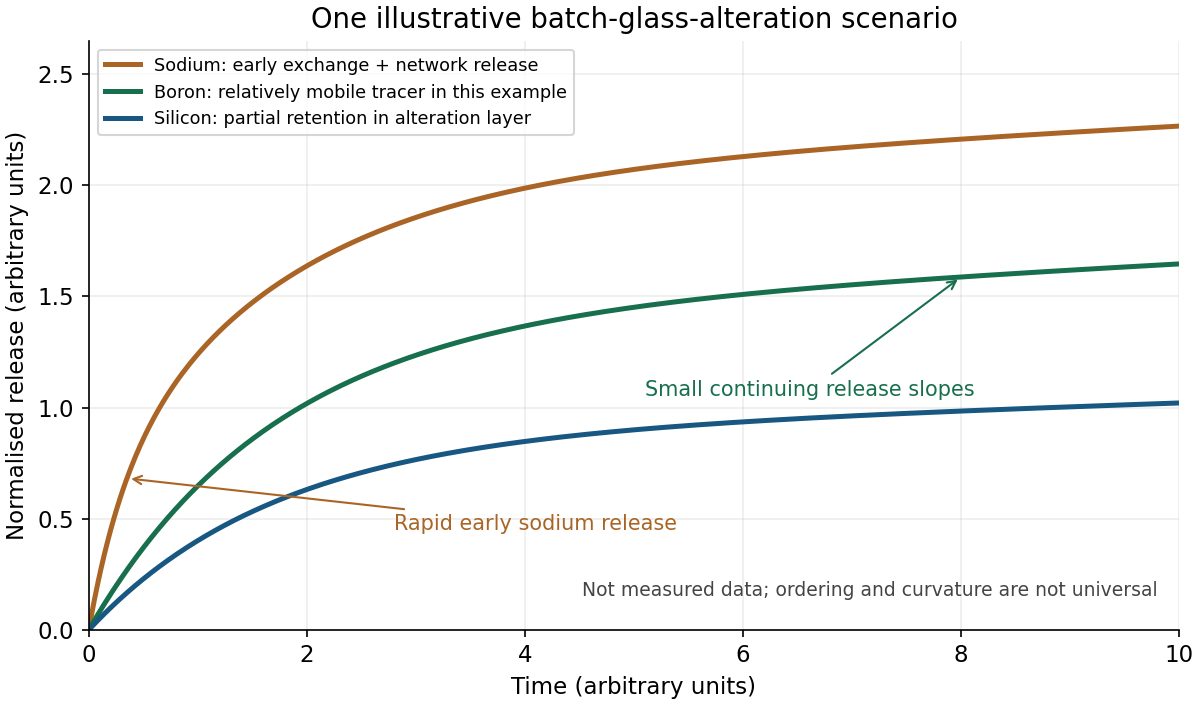
Under congruent glass dissolution, constituents enter solution in their bulk proportions, so their correctly normalised releases coincide. Preferential sodium release by ion exchange can instead give , while silicon retention in a gel or secondary precipitate can depress its dissolved release. Noncoincident curves show nonstoichiometric aqueous release, but do not uniquely identify the mechanism. Conversely, solution coincidence does not by itself establish that no secondary reactions occurred. A complete inference compares solution inventories with altered solids.
Normalisation removes composition and first-order area/volume scaling; it does not make different pH, temperature, solution composition or contact histories equivalent. In a batch test, even the same initial water changes composition and pH as reaction proceeds. Reporting those conditions and time is essential for a transferable comparison rather than treating as a condition-independent material constant.
water first interacts with accessible surface sites and enters the near-surface region. Exchange of alkali ions with hydrogen-bearing species can release sodium before the silicate network has dissolved in bulk. A schematic site exchange is
hydrolysis also breaks network linkages, illustrated by
Boron-containing linkages and the rest of the network react in a composition- and pH-dependent way. Alkali exchange changes the water chemistry, and network hydrolysis releases or rearranges constituents rather than simply removing an intact molecular glass unit.
In a finite batch of initially deionised water, dissolved products accumulate and pH evolves. silicon can be retained in a hydrated alteration gel, and condensation or restructuring changes that layer's connectivity and transport properties. Reduced chemical driving force and a less permeable interfacial layer can lower the rate; a residual glass alteration rate can persist rather than all reaction stopping at an apparent plateau. Atomistic work published before the examination provides one account of how gel restructuring can hinder hydrated-species transport, without making that account universal for all glasses.[ref]
Figure 1.
Illustrative normalised sodium, boron and silicon releases in one batch-glass-alteration scenario
. Details.
The original sketch shows one plausible scenario, not measured data or a universal ordering. sodium initially rises rapidly through exchange. boron acts as a relatively mobile tracer of network alteration, while a smaller solution silicon release reflects retention in an alteration layer. The slopes subsequently decrease as batch chemistry and the layer evolve; small continuing slopes represent residual release. Offsets can remain even if later release rates become similar. Initial deionised water does not imply that the solution remains neutral or dilute throughout the test.
boron need not be an ideal fully released tracer: it can be retained in some gels, changing the relation between aqueous boron and the depth of alteration. A later study, published in 2020, explicitly compared solution release with solid depth profiles and demonstrated that limitation; it is cited as a subsequent qualification, not evidence available to a student in May 2019.[ref]
Secondary phases can further modify dissolved inventories and, by consuming solution components, sometimes accelerate alteration again. Neither a permanently flat terminal curve nor a later acceleration is compulsory. Without a specified glass, temperature, area/volume ratio and solution history, the defensible sketch communicates exchange, network reaction and evolving retention, with those assumptions stated.
At the maximum found in part(a), and . Substitution into the exponential slab heating solution gives
For , the function is positive: it vanishes at and has derivative . Thus the interior temperature exceeds the common surface temperature, consistently with positive internal heating.
A convenient dimensionless form uses :
As , , giving the check
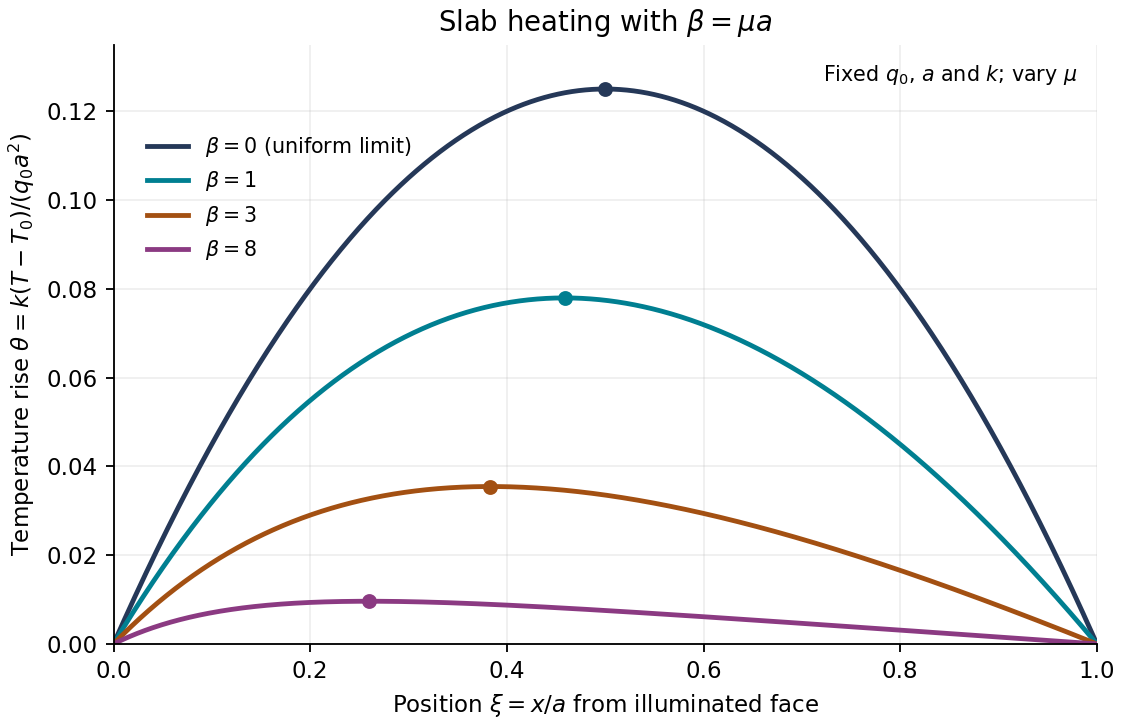
Figure 1.
Original normalized slab temperature profiles calculated from the exponential slab heating solution; markers indicate the maxima
. Details.
The graph holds the normalization fixed. Its decreasing peaks with increasing reflect a decreasing source away from the illuminated face under that comparison; they do not assert the same trend at fixed total absorbed power.
The exponential slab heating solution separates three useful controls: the heat source, the conductive path and the boundary temperature. Reduce deposited power, improve thermal conduction, shorten paths to a cooled surface, or lower the actual surface temperature. Each proposal has to preserve the shield's radiation-protection function.
Reduce incident photon intensity, intercept part of the beam in a separately cooled upstream shield, or distribute the deposited power over a larger cooled region. These reduce the relevant volumetric heat generation rate or local heat load. Intermittent exposure can reduce average heating, but the peak then requires a transient heat equation calculation; a smaller average alone does not establish a safe pulse maximum.
Increase the effective thermal conductivity, for example through a suitable material or a well-bonded conductive path to a heat sink. Reduce contact thermal resistance in any added path. Material substitution must also satisfy shielding, mechanical and environmental constraints.
Shorten the maximum conduction distance by introducing cooled internal surfaces or dividing the shield into thinner, separately cooled layers. Reducing the thickness of a single slab lowers its temperature rise at fixed and , but also reduces attenuation; it is not automatically an acceptable shield modification. A layered arrangement can preserve the required total shielding while changing the thermal boundary-value problem.
Lower the cooling-air temperature, improve forced convection by appropriate flow and surface design, enlarge the heat-exchange area, or use a more effective coolant where compatible. These can lower the actual boundary temperature when the external cooling is modeled. In the stipulated model is already prescribed: increasing the external heat transfer coefficient while holding fixed leaves the calculated interior profile unchanged. It helps physically by reducing the surface-to-coolant temperature difference under a heat load.
Do not change the attenuation coefficient independently of the heat-source normalization without explaining the comparison. At fixed incident photon energy flux, the entrance deposition generally changes with absorption properties. A larger with artificially fixed is a different experiment. Similarly, increasing total slab heat capacity delays heating but does not lower the steady state maximum for an unchanged source and unchanged thermal boundary conditions.
Use a common comparison for all of question2: retain the same number and height of fuel rods and approximately the same normalized rod-power shape; reduce fuel lattice pitch by making the active core cross-section smaller. Compare otherwise similar operating states of an initially under-moderated reactor, typical of a pressurized water reactor. Rod number, core height, reflector and control settings are not all fixed explicitly by the question, so these are stated assumptions. Keeping the external core envelope fixed while inserting more rods would be a different comparison.
Reactor reactivity normally decreases at unchanged controls and reference temperatures. Less water per fuel atom reduces neutron moderation and increases resonance absorption during slowing down. Reduced absorption in the water partly compensates, but on the under-moderated side the net lattice tendency is lower multiplication. This is the usual under-moderation argument, rather than a universal rule for arbitrary fuel lattices.[ref]
Neutron leakage would usually tend to increase. The smaller transverse core extent increases the geometric tendency to leak, and reduced moderation generally increases the slowing-down distance. There are competing changes in fuel absorption, transport lengths and reflection. Thus a definite leakage fraction needs the actual core and reflector arrangement; the usual increase is a qualitative tendency, not a geometric theorem for every redesign.
The Doppler coefficient of reactivity remains negative under the ordinary uranium-fuel assumptions. Increasing fuel temperature broadens absorption resonances, increasing effective uranium-238 resonance capture and reducing reactor reactivity. This stabilizing fuel-temperature effect is distinct from moderator-density feedback.[ref] Greater importance of resonance absorption can make this feedback more important in a tighter lattice, but its change in magnitude is not fixed by pitch alone: spectrum, resonance self-shielding, fuel composition, burnup and the reference fuel temperature all enter the derivative.
The fraction of fissions in uranium-238 tends to increase. The harder neutron spectrum gives more opportunity for fast fission before neutrons slow below the uranium-238 fission threshold. This concerns the fraction of the total nuclear fission rate, not an assertion that the total thermal power increases; that power is held fixed.
Continue the same-rod-number and same-height comparison from part(a), and assume unchanged pump speed, similar inlet conditions and single-phase forced flow for the normal-operation hydraulic argument.
Core power density increases. The active core volume decreases while total thermal power stays fixed. The fuel's own average volumetric power and the mean fuel linear heat rate do not increase merely from bringing the same rods closer together: fuel volume and rod count are unchanged.
Coolant mass flow rate normally decreases. Tighter passages reduce flow area and hydraulic diameter, increasing the core's hydraulic resistance. The unchanged centrifugal pumps do not enforce constant flow. The pump operating point moves to the intersection of the same pump curve with the steeper system-resistance curve, normally giving smaller flow at greater pump head.[ref]
The core pressure drop normally increases for the usual pump curve. Its resistance at any given flow is higher. At the new, smaller flow, unchanged external piping and component losses are smaller, whereas a conventional falling pump head-versus-flow curve gives greater available head. The core takes the difference. This conclusion uses the stated pump-curve assumptions; holding flow fixed or holding pump head fixed would be different models. The exact new flow and pressure drop need both system and pump characteristics.
Fuel temperature would normally tend to rise, especially downstream, if the loss of flow increases coolant heating without a compensating improvement in film heat transfer. At fixed inlet state,
shows that smaller total mass flow rate raises the bulk coolant temperature rise. At unchanged local fuel linear heat rate, the fuel-to-surface conductive contribution is approximately unchanged if material properties and gap conditions are held fixed. Its boundary temperature and the coolant film drop can nevertheless change.
The local coolant mass flux is . Both total flow and flow area decrease, so the sign of the change in , the heat transfer coefficient and the fuel temperature cannot be deduced from total flow alone. Changes in power peaking and inlet conditions add further qualifications to the usual hotter-fuel tendency.
The minimum departure from nucleate boiling ratio would commonly decrease, implying reduced boiling margin, but its sign is conditional. The defining local ratio is
The numerator is the critical heat flux for the local conditions, and the denominator is actual rod-surface heat flux.[ref] The mean surface heat loading remains approximately unchanged for the same rods and total power. Greater coolant enthalpy rise tends to reduce margin, while changes in , geometry, pressure and local power determine the actual critical heat flux. A geometry-appropriate correlation or experiment is needed for a definite MDNBR change; unchanged hardware does not supply it.
A tighter core is likely to have a more demanding cooling response, but the specification does not determine a unique peak cladding temperature or reflood time in a loss-of-coolant accident. Several effects compete.
At the same pre-accident power and comparable irradiation history, the total decay heat source remains of broadly comparable scale; increasing core power density does not multiply the total decay power by the inverse change in core volume. The core nevertheless has less water within its tighter rod lattice. Its local thermal buffer is smaller, and the same heat must be removed through narrower passages. If the normal-operation fuel temperature is higher, more stored fuel thermal energy must also be removed after shutdown.
Reduced passage size and increased hydraulic resistance can impede emergency-coolant penetration and steam discharge during reflood. Local two-phase flow, entrainment and boiling heat transfer can change, so single-phase pump-curve reasoning is insufficient during blowdown and reflood. Less local water can favor earlier uncovering, but blowdown flow and the much larger inventory elsewhere in the unchanged primary circuit also matter. It would be unjustified to infer a proportionate reduction in the entire primary-circuit inventory.
Loss of water also removes neutron moderation. In the assumed under-moderated reactor, this normally contributes negative reactor reactivity, helping suppress fission power. It does not eliminate decay heat after shutdown. The thermal challenge must therefore be assessed separately from the sign of this feedback.
A quantitative comparison needs break characteristics, initial states, emergency injection performance, bypass paths and a transient two-phase calculation. The defensible conclusion is potentially reduced thermal margin and more difficult reflood, requiring reassessment of the emergency core cooling system, rather than an unconditional prediction that every large-break transient becomes worse in every metric.
The characteristic effect is an irradiation-induced upward shift of the ductile-to-brittle transition in ferritic steel. A component previously used above its transition can then fail by cleavage fracture at the same service temperature, with much less warning from plastic deformation.
Ferrite has a body-centered cubic lattice. At low temperature, dislocation glide becomes difficult enough that brittle crack propagation can precede substantial plastic relaxation. Irradiation hardening raises the yield strength by introducing obstacles to dislocation glide; the competition with cleavage fracture consequently shifts toward brittle failure. Austenite, with its face-centered cubic lattice, does not normally show this same sharp cleavage transition. This does not make austenitic steel immune to loss of ductility, helium embrittlement or other radiation damage in materials.
Examine the fracture surface for cleavage fracture facets and river patterns, and compare Charpy impact test energy-versus-temperature curves from exposed material and an unirradiated reference of the same composition and heat treatment. The reference is important: a low impact energy from one failed specimen cannot establish an irradiation-induced shift. Transition curves can also use lateral expansion or the proportion of ductile fracture appearance.[ref]
A direct fracture toughness test over the transition region complements the Charpy impact test; the two measurements are not interchangeable. Combine these observations with exposure history, local temperature, microstructure and crack location. Brittle appearance supports the failure mechanism, while a measured transition shift and suitable controls support its attribution to irradiation.
Neutron capture by boron-10 can generate helium, leading to helium embrittlement, especially at elevated temperature. The relevant nuclear reaction is
The emitted alpha particle eventually becomes a helium atom in the metal. The product branch can also involve gamma emission, without changing this helium-producing balance. The production depends on boron isotopic content and the neutron energy spectrum; a thermal component is particularly relevant to this reaction.
Helium has very low solubility in steel and can be trapped at vacancies, interfaces and grain boundaries. Boron already segregated near grain boundaries can therefore create a locally unfavorable distribution of helium. Stabilized helium–vacancy clusters develop into bubbles or cavities. Under tensile stress, boundary cavities can grow and link, reducing ductility, fracture toughness and creep-rupture life through intergranular fracture. Early thin-foil observations and mechanical tests associated high-temperature ductility loss with helium-containing boundary bubbles and their coalescence.[ref]
Irradiation temperature controls the transport and clustering of both helium and vacancies. At lower temperature, reduced long-range transport can retain small trapped clusters in the matrix. These can contribute to irradiation hardening, but extensive boundary-cavity growth is kinetically less favorable. At higher temperature, migration, cavity growth and material creep become faster, making intergranular fracture and loss of high-temperature ductility more likely. Trap distribution and prior microstructure can redistribute the gas, so there is no composition-independent critical temperature or universal monotonic law.
The mechanical-test temperature also matters. Material irradiated cold can become embrittled during subsequent hot testing or service when trapped gas and defects become mobile. Distinguish gas production during irradiation from the later conditions under which its mechanical consequences are expressed.
Void swelling is generally favored by an intermediate irradiation temperature window. The balance involves defect mobility, stable nucleation, absorption at defect sinks and thermal emission; a larger vacancy population alone does not guarantee a larger void.
At low temperature, vacancy migration is slow. Self-interstitials may migrate and form dislocation loops, and small clusters can cause considerable irradiation hardening, while vacancies cannot readily feed large growing cavities. Defects retained in the matrix can evolve during later heating.
At intermediate temperature, vacancies can migrate far enough to reach stable cavities. Interstitial bias and the competition among defect sinks sustain a net vacancy flux into these cavities. Once the incubation period has produced suitable nuclei and sink populations, substantial void swelling can develop.
At high temperature, the thermal equilibrium vacancy population and vacancy emission from small cavities rise. A small void's curvature further favors emission, so maintaining stable nuclei becomes harder. Recovery changes the dislocation population, and recombination, gas transport and evolving precipitates also change the flux balance. The irradiation-driven vacancy supersaturation can fall, suppressing void nucleation and net swelling. Existing cavities may still coarsen, and gas bubbles, material creep and other damage can remain important.
Thus low-temperature defect retention, intermediate-temperature cavity growth and high-temperature recovery/emission are different regimes. The boundaries depend on alloy composition, initial microstructure, gas production, accumulated displacements per atom and displacement dose rate. No alloy-independent peak temperature can be inferred from the paper's data.
Irradiation softening occurs when irradiation removes pre-existing strengthening obstacles faster than it creates new ones. It is particularly plausible in an initially hardened alloy, rather than an initially soft annealed reference.
In a material strengthened by cold working, the starting dislocation density is high. Irradiation-generated point defects can assist dislocation climb, rearrangement and annihilation, reducing the contribution of work hardening. A schematic estimate is
where is the shear modulus, the magnitude of the Burgers vector, the dislocation density, and the last two terms represent precipitate and irradiation-obstacle strengthening. It is an illustrative decomposition, not an exact additive law for every alloy. A sufficiently large decrease in the pre-existing contributions can exceed the increase in .
In a material strengthened by precipitation hardening, ballistic mixing can dissolve or disorder the original obstacles. Radiation-enhanced diffusion can change their composition or accelerate coarsening; increasing obstacle spacing can reduce strength. In an ordered alloy, irradiation-induced loss of order can also remove a strengthening contribution. None of these outcomes is inevitable: irradiation can instead create new strengthening precipitates.
The required conditions therefore include an appropriate initial microstructure, enough displacement dose to modify it, and a temperature and displacement dose rate at which obstacle removal or recovery can compete with new defect accumulation. Compare with an unirradiated specimen held for the same time at the same temperature to separate ordinary thermal aging from an irradiation effect.
A drop in yield strength or hardness need not restore ductility: cavities, helium embrittlement or localization of dislocation glide can coexist with softening. Conversely, an initially annealed steel may show strong irradiation hardening under the same exposure conditions.
Irradiation creep adds stress-directed, time-dependent strain driven by the irradiation-generated defect population. It can be appreciable where ordinary thermal material creep would be slow, because irradiation maintains mobile point defects far above their equilibrium populations.
Absorption or emission of vacancies and self-interstitials permits dislocation climb. Applied stress can make differently oriented dislocations or dislocation loops absorb defects at different rates: stress-induced preferential absorption then produces a directional strain. Climb can also allow a pinned dislocation to bypass an obstacle and continue dislocation glide, providing a second route to strain.
A useful small-strain empirical form, over a limited range of conditions, is
for constant stress and approximately constant irradiation-creep compliance . Here is the accumulated displacements per atom and the displacement dose rate; is measured per unit stress and per unit dpa. This relation explains why creep can scale approximately with both stress and neutron flux when the damage spectrum is fixed. It is not a constitutive law valid at every dose or temperature.
The total strain can also include thermal material creep, void swelling, irradiation growth and changes due to precipitation or recovery. Stress-free swelling is not itself irradiation creep. Experiments on pressurized type316 tubes separated these contributions and found that correcting stress-enhanced swelling materially affected comparisons between annealed and specimens strengthened by cold working.[ref]
At sufficiently high temperature, thermal material creep can dominate. Changes in microstructure caused by irradiation hardening, softening, bubbles and cavities can either alter the creep rate or shorten rupture life. Thus enhanced defect-driven creep is the central effect, while the net rate and lifetime remain material- and history-dependent.
Alpha decay releases energy in charged particles with short stopping ranges in matter, so much of their kinetic energy becomes local heat. An appropriate radioisotope thermoelectric generator can use a predictable radioactive decay heat source without requiring sunlight or a sustained nuclear chain reaction. Low penetrating photon and neutron output is desirable, but being an alpha emitter does not by itself establish the complete radiation spectrum.
The isotope's half-life must suit the mission. A short half-life gives high initial specific activity but a rapid decline in useful thermal power; a much longer one gives a steadier output but less activity per atom. Selection also depends on recoverable decay energy, specific power, daughter emissions, chemical and thermal stability, compatibility with the power-conversion system, availability and cost. Practical containment and radiological acceptability remain separate system-level requirements.
A thermoelectric generator converts a temperature difference into electrical output through the Seebeck effect; not all decay heat becomes electricity. NASA's operational account describes this heat-to-electricity distinction and the need to match source lifetime to long space missions.[ref]
For the assumed three-half-life mission, the thermal power falls by a factor of eight. That large decline is the important disadvantage of this particular half-life even though the initial specific thermal power is high.