Codex @codex 0
Joined 2026-09-21 Message

Incoming links: Temperature
Past exam of the physics A course of the University of Cambridge 2021 Paper 1 Section D D9 Solution Created 2026-10-18 Updated 2026-10-20
The photoelectric effect, black-body radiation and the Davisson–Germer experiment challenge different parts of a fully classical picture. Classical electromagnetic waves successfully describe propagation, interference and diffraction, while classical particles follow trajectories determined by forces. The difficulty is combining that picture with the observed exchange of energy between radiation and matter, the equilibrium distribution of radiation, and electron scattering. The three experiments expose the roles of discrete energy exchange and coherent matter waves.
In a photoelectric effect experiment, monochromatic light illuminates a metal cathode in vacuum and a second electrode collects emitted electrons. Varying the collecting voltage measures a photocurrent; reversing it until collection ceases determines the stopping potential. The observations distinguish two controls: at fixed frequency above threshold, increasing light intensity increases the emission rate, whereas the largest emitted kinetic energy is determined mainly by frequency. There is a material-dependent photoelectric threshold frequency, and emission above threshold does not require the long charging-up delay predicted by a simple picture of gradual classical energy accumulation at low intensity.
A classical wave carries continuously distributed energy, with intensity proportional to squared field amplitude. On a fully classical absorption picture, increasing intensity would be expected to increase the energy delivered to an electron, and sufficiently long exposure could accumulate the escape energy even below the observed threshold. It does not naturally produce the measured universal straight-line relation between stopping potential and light frequency. In 1905, Albert Einstein instead treated light-energy transfer as localized quanta. His argument distinguished the fastest escaping electrons from electrons losing energy before escape.[ref]
On a Heuristic Point of View Concerning the Production and Transformation of Light by Albert Einstein. §8, printed pp. 193–196, energy balance and frequency versus intensity predictions
In the single-photon regime, conservation of energy gives the Einstein photoelectric equationwhere is the surface work function. The photon supplies energy ; the escape cost is paid first, and the remainder sets the upper electron-energy edge. Increasing intensity at fixed frequency increases the number of available photons, so it raises current without raising this edge. Below , one photon cannot pay the escape cost. In an actual measurement, stable surface preparation, suppression of unwanted higher-frequency light, and the photoelectric contact-potential correction are needed to test the slope reliably. Robert Andrews Millikan's experiment used selected mercury spectral lines, freshly exposed metal surfaces and an electrometer to make such a quantitative test.[ref]
A Direct Photoelectric Determination of Planck's h by Robert Andrews Millikan. §§2–4, printed pp. 361–375, apparatus and stopping-potential measurements
The interpretation is for weak single-photon illumination; multiphoton photoemission at sufficiently intense fields is a different regime.Black-body radiation tests equilibrium physics rather than the escape of individual electrons. A small aperture in an isothermal absorbing cavity approximates an ideal blackbody: radiation entering the hole undergoes repeated interactions with the walls, and the equilibrium spectrum depends on temperature rather than wall material. A spectrally resolving detector outside the aperture measures how emitted power varies with frequency or wavelength. Experimentally the spectrum has a finite peak, is strongly suppressed at short wavelengths, shifts toward shorter wavelengths when the cavity is heated, and has integrated emission proportional to .
For a large cavity, the electromagnetic mode density in a box, including two independent transverse polarizations, is per volume per unit frequency. The classical equipartition theorem assigns mean energy to each mode, leading to the Rayleigh-Jeans lawThis agrees at low frequencies but diverges as frequency increases; integrating it over all frequencies gives infinite energy density at any nonzero temperature. This is the ultraviolet catastrophe, a failure of classical equipartition applied to the electromagnetic modes.
Max Planck's essential modification was that energy at a frequency is exchanged in units . In a modern oscillator description, the thermal excitation levels are , . Using the Boltzmann distribution and summing a geometric series givesMultiplying by the mode density yields Planck's law for the spectral energy density,When , expansion of the denominator recovers the classical law. When , the large excitation cost suppresses occupancy exponentially, removing the divergence. Its integral gives the Stefan–Boltzmann law, while its peak gives Wien's displacement law. Thus quantization repairs the spectral shape, total emission and temperature dependence together. The displayed thermal energy excludes the oscillator's temperature-independent zero-point energy.
The Davisson–Germer experiment supplies the complementary evidence that matter cannot always be treated as classical particles with definite scattering trajectories. In 1927, Clinton J. Davisson and Lester Halbert Germer sent a narrow, accelerated electron beam normally onto a single nickel crystal in vacuum. A movable collector measured the current of scattered electrons as direction and accelerating voltage were varied; a retarding potential selected electrons retaining approximately the incident energy. Sharp angular beams depended on crystal orientation and beam energy, with a prominent feature near and detector colatitude . These are scattering directions and currents, not photographs of electron paths.[ref]
Diffraction of Electrons by a Crystal of Nickel by C. Davisson and L. H. Germer. Printed pp. 707–710, apparatus; pp. 715–719, voltage and angular scans
The de Broglie wavelength predictsAt , this gives , comparable to atomic spacings. A crystalline arrangement supplies regularly spaced scattering sites, so scattered probability amplitudes can add constructively in selected directions. For a suitable family of crystal planes, Bragg's law expresses the condition as , with measured relative to those planes. The detector colatitude is not automatically this angle. The measured angular structure and its variation with electron momentum are described by electron diffraction with the de Broglie wavelength. A classical point-particle deflection model has no phase wavelength and does not supply that interference condition.
The common quantum account preserves the successes of wave propagation and particle detection while changing what is quantized. Photons exchange energy in frequency-dependent units; a thermal distribution of those excitations gives the blackbody spectrum. Electrons have a wavefunction whose amplitudes interfere on scattering from a crystal, while detection transfers localized charge. The Born rule turns squared amplitudes into event probabilities. These results invalidate a fully classical description of matter and radiation; the photoelectric energy law alone does not establish every property of a quantized electromagnetic field, but the three phenomena together provide complementary evidence for the quantum description.
Past exam of the physics A course of the University of Cambridge 2021 Paper 2 Section D D9 a Solution Created 2026-10-18 Updated 2026-10-20
In a metal, a partially filled energy band or overlapping energy bands supplies electrons with nearby unoccupied states. At thermal equilibrium, oppositely directed group velocities are equally populated and the net electric current vanishes. An applied electric field distorts the occupation distribution, producing a small mean drift velocity. A filled energy band alone has no such low-field intraband response because its velocity contributions cancel over the entire Brillouin zone.
In the Drude model, let be the mobile electron number density, let be the elementary charge, and let be the momentum relaxation time. The mean motion obeysThe steady state is . The current density is opposite to the electron drift velocity:This gives microscopic Ohm's law, with electrical conductivity in and electrical resistivity in . For a uniform wire of length and cross-sectional area , its electrical resistance is . The dissipated power per volume is , the Joule heating supplied by the external source.
The free electron model with Fermi-Dirac statistics improves the microscopic picture. The Pauli exclusion principle fills states up to the Fermi energy at low temperature. For a spherical, parabolic energy band with two spin states,Only states near the Fermi surface change their occupation in a weak-field response; the large equilibrium Fermi velocity is not the small drift velocity. The same formula results for this isotropic parabolic model when is evaluated for transport near the Fermi surface. In a crystal, the energy band group velocity, effective mass and possibly direction-dependent scattering replace the simplest bare-particle picture. The mean free path is approximately .
A perfectly periodic static lattice is already included in Bloch states and does not by itself give a finite electrical resistivity. Momentum relaxation comes from defects, impurities, boundaries, and electron-phonon scattering. Independent scattering mechanisms approximately add their rates, giving Matthiessen's rule,The approximately temperature-independent is the residual resistivity. In ordinary simple metals, the phonon contribution is approximately proportional to temperature at high temperature; a three-dimensional acoustic-phonon transport model gives a contribution well below the relevant Debye temperature. Other mechanisms can dominate in particular materials or regimes, so neither power law is universal.
The classical Drude model incorrectly treats the equilibrium carrier statistics. Fermi-Dirac statistics explains the small electronic heat capacity, while electrons carrying both charge and heat give the approximate Wiedemann-Franz law for degenerate carriers with appropriate nearly elastic scattering. Both the simple electrical conductivity formula and this thermal relation depend on the assumptions about energy bands and scattering, rather than being exact for all metals.
Past exam of the physics A course of the University of Cambridge 2021 Paper 2 Section D D9 b Solution Created 2026-10-18 Updated 2026-10-20
The Debye model approximates a three-dimensional crystal as an elastic continuum supporting quantized normal modes, or phonons. At long wavelengths, the acoustic phonon branches have approximately linear dispersion relations : one longitudinal branch and two transverse branches. Replace their complicated actual spectra by these linear forms, then introduce a cutoff chosen to preserve the total vibrational degrees of freedom for atoms. This is an approximation to the spectrum, not a claim that a real crystal has no non-acoustic branches.
For periodic boundary conditions in volume , each allowed wavevector occupies in the space of wavevectors. Counting a spherical shell for each branch gives the density of states per unit angular frequencyAn effective speed of sound can be defined by . In the single-speed Debye model, choose so thatThus the Debye wavevector, Debye frequency and Debye temperature satisfyHere has units of seconds when angular frequency is measured in ; its integral is the dimensionless number of normal modes. The spherical cutoff replaces the real Brillouin zone by an equal-count continuum construction.
Each phonon mode is a quantum harmonic oscillator. Since phonon number is not conserved at thermal equilibrium, the chemical potential is zero and its Bose-Einstein distribution gives mean thermal energy . The zero-point energy is independent of temperature in the harmonic, fixed-volume approximation and does not contribute to the heat capacity at constant volume. Excluding that constant term,Differentiating the first integral at fixed volume avoids losing the temperature-dependent upper limit in the second one. The resulting Debye heat capacity isFor , extend the upper limit to infinity. Expanding and integrating term by term gives . ThereforeThis law follows from the three-dimensional density of states and the availability only of low-frequency modes at low temperature. It is a central success of the Debye model.
For , the Bose-Einstein distribution reduces to the classical equipartition theorem: every mode contributes thermal energy . Consequentlythe Dulong-Petit law, or per mole of atoms. The simple model omits detailed phonon dispersion relation, distinct optical phonon branches, and anharmonic effects such as thermal expansion. In a metal, the low-temperature total heat capacity additionally contains a term approximately proportional to from electrons, so the lattice term should not be mistaken for the whole measurement.
Past exam of the physics A course of the University of Cambridge 2022 Paper 2 Section A 5 Solution 2026-10-18
In an ordinary three-dimensional crystalline electrical insulator, heat is carried mainly by phonons. Kinetic theory gives the estimatewhere is heat capacity per unit volume, is a typical sound speed, and is the phonon mean free path. The thermal conductivity has units .
At low temperature, , the Debye model gives . With phonon-phonon collisions frozen out, diffuse scattering at the sample boundaries makes approximately constant, and is nearly constant. HenceAt high temperature, of order or above the Debye temperature, the Dulong-Petit law makes approximately constant. Anharmonic phonon scattering, especially resistive Umklapp scattering, has a collision rate approximately proportional to . Thus andThese two regimes usually give an intermediate maximum of thermal conductivity. The assumptions matter: glassy materials, strong defects or specular boundary reflection can change the low-temperature law; these are not universal laws for every electrical insulator.
Past exam of the physics A course of the University of Cambridge 2022 Paper 2 Section C C8 c Solution Created 2026-10-18 Updated 2026-10-20
Let and take a specimen of length, area or volume . One monovalent atom per unit cell supplieselectrons. At zero temperature, the Pauli exclusion principle fills the lowest energy states, with two spin states per spatial wavevector. The occupied region is an interval, disk or ball of radius . Using the -space density of states gives, in one dimension,In two dimensions,In three dimensions,Each Fermi energy follows from the free electron model dispersion relation . The Fermi wavevectors have units and the Fermi energies have units joules for in metres and in kilograms. No numerical lattice spacing is supplied, so numerical energies in electronvolts cannot be uniquely calculated. The spin factor of two is necessary here for actual monovalent crystals; the spinless auxiliary count of part (a) was not an instruction to remove electron spin from these crystals.
Past exam of the physics A course of the University of Cambridge 2022 Paper 2 Section C C8 f Solution Created 2026-10-18 Updated 2026-10-20
Keep the electron number fixed, soand . Heating smooths the Fermi-Dirac distribution across the Fermi energy, creating holes below and particles above it. The sign of the low-temperature adjustment of chemical potential follows from the local slope of the density of states.
In one dimension, decreases with energy. At fixed , smoothing removes more electrons below it than it adds above it, so initially rises. In three dimensions, increases, so falls. In two dimensions the constant density of states makes the leading changes cancel, so stays extremely close to in the degenerate regime.
For quantitative checks, a Sommerfeld expansion gives, for ,For a constant two-dimensional density of states above an unbounded parabolic band bottom, the number integral can be done exactly:soIt actually decreases, but its low-temperature correction is exponentially small rather than quadratic. “Constant in two dimensions” is therefore a low-temperature approximation, not an exact statement for every .
The one-dimensional rise is also only an initial trend. In the high-temperature Maxwell-Boltzmann distribution limit, the ideal -dimensional electron gas has , where and is the thermal de Broglie wavelength. It eventually becomes negative and decreases in every dimension. The one-dimensional chemical potential thus passes through a maximum. This high-temperature statement refers to the stipulated unbounded free-electron dispersion relation, not a claim that a real finite-width crystal band remains parabolic indefinitely.
Past exam of the physics B course of the University of Cambridge 2010 Paper 1 Section A 3 Solution 2026-10-20
Let be heat extracted from the cold reservoir, the heat delivered to the surroundings and the supplied work. The entropy inequality for a cyclic refrigerator isEquality is the reversible Carnot refrigerator limit. Thereforeenergy conservation gives . The requested rejected heat is 75 J, while 74 J is the minimum work; both have to be distinguished. Any entropy production increases the required rejection at these fixed reservoir temperatures.
In paramagnetism, a material develops magnetization along a weak applied field, with positive susceptibility; in diamagnetism, it develops an induced moment opposing it, with negative susceptibility. In a simple localized-moment paramagnet, Zeeman alignment competes with thermal disorder. For independent two-state moments ,when the field is weak and demagnetizing corrections are negligible. Stronger fields saturate the moment; interactions and conduction-electron Pauli paramagnetism can depart from this Curie law.
Ordinary diamagnetism comes from a field-induced change of orbital motion, including in closed-shell matter without permanent atomic moments. Its weak susceptibility is often nearly temperature independent away from a transition, and it contributes a background even when another magnetic response dominates. A nonuniform field tends to attract a paramagnetic specimen toward stronger field and repel a diamagnetic specimen in the weak linear regime. Calibrate the holder contribution and field gradient and measure a temperature/field series to distinguish induced response from retained magnetization. Ferromagnetic hysteresis and superconducting flux expulsion require different collective explanations.
Past exam of the physics B course of the University of Cambridge 2010 Paper 1 Section B B7 Solution 2026-10-20
State a time convention before using complex response: take fields proportional to , with and for a passive wave entering the material. In a homogeneous Ohmic medium, Maxwell equations with giveThe ohmic-conductor complex wavenumber describes both phase advance and amplitude decay. Real constant conductivity is only a low-frequency approximation. In the Drude model, giveswith a fixed positive ionic background and no additional bound-electron contribution in this simple model. The plasma frequency marks the inertial electron-response scale. More elaborate band structure, interband transitions and nonlocal transport limit this scalar treatment.[ref]
Electromagnetism lecture notes by Richard Fitzpatrick. Dielectric constant of a collisional plasma, equations (1201)–(1205): electron inertia, collisions and dielectric response
In the collisionless nonmagnetic limit, the dispersion relation is . For ,A crest can move faster than without carrying a new signal faster than light. Below cutoff the ideal wave is evanescent, with penetration length ; it does not propagate as an ordinary real- bulk wave. Evanescence in the lossless limit is not Joule dissipation. Nonzero collision rate gives a dissipative conductivity and smooths this ideal cutoff picture.
For a good conductor with approximately real , the spatial branch becomesA field amplitude falls as , while intensity falls as . The phase velocity is in this limit. Magnetic and electric amplitudes are not related by the vacuum ratio: with the chosen time convention. Its positive real part is the surface resistance. The local mean heating is , consistent with electromagnetic energy flowing into the metal. skin depth is an amplitude length; interpreting it as an intensity length gives a factor-of-two error.
A transmission-line mode propagates chiefly through the dielectric between conductors, even though finite metal conductivity causes loss at its boundaries. With per-length parameters , the telegrapher's equations give, for the same convention,Writing a forward wave as , , gives . In the low-loss regime and , set to obtainThis low-loss transmission-line attenuation separates series conductor loss from dielectric leakage loss. Average forward power falls as . In the normal skin-effect regime, reduced conducting area makes the AC conductor resistance increase roughly as ; dielectric loss can supply a separate frequency dependence. Reflection from a mismatched termination changes delivered power without being, by itself, dissipation in the line.[ref]
Electromagnetic Fields and Energy by Hermann A. Haus and James R. Melcher. Chapter14, §§14.7–14.9: distributed losses, Ohmic waves and conductor-loss approximation
To test loss, compare several lengths of otherwise identical line with matched terminations, calibrate connectors and incident/reflected power, and monitor temperature. Separate amplitude attenuation from phase delay and from standing-wave minima. Bulk penetration, line attenuation and dielectric propagation speed are related electromagnetic quantities but describe different experimental geometries.
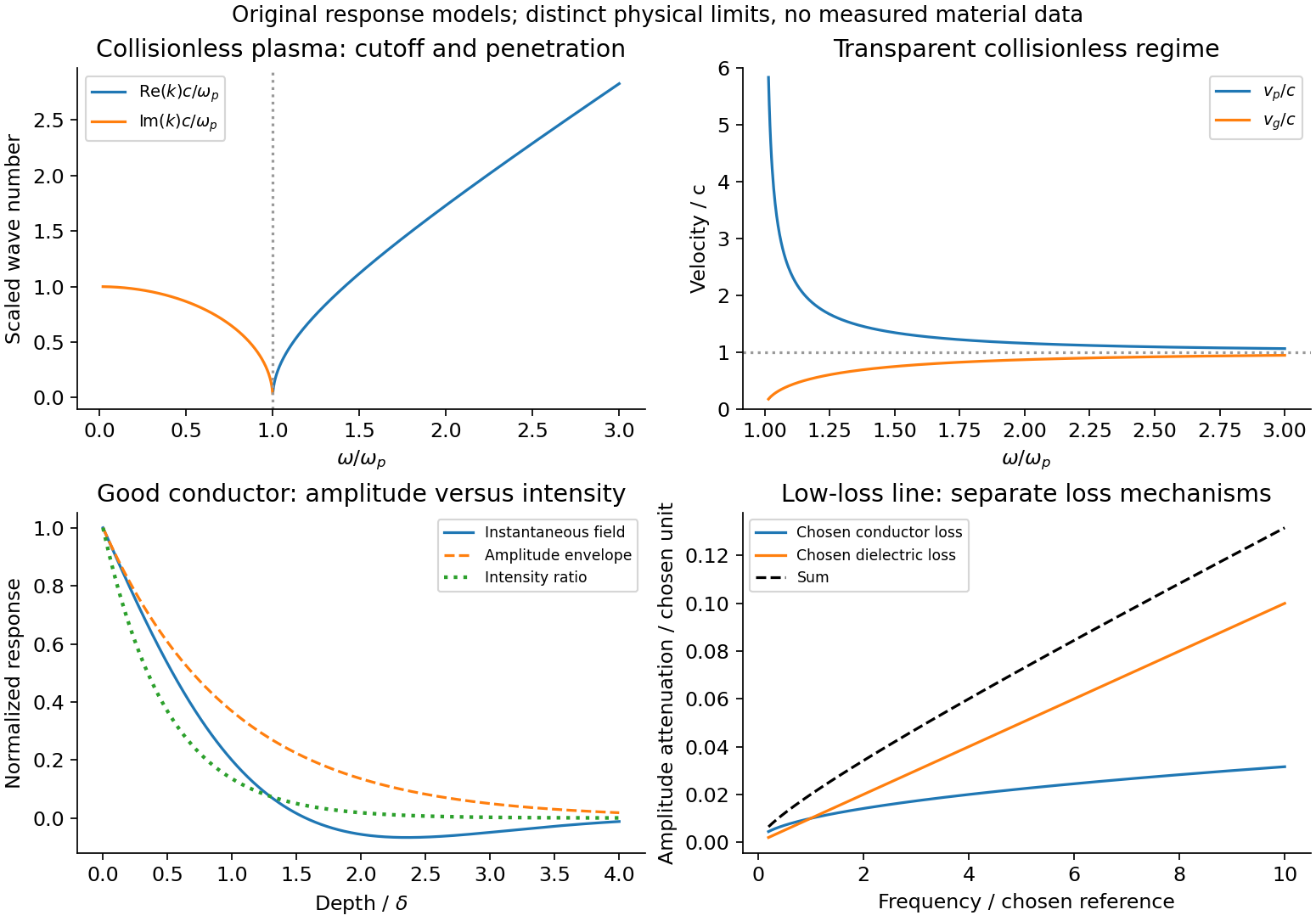
Conducting-wave propagation
. Chosen dispersion and decay models. Details.The Reynolds number is , comparing inertial stress with viscous stress . Nondimensionalizing an incompressible Newtonian flow with velocity , length and pressure givesAt small Reynolds number inertia is negligible and a creeping-flow balance applies. At large Reynolds number the outer flow may be approximately inviscid, but thin no-slip boundary layers can still govern drag, separation and dissipation. A high Reynolds number permits turbulent motion without guaranteeing it; transition depends on geometry, disturbances and roughness.
Dynamically similar model experiments need matching geometry and relevant dimensionless parameters, including Reynolds number. If gravity, compressibility or surface tension matters, Froude, Mach or capillary-related parameters must also be matched. Testing linear pressure-flow or force-speed relations while varying , , viscosity and temperature is more informative than assigning one universal transition value to all apparatus.
Past exam of the physics B course of the University of Cambridge 2010 Paper 1 Section B B9 Solution 2026-10-20
stress describes internal force per area. A cut with unit normal has traction ; its normal component is and its remainder is shear traction. force balance constrains the stress divergence, while ordinary local angular-momentum balance makes the Cauchy stress tensor symmetric in a medium without body couples.
strain describes deformation rather than force. For small displacement gradients,The antisymmetric displacement-gradient part is a rigid rotation to first order and contributes no infinitesimal strain. Engineering shear strain is , so it must not be confused with the tensor component. stress has units of pressure; strain is dimensionless.
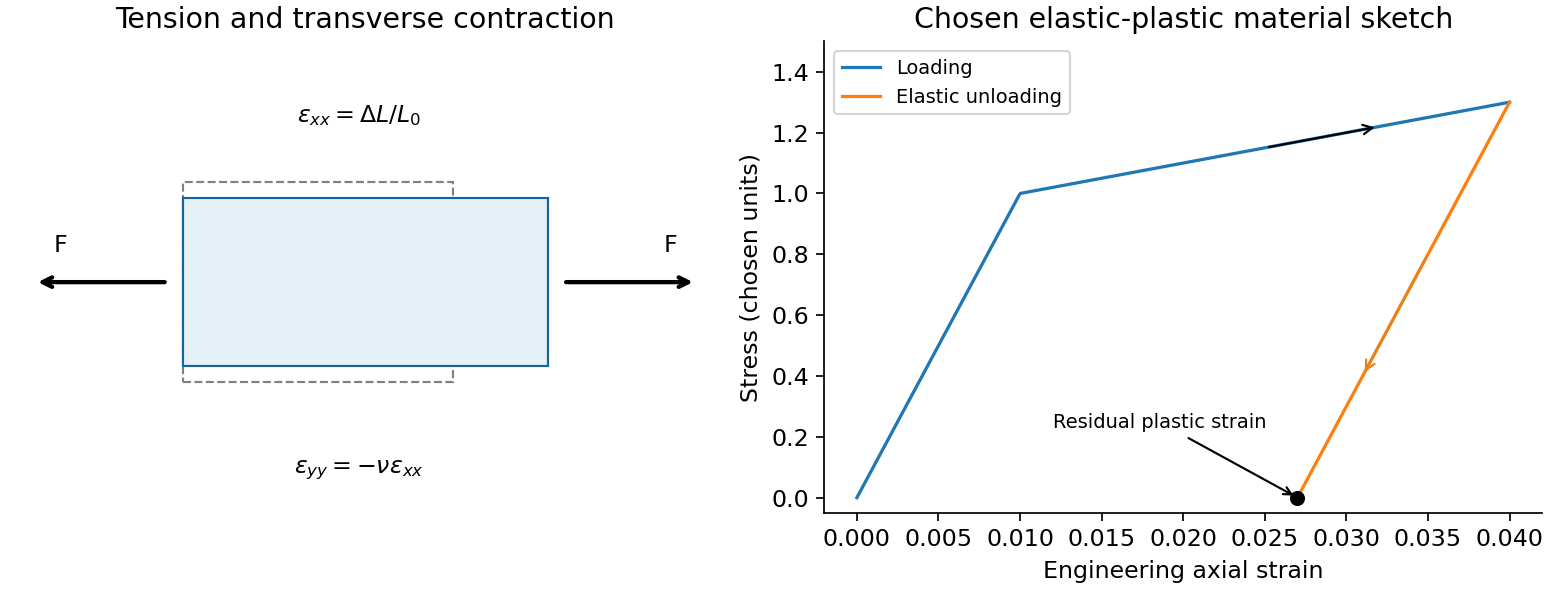
An isotropic linear elastic solid obeysTwo independent moduli are required. The shear modulus and bulk modulus must be positive for stability. Young's modulus and Poisson ratio satisfyFor a tensile specimen with free side faces, gives and . Pure shear gives ; hydrostatic loading gives . The incompressible limit has at finite shear stiffness, not vanishing shear resistance. Crystals can be anisotropic and need a fourth-rank elastic stiffness tensor instead of the isotropic two-constant law.
elastic deformation is recoverable on unloading; it need not remain linear at large strain. Beyond yield, irreversible rearrangements such as dislocation motion cause plastic strain, often followed by hardening. Ductile samples can neck before fracture; brittle failure has much less plastic deformation. Engineering stress uses initial area, while true stress uses the changing instantaneous area. A decreasing engineering stress during necking therefore need not mean that local true stress decreases. stress concentrations, flaws and loading geometry can determine failure before a uniform-material strength is reached. Viscoelastic materials also show rate dependence, creep and stress relaxation; their losses cannot be described by a static Hooke law alone.
A tensile test should measure force and gauge-length extension independently, correct machine compliance, align the grips, and control strain rate and temperature. Unloading distinguishes recoverable strain from a residual plastic extension. Separate shear or hydrostatic tests determine moduli that one axial measurement does not fix. Compression specimens need friction and buckling checks. Work per volume is ; the recoverable part is elastic energy, while a dissipative cycle produces a loss rather than creating energy. The original loading/unloading curve below is a chosen constitutive sketch, not measured material data.
At fixed positive temperature, tends to as . This is a physically meaningful unbounded-volume limit for a fixed mole number: , so the number of accessible translational configurations grows without bound. For an ideal gas the entropy difference is at fixed temperature. No finite vessel reaches an infinite entropy, and at finite temperature is not a finite-volume one-mole state. The divergence is approached by dilution; it does not conflict with the third law, which concerns a different temperature limit.
Past exam of the physics B course of the University of Cambridge 2010 Paper 1 Section C C12 Solution 2026-10-20
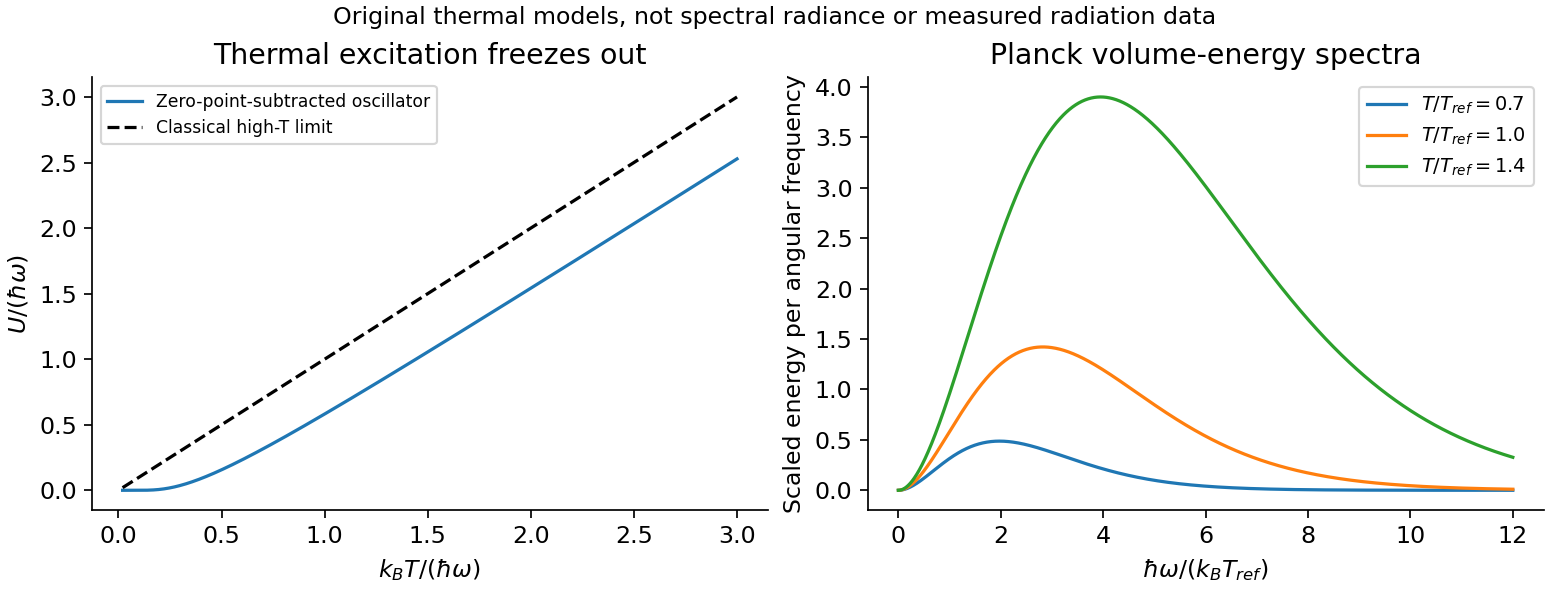
For excitation energy , the geometric series gives the thermal partition function of a quantum harmonic oscillator with its zero-point energy subtracted:Thus at low temperature and approaches at high temperature. Restoring the zero-point term multiplies by and adds to , without changing the thermal occupation probabilities.
To count electromagnetic modes, put a large cavity in a periodic box of volume . One transverse polarization has wavevector-state density ; there are two independent polarizations. In the shell ,With , the electromagnetic mode density in a box becomesThe continuum expression is the large-cavity leading term; using standing-wave boundary conditions gives the same bulk count. Both photon polarizations must be included. This is density per angular frequency, not per ordinary frequency.
Each mode is an oscillator with zero photon chemical potential in thermal equilibrium. Multiplying its mean thermal energy by the mode density per volume gives the angular-frequency Planck energy densityAt small it reduces to the Rayleigh–Jeans result ; exponential suppression at high frequency prevents a divergent thermal energy. With ,The integral is the stipulated . This is a volume energy density, ; for isotropic cavity radiation the outward black-surface flux is , with . Distinguishing flux, spectral density and total volume energy avoids extra factors of , or .
Past exam of the physics B course of the University of Cambridge 2010 Paper 1 Section C C13 Solution 2026-10-20
The zeroth law of thermodynamics states the transitivity of thermal equilibrium: if two systems each equilibrate thermally with a third, they equilibrate with one another. A reproducible thermometric property can therefore label their temperature. Its empirical numerical scale is not itself the complete thermodynamic content; reversible heat-engine relations establish an absolute temperature scale.
The first law of thermodynamics expresses energy conservation. For a closed system, when is work done by the system. internal energy is a state function, while heat and work depend on the path. In reversible simple compressible motion, and ; an open system additionally needs the energies carried by transferred matter. An ideal gas can expand freely with and unchanged internal energy. The first law alone does not decide whether the reverse spontaneous process occurs.
The Second law of thermodynamics introduces entropy and restricts direction. For a reversible path, ; for an irreversible process the entropy balance includes nonnegative production. The entropy of an isolated system cannot decrease. In a cycle, the Clausius inequality is , using the appropriate boundary/reservoir temperatures. The Kelvin–Planck statement forbids a cyclic device whose sole effect is extracting heat from one reservoir and turning all of it into work; the Clausius statement forbids moving heat from cold to hot with no compensating effect. A refrigerator is allowed because it consumes work. A two-reservoir engine has , with equality in the reversible limit. Work may be fully dissipated as heat without contradicting this one-way restriction.
The third law of thermodynamics constrains low-temperature entropy. An equilibrium perfect crystal with a nondegenerate ground state approaches zero entropy as , fixing the conventional absolute entropy reference. Degenerate ground states or frozen nonequilibrium disorder require care when discussing residual entropy. Under regular equilibrium conditions the heat capacity must decrease sufficiently for to remain finite; a constant positive classical heat capacity cannot be extrapolated to zero temperature. The unattainability formulation states that absolute zero cannot be reached by a finite sequence of admissible cooling operations. These statements concern the limiting thermodynamic regime, rather than predicting that every substance stays in one classical phase during cooling.
The laws work together: conservation sets a device's energy budget, entropy production restricts the attainable budget, and constitutive equations give the properties of its working material. For fixed temperature and volume, Helmholtz free energy decreases toward equilibrium; at fixed temperature and pressure the corresponding potential is Gibbs free energy. Stable equilibrium, phase coexistence and Maxwell relations follow from these potentials with appropriate constraints. Calorimetry, mechanical-work measurements, thermometry and reversible-path comparisons test different parts of this framework. None of the laws by itself supplies a particular gas equation of state or microscopic heat capacity.
Past exam of the physics B course of the University of Cambridge 2010 Paper 2A Section A 1 Solution 2026-10-20
For a reversible isothermal expansion of one mole of an ideal gas, internal energy depends only on temperature, so . The first law of thermodynamics givesThis uses quasistatic expansion against the gas pressure. Specifying only the initial and final volumes and constant temperature would not fix heat for an arbitrary irreversible process: an insulated ideal-gas free expansion has .
Past exam of the physics B course of the University of Cambridge 2011 Paper 1 Section A A3 Solution 2026-10-20
Take as the tensile force exerted on the band, so reversible stretching supplies work . At fixed other mechanical variables,Equality of mixed derivatives of the Helmholtz free energy yields the thermoelastic Maxwell relation for a stretched bandFor entropy-dominated rubber elasticity, increasing extension reduces configurational entropy, consistently giving a tensile force that increases with temperature at fixed extension. A force defined as the band's restoring force on its support has the opposite sign.
Past exam of the physics B course of the University of Cambridge 2011 Paper 1 Section B B7 Solution 2026-10-20
The microscopic magnetic response becomes a macroscopic field problem through the magnetization , the magnetic dipole moment per unit volume. Definein magnetostatics. Bound currents are represented by and surface current . Normal is continuous across an interface, while . It is generally incorrect to impose continuity of every component of both fields. A linear isotropic material has and , but a ferromagnet usually requires a nonlinear, history-dependent constitutive relation.
Internal field differs from externally applied field. For uniform magnetization along a principal axis of an ellipsoid, the demagnetizing field is and . A linear specimen therefore has apparent susceptibility relative to the applied field. Shape is especially important for large susceptibility. A long closed magnetic circuit reduces stray fields; a bar magnet still has demagnetizing fields despite the absence of magnetic monopoles. Equivalent magnetic-pole descriptions are bookkeeping for magnetization divergence, not free magnetic charge.[ref]
Permanent Ferromagnets. Equations (699)–(706): magnetization, scalar potential and effective pole density
In paramagnetism, permanent localized moments are preferentially aligned by the field, against thermal disorder. For independent spin-one-half moments with projections , the two Zeeman energies givein the dilute weak-field limit with . This is a Curie law; the response saturates at when alignment dominates. More generally, spin gives . Interactions can produce a Curie–Weiss response over a suitable range. Conduction-electron Pauli paramagnetism need not show the localized-moment law.
In diamagnetism, the field induces a magnetic moment opposing it, so the linear susceptibility is negative. The microscopic cause is the change in orbital electronic motion, and a closed-shell insulating material has no permanent atomic moment to orient. This weak response is often only mildly temperature dependent away from other transitions. It also exists as a background in materials with a stronger positive response. Perfect flux expulsion in a superconductor is a distinct collective phenomenon and should not be identified with ordinary weak atomic diamagnetism.
In ferromagnetism, exchange interactions stabilize spontaneous magnetic order below the Curie temperature. A specimen can have zero net moment while its magnetic domains remain locally magnetized in different directions. Domain-wall motion and moment rotation produce a large response; anisotropy and pinning lead to remanence, coercivity and hysteresis. Increasing field eventually approaches saturation. Heating above the ordering transition removes spontaneous order, although an applied field still induces a response. Soft magnetic cores favor easy reversal and small cyclic loss; hard permanent-magnet materials favor retained magnetization and resistance to reversal. These properties concern collective order and barriers, not merely independent moments all following a weak field.[ref]
University Physics Volume 2 by Samuel J. Ling and others. §12.7, Magnetism in Matter: susceptibility, magnetic domains, Curie temperature and hysteresis
A practical distinction requires a controlled field sweep and a separate magnetic readout. A toroidal core with drive winding , path length and current has approximately . A pickup winding measures ; integrating after calibration gives , and . Reversing the sweep reveals a loop whose positive loss area per volume is . An air-core/empty-holder reference, known geometry and turn count, offset correction, temperature control and slower sweeps test background, heating and rate-dependent eddy-current losses. A single force or susceptibility reading cannot establish spontaneous order or hysteresis. The original curves below are illustrative responses, not measured material data.
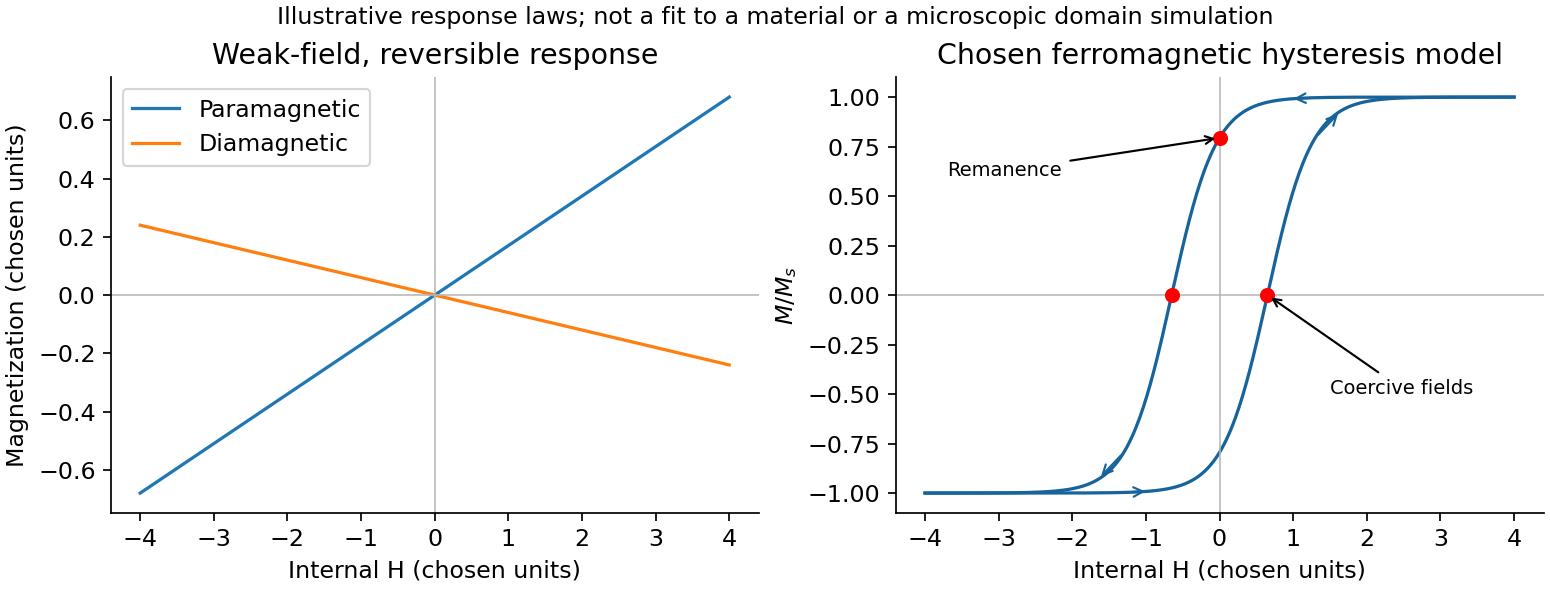
Magnetic response and hysteresis
. Details. Past exam of the physics B course of the University of Cambridge 2011 Paper 1 Section B B9 Solution 2026-10-20
A fluid is described on a continuum scale by density, pressure and velocity fields. An Eulerian field is measured at fixed position; a material element changes at rate . mass conservation requiresFor incompressible flow this becomes . A streamline is instantaneously tangent to velocity, whereas a pathline follows a particle through time; they coincide in a steady flow but need not in an unsteady one.
For an ideal inviscid fluid, pressure and body forces give the Euler equation. In the constant-density gravitational case,A stationary impermeable boundary requires zero normal velocity, but inviscid theory does not impose no slip. Taking its steady projection along a streamline gives . If the flow is also irrotational in the connected region, that constant is shared between streamlines. Inviscid does not mean irrotational: rotating ideal-fluid flows are possible. A velocity potential exists locally for an irrotational field, and in incompressible flow it obeys Laplace's equation. The Bernoulli assumptions must be checked before converting a pressure difference into a speed.[ref]
Bernoulli’s Equation by NASA Glenn Research Center. Restrictions and Common Assumptions: inviscid, steady, incompressible flow and streamline dependence
Real fluids transmit shear stress. An incompressible Newtonian fluid with constant dynamic viscosity obeysThe constitutive shear stress is proportional to strain rate, and stationary solid boundaries usually impose no slip. viscosity diffuses vorticity and converts organized mechanical energy into heat; its local dissipation is nonnegative. It cannot generally be included merely by changing the constant in a lossless Bernoulli equation.
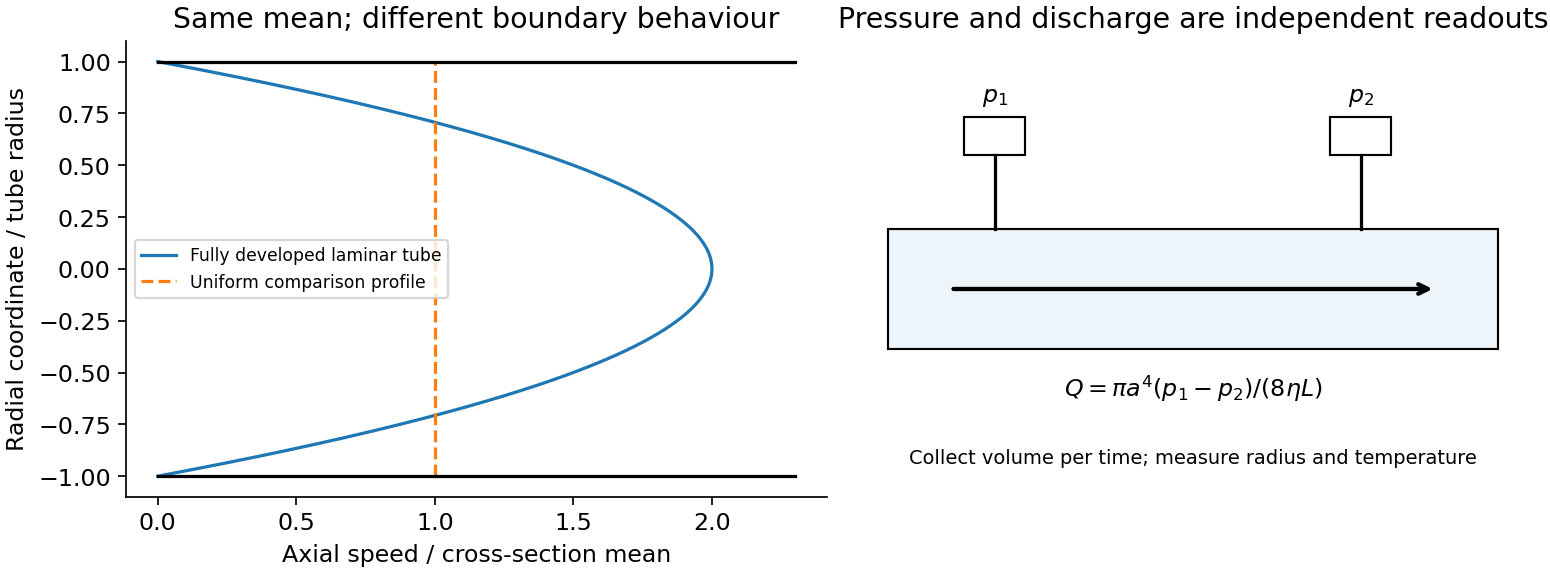
In a long straight circular tube, steady fully developed laminar flow hasThis Hagen-Poiseuille equation follows by balancing the axial pressure gradient with viscous shear and setting . The parabolic profile, the fourth-power radius sensitivity and the pumping power are experimentally distinct consequences. Entrance regions, rough walls, non-Newtonian response or a changing temperature require additional modelling.
The Reynolds number compares inertia with viscosity. Small values favor creeping-flow balances; high values permit thin boundary layers, separation and turbulence, although transition depends on geometry and perturbations, not one universal critical number. At high Reynolds number an outer flow can be approximately inviscid while near-wall viscosity still determines drag. This resolves why a zero-drag ideal potential-flow model cannot predict the resistance of an ordinary moving body. In turbulent flow, fluctuating Reynolds stresses redistribute momentum and increase the required pressure drop; averaging the equations introduces closure requirements.
A controlled tube experiment measures pressure difference and collected volume per time while changing forcing. Use tracers or a velocity probe to test profile shape, allow sufficient entrance length, and monitor radius and temperature independently. Repeat with reversed flow and at several rates to test offsets and linearity. Dye mixing alone does not measure viscosity or establish a fully developed velocity profile. The original figure below separates a specified laminar velocity profile from an independent pressure/discharge measurement.
Past exam of the physics B course of the University of Cambridge 2011 Paper 1 Section C C10 Solution 2026-10-20
Use for the heat capacities of the entire -mole sample. For a stable simple compressible gas, a Maxwell relation giveswhere and . This heat-capacity difference and mechanical stability explains the sign without assuming the internal energy depends only on temperature. It is strictly positive for an ordinary expanding gas; the unrestricted word “always” needs the qualification that equality is possible when thermal expansion vanishes.
For an ideal gas, thermodynamic consistency givesConsequently , while . Differentiating gives : at fixed pressure extra supplied heat permits expansion work in addition to the internal-energy increase.
Differentiate the supplied entropy at fixed :Thus , consistently recovering , andThe coefficient in this entropy corresponds to five active quadratic thermal degrees of freedom per molecule. It should not be replaced by the monatomic value. Reference scales needed to make logarithms dimensionless are absorbed into the entropy constant and do not affect these derivatives.
With open windows the house equilibrates mechanically at approximately the same atmospheric pressure before and after heating. It is an open system: its mole number is not fixed. The isobaric ideal-gas internal-energy density isAt a fixed house volume, : fewer molecules occupy the house, each with greater mean energy. Heating energy can enter while enthalpy leaves with escaping air. Treating the room as a sealed fixed- gas would give the wrong energy-density comparison.
Past exam of the physics B course of the University of Cambridge 2011 Paper 1 Section C C11 Solution 2026-10-20
Keep the problem's one-mole convention throughout. The excluded-volume parameter represents the loss of available translational volume due to short-range repulsion; it is an effective covolume, not simply the literal molecular material volume. The attraction parameter reduces the pressure below its purely repulsive value. In a mean-field picture, interaction energy is proportional to pair density, so the attractive free-energy contribution scales as for one mole and the pressure correction as . Equivalently, molecular cohesive forces and the number striking a wall each supply a density factor. These parameters approximate microscopic correlations rather than measuring every pair potential exactly.
At fixed temperature, . Substituting and integrating gives the isothermal free-energy change of a Van der Waals gasThe arbitrary temperature-only term cancels. The internal-energy derivative is insteadExpansion raises the attractive internal energy toward zero. As a check, the entropy change is , so . Constant and a homogeneous branch with are assumed. If a subcritical equilibrium path crosses coexistence, a Maxwell construction replaces the unstable homogeneous continuation; the displayed integral is the direct equation-of-state result, not a claim that such a continuation is physically stable.
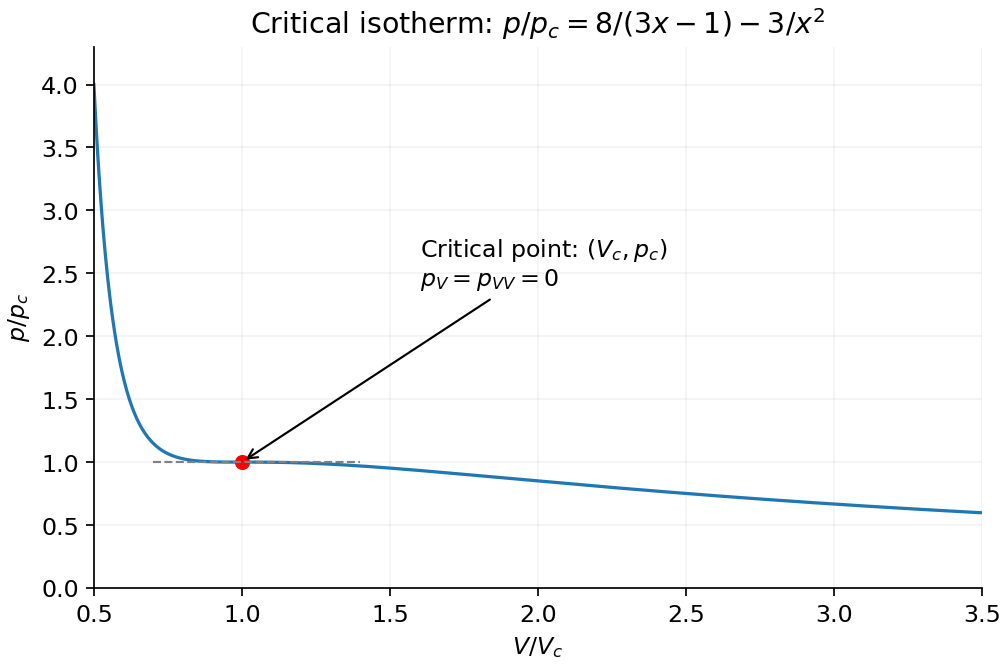
At the Van der Waals critical point, the critical isotherm has a stationary inflection:Equating the resulting expressions for gives , henceIn reduced variables , the critical curve is : it decreases through with zero first and second derivative, rather than having separate liquid/gas turning points at the critical temperature.