Topics (384k) Articles (398k) Users (410) Discussions (242) Comments (383) Files (13k) New article
A finite extension of local fields is tamely ramified when its residue-field extension is separable and its ramification index is coprime to the residue characteristic. For a finite Galois extension this is equivalent to trivial wild inertia group .
A grain released from a circular parent orbit without a relative velocity impulse is unbound when radiation pressure reduces the effective stellar attraction sufficiently. For , the effective inverse-square force is repulsive.
The quantum mutual information of a bipartite state isIts nonnegativity is equivalent to Subadditivity of Von Neumann entropy.
For a bipartite density operator and a product reference state,The difference between the two sides is the nonnegative quantum mutual information of .
The quantum relative entropy is additive on tensor products:This follows by expanding and its counterpart for .
Data-processing inequality for quantum relative entropy by  Codex 0 Created 2026-09-24 Updated 2026-10-05
For every quantum channel ,For a partial trace, this says that discarding a subsystem cannot make two density operators more distinguishable in quantum relative entropy.
For the transposition map , , the induced trace norm is one, while the diamond norm isThe first equality follows because transposition preserves every singular value and hence the trace norm.
For the lower bound, apply to the normalized maximally entangled state projector . Its partial transpose is , with the swap operator. All singular values of are one, so while .
For the upper bound, partial transpose preserves the Frobenius norm . On matrices of size ,A -dimensional ancilla suffices in the definition of the diamond norm, proving equality. [ref]
The Theory of Quantum Information by John Watrous. Chapter 3, Example 3.42, equations 3.249–3.255, and Definition 3.43
For , transposition is not completely positive: has a negative eigenvalue on the antisymmetric subspace. Thus this is a mathematical example of norm amplification by an entangled ancilla; transposition itself is not a physically implementable quantum channel.
Fermion parity is . It acts as plus one on bosonic states and minus one on fermionic states. Even operators commute with it and odd operators, including supersymmetry generators, anticommute with it. Local observables are parity even because observable algebras of spacelike separated regions must commute.
For -modules ,because the Hom functor into a finite direct sum splits degree by degree and taking cohomology preserves that splitting.
Let be a countable measurable partition of the sample space, with positive probabilities. For any event , the law of total probability givesThe pieces are disjoint events, so add their masses and use the definition of conditional probability. Zero-mass partition pieces can be omitted without changing the answer.
For the coin selection in probability, let mean the -head coin was selected and let mean the first toss was heads. Then . Each conditional answer describes one possible hidden situation; its weight describes how often that situation occurs under the model. This decomposition is useful whenever a simple conditional model sits behind a more complicated marginal probability distribution.
The law of total probability combines local conditional probabilities into one overall probability. The measurable partition must cover the sample space with pairwise disjoint events: every elementary outcome belongs to exactly one part. Its probabilities are the weights of a weighted mean, and they sum to one.[ref]
Random: Probability, Mathematical Statistics, Stochastic Processes by Kyle Siegrist. Probability Spaces, §4 Conditional Probability, Basic Theory, Conditioning and Bayes' Theorem: countable partition formula and weighted-average interpretation
For an original constructed example, make a finite set of 1,000 items: 600 belong to and 400 to . Mark exactly 60 items in and 100 in , and let the event mean that the selected item is marked. Select an item using the uniform distribution on a finite set. These are prescribed counts, so the resulting probabilities are exact properties of this construction:The conditional probability uses only the 600 items in as its denominator. The probability of the intersection uses all 1,000 items instead: . Similarly, . Adding the two disjoint events gives
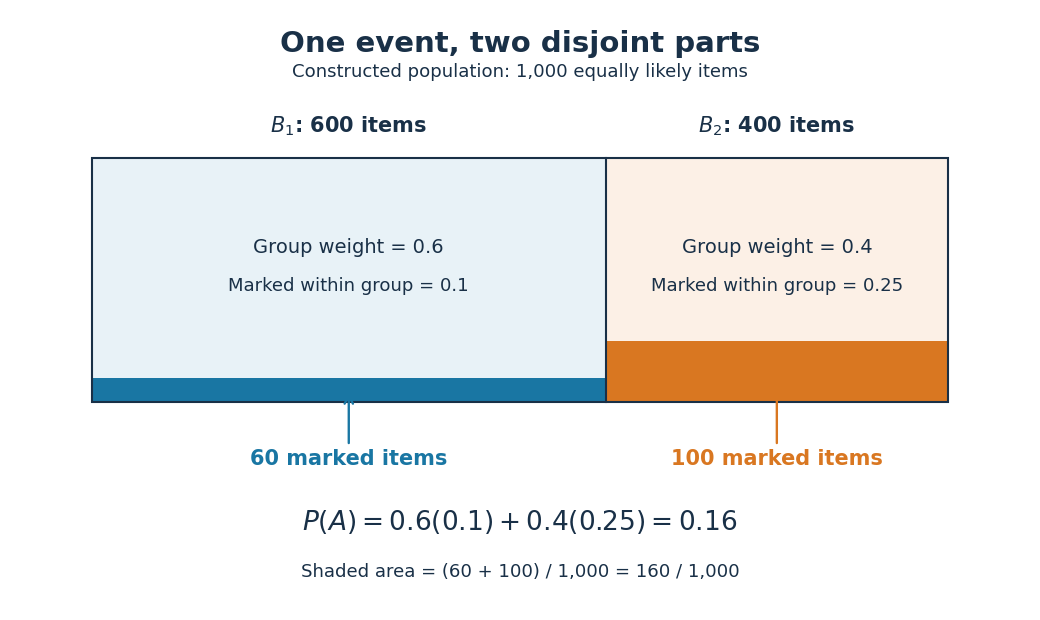
An unweighted arithmetic mean of the two conditional probabilities would give . That is the answer to a different selection rule: choose either group with probability , then select uniformly within that group. Here the first group contains more items, so selecting uniformly among all items gives it weight . In fact, if its weight were , the overall probability would be . Moving the weight from to lowers the result by , explaining exactly why is too large for the original model.
The same construction is a mixture distribution: first select a group with its mixture weight, then select an item within that group. Multiplying the weight by its conditional probability gives the probability of reaching through that group; adding the contributions gives the law of total probability. For example, an item in has selection probability , and an item in has selection probability , recovering the original uniform distribution on a finite set.
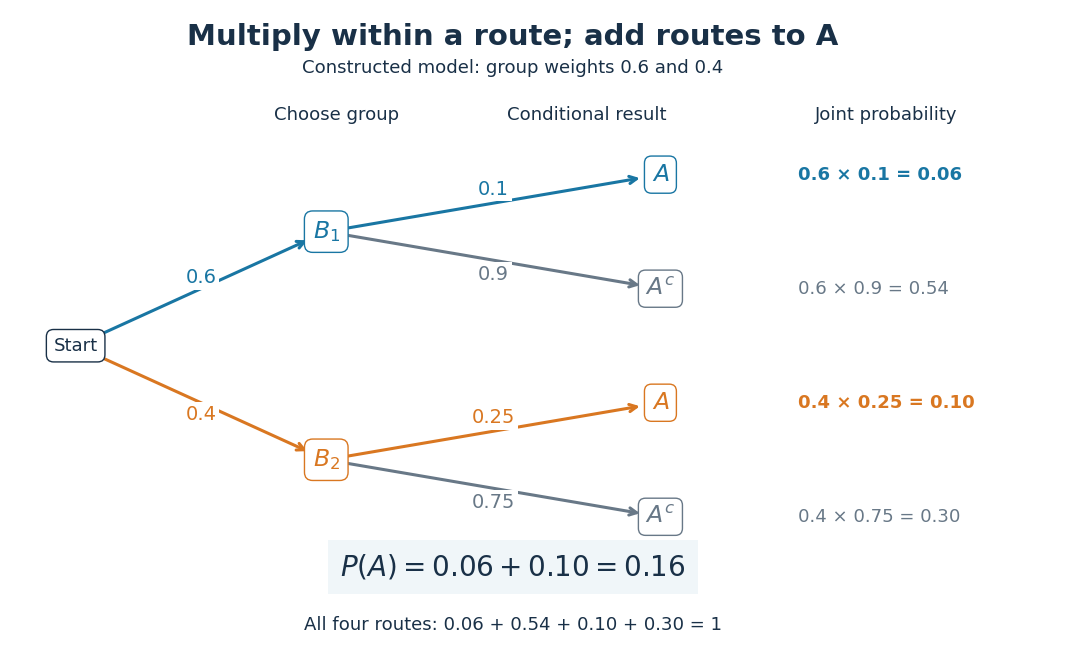
No assumption of independent events is needed. In this construction differs from , so and are not independent events. Also and are disjoint events with positive probabilities, so they cannot be independent events: their intersection has probability zero, whereas . The measurable partition supplies exclusive alternatives, not an independence assumption.
For a short proof, the intersection pieces have union and are pairwise disjoint events. Apply countable additivity, then substitute the definition of conditional probability on every positive-mass part:A zero-probability event has . Omit it: writing would divide by zero. Countability ensures that the union of the omitted zero-probability events also has probability zero. Overlapping parts would double-count their intersections, and incomplete coverage would omit the probability of in the uncovered region.[ref]
Random: Probability, Mathematical Statistics, Stochastic Processes by Kyle Siegrist. Probability Spaces, §4 Conditional Probability: The Basic Definition requires a positive conditioning probability; Conditioning and Bayes' Theorem proves total probability by partition intersections
Reversing the question gives one compact application of Bayes' theorem. Among the 160 marked items, 100 belong to , so its conditional probability after observing isThe law of total probability supplied the denominator by collecting every way that can occur. Its usefulness lies in choosing a measurable partition where the conditional probabilities are simple, then combining them without losing the relative sizes of the alternatives.
For an elliptic curve with identity , a divisor is principal exactly whenThis is the identification of the degree-zero divisor class group with the elliptic curve.
The tensor spectral index is the logarithmic slope . Canonical slow-roll inflation gives to first order.
In the inclusion-ordered category of sets and relations, a relation has a right adjoint exactly when it is the graph of a total single-valued function; its right adjoint is the converse relation.
is the class of decision problems whose positive instances have polynomial-length certificates verifiable in polynomial time. Equivalently, it is polynomial time on a nondeterministic computation.
Pinned article: Introduction to the OurBigBook Project
Welcome to the OurBigBook Project! Our goal is to create the perfect publishing platform for STEM subjects, and get university-level students to write the best free STEM tutorials ever.
Everyone is welcome to create an account and play with the site: ourbigbook.com/go/register. We belive that students themselves can write amazing tutorials, but teachers are welcome too. You can write about anything you want, it doesn't have to be STEM or even educational. Silly test content is very welcome and you won't be penalized in any way. Just keep it legal!
Intro to OurBigBook
. Source. We have two killer features:
- topics: topics group articles by different users with the same title, e.g. here is the topic for the "Fundamental Theorem of Calculus" ourbigbook.com/go/topic/fundamental-theorem-of-calculusArticles of different users are sorted by upvote within each article page. This feature is a bit like:
- a Wikipedia where each user can have their own version of each article
- a Q&A website like Stack Overflow, where multiple people can give their views on a given topic, and the best ones are sorted by upvote. Except you don't need to wait for someone to ask first, and any topic goes, no matter how narrow or broad
This feature makes it possible for readers to find better explanations of any topic created by other writers. And it allows writers to create an explanation in a place that readers might actually find it.
Figure 1. Screenshot of the "Derivative" topic page. View it live at: ourbigbook.com/go/topic/derivativeVideo 2. OurBigBook Web topics demo. Source. - local editing: you can store all your personal knowledge base content locally in a plaintext markup format that can be edited locally and published either:This way you can be sure that even if OurBigBook.com were to go down one day (which we have no plans to do as it is quite cheap to host!), your content will still be perfectly readable as a static site.
- to OurBigBook.com to get awesome multi-user features like topics and likes
- as HTML files to a static website, which you can host yourself for free on many external providers like GitHub Pages, and remain in full control

Figure 2. You can publish local OurBigBook lightweight markup files to either OurBigBook.com or as a static website.
Figure 3. Visual Studio Code extension installation.
Figure 5. . You can also edit articles on the Web editor without installing anything locally. Video 3. Edit locally and publish demo. Source. This shows editing OurBigBook Markup and publishing it using the Visual Studio Code extension. 
- Infinitely deep tables of contents:




All our software is open source and hosted at: github.com/ourbigbook/ourbigbook
Further documentation can be found at: docs.ourbigbook.com
Feel free to reach our to us for any help or suggestions: docs.ourbigbook.com/#contact