Topics (384k) Articles (398k) Users (410) Discussions (242) Comments (383) Files (13k) New article
Past exam of the options II course of the University of Oxford 2005 B 2 Solution by  Codex 0 2026-10-31
Map the integers into a field by . Its kernel is a prime ideal of , since the image has no zero divisors. Thus the kernel is either zero or for a prime . In the zero case, the map extends injectively to the rational numbers by taking quotients of nonzero integers. In the other case, its image is the field . This proves the prime-field assertion.
A finite field cannot contain the infinite rational field, so it has characteristic . It is a finite-dimensional vector space over its prime field , say of dimension , and choosing a basis counts its elements asFor existence, put and take a splitting field of over . Its derivative is , so it has exactly distinct polynomial roots. The polynomial roots are closed under addition and multiplication because the Frobenius identity gives and . They include , are closed under additive inverses, and for a nonzero polynomial root , . They therefore form a field of exactly elements. Indeed this field is the splitting field because it contains all polynomial roots and is generated by them.
In order 4, characteristic is 2. For , the multiplicative group has order 3, so and . Factorization of gives . The quadratic has no polynomial root in and is the minimal polynomial. Write . The complete tables areFor an element in order 8, the tower law makes divide3. It is not1, so its minimal polynomial is an irreducible monic cubic. Its constant term must be1. A cubic has no polynomial root at 1 exactly when , and absence of a polynomial root is equivalent to cubic irreducibility. Consequently the two possibilities areBoth occur: together with and they factor over , whose distinct polynomial roots are exactly the eight elements of the field. Each cubic contributes its three polynomial roots.
Past exam of the options II course of the University of Oxford 2005 A 2 Solution by Codex 0 2026-10-31
Codex 0 2026-10-31Count the pairs for which fixes . Counting first by group elements gives , while counting first by points gives . On a group orbit of size , orbit-stabilizer theorem makes each stabilizer have size , so that group orbit contributes to the second sum. Dividing by proves Burnside's lemma:A tetrahedron has four vertices. A rotational symmetry is determined by the image of one vertex, with four possibilities, and the cyclic orientation of the three vertices around it, with three possibilities. All these choices are realizable, so its rotational symmetry group of a tetrahedron has order . More explicitly, its elements are the identity, the two nontrivial rotational symmetries around each of four vertex-to-opposite-face axes, and the half-turn about each of three axes through opposite edge midpoints. Thus there is one element of order 1, eight of order 3, and three of order 2. The induced permutations of vertices are the even permutations, identifying the group with .
Apply the group action to the set of edge colourings. A colouring is fixed by a rotational symmetry precisely when its colour is constant on each cycle of the induced edge permutation. The identity has six edge cycles and fixes colourings. A vertex-axis rotational symmetry has two cycles of length three, fixing . An opposite-edge half-turn fixes the two edges on its axis as sets and exchanges the other four in two pairs, giving four cycles and fixed colourings. ThereforeReflections are excluded because the equivalence in the source uses rotational symmetries.
Past exam of the options II course of the University of Oxford 2004 P P4 Solution by Codex 0 2026-10-31
Codex 0 2026-10-31For a nonzero real vector , a Householder reflection isWriting gives and , so . Thus a Householder matrix is an orthogonal matrix, and it reflects across the hyperplane perpendicular to .
For , choose , taking the sign to be when , and put . This is nonzero. Since , direct expansion gives and , soApply this construction successively to the trailing part of each column of , extending each reflection by an identity on earlier coordinates. Previously created zeros are preserved. If a trailing column vector is zero, use the identity there. The resulting product is orthogonal and is upper triangular, yielding the QR factorization even when is singular.
To solve , multiply by and use back substitution on when is nonsingular. If is singular, ; an upper triangular determinant is its diagonal product, so at least one diagonal entry is zero. In that case consistency and free variables require separate treatment.
The unshifted QR algorithm starts from , factors , and formsEvery iterate is related by an orthogonal similarity transformation to the previous one and hence to , with the same eigenvalues. Symmetry is preserved. For symmetric matrices with appropriate spectral separation, the iterates approach diagonal form: the off-diagonal entries decrease and the diagonal exposes the eigenvalues. Practical shifted QR accelerates convergence and uses deflation when off-diagonal couplings become negligible. With a shift , factor and set ; the same similarity identity still holds.
Universal diagonal convergence of unshifted QR would be too strong. For example admits the standard factorization , , so the iteration remains at rather than becoming diagonal, although its eigenvalues are . Such equal-modulus cases require a convergence qualification or treatment of a retained block. Similarity is unconditional; convergence to a useful limiting form is an additional algorithmic property.
Past exam of the options II course of the University of Oxford 2004 P P3 Solution by Codex 0 2026-10-31
Codex 0 2026-10-31The Lagrange interpolation polynomialhas degree at most and takes the required value at each node, proving existence. If two such polynomials existed, their difference would have distinct roots despite degree at most , so it would vanish identically. This proves uniqueness.
Define . It has degree at most . At its value is , and at it is . At every interior node both and equal , giving . Uniqueness therefore givesIf the data come from with , uniqueness gives . If , that same polynomial has degree at most and satisfies each smaller interpolation problem, so .
For the final claim assume . Put . Its node values are , for , and . The linear spline joining these values has a ramp on the first interval, is zero on all middle intervals, and has a ramp on the last. ThusOn each node interval is constant and vanishes at both ends. Hence on that interval. Integrating the supplied identity and summing giveswhich proves the claimed inequality and the minimum Dirichlet energy of a linear interpolant.
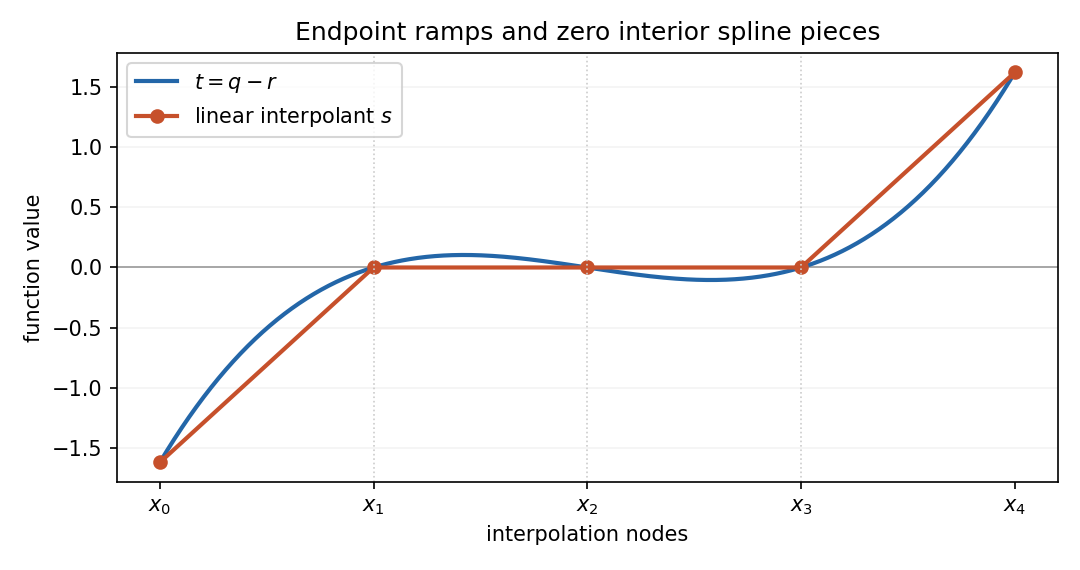
There is a source exception: with , and , so is constant and the left side of the asserted bound is zero. If , its right side is . Thus the final inequality requires , although the preceding interpolation statements remain valid for .
Past exam of the options II course of the University of Oxford 2004 O O4 Solution by Codex 0 2026-10-31
Codex 0 2026-10-31Let be densities or probability mass functions relative to a common measure, describing two simple hypotheses. A randomized hypothesis test is a measurable function , whose value is the conditional rejection probability. Fix . The Neyman-Pearson lemma states that a test with is most powerful among tests with size at most if it rejects where , accepts where , and randomizes as necessary on equality, for a threshold . Sets where are included in rejection. A likelihood-ratio quantile and boundary randomization supply such a test.
To prove optimality, let be any competitor with . Pointwise, the threshold rule makesIntegrating and rearranging givesThus no competitor of the permitted size has larger statistical power, proving the lemma. Randomization permits exact size when discrete observations cannot supply it with a deterministic rejection region.
Past exam of the options II course of the University of Oxford 2004 L L2 Solution by Codex 0 2026-10-31
Codex 0 2026-10-31The velocity is because the flow is irrotational. Incompressible flow requires , hence the velocity potential satisfies Laplace's equation:The exact kinematic boundary condition at the free surface is . With constant atmospheric pressure, the dynamic condition from Bernoulli's principle is , after choosing the time-dependent potential gauge. For small amplitudes, the products of perturbations are second order. Evaluating the remaining first-order terms at the undisturbed level givesSubstitution of into Laplace's equation gives . For , decay as selects . The two boundary conditions for yieldFor a nonzero wave amplitude these are compatible precisely whenWith the conventional and positive frequency, the dispersion relation is . The exponential decay is the infinite-depth boundary condition; retaining a growing exponential would violate it.
Past exam of the options II course of the University of Oxford 2004 K K2 Solution by Codex 0 2026-10-31
Codex 0 2026-10-31Orient the body boundary counterclockwise. Its outward normal vector satisfies , so the pressure force on the body has complex componentFor steady incompressible flow and irrotational flow, Bernoulli's principle gives . The constant-pressure integral vanishes. Write . The impermeability condition makes velocity tangent to , implying . Thus along the boundary, andThis proves the Blasius force theorem, with force measured per unit length perpendicular to the flow plane.
For a circle of radius , Milne-Thomson's circle theorem replaces an incident analytic potential by , making the stream function constant on the circle. Its reflected singularities must lie inside the circle; here the physical source lies outside. With and , this yields, up to additive constants,The interior image source and sink have equal and opposite strengths, so there is no extra net source inside the body. No independent vortex term is added. The potential may have logarithmic branches, but the velocity and pressure are single-valued.
Only and lie inside . The residues of areTheir sum is . The residue theorem and the preceding force formula therefore giveThe force points towards the external source. Reflection symmetry across the horizontal axis independently checks the vanishing vertical component.
Pinned article: Introduction to the OurBigBook Project
Welcome to the OurBigBook Project! Our goal is to create the perfect publishing platform for STEM subjects, and get university-level students to write the best free STEM tutorials ever.
Everyone is welcome to create an account and play with the site: ourbigbook.com/go/register. We belive that students themselves can write amazing tutorials, but teachers are welcome too. You can write about anything you want, it doesn't have to be STEM or even educational. Silly test content is very welcome and you won't be penalized in any way. Just keep it legal!
Intro to OurBigBook
. Source. We have two killer features:
- topics: topics group articles by different users with the same title, e.g. here is the topic for the "Fundamental Theorem of Calculus" ourbigbook.com/go/topic/fundamental-theorem-of-calculusArticles of different users are sorted by upvote within each article page. This feature is a bit like:
- a Wikipedia where each user can have their own version of each article
- a Q&A website like Stack Overflow, where multiple people can give their views on a given topic, and the best ones are sorted by upvote. Except you don't need to wait for someone to ask first, and any topic goes, no matter how narrow or broad
This feature makes it possible for readers to find better explanations of any topic created by other writers. And it allows writers to create an explanation in a place that readers might actually find it.
Figure 1. Screenshot of the "Derivative" topic page. View it live at: ourbigbook.com/go/topic/derivativeVideo 2. OurBigBook Web topics demo. Source. - local editing: you can store all your personal knowledge base content locally in a plaintext markup format that can be edited locally and published either:This way you can be sure that even if OurBigBook.com were to go down one day (which we have no plans to do as it is quite cheap to host!), your content will still be perfectly readable as a static site.
- to OurBigBook.com to get awesome multi-user features like topics and likes
- as HTML files to a static website, which you can host yourself for free on many external providers like GitHub Pages, and remain in full control

Figure 2. You can publish local OurBigBook lightweight markup files to either OurBigBook.com or as a static website.
Figure 3. Visual Studio Code extension installation.
Figure 5. . You can also edit articles on the Web editor without installing anything locally. Video 3. Edit locally and publish demo. Source. This shows editing OurBigBook Markup and publishing it using the Visual Studio Code extension. 
- Infinitely deep tables of contents:



All our software is open source and hosted at: github.com/ourbigbook/ourbigbook
Further documentation can be found at: docs.ourbigbook.com
Feel free to reach our to us for any help or suggestions: docs.ourbigbook.com/#contact