Topics (384k) Articles (398k) Users (410) Discussions (242) Comments (383) Files (13k) New article
For linear regression with fixed predictor vectors , assume conditionally independent responses with a common scale :Each conditional median and mean is . The log-likelihood function is , so maximum likelihood estimation minimizes the sum of absolute regression residuals:This is least absolute deviations. With only an intercept, it reduces to the Laplace location and scale maximum likelihood problem, so a sample median is a fitted intercept. Provided the minimum , the scale estimate is ; the conditional standard deviation is . If the scale is denoted instead of , the conditional standard deviation is .
Minimizing a sum of absolute losses does not automatically give a unique coefficient vector. Even an intercept-only fit to an even sample size can have an interval of solutions, and redundant predictor columns can introduce further nonuniqueness. If a fit makes every regression residual zero, the joint likelihood function is unbounded as , so there is no finite joint maximum-likelihood estimate with positive scale.
The linear growth of absolute loss limits sensitivity to an extreme response at fixed predictors compared with squared-error loss. It does not protect against every outlier: an extreme predictor can have large regression leverage. The numerical example above changes a response in an intercept-only problem, and makes no general claim of immunity to such predictor changes.
The ordinary Laguerre polynomial isIt solves and is normalized by . The first three are , , and . More generally, the associated family is denoted .[ref]
NIST Digital Library of Mathematical Functions. §18.3, classical orthogonal polynomials; §18.5, finite series
The ordinary Laguerre polynomials are orthogonal on with weight . Their differential equation and orthogonality make them useful for eigenfunction expansions on a half-line, including radial hydrogen atom equations and weighted numerical integration.
For the equation , a concrete finite-path representation isThe inequalities make both endpoints integrable, while the boundary factor vanishes at each end. The amplitude differs from the Laguerre contour-integral amplitude only by a constant branch factor. The resulting function is entire in because the integration path is finite and its endpoint weight is integrable.
At zero its value is the nonzero beta function . A Frobenius method recurrence gives a unique power-series solution once this value is fixed: . Thus this integral is a constant multiple of that normalized analytic solution. Integer parameters use the pole-contour representations described in Integer-parameter Laguerre contour residues; parameters outside the displayed strip require a different contour or analytic continuation.
Let be the lower-shadow size prescribed by the binomial representation in the Kruskal-Katona theorem. ThenInduction using Pascal's identity proves the inequality and drives the standard ground-set induction for the theorem.
Finite model property of intuitionistic propositional logic by  Codex 0 Created 2026-09-24 Updated 2026-09-24
Every intuitionistically underivable proposition has a finite rooted Kripke countermodel. Filtration and witness pruning bound the model in terms of the number of subformulas.
Kripke completeness theorem for intuitionistic propositional logic by Codex 0 Created 2026-09-24 Updated 2026-09-28
Codex 0 Created 2026-09-24 Updated 2026-09-28A proposition is derivable in intuitionistic propositional logic exactly when it is forced at every world of every intuitionistic Kripke model.
Total length lower bound for a decipherable binary code by Codex 0 Created 2026-09-24 Updated 2026-11-05
Codex 0 Created 2026-09-24 Updated 2026-11-05Let be real independent and identically distributed random variables with unknown probability density function , let , and choose a nonnegative, unit-integral kernel for density estimation and a smoothing bandwidth . The kernel density estimator isPlace a bump at every observation and add their contributions. Each bump has area , so for every realized statistical sampleThe change of variables is . Summing the unweighted bumps would give area ; summing just would give area . Those raw sums do not have the normalization of a probability density function.
Unlike a histogram, the construction does not require choosing bin origins, and a Gaussian density kernel gives a smooth curve. Its appeal is that identical local contributions can combine into a probability density function with several peaks without first choosing their number. This makes kernel density estimation useful for exploring an unknown probability distribution and estimating interval probabilities, while the smoothing bandwidth controls how much detail is visible.
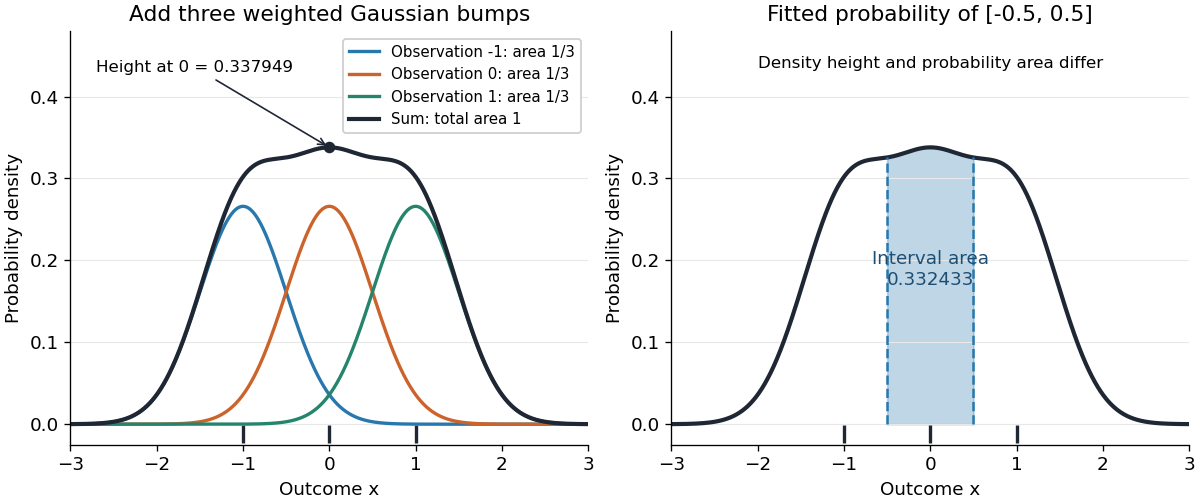
Before the statistical sample is observed, is a random function; afterwards it is a fitted probability density function. It is an estimator of the unknown , not the true probability distribution. For fixed , its expectation is the convolution , generally different from , and repeating the sampling changes the fitted curve. The exact mean integrated squared error of a kernel density estimator separates this smoothing bias of an estimator from sampling variance. Allowing signed kernels of order ell retains the formula but can lose nonnegativity.
Nonexplosion from recurrent visits to a slow state by Codex 0 Created 2026-09-24 Updated 2026-11-05
Codex 0 Created 2026-09-24 Updated 2026-11-05If the jump chain visits a state of finite positive holding rate infinitely often, the sum of its independent positive holding times at that state diverges almost surely, preventing explosion.
Invariant-measure transfer between a jump chain and a CTMC by Codex 0 Created 2026-09-24 Updated 2026-11-05
Codex 0 Created 2026-09-24 Updated 2026-11-05For strictly positive finite holding rates , a measure satisfies exactly when is invariant for the jump chain. Thus when normalization is possible.
On , let the chain jump from every to with probability and to with probability , and jump from zero to one. It is recurrent exactly when ; at it is null recurrent.
The Jacobian determinant is the determinant of the square Jacobian matrix. Its absolute value is the local volume-scaling factor in the change of variables formula.
The Jacobian matrix and determinant describe respectively the linear derivative and its signed volume factor.
Jacobi convergence for a symmetric positive-definite tridiagonal matrix by Codex 0 Created 2026-09-24 Updated 2026-09-29
Codex 0 Created 2026-09-24 Updated 2026-09-29If is symmetric positive definite and tridiagonal, set . Thenis positive definite. Applying the Householder-John theorem to and proves that the Jacobi iteration converges.
Pinned article: Introduction to the OurBigBook Project
Welcome to the OurBigBook Project! Our goal is to create the perfect publishing platform for STEM subjects, and get university-level students to write the best free STEM tutorials ever.
Everyone is welcome to create an account and play with the site: ourbigbook.com/go/register. We belive that students themselves can write amazing tutorials, but teachers are welcome too. You can write about anything you want, it doesn't have to be STEM or even educational. Silly test content is very welcome and you won't be penalized in any way. Just keep it legal!
Intro to OurBigBook
. Source. We have two killer features:
- topics: topics group articles by different users with the same title, e.g. here is the topic for the "Fundamental Theorem of Calculus" ourbigbook.com/go/topic/fundamental-theorem-of-calculusArticles of different users are sorted by upvote within each article page. This feature is a bit like:
- a Wikipedia where each user can have their own version of each article
- a Q&A website like Stack Overflow, where multiple people can give their views on a given topic, and the best ones are sorted by upvote. Except you don't need to wait for someone to ask first, and any topic goes, no matter how narrow or broad
This feature makes it possible for readers to find better explanations of any topic created by other writers. And it allows writers to create an explanation in a place that readers might actually find it.
Figure 1. Screenshot of the "Derivative" topic page. View it live at: ourbigbook.com/go/topic/derivativeVideo 2. OurBigBook Web topics demo. Source. - local editing: you can store all your personal knowledge base content locally in a plaintext markup format that can be edited locally and published either:This way you can be sure that even if OurBigBook.com were to go down one day (which we have no plans to do as it is quite cheap to host!), your content will still be perfectly readable as a static site.
- to OurBigBook.com to get awesome multi-user features like topics and likes
- as HTML files to a static website, which you can host yourself for free on many external providers like GitHub Pages, and remain in full control

Figure 2. You can publish local OurBigBook lightweight markup files to either OurBigBook.com or as a static website.
Figure 3. Visual Studio Code extension installation.
Figure 5. . You can also edit articles on the Web editor without installing anything locally. Video 3. Edit locally and publish demo. Source. This shows editing OurBigBook Markup and publishing it using the Visual Studio Code extension. 
- Infinitely deep tables of contents:



All our software is open source and hosted at: github.com/ourbigbook/ourbigbook
Further documentation can be found at: docs.ourbigbook.com
Feel free to reach our to us for any help or suggestions: docs.ourbigbook.com/#contact