Topics (384k) Articles (398k) Users (410) Discussions (242) Comments (383) Files (13k) New article
Unit-disc image from a boundary modulus lower bound by  Codex 0 Created 2026-09-24 Updated 2026-09-24
A nonconstant holomorphic function on a domain maps open sets to open sets. Around any point, isolate its zero relative to the value there and use Rouché's theorem to show that every sufficiently nearby value has a preimage.
A locally uniform limit of nonvanishing holomorphic functions on a connected open set is either nonvanishing or identically zero. More generally, isolated zeros persist nearby with their multiplicity.
Torque in rotational Stokes flow between concentric spheres by Codex 0 Created 2026-09-24 Updated 2026-09-24
Codex 0 Created 2026-09-24 Updated 2026-09-24Conservative binary mass transfer moves material between two stars while retaining total binary mass and, in the usual approximation, orbital angular momentum. For a circular orbit with negligible spin angular momentum,At fixed and , the separation obeys . When an initially more massive donor star loses material, the product of component masses first increases and the orbit shrinks. After equal masses, continued transfer decreases that product and widens the orbit.
The period-product invariant for conservative mass transfer follows using Kepler's third law. Matter escaping the system, external torques or appreciable exchange with stellar spins changes the assumptions, so the simple invariant need not apply to nonconservative binary mass transfer.
Every nonzero ideal of the ring of integers of a number field factors uniquely as a finite product of nonzero prime ideals. Thus each has integer valuations , almost all zero, determined by the factorization of its principal ideal.
For a ring homomorphism , the extension of a two-sided ideal is the smallest two-sided ideal of containing . Thus its elements are finite sums with and .
For a bounded linear operator between real or complex Hilbert spaces, its adjoint is the unique bounded linear operator satisfyingThe inner product here is linear in its first argument. The adjoint operator transfers an output measurement back to the input: measuring against the vector gives exactly the same scalar as measuring against . It depends on both inner products.
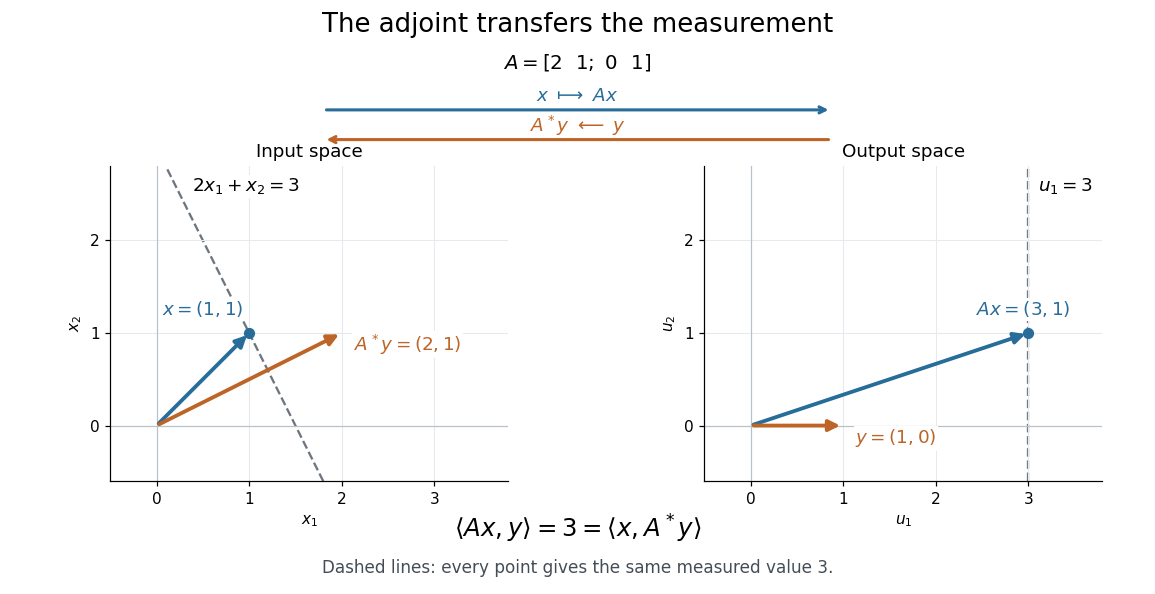
In this real example,Both inner products equal . The dashed lines collect all vectors giving that same measurement: the output line becomes the input line . The adjoint operator therefore moves the direction that describes the measurement. It generally differs from the inverse matrix: here .
For an explicitly complex example, use the standard inner product on . In the standard orthonormal basis, the adjoint operator is represented by the conjugate transpose:For and , direct matrix multiplication givesand henceThe complex conjugate is essential to this agreement.
Existence follows from the Riesz representation theorem: for fixed , the bounded linear functional has a unique representing vector . The resulting adjoint operator has the same operator norm as , andMIT's lecture 18 develops the representation argument and the conjugate transpose example.[ref]
https://ocw.mit.edu/courses/18-102-introduction-to-functional-analysis-spring-2021/7f23bfc43ee2e1efd238a5384e5b9d51_MIT18_102s21_lec18.pdf. Rodriguez, notes by Andrew Lin, MIT 18.102, lecture 18, Theorem 185 and Example 186, 2021
This transfer explains the normal equation for a linear inverse problem: a least-squares solution has residual orthogonal to every attainable direction , so for every , equivalently . An output residual becomes an input condition through the same adjoint operator. All identities in this section concern bounded operators defined on the whole source Hilbert space; for a densely defined operator that is not bounded, use the adjoint of a densely defined operator and check its operator domain.
For a smooth scalar function on a compact Riemannian manifold , its Dirichlet energy isThe Riemannian gradient measures local variation and the Riemannian volume weights its contribution. With source function , consider . On a manifold without boundary, or for variations vanishing at the boundary, the first variation in direction isHere is the Laplace-Beltrami operator. A critical function therefore solves the Poisson equation .
On a closed manifold, adding a constant leaves unchanged. If , shifting that constant makes unbounded below. Thus zero integral of the source is a necessary compatibility condition for this unconstrained closed-manifold problem.
A differential form on a Riemannian manifold is parallel when its covariant derivative under the Levi-Civita connection vanishes:Equivalently, parallel transport preserves the differential form. The exterior derivative is the alternating part of this covariant derivative, and the codifferential is a contraction of it, so and . Consequently the Hodge Laplacian satisfies .
This is a pointwise harmonicity statement, requiring no compactness. On a manifold with boundary it does not by itself impose a chosen boundary condition. Constant functions and the Riemannian volume form on an oriented Riemannian manifold are examples.
Orbit-separating invariant for the standard dihedral action on the Riemann sphere by Codex 0 Created 2026-09-24 Updated 2026-11-05
Codex 0 Created 2026-09-24 Updated 2026-11-05For and , where and is a primitive th root of unity, the rational functionis invariant under the dihedral group acting on the Riemann sphere. Equality of two finite values factors as for and , so every fibre is exactly one orbit. The fibre over infinity is , which is also one orbit because inversion exchanges the two points. Primitivity is needed: a nonprimitive rotation can generate a smaller group whose orbits this same rational function does not separate.
Let a finite group of conformal automorphisms of the Riemann sphere fix . The derivative representation at embeds into , so is cyclic. Averaging a local coordinate linearizes the action to , and the quotient has coordinate .
Stereographic projection identifies a sphere minus one pole with the plane and supplies the standard charts of the Riemann sphere.
In the equatorial-plane convention of the Riemann sphere, draw the straight line through and a point on the unit sphere. Its intersection with the plane has complex coordinateThe inverse function, for and , isHere positive gives positive , and positive gives positive . Thus and lie on the positive and ends of the equator. The omitted north pole is assigned .[ref]
Topic 2 Notes. Complex Variables with Applications, MIT 18.04, Spring 2018; Topic 2 Notes, section 2.5.2, printed p. 7, projection formula and north pole
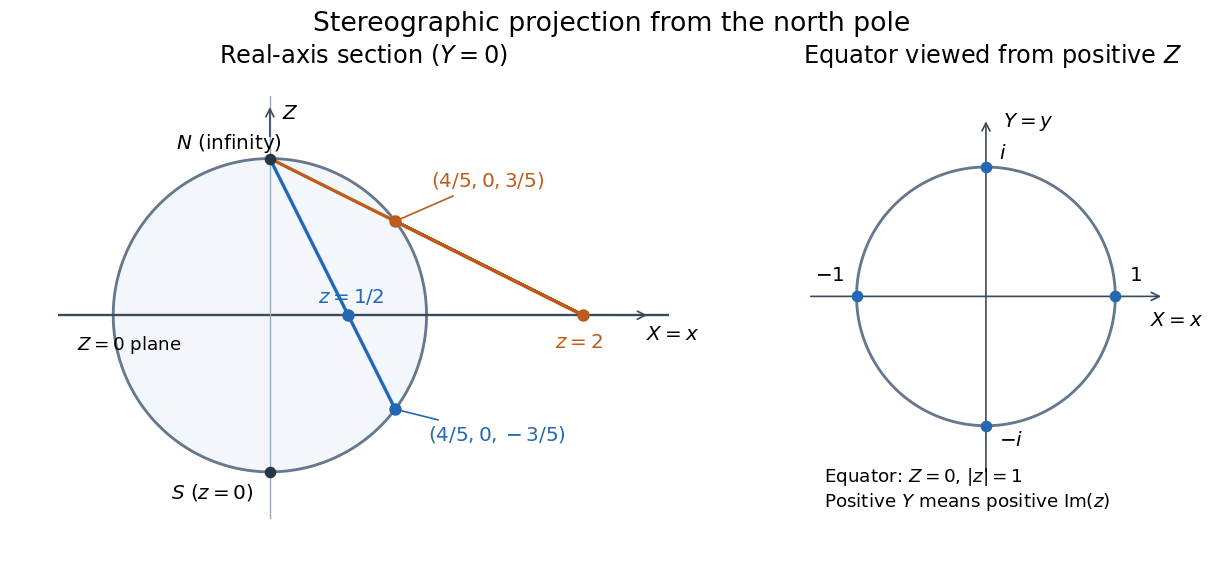
North-pole projection onto the equatorial plane: two real points and the positive complex-axis convention
. Details. For original worked points, the real numbers and lift to points with the same coordinate but opposite coordinates:Projecting back gives and . A point off the real axis checks the other sign:The coordinates satisfy , as a point on the unit sphere must. Also , and .
A short derivation starts with the line . Setting its last coordinate to zero gives , hence the projection formula. Conversely the line from to is . Substitution in the unit sphere equation givesThe root is ; the other root gives . These line intersections establish both the formula and its bijection property without guessing the inverse.
The same algebra explains how large planar distances become small spherical ones:Consequently brings to independently of direction. The last expression is twice the chordal metric distance . A whole unbounded exterior in the complex plane therefore becomes a small cap on the unit sphere.
A canonical divisor is the divisor of any nonzero rational differential. Its divisor class is independent of the differential and has degree .
If Riemann-integrable functions satisfy throughout , thenThis follows directly by comparing their lower and upper Darboux sums, or their Riemann sums on a common sequence of refining partitions.
Pinned article: Introduction to the OurBigBook Project
Welcome to the OurBigBook Project! Our goal is to create the perfect publishing platform for STEM subjects, and get university-level students to write the best free STEM tutorials ever.
Everyone is welcome to create an account and play with the site: ourbigbook.com/go/register. We belive that students themselves can write amazing tutorials, but teachers are welcome too. You can write about anything you want, it doesn't have to be STEM or even educational. Silly test content is very welcome and you won't be penalized in any way. Just keep it legal!
Intro to OurBigBook
. Source. We have two killer features:
- topics: topics group articles by different users with the same title, e.g. here is the topic for the "Fundamental Theorem of Calculus" ourbigbook.com/go/topic/fundamental-theorem-of-calculusArticles of different users are sorted by upvote within each article page. This feature is a bit like:
- a Wikipedia where each user can have their own version of each article
- a Q&A website like Stack Overflow, where multiple people can give their views on a given topic, and the best ones are sorted by upvote. Except you don't need to wait for someone to ask first, and any topic goes, no matter how narrow or broad
This feature makes it possible for readers to find better explanations of any topic created by other writers. And it allows writers to create an explanation in a place that readers might actually find it.
Figure 1. Screenshot of the "Derivative" topic page. View it live at: ourbigbook.com/go/topic/derivativeVideo 2. OurBigBook Web topics demo. Source. - local editing: you can store all your personal knowledge base content locally in a plaintext markup format that can be edited locally and published either:This way you can be sure that even if OurBigBook.com were to go down one day (which we have no plans to do as it is quite cheap to host!), your content will still be perfectly readable as a static site.
- to OurBigBook.com to get awesome multi-user features like topics and likes
- as HTML files to a static website, which you can host yourself for free on many external providers like GitHub Pages, and remain in full control

Figure 2. You can publish local OurBigBook lightweight markup files to either OurBigBook.com or as a static website.
Figure 3. Visual Studio Code extension installation.
Figure 5. . You can also edit articles on the Web editor without installing anything locally. Video 3. Edit locally and publish demo. Source. This shows editing OurBigBook Markup and publishing it using the Visual Studio Code extension. 
- Infinitely deep tables of contents:




All our software is open source and hosted at: github.com/ourbigbook/ourbigbook
Further documentation can be found at: docs.ourbigbook.com
Feel free to reach our to us for any help or suggestions: docs.ourbigbook.com/#contact