Topics (384k) Articles (398k) Users (410) Discussions (242) Comments (383) Files (13k) New article
A sheaf of modules on a scheme is quasi-coherent when every affine chart restricts it to the sheaf associated with an -module. On an affine scheme it is determined by its module of global sections.
For an open inclusion , extension by zero is the sheaf whose stalk equals on and zero outside . Its sections are local sections on whose support is closed in the ambient open set.
Sheafification associates a sheaf to a presheaf without changing its stalks and is universal among morphisms from that presheaf to sheaves.
The stalk is the direct limit of over neighborhoods of . A morphism of sheaves is an isomorphism or forms an exact sequence exactly when it does so on every stalk.
A transgression is a spectral-sequence differential from a fiber class on the vertical edge to a base class on the horizontal edge.
The harmonic series is the positive seriesIts partial sums are the harmonic numbers . Although the individual terms tend to zero, grows without bound, so the harmonic series is not a convergent series. This is a basic warning against using the size of one term as a bound on all the terms still to come.
The growth is slow enough to be visually deceptive. The partial sums at are approximately . Adding ten times as many terms increases the accumulated total by roughly , rather than multiplying the total by ten. The telescoping series has similarly vanishing terms but approaches the finite sum one.
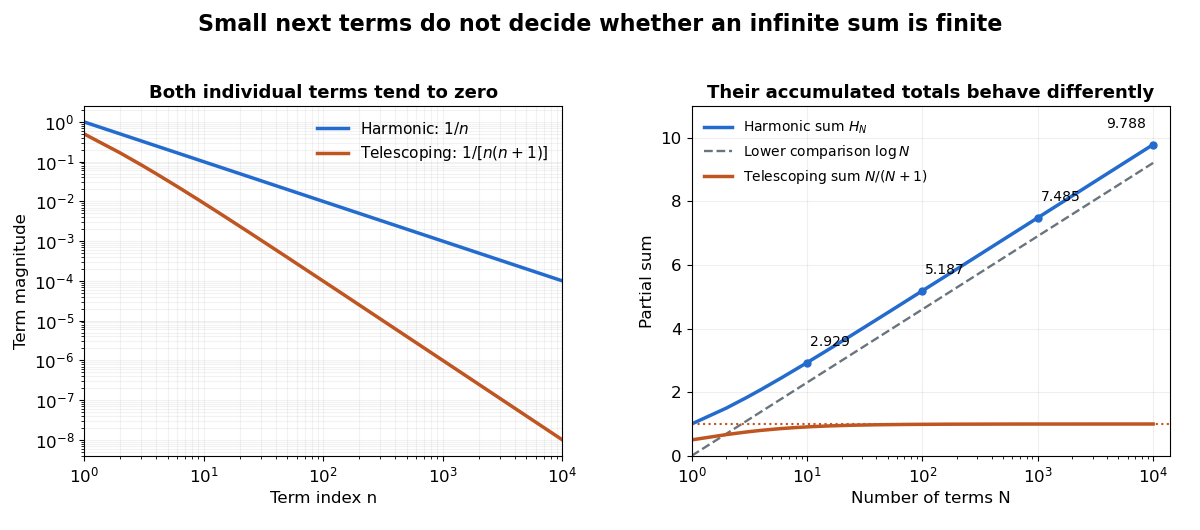
A short block argument proves the divergence without trusting a finite plot. For each integer , the block from through contains terms, each at least . ThereforeEvery doubling supplies at least another half, and arbitrarily many doublings are possible. A collection of tiny terms can still have a substantial combined contribution. See Jiří Lebl, Basic Analysis I, Example 2.5.11 for this grouping proof.
Integral comparison sharpens the growth estimate. Here denotes the natural logarithm. Since is a strictly decreasing function for positive , comparison of rectangles with the integral givesThus the divergence is logarithmic. The finer difference tends to the Euler--Mascheroni constant, approximately ; the harmonic number expansion supplies higher-order corrections. This turns the counterexample into a usable quantitative estimate of accumulated reciprocal contributions.
Euler's De progressionibus harmonicis observationes, written in 1734 and published in 1740, studies these sums beyond the yes-or-no question of convergence. Sections 2–3 compare long blocks to show continued growth, and later sections compare the sums with logarithms and calculate the constant offset. The [ref]
https://scholarlycommons.pacific.edu/euler-works/43/. Euler Archive record, E43
identifies the dates and original publication; [ref]https://download.uni-mainz.de/mathematik/Algebraische%20Geometrie/Euler-Kreis%20Mainz/E43.pdf. Alexander Aycock's translation of Euler's original paper
makes the calculations accessible. This is not a claim that Euler first discovered divergence: the paper's interest includes measuring how slowly a divergent sum grows.The th partial sum of a series with terms is the finite sum . It records the accumulated total after additions. The terms and their partial sums are different sequences: the terms of the harmonic series get small, while their partial sums grow without bound.
For the telescoping series with terms , the first three partial sums areBy contrast, the harmonic series gives , , and , where is the harmonic number. Computing more partial sums approximates an infinite sum only when a limit of a sequence exists, and the tail of a telescoping reciprocal series shows how an error estimate can certify the approximation.
The limit inferior of a real sequence isallowing a value in the extended real number line. For a finite value , it has two complementary meanings: for every , all sufficiently late terms satisfy , while arbitrarily late terms satisfy . The first prevents persistent dips below ; the second prevents any larger number from being the true lower edge.
For , the lower bounds in limit inferior and limit superior approach . Every late term eventually exceeds , and the subsequence at odd integers comes arbitrarily close to . For , the lower bound of every infinite tail of a sequence is already zero, although no term equals zero. Thus a limit inferior need not be the minimum of any tail.
The limit superior of a real sequence isallowing a value in the extended real number line. For a finite value , every gives an eventual upper bound , while arbitrarily late terms still satisfy . The second condition concerns recurrence at arbitrarily large indices, not the fraction of indices where a large value occurs.
In limit inferior and limit superior, has limit superior one because its positive branch approaches one from above and all later values eventually stay below . Changing any finite number of terms leaves the limit superior unchanged: once the tail of a sequence begins beyond those positions, all its suprema are the same as before. The sparse peaks can determine a limit superior example shows that even a set of peak indices with zero natural density can decide the upper long-run edge.
A monotone sequence has one of these directions for every index. Here increasing means nondecreasing and decreasing means nonincreasing: equal successive terms are allowed. Strict increase would require at every step, and strict decrease would require . A constant sequence is both increasing and decreasing. These conventions are those of Basic Analysis: Introduction to Real Analysis, Volume I by Jiří Lebl (§2.1.1, Definition 2.1.9).
For , the sequence increases toward one, while decreases toward one. Repeating each term gives the still increasing sequence . Plateaus do not obstruct the bounded monotone sequence theorem. Checking the sign of is often the simplest way to verify a direction; finding an upper bound or lower bound is a separate task.
On real polynomials with the weighted inner productthe differential operator is symmetric. Indeed, and integration by parts givesThe factor removes the boundary term at zero and the exponential removes it at infinity. On the finite-dimensional polynomial vector space of degree at most , preserves the space and is a self-adjoint operator. Its eigenvalues are , with the ordinary Laguerre polynomials as eigenvectors. On the full weighted Hilbert space, symmetry on the polynomial domain alone does not assert equality of adjoint operator domains; a self-adjoint realization requires its operator domain to be specified.
Every self-adjoint operator on a finite-dimensional real or complex inner product space has an orthonormal eigenbasis, and all its eigenvalues are real. In orthonormal coordinates, a real symmetric matrix has the form , with an orthogonal matrix and a real diagonal matrix. A complex Hermitian matrix instead has , with a unitary matrix and its conjugate transpose. These are the self-adjoint cases of the spectral theorem; Axler gives the real and complex finite-dimensional statements in Section 7B.[ref]
https://linear.axler.net/LADR4e.pdf. Sheldon Axler, Linear Algebra Done Right, fourth edition, Section 7B, Theorems 7.29 and 7.31; accessed 2026-10-11
An orthonormal eigenbasis turns a seemingly coupled linear map into independent scalar multiplications while preserving lengths and angles. If and , thenThe last identity removes every cross term from the quadratic form. The eigenvalues tell us whether it is positive, negative, or mixed in sign, and the eigenvectors identify the corresponding directions. This connects positive-definite matrices, quadratic forms, and the Hermitian Rayleigh quotient range.
For a fully computed example, takeDirect multiplication gives and . Their dot product is zero and each has norm one. ThusWriting changes into . Its level set is therefore an ellipse with semiaxis lengths and , along and . The coordinates change, but the ellipse does not: orthogonal diagonalization reveals its existing geometry.
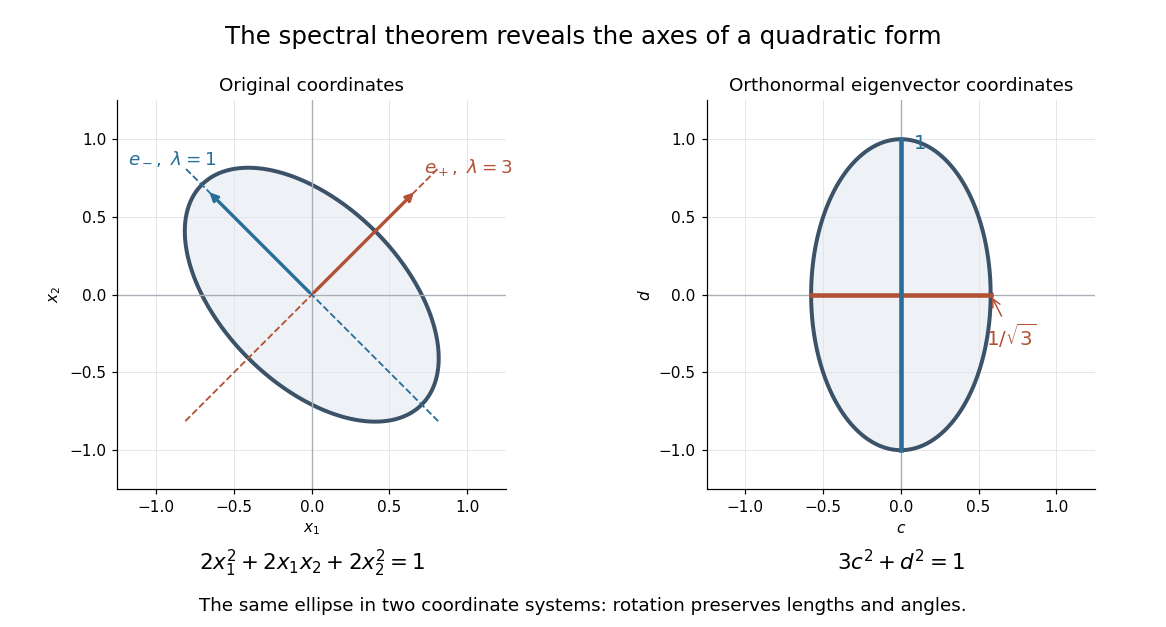
An orthonormal eigenbasis removes the cross term from a quadratic form and reveals the axes of its ellipse
. Details. For distinct eigenvalues, orthogonality follows at once from self-adjointness: . Within a repeated eigenspace, choose an orthonormal basis; arbitrarily chosen eigenvectors of the same eigenvalue need not be orthogonal. One outline of the full argument finds an eigenvector, observes that its orthogonal complement is invariant, and repeats in that smaller space. Merely having real eigenvalues is weaker: has two real eigenvalues, but its eigenvectors and are not orthogonal.
Generation of a fundamental group by two open sets by  Codex 0 Created 2026-09-24 Updated 2026-09-24
If , the sets , and their intersection are path-connected, and the base point lies in the intersection, then is generated by the images of and . Subdivide each loop into arcs lying in cover members and join every transition point to the base point within the intersection; the inserted paths telescope.
Given homomorphisms and , the amalgamated free product comes with homomorphisms from and that agree on . It is universal with this property: every compatible pair of homomorphisms and factors uniquely through .
Pinned article: Introduction to the OurBigBook Project
Welcome to the OurBigBook Project! Our goal is to create the perfect publishing platform for STEM subjects, and get university-level students to write the best free STEM tutorials ever.
Everyone is welcome to create an account and play with the site: ourbigbook.com/go/register. We belive that students themselves can write amazing tutorials, but teachers are welcome too. You can write about anything you want, it doesn't have to be STEM or even educational. Silly test content is very welcome and you won't be penalized in any way. Just keep it legal!
Intro to OurBigBook
. Source. We have two killer features:
- topics: topics group articles by different users with the same title, e.g. here is the topic for the "Fundamental Theorem of Calculus" ourbigbook.com/go/topic/fundamental-theorem-of-calculusArticles of different users are sorted by upvote within each article page. This feature is a bit like:
- a Wikipedia where each user can have their own version of each article
- a Q&A website like Stack Overflow, where multiple people can give their views on a given topic, and the best ones are sorted by upvote. Except you don't need to wait for someone to ask first, and any topic goes, no matter how narrow or broad
This feature makes it possible for readers to find better explanations of any topic created by other writers. And it allows writers to create an explanation in a place that readers might actually find it.
Figure 1. Screenshot of the "Derivative" topic page. View it live at: ourbigbook.com/go/topic/derivativeVideo 2. OurBigBook Web topics demo. Source. - local editing: you can store all your personal knowledge base content locally in a plaintext markup format that can be edited locally and published either:This way you can be sure that even if OurBigBook.com were to go down one day (which we have no plans to do as it is quite cheap to host!), your content will still be perfectly readable as a static site.
- to OurBigBook.com to get awesome multi-user features like topics and likes
- as HTML files to a static website, which you can host yourself for free on many external providers like GitHub Pages, and remain in full control

Figure 2. You can publish local OurBigBook lightweight markup files to either OurBigBook.com or as a static website.
Figure 3. Visual Studio Code extension installation.
Figure 5. . You can also edit articles on the Web editor without installing anything locally. Video 3. Edit locally and publish demo. Source. This shows editing OurBigBook Markup and publishing it using the Visual Studio Code extension. 
- Infinitely deep tables of contents:




All our software is open source and hosted at: github.com/ourbigbook/ourbigbook
Further documentation can be found at: docs.ourbigbook.com
Feel free to reach our to us for any help or suggestions: docs.ourbigbook.com/#contact