Topics (384k) Articles (398k) Users (410) Discussions (242) Comments (383) Files (13k) New article
For oriented curves on a Seifert surface, the Seifert form iswhere is a positive normal push-off of .
Mean curvature measures the average signed bending of a smooth surface. Unlike Gaussian curvature, it adds the two principal curvatures rather than multiplying them. A circular cylinder therefore has nonzero mean curvature despite zero Gaussian curvature, whereas a catenoid has zero mean curvature despite negative Gaussian curvature. The cancellation on a catenoid explains how a curved minimal surface can be stationary for surface area.
Choose a unit normal and the shape operator , as in the second fundamental form convention . For a smooth surface in Euclidean space of dimension three, define the signed scalar mean curvature byHere are the coefficients of the first fundamental form, and those of the second fundamental form. The factor makes an average; the scalar trace convention instead calls the mean curvature. Authors who use reverse both signs. A formula involving mean curvature is therefore incomplete unless its shape operator, unit normal, and averaging convention are specified.
In orientation reversal of surface curvature, both principal curvatures and change sign, while Gaussian curvature and the mean curvature vector do not. The units of mean curvature are inverse length, compared with inverse squared length for Gaussian curvature. The distinction matters in soap film pressure balance: pressure couples to the sum of the signed principal curvatures.
Rolling a sheet into a circular cylinder bends it without changing its internal lengths and angles. Fitting that same sheet smoothly onto a sphere requires distortion of its first fundamental form. Gaussian curvature distinguishes these situations: it measures the intrinsic curvature of a smooth surface, even though its simplest definition uses how the surface bends in Euclidean space.
The Gaussian curvature at a point is the determinant of the shape operator, or the product of the two principal curvatures:Here is the first fundamental form and is the second fundamental form, with . Regularity makes . Reversing the unit normal negates and both principal curvatures, leaving Gaussian curvature unchanged. [ref]
https://ghomi.math.gatech.edu/Classes/Math497C/LectureNotes9.pdf. Ghomi, Lecture Notes 9, §2.2: determinant formula and independence of normal choice
The sign describes bending at the point: positive Gaussian curvature means the principal curvatures have the same nonzero sign, as at an elliptic point; negative Gaussian curvature means opposite signs, as on a saddle; zero Gaussian curvature means at least one principal curvature vanishes. Zero Gaussian curvature at a single point does not imply that a neighborhood is a plane. [ref]
https://ghomi.math.gatech.edu/Classes/Math497C/LectureNotes10.pdf. Ghomi, Lecture Notes 10, §2.3.1: the sign of Gaussian curvature
Four worked models make the signs concrete:
- On a plane, the unit normal is constant, so the shape operator is zero and .
- On a sphere of radius , the outward unit normal gives . Thus , , and .
- On the lateral surface of a circular cylinder of radius , the outward unit normal gives and . Hence but : there is extrinsic curvature despite intrinsic flatness. The shape operator calculation above gives , , , so the determinant formula gives the same result.
- For the upward-oriented saddle with , the gradient vanishes at the origin. The fundamental forms of a graph surface therefore giveThe shape operator has eigenvalues , giving and . Away from the origin, Gaussian curvature of a graph surface gives ; the label applies only at the marked point.
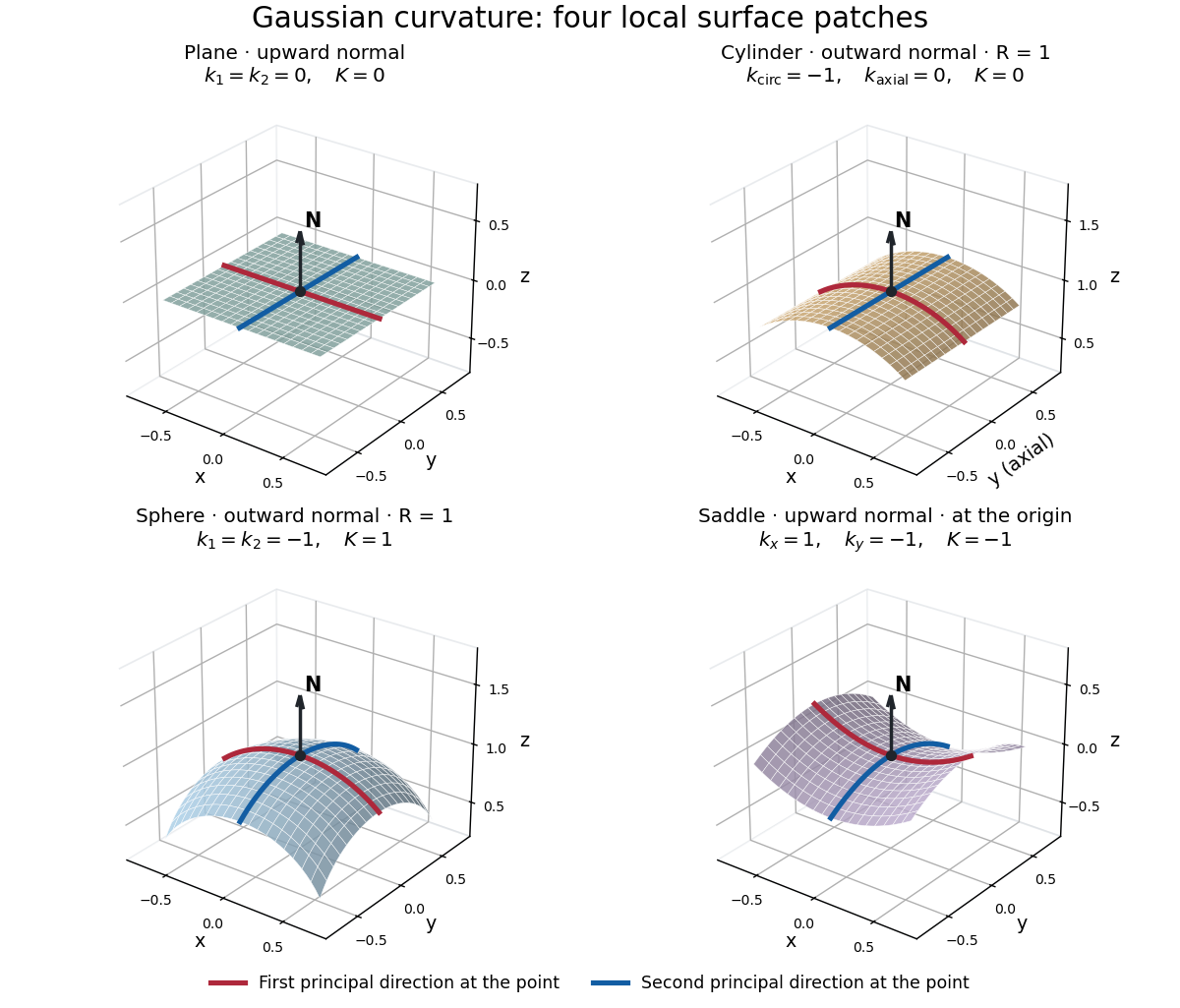
Plane, outward cylinder, outward sphere, and upward saddle compared by their principal curvatures and Gaussian curvature
. Details. The patches use a common length unit, with for the sphere and circular cylinder. The marked red and blue curves have principal directions at the black point; the arrow is the chosen unit normal. For physical lengths, principal curvature and mean curvature have units of inverse length, while Gaussian curvature has units of inverse squared length. Rescaling a surface by divides its principal curvatures by and its Gaussian curvature by . Writing the saddle as restores an explicit length scale: .
The Theorema Egregium says that Gaussian curvature depends only on the first fundamental form and its first two coordinate derivatives. A local isometry therefore preserves Gaussian curvature, even if the shape operator and the principal curvatures change. [ref]
https://ghomi.math.gatech.edu/Classes/Math497C/LectureNotes11.pdf. Ghomi, Lecture Notes 11, §2.5: Theorema Egregium
Here is the outline, rather than a full proof. The Gauss formula splits second derivatives of a parametric surface into tangential Christoffel symbols and the second fundamental form. The Christoffel symbols are determined by the first fundamental form and its first derivatives. Commuting the next partial derivatives gives the Gauss equation, which identifies with the intrinsic sectional curvature computed from the Riemann curvature tensor. Thus the apparently extrinsic product is determined by the Riemannian metric. [ref]
https://ghomi.math.gatech.edu/Classes/Math497C/LectureNotes12.pdf. Ghomi, Lecture Notes 12, §§2.6–2.7: Gauss formula and metric-based curvature
One can see the distinction directly by rolling a plane strip with coordinates into the circular cylinder . Both have , so the map is a local isometry, and is one-to-one on an open strip of width less than . Extending over all real numbers wraps around periodically; it does not give a global isometry between the entire plane and the entire circular cylinder. A nonempty open patch of a sphere cannot be flattened by a local isometry into a plane, because its Gaussian curvature cannot become zero. The obstruction concerns preservation of the first fundamental form, rather than a particular drawing or choice of seam.
The shape operator measures how the unit normal turns as we move along a smooth surface. A plane has a constant unit normal, whereas the outward unit normal of a sphere turns in every direction in the tangent plane. Keeping the direction of this change, rather than just its magnitude, lets one recover the principal curvatures and their principal directions.
Choose an orientation of a surface , with Gauss map . The shape operator at is the linear mapHere is the differential of the Gauss map. Its output belongs to , identified with because both are the vector plane perpendicular to . The minus sign is our convention throughout this branch. [ref]
https://ghomi.math.gatech.edu/Classes/Math497C/LectureNotes9.pdf. Ghomi, Lecture Notes 9, §2.2: Gauss map and shape operator
The shape operator packages the second fundamental form as an operator using the inner product supplied by the first fundamental form:The symmetry of the second fundamental form makes the shape operator a self-adjoint operator for this inner product. Thus an orthonormal basis of principal directions diagonalizes it. In a coordinate basis of a parametric surface, writeThe matrix need not be a symmetric matrix in this coordinate basis: its self-adjointness means . Using the eigenvalues of alone gives the principal curvatures only when is the identity matrix. [ref]
For a worked example, parametrize the lateral surface of an outward-oriented circular cylinder of radius using circumferential arc length and axial coordinate :The coordinate tangent vectors are an orthonormal basis. Since and , the shape operator satisfiesChanging to angular coordinate gives and ; still has eigenvalues . This is why the first fundamental form must participate in the calculation.
For a sphere of radius centered at the origin, the outward unit normal is . Hence , so both principal curvatures are . For a plane, and the shape operator vanishes. Reversing the unit normal negates the shape operator and both principal curvatures; the Gaussian curvature remains unchanged while the mean curvature changes sign, as in orientation reversal of surface curvature.
For a Euclidean embedded submanifold, the covariant derivative of the second fundamental form satisfies
For a Euclidean embedded submanifold,It expresses intrinsic curvature in terms of the second fundamental form.
The second fundamental form of an embedded submanifold of a Riemannian manifold is symmetric. Its ambient Levi-Civita connection is a torsion-free connection, soThe Lie bracket of vector fields tangent to the submanifold is tangent and therefore has zero normal component. This proof applies to a curved ambient manifold as well as Euclidean space.
For , the optical tensor is the screen projection . Its trace, symmetric trace-free part, and antisymmetric part are the expansion, shear, and twist of the null congruence.
Under a regular simple -parameter null, the normalized score converges to , so its information-standardized squared norm converges to .
A restricted maximum-likelihood estimator maximizes likelihood over the null parameter space rather than the full model.
Simultaneous spacetime scaling symmetry of the wave equation by  Codex 0 Created 2026-09-24 Updated 2026-09-24
The Inviscid Burgers equation is the scalar conservation lawFor a classical solution, the chain rule makes this equivalent to , a nonlinear transport equation with characteristic speed . The conservative form remains meaningful for a discontinuous weak solution, whereas the product cannot simply be evaluated pointwise at a jump. Its discontinuities obey the Rankine-Hugoniot condition ; this condition alone permits inadmissible expansion jumps. For bounded initial conditions on the infinite line, imposing the Kruzhkov entropy inequalities and the initial trace selects a unique entropy solution. For step data, incoming characteristic curves select , while produces a rarefaction wave.[ref]
Satellite formula for the Levine-Tristram signature by Codex 0 Created 2026-09-24 Updated 2026-09-24
Codex 0 Created 2026-09-24 Updated 2026-09-24For a pattern of winding number ,whenever the relevant signatures are defined by nonsingular forms. The usual averaged convention extends the identity through roots.
Pinned article: Introduction to the OurBigBook Project
Welcome to the OurBigBook Project! Our goal is to create the perfect publishing platform for STEM subjects, and get university-level students to write the best free STEM tutorials ever.
Everyone is welcome to create an account and play with the site: ourbigbook.com/go/register. We belive that students themselves can write amazing tutorials, but teachers are welcome too. You can write about anything you want, it doesn't have to be STEM or even educational. Silly test content is very welcome and you won't be penalized in any way. Just keep it legal!
Intro to OurBigBook
. Source. We have two killer features:
- topics: topics group articles by different users with the same title, e.g. here is the topic for the "Fundamental Theorem of Calculus" ourbigbook.com/go/topic/fundamental-theorem-of-calculusArticles of different users are sorted by upvote within each article page. This feature is a bit like:
- a Wikipedia where each user can have their own version of each article
- a Q&A website like Stack Overflow, where multiple people can give their views on a given topic, and the best ones are sorted by upvote. Except you don't need to wait for someone to ask first, and any topic goes, no matter how narrow or broad
This feature makes it possible for readers to find better explanations of any topic created by other writers. And it allows writers to create an explanation in a place that readers might actually find it.
Figure 1. Screenshot of the "Derivative" topic page. View it live at: ourbigbook.com/go/topic/derivativeVideo 2. OurBigBook Web topics demo. Source. - local editing: you can store all your personal knowledge base content locally in a plaintext markup format that can be edited locally and published either:This way you can be sure that even if OurBigBook.com were to go down one day (which we have no plans to do as it is quite cheap to host!), your content will still be perfectly readable as a static site.
- to OurBigBook.com to get awesome multi-user features like topics and likes
- as HTML files to a static website, which you can host yourself for free on many external providers like GitHub Pages, and remain in full control

Figure 2. You can publish local OurBigBook lightweight markup files to either OurBigBook.com or as a static website.
Figure 3. Visual Studio Code extension installation.
Figure 5. . You can also edit articles on the Web editor without installing anything locally. Video 3. Edit locally and publish demo. Source. This shows editing OurBigBook Markup and publishing it using the Visual Studio Code extension. 
- Infinitely deep tables of contents:



All our software is open source and hosted at: github.com/ourbigbook/ourbigbook
Further documentation can be found at: docs.ourbigbook.com
Feel free to reach our to us for any help or suggestions: docs.ourbigbook.com/#contact