Topics (384k) Articles (398k) Users (410) Discussions (242) Comments (383) Files (13k) New article
During inward migration, dust can be captured into an exterior mean-motion resonance with a planet. A phase-shifted conjunction then lets planetary torque replace angular momentum lost to Poynting–Robertson drag.
Poynting–Robertson drag is the tangential component of stellar radiation force caused by aberration in an orbiting dust grain's frame. It removes orbital energy and angular momentum and drives the grain inward.
The radiation-pressure coefficient is the ratio of outward stellar radiation pressure to inward stellar gravity on a dust grain. The grain therefore feels effective gravitational parameter .
Two-stage stability exchange in a symmetric planar system by  Codex 0 Created 2026-09-24 Updated 2026-09-24
Successive symmetry-breaking bifurcations can pass stability from one boundary branch to an interior branch and then to a second boundary branch.
The force on a pipe junction follows from vector momentum conservation for the fluid inside the junction. In steady flow, the sum of outward momentum fluxes minus inward momentum fluxes equals the external resultant on that fluid. A section with nearly uniform velocity contributes mass flow rate times its velocity vector, with the appropriate inlet or outlet sign.
Pressure also pushes on every cut section: with an outward normal , the pressure force on the control-volume fluid is . Adding gravity and the unknown wall force gives a solvable balance once flow rates, directions and pressures are specified. The force of the fluid on the pipe is the opposite of the wall force on the fluid.
A Bézout domain is an integral domain in which every finitely generated ideal is principal. Equivalently, every pair has a greatest common divisor satisfying a Bézout identity . A Noetherian Bézout domain is a principal ideal domain because all its ideals are finitely generated.
A greatest-common-divisor domain is an integral domain in which every two nonzero elements have a greatest common divisor, defined up to multiplication by a unit.
A nonzero nonunit in an integral domain is irreducible when every factorization has at least one unit factor.
The field discriminant is the discriminant of any integral basis and controls the index of every suborder.
For a one-degree-of-freedom closed orbit, action-angle coordinates make the Hamiltonian a function and give , .
The Gram-Schmidt process turns a finite ordered family of linearly independent vectors in an inner product space over the real numbers into an orthonormal basis of their linear span. It keeps every successive linear span, so the first new vectors describe exactly the same directions as the first inputs. Its idea is geometric: remove the orthogonal projection onto directions already found, then divide the remaining vector by its norm. This makes a complicated basis easier to use without changing the vector subspace it describes.[ref]
Start with and . At step , use the previously obtained orthonormal set to defineThe sum is the orthogonal projection onto a finite-dimensional subspace , and is the orthogonal projection residual. Linear independence ensures : otherwise would already be a linear combination of earlier inputs. If the input family is linearly dependent, use only the retained orthonormal vectors in the sum and omit an input whenever its remainder is the zero vector; do not divide by zero. The retained outputs still form an orthonormal basis of the original linear span, but their number can be smaller than .
For a short verification, orthonormality makes every earlier inner product vanish:Also is minus a linear combination of earlier vectors, while is plus that same linear combination. These two inclusions, followed by division by a nonzero norm, giveThe argument also works in an inner product space over the complex numbers with the existing inner product convention, linear in the first argument: the coefficients remain . With the convention linear in the second argument, write instead.
For a first picture, take and in with the ordinary dot product. ThenSubtracting the diagonal component leaves an orthogonal direction; dividing by its norm makes its length one. If the second input were instead, its orthogonal projection would be the entire input and , revealing linear dependence.
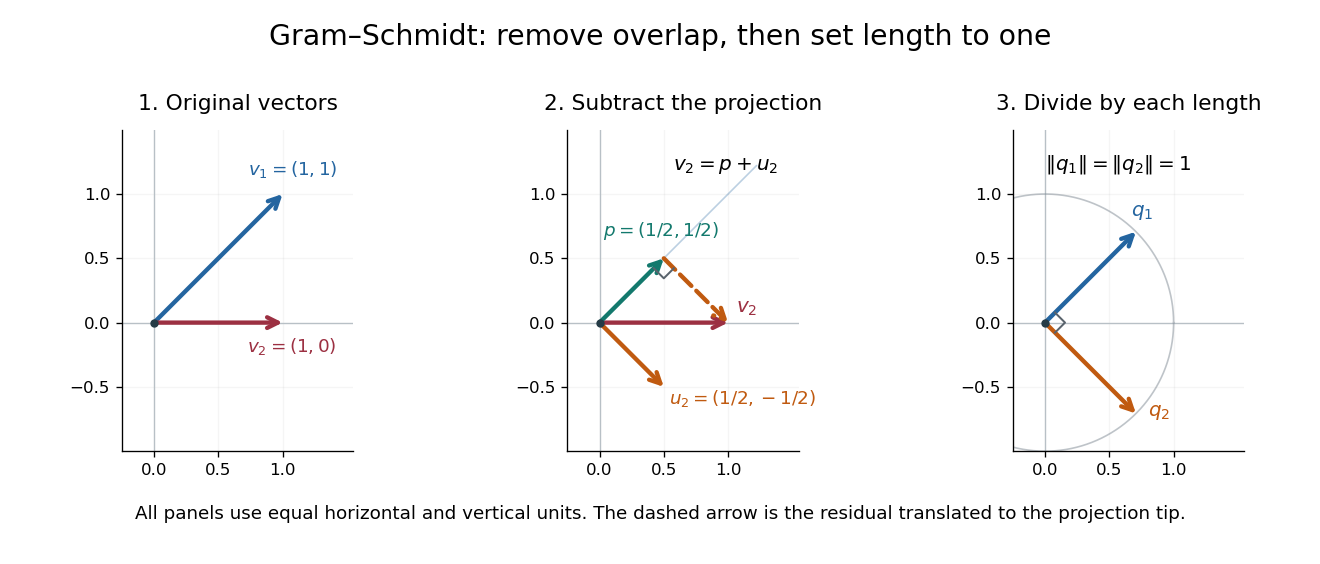
Gram-Schmidt orthogonalization in : input vectors, subtraction of an orthogonal projection, and an orthonormal basis
. Details. For a full three-dimensional calculation, use the ordinary dot product and the input vectorsThe first two steps giveAt the third step, the inner products are and . ConsequentlyThe three numerator vectors have pairwise dot products and squared Euclidean norms . Thus the displayed outputs are indeed an orthonormal basis, and the three nonzero remainders also confirm linear independence of the inputs. Keeping the removed coefficients produces the QR decomposition below.
An immediate reward is a reusable orthogonal projection: once an orthonormal basis of a vector subspace is known, any vector hasFor the linear span of just the first two inputs in the three-dimensional example, gives . Its orthogonal projection residual is , visibly in the missing orthogonal direction. This is the geometry behind the linear least-squares problem.
The formulas above describe exact arithmetic. With floating-point arithmetic, subtracting an orthogonal projection nearly equal to the input can leave a small remainder; dividing by its small norm can magnify existing roundoff error. The classical Gram-Schmidt and modified Gram-Schmidt arrangements agree in exact arithmetic but can give different rounded results. Exact linear dependence and a small computed remainder therefore require different judgments in a numerical implementation.[ref]
https://nhigham.com/wp-content/uploads/2023/10/high95m.pdf. Higham, The Test Matrix Toolbox for Matlab, §8, p. 22
Two vectors are nonorthogonal when their inner product is nonzero. For the power method applied to a Hermitian matrix, this condition detects whether the starting vector has a nonzero component along a chosen eigenvector, because the eigenvectors can be taken as an orthonormal basis.
For a general nonnormal matrix, the relevant component is instead detected by a corresponding left eigenvector. For example,The dominant right eigenvector has nonzero dot product with , but , so repeated multiplication never picks up the eigenvalue two. The corresponding left eigenvector is , and correctly detects the missing dominant component. Thus an arbitrary right-eigenvector nonorthogonality condition is insufficient for nonnormal matrices.
Two vectors are orthogonal when their inner product is zero.
For real Euclidean vectors, the inner product is the dot product, so and are orthogonal: . For nonzero Euclidean vectors, this means their angle is . The zero vector is orthogonal to every vector, although it has no direction or defined angle.[ref]
https://ocw.mit.edu/courses/18-06-linear-algebra-spring-2010/resources/lecture-14-orthogonal-vectors-and-subspaces/. Strang, MIT 18.06, Lecture 14: orthogonal vectors and subspaces
In an abstract inner product space, orthogonality always refers to its chosen inner product. For example, the weighted inner product makes and orthogonal, since . Their ordinary dot product is , so their arrows are not perpendicular in the usual Cartesian coordinate system. The algebraic definition also applies to functions, where arrows need not be available.
Orthogonal projection onto a finite-dimensional subspace by Codex 0 Created 2026-09-24 Updated 2026-10-14
Codex 0 Created 2026-09-24 Updated 2026-10-14A finite-dimensional linear subspace of an inner product space has a unique closest vector to any given vector . This is its orthogonal projection . If is an orthogonal basis of , compute it one direction at a time:The inner product convention here is linear in its first argument, including over the complex numbers. For an orthonormal basis, each denominator is one. When consists only of the zero vector, the empty sum gives . The finite-dimensional formula is described in Francis Narcowich, Inner Products and Norms: minimization problems.
Take and , using the dot product. With ,The orthogonal projection residual has . To verify the best approximation directly, every candidate in the line is , andThe smallest squared Euclidean norm error is therefore , attained only at . The diagram connects the perpendicular residual to this one-variable quadratic polynomial.
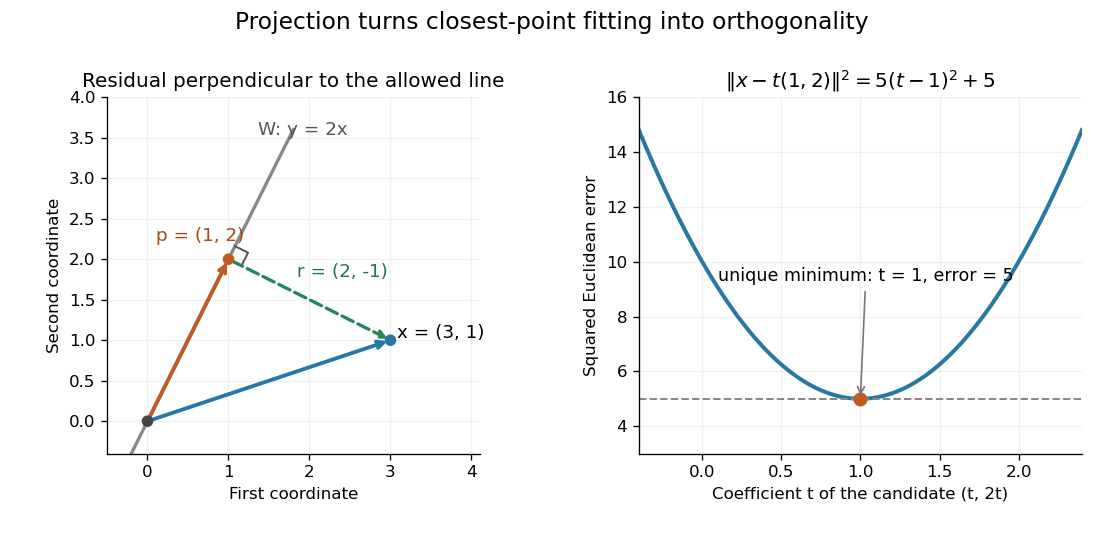
The perpendicular residual identifies the closest point on a line and the unique minimum of the squared error
. Details. The general mechanism is the Pythagorean theorem in an inner-product space. For any , the vectors and are orthogonal, soMoving away from inside adds a nonnegative squared norm, which is zero only when . This proves both optimality and uniqueness.
The useful feature is separation of preparation from evaluation. Construct an orthonormal basis once with the Gram-Schmidt process, then obtain each new best approximation using inner products instead of a fresh optimization problem. When is the column space of a matrix, this gives linear least squares; when is spanned by orthogonal polynomials, it gives a least-squares polynomial in an orthogonal-polynomial basis. The ambient inner product space need not be a Hilbert space for this finite-dimensional construction. In an infinite-dimensional target linear subspace, existence requires additional hypotheses, supplied by orthogonal decomposition by a closed subspace.
If vectors in a real or complex inner product space are orthogonal, thenIndeed, expanding the inner product gives , and orthogonality removes the last term. Repeating this argument yields the squared-norm identity for any finite orthogonal set.
Over the real numbers, the equality also implies orthogonality. Over the complex numbers it only implies . For example, in the vectors and satisfy , but their inner product is nonzero. Thus the converse requires the real-space hypothesis.
For a finite family of vectors in an inner product space, its Gram matrix records all pairwise inner products:Its diagonal entries are the squared norms of the vectors, and its off-diagonal entries describe their pairwise alignment. For example, and in giveThe positive definiteness of a Gram matrix relates the resulting quadratic form to the squared norm of a linear combination. In particular, is a positive semidefinite matrix, and it is invertible exactly when the original vectors are linearly independent. This permits geometric questions about a family to be answered through one matrix.
Two finite families with the same Gram matrix are related by a linear isometry between their linear spans: send to the same linear combination of the second family. Equality of the Gram matrices preserves squared norms, so every zero combination maps to zero and the rule is well-defined. If the two ambient inner product spaces are finite-dimensional and have the same dimension, completing orthonormal bases extends this map to an ambient unitary map. Equality of the ambient dimensions is needed for that last extension.
An orthonormal basis of a Hilbert space is an orthonormal set whose linear span has the whole space as its closure. This completeness of an orthonormal system allows every vector to be expanded in the basis vectors, with convergence in norm. In finite dimension it is also a basis in the finite-linear-combination sense.
Pinned article: Introduction to the OurBigBook Project
Welcome to the OurBigBook Project! Our goal is to create the perfect publishing platform for STEM subjects, and get university-level students to write the best free STEM tutorials ever.
Everyone is welcome to create an account and play with the site: ourbigbook.com/go/register. We belive that students themselves can write amazing tutorials, but teachers are welcome too. You can write about anything you want, it doesn't have to be STEM or even educational. Silly test content is very welcome and you won't be penalized in any way. Just keep it legal!
Intro to OurBigBook
. Source. We have two killer features:
- topics: topics group articles by different users with the same title, e.g. here is the topic for the "Fundamental Theorem of Calculus" ourbigbook.com/go/topic/fundamental-theorem-of-calculusArticles of different users are sorted by upvote within each article page. This feature is a bit like:
- a Wikipedia where each user can have their own version of each article
- a Q&A website like Stack Overflow, where multiple people can give their views on a given topic, and the best ones are sorted by upvote. Except you don't need to wait for someone to ask first, and any topic goes, no matter how narrow or broad
This feature makes it possible for readers to find better explanations of any topic created by other writers. And it allows writers to create an explanation in a place that readers might actually find it.
Figure 1. Screenshot of the "Derivative" topic page. View it live at: ourbigbook.com/go/topic/derivativeVideo 2. OurBigBook Web topics demo. Source. - local editing: you can store all your personal knowledge base content locally in a plaintext markup format that can be edited locally and published either:This way you can be sure that even if OurBigBook.com were to go down one day (which we have no plans to do as it is quite cheap to host!), your content will still be perfectly readable as a static site.
- to OurBigBook.com to get awesome multi-user features like topics and likes
- as HTML files to a static website, which you can host yourself for free on many external providers like GitHub Pages, and remain in full control

Figure 2. You can publish local OurBigBook lightweight markup files to either OurBigBook.com or as a static website.
Figure 3. Visual Studio Code extension installation.
Figure 5. . You can also edit articles on the Web editor without installing anything locally. Video 3. Edit locally and publish demo. Source. This shows editing OurBigBook Markup and publishing it using the Visual Studio Code extension. 
- Infinitely deep tables of contents:




All our software is open source and hosted at: github.com/ourbigbook/ourbigbook
Further documentation can be found at: docs.ourbigbook.com
Feel free to reach our to us for any help or suggestions: docs.ourbigbook.com/#contact