Topics (384k) Articles (398k) Users (410) Discussions (242) Comments (383) Files (13k) New article

An extensional program property gives identical answers to all codes computing the same object.
For a sequence of random variables on a probability space , defineThe decreasing sigma-algebras are generated by the listed random variables. Their intersection consists of events expressible after discarding every finite prefix. No independence is required.[ref]
Probability: Theory and Examples (fifth edition) by Rick Durrett. Probability: Theory and Examples (fifth edition), §2.5 Convergence of Random Series, printed p. 81: definition of the tail sigma-field
The point is to distinguish a long observation record from a property of an infinite sequence. The event of seeing infinitely many heads and the event that sample means converge survive any finite change, while an exact first-head time does not. Kolmogorov's zero–one law adds the striking conclusion that under independence each tail event has probability zero or one; the tail sigma-algebra itself can still contain many nonempty sets.
If two pi-systems satisfy the probability factorization pairwise, their generated sigma-algebras are independent. For one event in the first family, the events in the second sigma-algebra satisfying the factorization form a Dynkin system; apply Dynkin lemma, then repeat with the roles reversed.
Events are mutually independent whenfor every nonempty index subset . For two events and , this is equivalent to : learning whether occurred does not change the chance of .
For independent uniform dice, the events that the first result is an even integer and that the second result is an even integer each have probability ; their intersection has probability . In contrast, "first result is an even integer" and "first result is an odd integer" are disjoint events of positive probability, so they cannot be independent events. Learning one occurred completely rules out the other.
Pairwise independence is weaker than mutual independence. Take two independent fair bits . The three events , , and each have probability and every pair has intersection probability . Their triple intersection is the single outcome , of probability rather than . Checking pairs alone misses the joint constraint.
Every finite graph of maximum degree at most has an independent set of size at least . Greedily choose a vertex and delete its closed neighbourhood.
In the operator sense, a finite-dimensional group representation is unipotent when every represented element is a unipotent matrix: for each , is a nilpotent endomorphism. This terminology is distinct from the special unipotent characters in the representation theory of finite groups of Lie type.
For example, the generator of can act on a two-dimensional vector space by . Then , and the first coordinate line gives a nonsplit extension of representations of the trivial representation by itself. Over a field of characteristic zero, a unipotent matrix of finite order is the identity, because its minimal polynomial divides both a power of and the separable polynomial . Thus every unipotent group representation of a finite group is trivial in characteristic zero; in characteristic , the displayed instead gives a nontrivial group representation of .
A nonsplit extension contains an invariant subrepresentation with no invariant complementary subspace.
For an unnormalized target density, self-normalized importance sampling uses weights and estimates expectations by . Resampling a point with probability proportional to produces the associated weighted empirical distribution.
Coordinates on an immersed surface are isothermal when the first fundamental form is for a positive function .
A smooth embedding is an injective immersion that is a homeomorphism onto its image with the subspace topology.
This is the differentiable specialization of an embedding, with an injective differential in addition to its topological embedding property.
Matsubara frequencies are the discrete Fourier frequencies on an imaginary time thermal interval. With and , periodic bosonic fields have , while antiperiodic fermionic fields have .
Their difference follows from requiring the Fourier phase to return with the appropriate sign after one thermal period. The bosonic zero mode can dominate long-distance finite-temperature fluctuations, whereas fermions have no zero Matsubara mode in the ordinary thermal trace. These are labels in an imaginary time calculation, not discrete frequencies of an externally applied real-time drive. Extracting a real-frequency response requires the corresponding analytic continuation and spectral information.
The Kubo--Martin--Schwinger condition uses cyclicity of the thermal trace to relate correlation functions separated by imaginary time .
For a fixed amount of substance and composition of classical ideal gas, internal energy depends only on temperature: , with no independent volume dependence. This does not require constant heat capacity at constant volume. Between equilibrium endpoints,Here is total heat capacity at constant volume, is molar heat capacity, and for sample mass is specific internal energy, whose change is . These endpoint relations apply even when the intervening process is not at fixed volume; they do not say that transferred heat always equals . With constant , the safe statement is . Writing additionally chooses the reference energy; it does not prove that a physical gas remains classical and ideal down to zero temperature. [ref]
https://www.feynmanlectures.caltech.edu/I_45.html#Ch45-S1. Richard Feynman, Robert Leighton and Matthew Sands, §45-1: internal-energy derivatives and heat capacity
A thermodynamic proof outline uses the first law of thermodynamics in equilibrium form, , and the Maxwell relation :The last step uses the ideal gas law and the molar gas constant , with fixed composition and amount of substance. Microscopically, separated ideal gas particles store no intermolecular interaction energy; their translational kinetic energy and any internal molecular energy are determined by temperature. Negligible intermolecular interactions still allow a molecule to have internal vibrational potential energy.
An original analytical model makes the distinction between an ideal gas and constant heat capacity concrete. Assume classical translation, two fully active rotational terms, and one independent quantum harmonic oscillator per diatomic molecule, with fixed angular frequency . Define the vibrational temperature scale , using the reduced Planck constant and Boltzmann constant . Summing its thermal occupations givesThe constant includes the chosen reference and zero-point energy, whose temperature derivative vanishes. When the vibrational contribution to heat capacity is exponentially small; when it tends to per mole. This model assumes rotations remain active throughout the interval and excludes dissociation, electronic excitation and real gas corrections. Its low- edge is not a model of rotational freezing or of an actual substance at absolute zero.[ref]
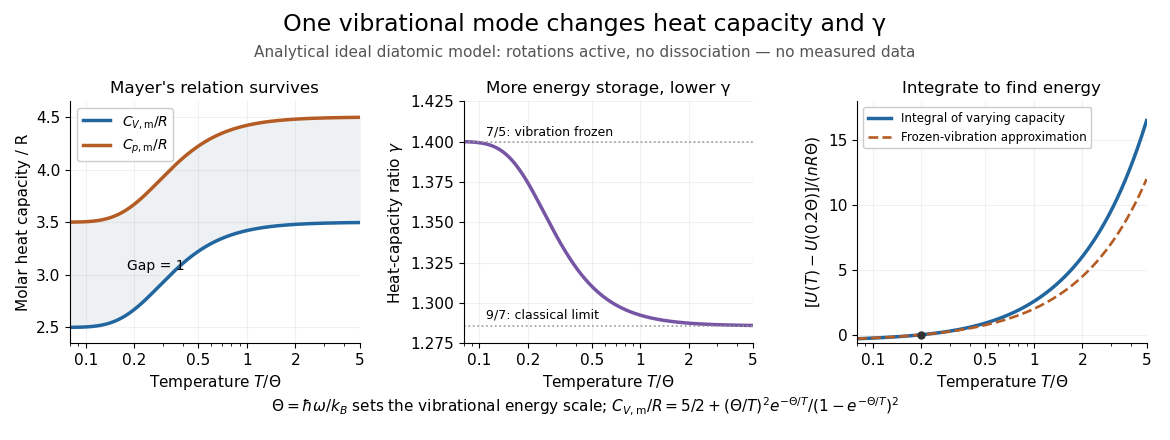
Temperature-dependent internal energy of an ideal gas, molar heat capacities and heat capacity ratio in a vibrational model
. Analytical illustration with active rotations and one quantum harmonic oscillator per molecule. Left: Mayer's relation keeps the capacity difference equal to . Middle: heat capacity ratio falls from toward . Right: the internal energy change from is an integral of varying heat capacity at constant volume; the dashed line suppresses the vibrational contribution. No measured gas curve or material-specific vibrational frequency is implied. Details.For this stipulated model, heating from to gives . Holding the frozen-vibration value throughout would give , underestimating the required internal energy increase by about of the model's full value. The integral measures all thermal storage activated along the interval. At fixed volume with only heat input, this is also the supplied heat; at fixed pressure, expansion work must be added through Mayer's relation.
Joule's free-expansion experiment tests the independence from volume in a different way: an insulated rigid vessel allows gas into an evacuated compartment, so no external work is delivered and ideally no heat is exchanged. The first law of thermodynamics gives ; positive then predicts equal initial and final equilibrium temperatures for the ideal gas. The apparatus, thermal-capacity controls and limitations of this inference are described in Joule's free-expansion experiment and temperature sensitivity of a free-expansion experiment. This endpoint test differs from the reversible adiabatic expansion of a loaded piston, which delivers work and lowers internal energy.
A gas is nondegenerate when its occupation numbers are low enough that quantum statistics reduce to the Maxwell-Boltzmann distribution. A common criterion is , where is the thermal de Broglie wavelength.
For an ideal gas, this is the classical statistical regime; nondegeneracy alone does not assert the absence of interactions.
Every element of a finite ideal class group has finite order. Therefore every nonzero ideal has a positive power that is principal.
Pinned article: Introduction to the OurBigBook Project
Welcome to the OurBigBook Project! Our goal is to create the perfect publishing platform for STEM subjects, and get university-level students to write the best free STEM tutorials ever.
Everyone is welcome to create an account and play with the site: ourbigbook.com/go/register. We belive that students themselves can write amazing tutorials, but teachers are welcome too. You can write about anything you want, it doesn't have to be STEM or even educational. Silly test content is very welcome and you won't be penalized in any way. Just keep it legal!
Intro to OurBigBook
. Source. We have two killer features:
- topics: topics group articles by different users with the same title, e.g. here is the topic for the "Fundamental Theorem of Calculus" ourbigbook.com/go/topic/fundamental-theorem-of-calculusArticles of different users are sorted by upvote within each article page. This feature is a bit like:
- a Wikipedia where each user can have their own version of each article
- a Q&A website like Stack Overflow, where multiple people can give their views on a given topic, and the best ones are sorted by upvote. Except you don't need to wait for someone to ask first, and any topic goes, no matter how narrow or broad
This feature makes it possible for readers to find better explanations of any topic created by other writers. And it allows writers to create an explanation in a place that readers might actually find it.
Figure 1. Screenshot of the "Derivative" topic page. View it live at: ourbigbook.com/go/topic/derivativeVideo 2. OurBigBook Web topics demo. Source. - local editing: you can store all your personal knowledge base content locally in a plaintext markup format that can be edited locally and published either:This way you can be sure that even if OurBigBook.com were to go down one day (which we have no plans to do as it is quite cheap to host!), your content will still be perfectly readable as a static site.
- to OurBigBook.com to get awesome multi-user features like topics and likes
- as HTML files to a static website, which you can host yourself for free on many external providers like GitHub Pages, and remain in full control

Figure 2. You can publish local OurBigBook lightweight markup files to either OurBigBook.com or as a static website.
Figure 3. Visual Studio Code extension installation.
Figure 5. . You can also edit articles on the Web editor without installing anything locally. Video 3. Edit locally and publish demo. Source. This shows editing OurBigBook Markup and publishing it using the Visual Studio Code extension. 
- Infinitely deep tables of contents:



All our software is open source and hosted at: github.com/ourbigbook/ourbigbook
Further documentation can be found at: docs.ourbigbook.com
Feel free to reach our to us for any help or suggestions: docs.ourbigbook.com/#contact