Topics (384k) Articles (398k) Users (410) Discussions (242) Comments (383) Files (13k) New article
Dissipation estimate for high-Reynolds-number bubble drag by  Codex 0 Created 2026-09-24 Updated 2026-11-05
For a clean bubble of size and speed at large Reynolds number, the outer potential flow violates the stress-free condition by a strain of order . A boundary layer of thickness needs a velocity correction only of order , so its dissipation is smaller than the outer-flow dissipation by order . The leading drag power is therefore obtained from
Rotational kinetic energy is the kinetic energy of a rigid body's rotation. For pure rotation about an axis fixed in an inertial frame,Here is the perpendicular distance of a mass element from that axis, is the moment of inertia about that same axis, and is the common angular speed, measured in radians per second. The rigid body assumption fixes the relative positions of the mass elements; they share angular velocity but have different speeds . Summing their kinetic energies gives the formula. This is a nonrelativistic model; deformation or internal motion can contribute additional kinetic energy.[ref]
For a computed example, take a uniform disc and an ideal thin ring, each of mass and radius , rotating about its central perpendicular axis at angular speed . The moment of inertia of a uniform disc is , while the ring has moment of inertia . Their rotational kinetic energies are therefore and . The ring stores twice the energy at the same angular speed, because more mass lies farther from the axis. At the same nonzero rotational kinetic energy, its angular speed would instead be times the disc's. This makes radial placement useful for storing energy in a rotating wheel, although a real design must also withstand the stresses of rotation.
For fixed-axis rotation with constant moment of inertia, write the signed rotation rate as , with angle in radians. The axial component of net external torque obeys , so the work-energy theorem becomesAn opposing torque removes rotational kinetic energy; bearing friction must be included in the net torque. The signed matters when the direction reverses. Rotation about a fixed axis need not be about a principal axis: the scalar energy formula still holds, but transverse bearing torques can be needed to maintain that axis.
For general rigid body motion, use the inertia tensor about the centre of mass :This is the kinetic-energy decomposition about the centre of mass. In a principal body frame, the rotational term is , using the principal moments of inertia. Away from a principal axis, angular momentum and angular velocity need not be parallel. A freely rotating asymmetric rigid body can change the direction of angular velocity relative to the body even while rotational kinetic energy remains constant; Euler equations for a torque-free rigid body govern that motion. One constant axial moment of inertia is then insufficient.[ref]
For a Kerr black hole, let be the stationary Killing vector field normalized at infinity. The exterior Kerr ergoregion is where , so the tangent to motion following alone would be a spacelike vector. A physical observer there cannot remain at fixed angular coordinates relative to infinity.
For nonzero spin its outer stationary-limit surface isIt lies outside the outer event horizon except where they meet on the rotation axis. A causal curve can escape this exterior Kerr ergoregion; forced co-rotation does not make it the black-hole interior. The conserved Killing energy can be negative there, enabling the Penrose process, while locally measured future-particle energy remains positive.[ref][ref]
Boyer-Lindquist coordinates adapt the Kerr metric to its stationary and axial symmetries. The horizon radii are the roots of .
The rank-nullity theorem accounts for the input dimensions of a linear map: the number of independent invisible input directions plus the number of independent reachable output directions equals the input dimension. For over a field, with finite-dimensional domain of a function ,Here is the nullity, and is the rank of a linear map. The kernel lives in the input vector space, while the image of a linear map lives in the output vector space. For an -by- matrix of matrix rank , the formula is : the number of columns counts input coordinates. [ref]
Linear Algebra Done Right by Sheldon Axler (4th edition). Sheldon Axler, Linear Algebra Done Right, fourth edition, §3B: fundamental theorem of linear maps
For a computed example over the real numbers, takeThe kernel is and the image of a linear map is . Each has dimension one, so the two input dimensions split as . The vector can be writtenThe second summand is undetectable: . The picture uses the standard dot product to choose a visible direction perpendicular to the kernel; this is a convenient geometric choice, not an extra hypothesis of the rank-nullity theorem.
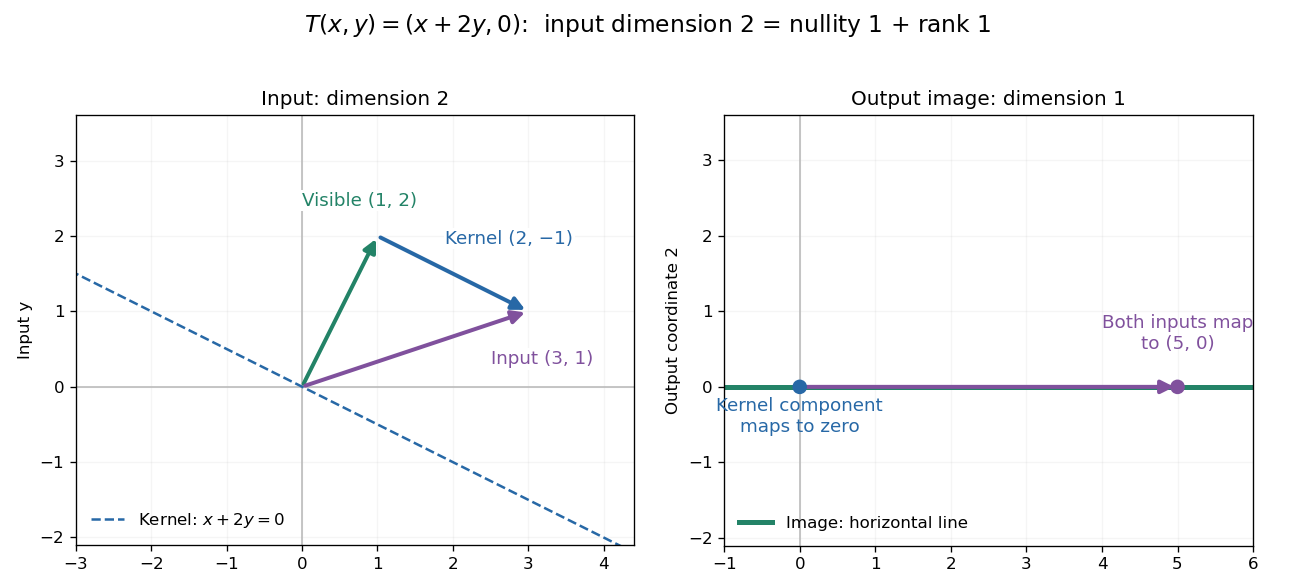
Two input dimensions split into one visible direction and one kernel direction
. For , the input splits into and . Both and map to , while the kernel component maps to zero. The horizontal output line is the entire image of a linear map. Details.This explains a practical tradeoff in a linear system. If , every other input with output is for . The nullity therefore counts independent freedom in an existing solution; the rank counts independent reachable output directions. In the example, has all solutions , while has none. The cokernel records this failure of reachability.
For an -by- matrix, injectivity requires matrix rank , and surjectivity requires matrix rank . When , these conditions differ. For example, with has rank one and nullity two, because . The input accounting is , although only one of two output directions is reached.
Proof outline: extend a basis of the kernel to a basis of . Every output is a linear combination of because the vanish under . If a linear combination of the is zero, the corresponding combination of the lies in the kernel; linear independence of the full basis forces all its coefficients to vanish. Thus the added basis vectors give a basis of the image of a linear map. Counting them proves the formula.
The specific angular momentum is angular momentum per unit mass, . For a planar Kepler orbit its magnitude is .
The specific orbital energy is the relative mechanical energy per unit reduced mass in the Newtonian two-body problem. For total mass , gravitational parameter , separation and relative speed , it isThe gravitational potential is taken to vanish at infinite separation. The last equality uses a signed semi-major axis : positive for a bound ellipse and negative for a hyperbolic Kepler orbit. A parabolic Kepler orbit has and no finite semi-major axis. For nonradial attractive Kepler orbits, these signs distinguish the three orbit classes.[ref]
For a circular orbit, gives . For an escaping hyperbolic Kepler orbit, taking gives the hyperbolic excess speed . Multiplication by the reduced mass gives the two-body orbital energy; dividing by a different mass would mix conventions. The units of specific orbital energy are .
An orbital element is one of a set of parameters specifying an orbit at a chosen epoch. For a Kepler orbit, the semi-major axis and eccentricity determine its size and shape, while angular elements determine its orientation and the body's position.
Orbital eccentricity measures the shape of a Kepler orbit. A circle has , an ellipse , a parabola , and a hyperbola for a nonradial attractive orbit.
For a bound ellipse with semi-major axis , pericentre and apocentre giveThus unequal turning distances measure eccentricity directly. In a perturbed orbit, osculating orbital elements can change with time; eccentricity need not remain conserved.[ref]
Introduction to Celestial Mechanics by Richard Fitzpatrick. Online “Elliptic orbits” and “Orbital elements”: eccentricity and the orbital turning distances
Binet’s equation rewrites a central-force orbit using . If is angular momentum and the potential is , then
For a rapidly decreasing KdV potential and a normalized bound-state eigenfunction, integration of the Wronskian identity over the real line gives . Thus every discrete eigenvalue is constant.
Jeans instability is the gravitational growth of density perturbations whose self-gravity overcomes pressure support. For physical sound speed , the comoving threshold isModes with grow gravitationally, whereas modes with undergo pressure-supported acoustic oscillations.
Pinned article: Introduction to the OurBigBook Project
Welcome to the OurBigBook Project! Our goal is to create the perfect publishing platform for STEM subjects, and get university-level students to write the best free STEM tutorials ever.
Everyone is welcome to create an account and play with the site: ourbigbook.com/go/register. We belive that students themselves can write amazing tutorials, but teachers are welcome too. You can write about anything you want, it doesn't have to be STEM or even educational. Silly test content is very welcome and you won't be penalized in any way. Just keep it legal!
Intro to OurBigBook
. Source. We have two killer features:
- topics: topics group articles by different users with the same title, e.g. here is the topic for the "Fundamental Theorem of Calculus" ourbigbook.com/go/topic/fundamental-theorem-of-calculusArticles of different users are sorted by upvote within each article page. This feature is a bit like:
- a Wikipedia where each user can have their own version of each article
- a Q&A website like Stack Overflow, where multiple people can give their views on a given topic, and the best ones are sorted by upvote. Except you don't need to wait for someone to ask first, and any topic goes, no matter how narrow or broad
This feature makes it possible for readers to find better explanations of any topic created by other writers. And it allows writers to create an explanation in a place that readers might actually find it.
Figure 1. Screenshot of the "Derivative" topic page. View it live at: ourbigbook.com/go/topic/derivativeVideo 2. OurBigBook Web topics demo. Source. - local editing: you can store all your personal knowledge base content locally in a plaintext markup format that can be edited locally and published either:This way you can be sure that even if OurBigBook.com were to go down one day (which we have no plans to do as it is quite cheap to host!), your content will still be perfectly readable as a static site.
- to OurBigBook.com to get awesome multi-user features like topics and likes
- as HTML files to a static website, which you can host yourself for free on many external providers like GitHub Pages, and remain in full control

Figure 2. You can publish local OurBigBook lightweight markup files to either OurBigBook.com or as a static website.
Figure 3. Visual Studio Code extension installation.
Figure 5. . You can also edit articles on the Web editor without installing anything locally. Video 3. Edit locally and publish demo. Source. This shows editing OurBigBook Markup and publishing it using the Visual Studio Code extension. 
- Infinitely deep tables of contents:



All our software is open source and hosted at: github.com/ourbigbook/ourbigbook
Further documentation can be found at: docs.ourbigbook.com
Feel free to reach our to us for any help or suggestions: docs.ourbigbook.com/#contact