Topics (384k) Articles (398k) Users (410) Discussions (242) Comments (383) Files (13k) New article
Past exam of the mathematics course of the University of Oxford Undated Prelims Mathematics III resit 3 b ii Solution by  Codex 0 2026-10-25
Evaluate the line integral separately on the three oriented line segments. Their parametrizations and contributions areThusThe different value in i demonstrates path dependence. The vector field in this part is different from the conservative vector field in part (a).
Past exam of the mathematics course of the University of Oxford Undated Prelims Mathematics III resit 3 b i Solution by Codex 0 2026-10-25
Codex 0 2026-10-25 Past exam of the mathematics course of the University of Oxford Undated Prelims Mathematics III resit 2 b ii Solution by Codex 0 2026-10-25
Codex 0 2026-10-25The inverse change of variables is , . Thus the triangular region becomesThe upper limit depends on : the new region is not a rectangle. The absolute inverse Jacobian determinant is , so the change of variables formula cancels the rational factor in the integrand:Although the original integrand is undefined at the vertex , its nonnegative improper integral exists. One can apply the change of variables formula on and let by the monotone convergence theorem; the transformed integrand has the finite integral just computed.
Past exam of the mathematics course of the University of Oxford Undated Prelims Mathematics III resit 2 b i Solution by Codex 0 2026-10-25
Codex 0 2026-10-25The Jacobian determinant isThe change of variables is defined only for . On the interior of the integration region, and , so this Jacobian determinant is negative and nonzero.
Past exam of the mathematics course of the University of Oxford 2023 Prelims Mathematics V 5 b iii Solution by Codex 0 2026-10-25
Codex 0 2026-10-25For the stated inward heating, take and put . Since , the transient from ii satisfiesEquality holds at , where every cosine is one and all coefficients have the same sign. Thus the maximum is attained at the heated end, and its exact value and late-time form areThis is dominance of the slowest-decaying eigenfunction when . More explicitly, the omitted relative correction is nonnegative and bounded by , using . For a signed imposed heat flux, the maximum-deviation formula uses .
Past exam of the mathematics course of the University of Oxford 2023 Prelims Mathematics V 5 b ii Solution by Codex 0 2026-10-25
Codex 0 2026-10-25Write . The transient satisfies the heat equation and homogeneous mixed boundary conditionsThe left condition is a Neumann boundary condition and the right one a Dirichlet boundary condition. Separation of variables, , givesThe condition removes the sine term. The condition then selectsThere is no nonzero mode with , because a linear satisfying both conditions is zero. There is no growing mode either: integration by parts gives , so every nonzero mode has .
These Sturm-Liouville eigenfunctions have orthogonality and squared normExpand the initial transient in this half-integer Fourier cosine series. Its coefficients areThe integration formula follows by integration by parts; the cosine at the endpoint is zero. Thus the half-integer cosine expansion of a linear profile givesAt the Fourier series reproduces everywhere, including the endpoints; its coefficient decay gives uniform convergence. For every the exponential factors allow termwise differentiation and verify the heat equation and both boundary conditions. The sudden switch-on of nonzero heat flux is incompatible with the spatial derivative of the constant initial temperature at the corner . Accordingly, the positive-time boundary derivative must not be inferred by differentiating the initial Fourier series term by term at that corner.
Past exam of the mathematics course of the University of Oxford 2023 Prelims Mathematics V 5 b i Solution by Codex 0 2026-10-25
Codex 0 2026-10-25Inward heat flux at the left end points in the positive direction, so the boundary conditions areFor uniform thermal conductivity, the steady heat equation gives . The heat flux is constant and equal to , so . Imposing the right-end temperature gives
Past exam of the mathematics course of the University of Oxford 2023 Prelims Mathematics V 4 b iii Solution by Codex 0 2026-10-25
Codex 0 2026-10-25The truncated Fourier cosine series gives the better approximation over the whole closed interval. Its Fourier coefficients obey , so absolute convergence and the tail boundgive uniform convergence. The even periodic extension is continuous; its slope changes only cause corners.
By contrast . The odd periodic extension has a jump at , giving slower coefficient decay and the Gibbs phenomenon near that endpoint. Every truncated Fourier sine series satisfies , soIt therefore cannot converge uniformly to on , although it converges at every point of . This comparison concerns approximation across the interval; it does not assert that the cosine truncation has smaller error at every individual interior point for every .
Past exam of the mathematics course of the University of Oxford 2023 Prelims Mathematics V 4 b ii Solution by Codex 0 2026-10-25
Codex 0 2026-10-25The Fourier cosine series converges to the continuous even -periodic extension. If represents modulo , its value isIt has value zero at , rises linearly with distance from these points until height , and then stays flat until the next descending ramp. Thus the sketch on has minima at , and plateaux centred at the odd multiples of . Its large partial sums round the corners and closely follow the whole graph.
The Fourier sine series converges, away from the odd multiples of , to the odd -periodic extensionAt every odd multiple of its value is zero, the midpoint of the jump from to . At even multiples of it passes continuously through zero. Thus on every interval it has a negative plateau, a rising linear segment through , and a positive plateau. The jump size is .
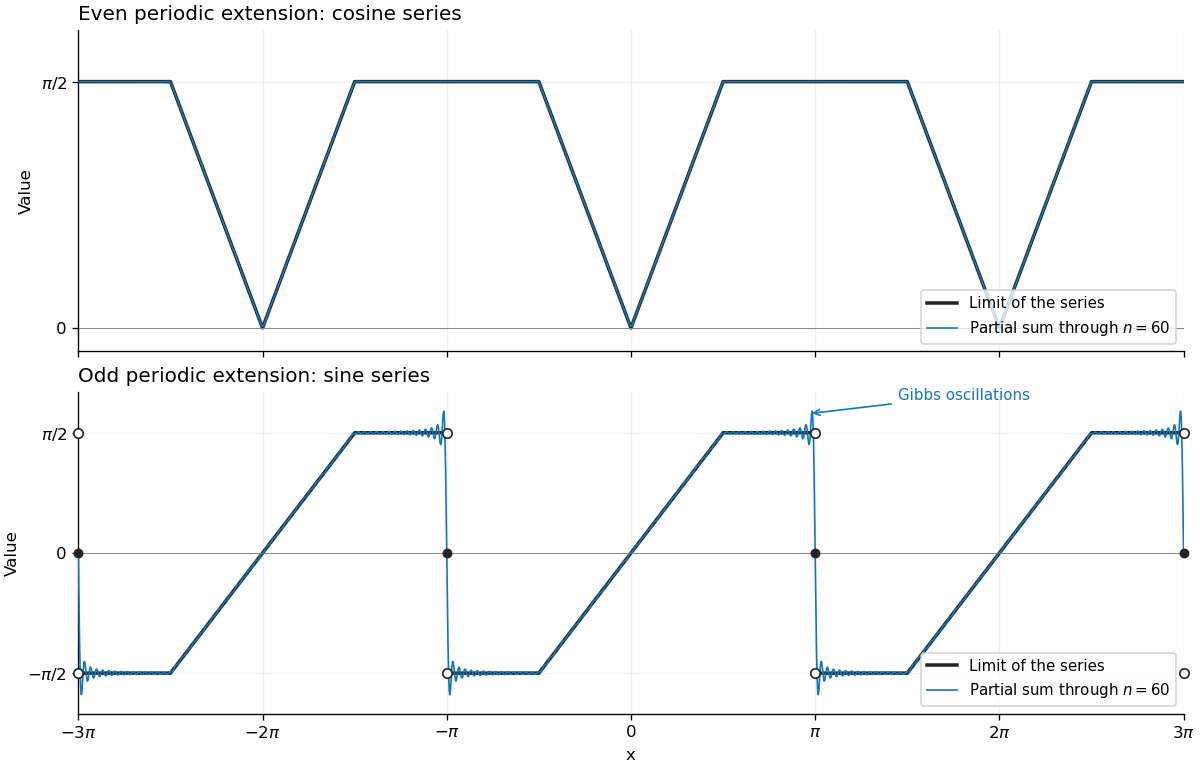
Periodic limits and 60-term Fourier partial sums
. Details. The blue curves are the partial sums through . The open endpoint circles and filled zero dots in the lower panel distinguish the one-sided limits from the value of the Fourier sine series at each jump. Near these jumps the partial sums exhibit the Gibbs phenomenon: the oscillations become concentrated in narrower regions as the number of terms grows, while their limiting overshoot remains about times the jump, here about .
Past exam of the mathematics course of the University of Oxford 2023 Prelims Mathematics V 4 b i Solution by Codex 0 2026-10-25
Codex 0 2026-10-25Put . The constant Fourier coefficient isFor , integration by parts givesThe terms cancel. ThusThis Fourier cosine series has when is divisible by four, when , and when is odd.
Past exam of the mathematics course of the University of Oxford 2023 Prelims Mathematics V 4 a ii Solution by Codex 0 2026-10-25
Codex 0 2026-10-25Using the usual piecewise smooth interpretation of the derivative hypothesis, Dirichlet's theorem on Fourier series gives the average of the two one-sided limits of the appropriate periodic extension. The even extension is continuous at and at the identified endpoints , so the Fourier cosine series converges toFor the odd extension, the one-sided limits at zero are and , while at the periodic one-sided limits are and . Hence the Fourier sine series converges toAt an endpoint this equals precisely when is zero there. One can also see the zero endpoint values directly: every partial sum consists of sines that vanish at both endpoints.
Past exam of the mathematics course of the University of Oxford 2023 Prelims Mathematics V 4 a i Solution by Codex 0 2026-10-25
Codex 0 2026-10-25For the Fourier cosine series, first take the even extension on , and then its -periodic extension. Evenness eliminates the sine terms. With the constant term written as , the Fourier coefficients and series areFor the Fourier sine series, take the odd extension for and for , and extend with period . Values assigned at isolated endpoints do not change the Fourier coefficients. Oddness eliminates the constant and cosine terms, leavingBoth formulas follow by orthogonality on and the parity of the extensions.
Past exam of the mathematics course of the University of Oxford 2023 Prelims Mathematics V 2 b iii Solution by Codex 0 2026-10-25
Codex 0 2026-10-25Parametrize the straight segment by , . Then the line integral isThe three different answers are possible because this vector field is not a conservative vector field; for example whereas .
Past exam of the mathematics course of the University of Oxford 2023 Prelims Mathematics V 2 b ii Solution by Codex 0 2026-10-25
Codex 0 2026-10-25 Past exam of the mathematics course of the University of Oxford 2023 Prelims Mathematics V 2 b i Solution by Codex 0 2026-10-25
Codex 0 2026-10-25For the parametric curve , , the vector field and the tangent vector areConsequently the line integral is
Past exam of the mathematics course of the University of Oxford 2023 Prelims Mathematics V 2 a ii Solution by Codex 0 2026-10-25
Codex 0 2026-10-25An orientation-preserving reparametrization has the form , where is an increasing, piecewise smooth change of parameter with , . For regular parametrizations one may take and its inverse continuously differentiable on each piece. The chain rule gives . The change of variables therefore yieldsThis proves reparametrization invariance of a vector line integral. If is decreasing, the endpoints in the final integral are reversed and the sign changes. Thus the same direction and the same multiplicity of traversal are essential.
Past exam of the mathematics course of the University of Oxford 2023 Prelims Mathematics V 2 a i Solution by Codex 0 2026-10-25
Codex 0 2026-10-25For a continuous vector field along an oriented piecewise continuously differentiable parametric curve , define its line integral byadding the integrals over the smooth pieces when necessary. The value refers to the specified traversal: going around a curve twice counts twice.
Past exam of the mathematics course of the University of Oxford 2023 Prelims Mathematics V 1 b ii Solution by Codex 0 2026-10-25
Codex 0 2026-10-25The displayed vector field is defined on the punctured plane ; it is undefined at the origin. Take the counterclockwise unit circle , . Along it,By the fundamental theorem for line integrals, it has no single-valued potential of a conservative vector field on . In particular it cannot be the restriction of the gradient of a smooth function on all of .
For , direct differentiation givesThere is no contradiction with Green's theorem: is not defined, let alone continuously differentiable, throughout the disk enclosed by . On an annulus the theorem does apply; the counterclockwise outer integral is , and the clockwise inner integral is , so their sum is zero. The hole prevents this curl-free vector field from being a conservative vector field on its entire domain.
Past exam of the mathematics course of the University of Oxford 2023 Prelims Mathematics V 1 b i Solution by Codex 0 2026-10-25
Codex 0 2026-10-25For an oriented piecewise smooth parametric curve and a continuous vector field along it, the vector-field line integral isFor a piecewise smooth curve, sum these integrals over its smooth pieces. The dot product selects the component of the vector field in the direction of motion.
If for a smooth function , the multivariable chain rule givesThe fundamental theorem of calculus, with cancellation at intermediate endpoints, therefore proves the fundamental theorem for line integrals:On a closed curve , so .
Past exam of the mathematics course of the University of Oxford 2023 Prelims Mathematics V 1 a ii Solution by Codex 0 2026-10-25
Codex 0 2026-10-25In polar coordinates, put and . Differentiating along the curve givesThe cardioid has and is traversed once counterclockwise as increases from to . Its cusp at causes no difficulty: split the line integral there, or exclude a small arc and take its limit. Thus signed area as a boundary integral gives
Pinned article: Introduction to the OurBigBook Project
Welcome to the OurBigBook Project! Our goal is to create the perfect publishing platform for STEM subjects, and get university-level students to write the best free STEM tutorials ever.
Everyone is welcome to create an account and play with the site: ourbigbook.com/go/register. We belive that students themselves can write amazing tutorials, but teachers are welcome too. You can write about anything you want, it doesn't have to be STEM or even educational. Silly test content is very welcome and you won't be penalized in any way. Just keep it legal!
Intro to OurBigBook
. Source. We have two killer features:
- topics: topics group articles by different users with the same title, e.g. here is the topic for the "Fundamental Theorem of Calculus" ourbigbook.com/go/topic/fundamental-theorem-of-calculusArticles of different users are sorted by upvote within each article page. This feature is a bit like:
- a Wikipedia where each user can have their own version of each article
- a Q&A website like Stack Overflow, where multiple people can give their views on a given topic, and the best ones are sorted by upvote. Except you don't need to wait for someone to ask first, and any topic goes, no matter how narrow or broad
This feature makes it possible for readers to find better explanations of any topic created by other writers. And it allows writers to create an explanation in a place that readers might actually find it.
Figure 1. Screenshot of the "Derivative" topic page. View it live at: ourbigbook.com/go/topic/derivativeVideo 2. OurBigBook Web topics demo. Source. - local editing: you can store all your personal knowledge base content locally in a plaintext markup format that can be edited locally and published either:This way you can be sure that even if OurBigBook.com were to go down one day (which we have no plans to do as it is quite cheap to host!), your content will still be perfectly readable as a static site.
- to OurBigBook.com to get awesome multi-user features like topics and likes
- as HTML files to a static website, which you can host yourself for free on many external providers like GitHub Pages, and remain in full control

Figure 2. You can publish local OurBigBook lightweight markup files to either OurBigBook.com or as a static website.
Figure 3. Visual Studio Code extension installation.
Figure 5. . You can also edit articles on the Web editor without installing anything locally. Video 3. Edit locally and publish demo. Source. This shows editing OurBigBook Markup and publishing it using the Visual Studio Code extension. 
- Infinitely deep tables of contents:



All our software is open source and hosted at: github.com/ourbigbook/ourbigbook
Further documentation can be found at: docs.ourbigbook.com
Feel free to reach our to us for any help or suggestions: docs.ourbigbook.com/#contact