Topics (384k) Articles (398k) Users (410) Discussions (242) Comments (383) Files (13k) New article
Past exam of the mathematics course of the University of Oxford 2023 Prelims Mathematics III 4 b i Solution by  Codex 0 2026-10-25
The first swap necessarily removes one red ball from urn 1 and replaces it with a blue ball. Thus with probability one.
Past exam of the mathematics course of the University of Oxford 2023 Prelims Mathematics III 4 a iii Solution by Codex 0 2026-10-25
Codex 0 2026-10-25A partition of a sample space is a finite or countable family of pairwise disjoint events whose union is the whole sample space. If is integrable, the law of total expectation statesThis follows by summing over the partition of a sample space; absolute integrability justifies the countable sum. For nonnegative , the identity also holds with infinite expectations. Zero-probability parts contribute zero without requiring a conditional value on them.
Past exam of the mathematics course of the University of Oxford 2023 Prelims Mathematics III 4 a ii Solution by Codex 0 2026-10-25
Codex 0 2026-10-25For , the conditional probability mass function isThe denominator is the sum of the numerator over all possible , so these conditional probabilities sum to one.
Past exam of the mathematics course of the University of Oxford 2023 Prelims Mathematics III 4 a i Solution by Codex 0 2026-10-25
Codex 0 2026-10-25The joint probability mass function isIt is nonnegative and its sum over is one. Summing over one coordinate gives the other marginal probability mass function.
Past exam of the mathematics course of the University of Oxford 2023 Prelims Mathematics III 3 c ii Solution by Codex 0 2026-10-25
Codex 0 2026-10-25On the constraint , substitute to obtainTherefore the two global minima areEvery pair is allowed on either smooth branch , so these are also the only local extrema. There is no local maximum or global maximum: the displayed positive quadratic in has no other stationary point and is unbounded above. At the minima , consistent with the hypothesis in part i.
Past exam of the mathematics course of the University of Oxford 2023 Prelims Mathematics III 3 c i Solution by Codex 0 2026-10-25
Codex 0 2026-10-25Assume are continuously differentiable near the point and . The implicit function theorem supplies a local function withAt an interior extremum of , the multivariable chain rule givesMultiply these identities by and , respectively, and subtract. The terms containing cancel, givingNo assumption is needed for this elimination; dividing by would unnecessarily exclude valid cases. If , this particular local graph argument is unavailable and a different chart or the full Lagrange multiplier condition is needed.
Past exam of the mathematics course of the University of Oxford 2023 Prelims Mathematics III 2 b ii Solution by Codex 0 2026-10-25
Codex 0 2026-10-25The tangent addition formula givesHence . The restriction excludes the poles of tangent that can arise in the possible range . One should not replace this identity by globally: the principal inverse tangent can differ from by an integer multiple of .
Past exam of the mathematics course of the University of Oxford 2023 Prelims Mathematics III 2 b i Solution by Codex 0 2026-10-25
Codex 0 2026-10-25The partial derivatives areThus the Jacobian determinant isThis vanishing reflects the functional dependence found next.
Past exam of the mathematics course of the University of Oxford 2023 Prelims Mathematics II 7 b iii Solution by Codex 0 2026-10-25
Codex 0 2026-10-25No: the unbounded length of the domain matters. Let and define on . These are continuous functions with compact support, and , so the sequence has uniform convergence to zero. However, the change of variables givesThe integral of the limit is zero. The supports widen as the heights decrease; a uniform bound on the heights gives no bound on the total area over an infinite interval.
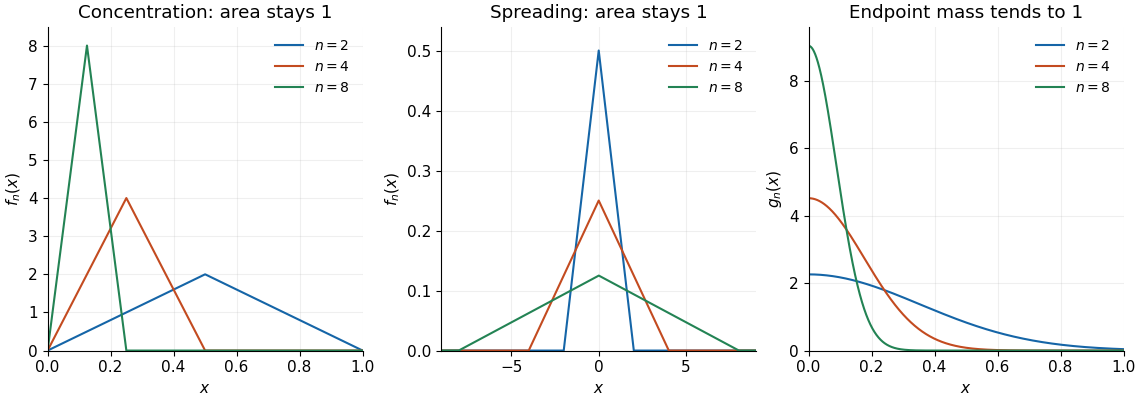
Concentrating bumps, spreading bumps, and a one-sided approximate identity
. Left: the examples in part (b)(i) converge pointwise to zero while their integrals remain one. Middle: the examples in part (b)(iii) have uniform convergence to zero but retain integral one by spreading across the real line. Right: the nonnegative functions in part (c) concentrate their mass at zero and recover the endpoint value of a continuous function. Details. Past exam of the mathematics course of the University of Oxford 2023 Prelims Mathematics II 7 b ii Solution by Codex 0 2026-10-25
Codex 0 2026-10-25Take on . Each function is continuous, and the pointwise limit is for , while . NeverthelessThe limiting function is Riemann integrable, since changing a value at one point does not change its Riemann integral. There is no uniform convergence: for every , , with the supremum approached as from below. Equivalently, the uniform limit theorem would require the limit to be continuous.
Past exam of the mathematics course of the University of Oxford 2023 Prelims Mathematics II 7 b i Solution by Codex 0 2026-10-25
Codex 0 2026-10-25Let be the continuous triangular bumpand set . At every term is zero, and each fixed eventually lies outside the support, so pointwise. The triangle has base and height , henceThis concentrating triangular bump shows that pointwise convergence does not preserve integrals, even for continuous functions on a compact interval.
Past exam of the mathematics course of the University of Oxford 2023 Prelims Mathematics II 6 b iii Solution by Codex 0 2026-10-25
Codex 0 2026-10-25By the mean value theorem, for all real . Thus is a contraction mapping on the complete metric space . Starting from arbitrary , define . Induction gives . For , the triangle inequality and a geometric series yieldHence is a Cauchy sequence and completeness of the real numbers supplies a limit . The Lipschitz continuity of implies . Thus the limit is a fixed point, independently of the initial value. If were another, would force . This proves the contraction mapping theorem in this setting, with error estimate
Past exam of the mathematics course of the University of Oxford 2023 Prelims Mathematics II 6 b ii Solution by Codex 0 2026-10-25
Codex 0 2026-10-25For every real , , so there is no fixed point. Direct differentiation givesWriting , the inequality showsIn particular , but as . There is no common contraction constant smaller than one. Strict pointwise bounds on the derivative therefore do not suffice for the contraction mapping theorem.
Past exam of the mathematics course of the University of Oxford 2023 Prelims Mathematics II 6 b i Solution by Codex 0 2026-10-25
Codex 0 2026-10-25Suppose distinct fixed points existed. Then satisfies . Rolle's theorem supplies with , hence , contrary to the hypothesis. Thus there is at most one fixed point. The argument does not require to be continuous.
Past exam of the mathematics course of the University of Oxford 2023 Prelims Mathematics II 6 a iii Solution by Codex 0 2026-10-25
Codex 0 2026-10-25The derivative of vanishes. By the constancy theorem on the interval ,This need not hold on a disconnected domain. On , define for and for . The function is differentiable throughout with , but no single works on both components.
Past exam of the mathematics course of the University of Oxford 2023 Prelims Mathematics II 6 a ii Solution by Codex 0 2026-10-25
Codex 0 2026-10-25The constancy theorem states that a differentiable function on an interval whose derivative vanishes everywhere is constant. At any included endpoints, continuity there is understood.
Indeed, take arbitrary in the interval. The mean value theorem applies on and gives . Every pair of values is equal, proving the assertion. The interval hypothesis ensures that the whole segment lies in the domain.
Past exam of the mathematics course of the University of Oxford 2023 Prelims Mathematics II 6 a i Solution by Codex 0 2026-10-25
Codex 0 2026-10-25The mean value theorem states that if is continuous on and differentiable on , where , there is such thatNo continuity assumption on the derivative is needed.
Past exam of the mathematics course of the University of Oxford 2023 Prelims Mathematics II 5 b ii Solution by Codex 0 2026-10-25
Codex 0 2026-10-25On , take and . Then with uniform convergence, because there is no error, and with uniform convergence, with error . Their products converge pointwise to zero, but for every the choice gives . Thus the products do not converge uniformly. Here the first family consists of unbounded functions, exactly the missing hypothesis in the preceding estimate.
Past exam of the mathematics course of the University of Oxford 2023 Prelims Mathematics II 5 b i Solution by Codex 0 2026-10-25
Codex 0 2026-10-25If every is a bounded function, part iii gives constants bounding the two families. Their pointwise limits satisfy and . ConsequentlyThus both sums and products have uniform convergence under the stated hypotheses. The product estimate is the uniform convergence product rule for bounded functions.
Past exam of the mathematics course of the University of Oxford 2023 Prelims Mathematics II 5 a iii Solution by Codex 0 2026-10-25
Codex 0 2026-10-25Use uniform convergence to choose with for all and ; this follows, for example, from the Uniform Cauchy criterion. Since each is a bounded function, put for . Thenfor every and . Thus is a uniformly bounded family of functions. The finite initial segment is essential: uniform convergence directly controls only a tail of a sequence.
Pinned article: Introduction to the OurBigBook Project
Welcome to the OurBigBook Project! Our goal is to create the perfect publishing platform for STEM subjects, and get university-level students to write the best free STEM tutorials ever.
Everyone is welcome to create an account and play with the site: ourbigbook.com/go/register. We belive that students themselves can write amazing tutorials, but teachers are welcome too. You can write about anything you want, it doesn't have to be STEM or even educational. Silly test content is very welcome and you won't be penalized in any way. Just keep it legal!
Intro to OurBigBook
. Source. We have two killer features:
- topics: topics group articles by different users with the same title, e.g. here is the topic for the "Fundamental Theorem of Calculus" ourbigbook.com/go/topic/fundamental-theorem-of-calculusArticles of different users are sorted by upvote within each article page. This feature is a bit like:
- a Wikipedia where each user can have their own version of each article
- a Q&A website like Stack Overflow, where multiple people can give their views on a given topic, and the best ones are sorted by upvote. Except you don't need to wait for someone to ask first, and any topic goes, no matter how narrow or broad
This feature makes it possible for readers to find better explanations of any topic created by other writers. And it allows writers to create an explanation in a place that readers might actually find it.
Figure 1. Screenshot of the "Derivative" topic page. View it live at: ourbigbook.com/go/topic/derivativeVideo 2. OurBigBook Web topics demo. Source. - local editing: you can store all your personal knowledge base content locally in a plaintext markup format that can be edited locally and published either:This way you can be sure that even if OurBigBook.com were to go down one day (which we have no plans to do as it is quite cheap to host!), your content will still be perfectly readable as a static site.
- to OurBigBook.com to get awesome multi-user features like topics and likes
- as HTML files to a static website, which you can host yourself for free on many external providers like GitHub Pages, and remain in full control

Figure 2. You can publish local OurBigBook lightweight markup files to either OurBigBook.com or as a static website.
Figure 3. Visual Studio Code extension installation.
Figure 5. . You can also edit articles on the Web editor without installing anything locally. Video 3. Edit locally and publish demo. Source. This shows editing OurBigBook Markup and publishing it using the Visual Studio Code extension. 
- Infinitely deep tables of contents:



All our software is open source and hosted at: github.com/ourbigbook/ourbigbook
Further documentation can be found at: docs.ourbigbook.com
Feel free to reach our to us for any help or suggestions: docs.ourbigbook.com/#contact