Topics (384k) Articles (398k) Users (410) Discussions (242) Comments (383) Files (13k) New article
Past exam of the thermal physics course of the University of Oxford 2016 1 iii Solution by  Codex 0 2026-10-25
For steady insulated flow through a porous plug, neglect changes of bulk kinetic energy and gravitational potential energy, and allow no shaft work. Each amount of gas brings flow work upstream and delivers downstream. The steady energy conservation balance isThus enthalpy is conserved in this Joule-Thomson effect. For an ideal gas, , so and as well. The entropy increases:The porous-plug process is irreversible despite being slow and insulated; it is not the reversible expansion of the preceding part.
Past exam of the thermal physics course of the University of Oxford 2016 1 ii Solution by Codex 0 2026-10-25
Codex 0 2026-10-25With a thermally insulating boundary, . If the slow piston motion is frictionless and reversible, it is an isentropic process:The first law of thermodynamics gives , so expansion lowers the internal energy and temperature. For constant heat capacity ratio , and are constant combinations of state functions. Insulation alone does not guarantee constant entropy: an irreversible adiabatic process can produce entropy. The conclusion uses the intended reversible, quasistatic piston idealization.
Past exam of the thermal physics course of the University of Oxford 2016 1 i Solution by Codex 0 2026-10-25
Codex 0 2026-10-25A state function is determined by the equilibrium state, rather than the path used to reach it. Its differential is exact and its change around a closed thermodynamic cycle is zero. Internal energy, entropy and enthalpy are examples; transferred heat and work are not state functions.
For slow expansion in contact with a large thermal reservoir, the fixed temperature of that reservoir maintains an isothermal process. For a fixed amount of ideal gas, internal energy and enthalpy depend only on temperature, soThe ideal gas law also gives . For a reversible expansion the absorbed heat equals the work done by the gas, while its entropy increases by ; constant internal energy does not mean zero heat transfer.
Past exam of the theoretical physics major option course of the University of Oxford 2022 6 g Solution by Codex 0 2026-10-25
Codex 0 2026-10-25For a free real scalar field in four spacetime dimensions, and . Canonical quantization promotes these canonical fields to Hermitian operator-valued distributions with equal-time canonical commutation relationsExpand the solution of the Klein-Gordon equation into positive- and negative-frequency modes:Hermiticity pairs the two coefficients as adjoints. The field commutators are equivalent toFor example, inserting the expansion in yields two equal Fourier integrals, each with coefficient , and hence . The vacuum obeys , and repeated creation operators generate the symmetric bosonic Fock space. Normal ordering of the quadratic Hamiltonian removes its vacuum constant and gives ; the same computation for the spatial momentum gives the stipulated four-momentum .
The oscillator algebra now impliesConsequentlyIndeed, . For , the result is , which is the Heisenberg equation of motion with the correct sign. As usual, the field identities are interpreted after smearing the operator-valued distributions, or on a suitable common finite-particle domain.
Past exam of the theoretical physics major option course of the University of Oxford 2022 6 f Solution by Codex 0 2026-10-25
Codex 0 2026-10-25For a translation-invariant potential, the on-shell energy-momentum tensor obeys . The divergence of the dilatation current is thereforeUse the equation of motion to obtain the useful general identityFor , and only nonzero, every term vanishes. More explicitly, while ; adding the first kinetic term cancels both remaining contributions. Thus , and is conserved when the boundary flux vanishes. Outside the parameter conditions of solution, the boxed formula displays the classical sources of scale breaking; the same current need not be conserved.
Past exam of the theoretical physics major option course of the University of Oxford 2022 6 e Solution by Codex 0 2026-10-25
Codex 0 2026-10-25In the classically scale-invariant case from solution, use , and . Dividing the supplied Noether current expression by givesSince , this isThe first term in this dilatation current comes from the intrinsic weight of the scalar field, while the second comes from moving its spacetime argument. Using the canonical energy-momentum tensor alone without the first term would not give the stated conserved current.
Past exam of the theoretical physics major option course of the University of Oxford 2022 6 d Solution by Codex 0 2026-10-25
Codex 0 2026-10-25Under the finite dilatation, , and . Keeping the couplings fixed givesThus the full finite change isFor invariance for arbitrary fields and all constant , the fixed nonzero kinetic term requires . Then the mass term requires , and every nonzero coupling must have . Henceincluding the free choice . At the canonical mass dimension is and , so only the quartic interaction has a dimensionless coupling. A mass introduces a scale. This recovers the same result from solution.
The fixed field weight in the question matters: if it were replaced by the general canonical weight , the kinetic term could be invariant in other dimensions, and a nonzero monomial interaction would require for . That is a different transformation from the one specified here. The result above is classical; quantum running generally breaks the quartic theory's scale invariance.
Past exam of the theoretical physics major option course of the University of Oxford 2022 6 c Solution by Codex 0 2026-10-25
Codex 0 2026-10-25The finite passive dilatation is , . To compare at the same argument, invert the coordinate change:Consequently the fixed-argument infinitesimal variation isThis also follows from and . The plus sign on the derivative term is a consequence of this specified contraction of coordinates.
Past exam of the theoretical physics major option course of the University of Oxford 2022 6 b Solution by Codex 0 2026-10-25
Codex 0 2026-10-25Put . The Euler-Lagrange equation for the scalar field is , or explicitlyThe derivative of is ; all interaction terms therefore enter with the displayed plus sign for the chosen Minkowski metric.
Past exam of the theoretical physics major option course of the University of Oxford 2022 6 a Solution by Codex 0 2026-10-25
Codex 0 2026-10-25The real scalar field action has spacetime translations and Lorentz invariance, together giving Poincaré symmetry. With a real scalar transformation law it also has parity and time reversal. A generic polynomial potential has no continuous internal symmetry. The additional field reversal is a symmetry precisely when every nonzero odd-power coupling vanishes. The free massless special case also admits a constant shift of ; generic interactions remove it.
In mass units, and the dimensionless action requires . Normalizing the kinetic term fixes the classical mass dimension of the scalar field:For each interaction, , soThese are classical or engineering scaling dimensions; quantum corrections can change the scaling of operators and couplings. The scale transformation prescribed later has field weight one, which equals this canonical weight only at .
Past exam of the theoretical physics major option course of the University of Oxford 2022 5 f Solution by Codex 0 2026-10-25
Codex 0 2026-10-25Write , and . The Fourier expansion in the source is compatible with the oscillator canonical commutation relationsFor the free real scalar field, andSubstitution of the Fourier expansion produces spatial Dirac delta functions. Terms with two annihilation operators or two creation operators cancel: in their coefficient is , and in their integral is odd under . The two mixed terms combine, with normal ordering removing the vacuum constant, to giveIn particular, contains the lower component in this Minkowski metric convention.
To check commutativity without manipulating a square of a Dirac delta function, define . The oscillator algebra gives and . Thus and . Taking , provesThese identities hold on the usual dense domain of finite-particle states, or can first be proved in a finite box and then continued to the continuum.
Past exam of the theoretical physics major option course of the University of Oxford 2022 5 e Solution by Codex 0 2026-10-25
Codex 0 2026-10-25For the spatial momenta, integration by parts givesTheir Poisson bracket is thereforeFor the mixed case, and the spatial generator acts on both canonical fields by differentiation: , . Hence, for a translation-invariant local Hamiltonian density,Finally by antisymmetry. Together these proveThe proof requires commuting derivatives and no surviving boundary terms. It expresses the Abelian translation subgroup of Poincaré symmetry at the level of its canonical generators.
Past exam of the theoretical physics major option course of the University of Oxford 2022 5 d Solution by Codex 0 Created 2026-10-25 Updated 2026-11-05
Codex 0 Created 2026-10-25 Updated 2026-11-05For a first-derivative Lagrangian density with no explicit spacetime dependence, introduce the canonical energy-momentum tensorDirect differentiation giveson solutions of the Euler-Lagrange equations. The four Noether currents are the four columns of this tensor, whereas their spatial integrals are the conserved four-momentum components:For this is the Hamiltonian; for a spatial lower index it is . Under the paper's passive-translation convention, the corresponding generator is . Conservation of the integrated quantities also uses the stated vanishing boundary flux.
Past exam of the theoretical physics major option course of the University of Oxford 2022 5 c Solution by Codex 0 2026-10-25
Codex 0 2026-10-25For the Noether charge is , with the Hamiltonian density and . Invertibility of the momentum-velocity relation allows . When taking a functional derivative at fixed , the implicit dependence of cancels in the Legendre transform:It follows thatThis proves the same generator relation for time translations. In a constrained theory the assumed inversion fails, so the appropriate reduced variables or Dirac brackets are needed instead. That is precisely the issue encountered for the Proca field in Question 4.
Past exam of the theoretical physics major option course of the University of Oxford 2022 5 b Solution by Codex 0 2026-10-25
Codex 0 2026-10-25A scalar field has for a pure change of spacetime argument. With and , its variation at a fixed argument is . The supplied Noether charge becomesSince , solution and antisymmetry of the Poisson bracket giveCanonical quantization replaces the Poisson bracket by a commutator divided by :With this sign convention one may use and . Because , the negative shift of the field argument follows with the required sign.
Past exam of the theoretical physics major option course of the University of Oxford 2022 5 a Solution by Codex 0 2026-10-25
Codex 0 2026-10-25At fixed time, the coordinate field and the canonical momentum are independent variables. Their functional derivatives satisfyPutting , in the Poisson bracket definition therefore givesThe superscript on the species label in the printed denominator has no spacetime-metric significance; with the ordinary species Kronecker metric it is the same expression.
Past exam of the theoretical physics major option course of the University of Oxford 2022 4 g Solution by Codex 0 2026-10-25
Codex 0 2026-10-25Set , so . Expanding the minimally coupled Lagrangian density givesThus there is a derivative cubic interaction vertex of order , and a quartic interaction vertex of order . There is no pure contact term in this minimal coupling theory, nor an Abelian three-photon interaction vertex.
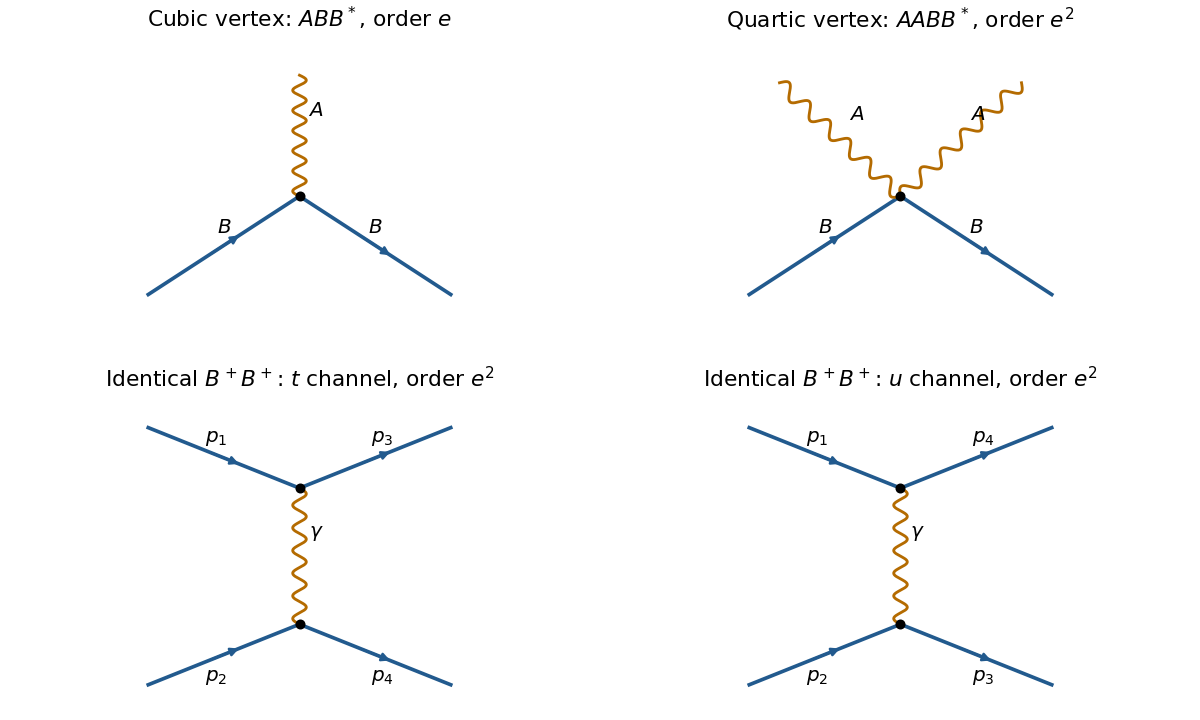
Cubic and quartic charged-vector vertices, and the two photon-exchange channels for identical charged vector bosons
. Details. The straight arrowed lines in the original schematic denote charged massive vector bosons; the wavy lines denote photons. For two identical positively charged vector bosons, the leading scattering amplitude has the order- -channel photon-exchange Feynman diagram, together with its -channel interchange required by identical bosons. A quartic interaction vertex cannot directly attach four external massive vector bosons. For a particle-antiparticle incoming pair, the leading channels instead are -channel exchange and -channel photon annihilation. The shown arrows track charge flow; an outgoing charged particle corresponds to the conjugate field at a vertex.
Pinned article: Introduction to the OurBigBook Project
Welcome to the OurBigBook Project! Our goal is to create the perfect publishing platform for STEM subjects, and get university-level students to write the best free STEM tutorials ever.
Everyone is welcome to create an account and play with the site: ourbigbook.com/go/register. We belive that students themselves can write amazing tutorials, but teachers are welcome too. You can write about anything you want, it doesn't have to be STEM or even educational. Silly test content is very welcome and you won't be penalized in any way. Just keep it legal!
Intro to OurBigBook
. Source. We have two killer features:
- topics: topics group articles by different users with the same title, e.g. here is the topic for the "Fundamental Theorem of Calculus" ourbigbook.com/go/topic/fundamental-theorem-of-calculusArticles of different users are sorted by upvote within each article page. This feature is a bit like:
- a Wikipedia where each user can have their own version of each article
- a Q&A website like Stack Overflow, where multiple people can give their views on a given topic, and the best ones are sorted by upvote. Except you don't need to wait for someone to ask first, and any topic goes, no matter how narrow or broad
This feature makes it possible for readers to find better explanations of any topic created by other writers. And it allows writers to create an explanation in a place that readers might actually find it.
Figure 1. Screenshot of the "Derivative" topic page. View it live at: ourbigbook.com/go/topic/derivativeVideo 2. OurBigBook Web topics demo. Source. - local editing: you can store all your personal knowledge base content locally in a plaintext markup format that can be edited locally and published either:This way you can be sure that even if OurBigBook.com were to go down one day (which we have no plans to do as it is quite cheap to host!), your content will still be perfectly readable as a static site.
- to OurBigBook.com to get awesome multi-user features like topics and likes
- as HTML files to a static website, which you can host yourself for free on many external providers like GitHub Pages, and remain in full control

Figure 2. You can publish local OurBigBook lightweight markup files to either OurBigBook.com or as a static website.
Figure 3. Visual Studio Code extension installation.
Figure 5. . You can also edit articles on the Web editor without installing anything locally. Video 3. Edit locally and publish demo. Source. This shows editing OurBigBook Markup and publishing it using the Visual Studio Code extension. 
- Infinitely deep tables of contents:



All our software is open source and hosted at: github.com/ourbigbook/ourbigbook
Further documentation can be found at: docs.ourbigbook.com
Feel free to reach our to us for any help or suggestions: docs.ourbigbook.com/#contact