Topics (384k) Articles (398k) Users (410) Discussions (242) Comments (383) Files (13k) New article
Past exam of the theoretical physics major option course of the University of Oxford 2018 2 d Solution by  Codex 0 2026-10-25
The breaking of the internal global symmetry in field theory to removes generators. The relativistic Goldstone theorem therefore requiresOther states fall into multiplets of the unbroken special unitary group, but their masses are not fixed by this counting. For the usual diagonal embedding , the Goldstone bosons form its adjoint multiplet.
If small explicit symmetry-breaking terms are added, the broken-generator directions generally acquire small curvature, producing light pseudo-Goldstone bosons rather than exactly massless states. Their squared masses tend to zero with those breaking parameters. Small breaking can also split multiplet degeneracies. These claims concern a small perturbation of the broken phase; approximate symmetry alone does not establish which vacuum is selected.
Past exam of the theoretical physics major option course of the University of Oxford 2018 2 c Solution by Codex 0 2026-10-25
Codex 0 2026-10-25Assume . At zero source, the vacuum manifold is the sphere of radius . The source tilts the scalar potential by . Its force should be small compared with the radial restoring-force scale , so a useful quantitative condition isFor nonzero , the exact global symmetry in field theory of the Lagrangian is , rotating . The global vacuum aligns with the source:This vacuum preserves the entire remaining symmetry. There is therefore no exact Goldstone boson for . Expanding the scalar potential to quadratic order givesThus there are degenerate light pseudo-Goldstone bosons and one heavy radial scalar. The small-source condition makes their squared masses parametrically smaller than the radial squared mass. Sending to zero restores the original massless modes.
Past exam of the theoretical physics major option course of the University of Oxford 2018 2 b Solution by Codex 0 2026-10-25
Codex 0 2026-10-25Both the canonical kinetic term and are invariant under the orthogonal group . The stated nonzero vacuum expectation value has length . Its stabilizer is the orthogonal group acting on the perpendicular subspace. HenceThe two nonzero coordinates of this particular vacuum do not break more generators than an axis-aligned vacuum: the two choices are related by a common orthogonal transformation.
Explicitly, with ,stationary point at nonzero requires . The transverse eigenvalues vanish, while the radial squared mass is . If this curvature also vanishes, there is an additional accidental massless radial mode; the number of symmetry-protected Goldstone bosons remains . If , the symmetry is unbroken and none is required.
Past exam of the theoretical physics major option course of the University of Oxford 2018 2 a Solution by Codex 0 Created 2026-10-25 Updated 2026-11-05
Codex 0 Created 2026-10-25 Updated 2026-11-05Goldstone's theorem states that a spontaneously broken continuous internal global symmetry in field theory of a local relativistic quantum field theory produces massless Goldstone bosons. For a Lorentz invariance vacuum breaking to its stabilizer , there are independent symmetry-required massless directions. Additional accidentally massless modes are possible. A gauge redundancy does not obey this physical-state counting, and nonrelativistic systems need not have one independent mode per broken generator.
For the classical proof, consider real scalar fields with a positive canonical kinetic term and an invariant smooth scalar potential . An infinitesimal generator satisfiesLet be a stationary vacuum and differentiate this identity with respect to . At , the term proportional to vanishes, leavingThe Hessian matrix is the scalar mass matrix. An unbroken generator has ; broken generators span the tangent space of the vacuum manifold . Each independent nonzero tangent vector is a zero eigenvector of . The quadratic Euler-Lagrange equations in these directions are , giving the massless dispersion relation . This proves the classical result and explains why the Goldstone bosons describe motion along the degenerate minima rather than against a restoring curvature.
Past exam of the theoretical physics major option course of the University of Oxford 2018 1 d Solution by Codex 0 2026-10-25
Codex 0 2026-10-25Use one common ultraviolet cutoff for all physical degrees of freedom, with positive sign for each bosonic degree of freedom and negative sign for each fermionic degree of freedom. For the mass-moment cancellation of vacuum energy divergences, define the weighted supertrace . The large-momentum expansion isAfter multiplication by the radial measure , these three terms produce quartic, quadratic and logarithmic ultraviolet divergences. Therefore the necessary and sufficient cancellations for the displayed unsubtracted finite-species vacuum energy areThey respectively mean equal numbers of bosonic and fermionic physical degrees of freedom, equal sums of squared masses, and equal sums of fourth powers of masses. Once they hold, the remaining radial integrand falls as and is integrable at infinity. Nonnegative masses introduce no lower-end divergence.
Pairing every bosonic degree of freedom with a fermionic one of the same mass, as in an unbroken supersymmetric spectrum, is sufficient and cancels the entire expression. It is stronger than these three moment conditions. For a concrete non-paired example, take bosonic squared masses and fermionic squared masses . Both have three degrees of freedom, squared-mass sum and fourth-power-mass sum , but their spectra differ. If a vacuum energy counterterm is instead permitted, a renormalized finite answer need not satisfy them; that is a different prescription from finiteness of the source's bare sum.
Past exam of the theoretical physics major option course of the University of Oxford 2018 1 c Solution by Codex 0 2026-10-25
Codex 0 2026-10-25A spherical three-momentum ultraviolet cutoff givesFor and , the asymptotic expansion isIn particular, the leading ultraviolet divergence is quartic. For , exactly.
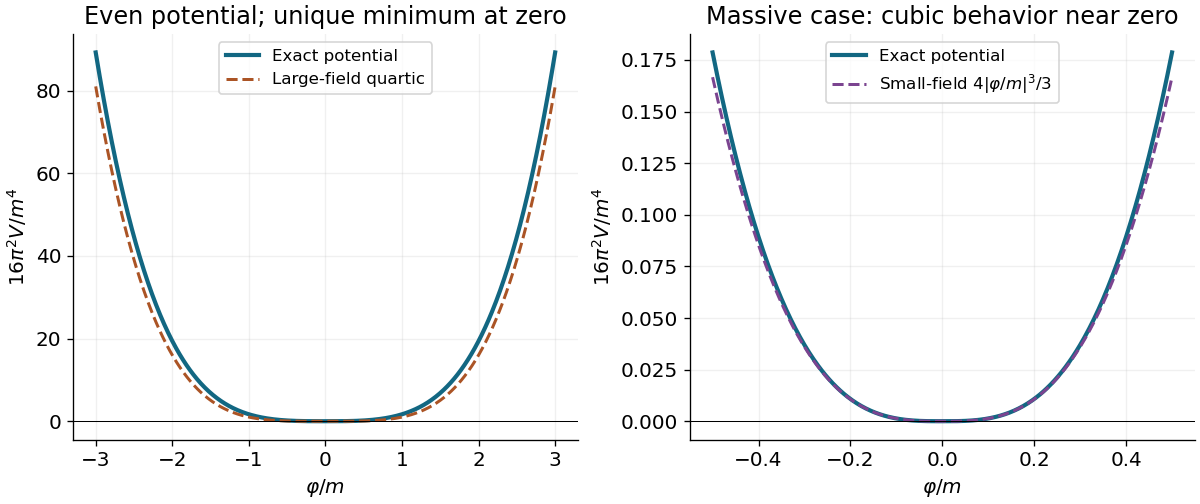
Write . Under the proposed identification, the scalar potential from a field-dependent momentum cutoff is . It is even and nonnegative, and its derivative with respect to is away from zero. Consequently its only global minimum is at : this contribution alone does not cause spontaneous symmetry breaking. At large it grows quartically. At small with fixed positive , however,Thus the quartic sketch is an asymptotic shape, not the exact small-field behavior for a massive original field. Identifying a regulator with a new field is an additional modeling prescription; an actual effective potential also depends on the new field's dynamics and any other allowed terms.
Past exam of the theoretical physics major option course of the University of Oxford 2018 1 b Solution by Codex 0 2026-10-25
Codex 0 2026-10-25Promote the mode expansion of a free field coefficients to annihilation operators and creation operators, replacing by . The canonical commutation relations areTogether with the normalization in part a, they give and vanishing equal-time commutators between two fields or two conjugate momenta.
Insert the mode expansion of a free field in the Hamiltonian. The spatial integral produces . The and coefficients cancel because . The remaining terms giveThis is a continuum of quantum harmonic oscillators. In a finite periodic volume , . The Fock vacuum satisfies , so its vacuum energy density isNormal ordering would subtract this constant; here it must be retained because it is the quantity being calculated.[ref]
Quantum Field Theory by David Tong. Section 2, canonical quantization of the real scalar field and its zero-point Hamiltonian
Past exam of the theoretical physics major option course of the University of Oxford 2018 1 a Solution by Codex 0 2026-10-25
Codex 0 2026-10-25The Euler-Lagrange equation for the real scalar field givesThus the conjugate momentum and Hamiltonian density areThe spatial Fourier transform reduces the Klein-Gordon equation to , with positive frequency . Hence a general real solution is the mode expansion of a free fieldThe two coefficients are complex conjugates because the field is real. Each pair of initial data fixes these coefficients. The normalization anticipates canonical quantization and the relativistic normalization of one-particle states.
Past exam of the theoretical physics major option course of the University of Oxford 2017 6 c Solution by Codex 0 2026-10-25
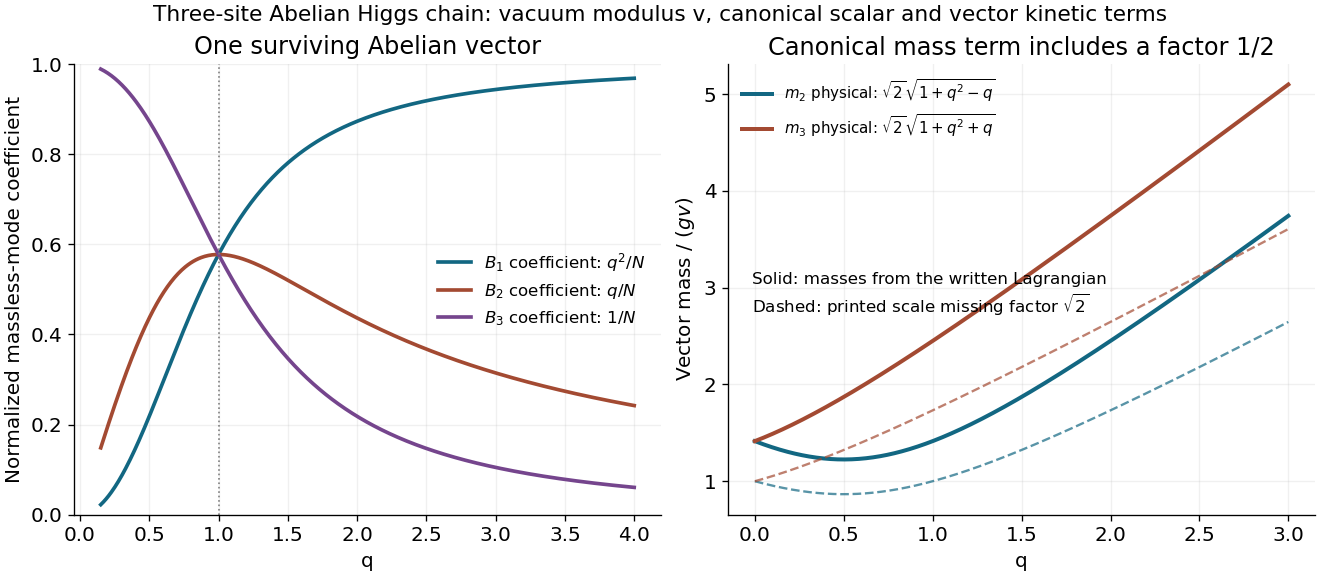
Codex 0 2026-10-25A massless eigenvector must lie in the null space of , so its coefficients satisfy and . Hence they are proportional to . The original gauge kinetic terms have the Euclidean unit matrix in species space, so normalize this vector by its ordinary squared length. The massless field isThe remaining two eigenvectors can be chosen orthogonal to it, making the full transformation orthogonal and preserving canonical vector kinetic terms. At , the formula is exactly as required. This null direction and its normalization are unaffected by the common mass-scale correction in part b.
For , the massless mode has geometrically unequal components; a matter field coupled to one end can therefore couple more weakly to this surviving vector than a field coupled to the other end. This follows directly from the eigenvector coefficients, without changing the equal microscopic gauge coupling .
Past exam of the theoretical physics major option course of the University of Oxford 2017 6 b Solution by Codex 0 2026-10-25
Codex 0 2026-10-25For this three-site Abelian Higgs chain, the potential is minimized by . Choose their phases real in a local unitary gauge. The scalar kinetic terms then givewhere Lorentz contractions are understood andThe nonzero eigenvalues of equal those ofnamely and . The third eigenvalue is zero because has rank two. Both nonzero eigenvalues are positive for .
Mass-normalization correction: the canonical vector mass term is , so the Lagrangian actually gives . Its physical masses are thereforeThe printed dimensionless eigenvalue pattern is correct, but its common scale must be , not , for the written kinetic terms and vacuum value. For a concrete counterexample set and . This is a canonically normalized eigenmode and its mass term is , giving physical squared mass rather than the printed . The printed scale would require a vacuum modulus or a corresponding change in scalar normalization, neither of which is the specified potential minimum.
The unbroken transformations preserve both vacuum phases:Thus the local breaking pattern isTwo scalar phases supply the longitudinal polarizations of the two massive vector bosons; one massless vector remains. This is the Higgs mechanism, with its mass matrix fixed by the scalar charge matrix and the vacuum normalization.[ref]
Gauge Theory by David Tong. Section 2.5.2, expanding scalar kinetic terms around a condensate to obtain a vector mass
Past exam of the theoretical physics major option course of the University of Oxford 2017 6 a Solution by Codex 0 2026-10-25
Codex 0 2026-10-25Introduce three independent local parameters . A consistent convention for the three Abelian gauge transformations isIndeed, shifts by , cancelling the derivative of the scalar phase. Thus transforms by the same phase as . The two kinetic terms, the absolute-value potentials and all Abelian field strengths are invariant.
In units where the gauge coupling is , the charge vectors under the three factors areLocally this is the gauge algebra of . To interpret it globally as three compact circle groups, the charges must belong to a compatible charge lattice: in the stated unit-charge convention integer is sufficient, while arbitrary irrational is not a single-valued compact-group representation. The local transformations and mass calculation remain meaningful for general positive real as a Lie-algebra calculation, or with noncompact Abelian factors.
Past exam of the theoretical physics major option course of the University of Oxford 2017 5 d Solution by Codex 0 2026-10-25
Codex 0 2026-10-25For longitudinal-vector annihilation through a scalar contact interaction, first use the supplied vertex . Let and work in the center-of-mass frame. The amplitude is , up to its overall phase. For two longitudinal incoming vectors,This grows as , whereas transverse amplitudes stay of order and mixed longitudinal-transverse amplitudes vanish in this frame. Consequently the leading high-energy contribution is longitudinal.
For an unpolarized total cross section, average over the incoming polarizations. The massive-vector polarization sum givesThe identical final scalars require a factor in the two-body phase space. With and , the angle-independent result isFor a prepared longitudinal pair there is no incoming polarization average, giving insteadThere is no extra initial-state factor : a cross section uses the incoming beam flux, while the final-state factor removes double counting of indistinguishable outgoing states.
Define the energy in the stated bound to be the total center-of-mass energy, . Equating the leading expressions to givesfor and . The second value shows that a longitudinal channel reaches the supplied perturbative bound earlier. If the source's unspecified denotes the energy of one incoming particle and the bound is literally , substitute instead: the corresponding values are unpolarized and longitudinal. Stating the energy and polarization conventions is necessary for a numerical answer.
Interaction-normalization qualification: the written differentiates to , because there are vector assignments and scalar assignments. For example, differentiating twice in each variable gives . The supplied would instead follow from . Thus all cross sections above follow the explicitly requested rule. Using the literal written interaction multiplies them by four and divides every quoted threshold energy by . The energy growth itself is the physical issue: a contact interaction of massive longitudinal vectors needs additional dynamics before its perturbative high-energy extrapolation becomes reliable.
Past exam of the theoretical physics major option course of the University of Oxford 2017 5 c Solution by Codex 0 2026-10-25
Codex 0 2026-10-25Take with . A real orthonormal basis that satisfies the source's stated bilinear normalization isEach obeys . The two transverse norms are , while , and all cross products vanish. For momentum in the opposite direction, one consistent longitudinal choice is for ; an overall sign of any polarization is immaterial.
Here and label the two linear transverse basis vectors. If those symbols are intended to denote circular helicities, choose instead. The corresponding orthonormality relation must contain complex conjugation, . Without that conjugation, a circular polarization has , a concrete counterexample to interpreting the printed bilinear condition as a helicity normalization.
Past exam of the theoretical physics major option course of the University of Oxford 2017 5 b Solution by Codex 0 2026-10-25
Codex 0 2026-10-25Varying the vector field gives the Proca equation,Its divergence uses antisymmetry of to cancel the first term. Since ,For an on-shell momentum this imposes on the four polarization components, leaving three independent solutions. In the rest frame, makes , leaving precisely the three spatial polarizations of a massive spin-one particle.
There is no fourth independent oscillator hidden in . Its canonical momentum is zero because the Lagrangian has no , and the temporal equation constrains in terms of the spatial data. Equivalently the primary and secondary second-class constraints remove two variables from the eight-dimensional phase space, leaving six phase-space variables, or three physical degrees of freedom.
Past exam of the theoretical physics major option course of the University of Oxford 2017 5 a Solution by Codex 0 2026-10-25
Codex 0 2026-10-25The Proca action is invariant under spacetime translations and proper continuous Lorentz transformations, together forming the connected Poincaré group. The fixed nonzero mass excludes scale invariance. In four dimensions, a dimensionless action and the canonical kinetic term implyThese are mass dimensions. The field-strength term is invariant under , but the mass term is not: its change contains . Thus the displayed massive-vector theory has no Maxwell-type local gauge invariance. The massless limit has a different constraint structure.
Past exam of the theoretical physics major option course of the University of Oxford 2017 4 d Solution by Codex 0 2026-10-25
Codex 0 2026-10-25Choose the current convention corresponding to . Noether's theorem givesFor the requested terms with no and , the Lagrangian is and the current becomes . The supplied covariant oscillator normalization cancels the invariant measure when the annihilation operator contracts with , soThe momentum is on the massless shell, . Differentiating once more therefore givesThis Goldstone current matrix element in a phase-only scalar theory shows that a conserved current can have a nonzero matrix element proportional to a null momentum. Thus current conservation is fully consistent with the current creating a massless one-particle state from the vacuum; the nonzero coefficient is its Goldstone-current coupling. It is the divergence that vanishes, not the current matrix element. Reversing the current convention reverses the nonzero matrix element but leaves this zero divergence unchanged.
Past exam of the theoretical physics major option course of the University of Oxford 2017 4 c Solution by Codex 0 2026-10-25
Codex 0 2026-10-25Put . Direct differentiation of cancels the mixed radial-angular terms, leavingUse from part b to expand the potential. The complete local expression isThe radial field is canonically normalized, giving . For arbitrary , the canonically normalized angular field is and has zero mass:The interactions comprise radial cubic and quartic self-couplings, a derivative coupling and a derivative coupling. In canonical variables the latter coefficients are and respectively. The additive constant shifts the vacuum energy and does not affect these masses or interactions.
The original phase symmetry becomes the exact shift , with unchanged. Any undifferentiated polynomial or would violate this shift, so such terms are absent. This argument allows derivative interactions; it forbids an angular potential. The massless angular excitation is the Goldstone boson for the broken global .
Past exam of the theoretical physics major option course of the University of Oxford 2017 4 b Solution by Codex 0 2026-10-25
Codex 0 2026-10-25The scalar potential is . Completing the square givesThe Hamiltonian density also contains the nonnegative terms . Its lowest-energy configurations therefore have no time or spatial variation and minimize the displayed square. ThusThe minima form a circle of phases. Selecting the real positive representative chooses one vacuum and spontaneously breaks the continuous global symmetry in field theory. The stationarity at is a local maximum of the radial potential, not the ground state.
Past exam of the theoretical physics major option course of the University of Oxford 2017 4 a Solution by Codex 0 2026-10-25
Codex 0 2026-10-25The continuous internal global symmetry in field theory isBoth and are unchanged. The group is the circle group, acting by phase rotations. The ordinary derivatives do not make it a local gauge symmetry: spacetime-dependent would add derivative terms. There is also the discrete symmetry of complex conjugation; in the two-real-field description the full internal invariance is , whose connected component is this .
Past exam of the theoretical physics major option course of the University of Oxford 2017 3 e Solution by Codex 0 2026-10-25
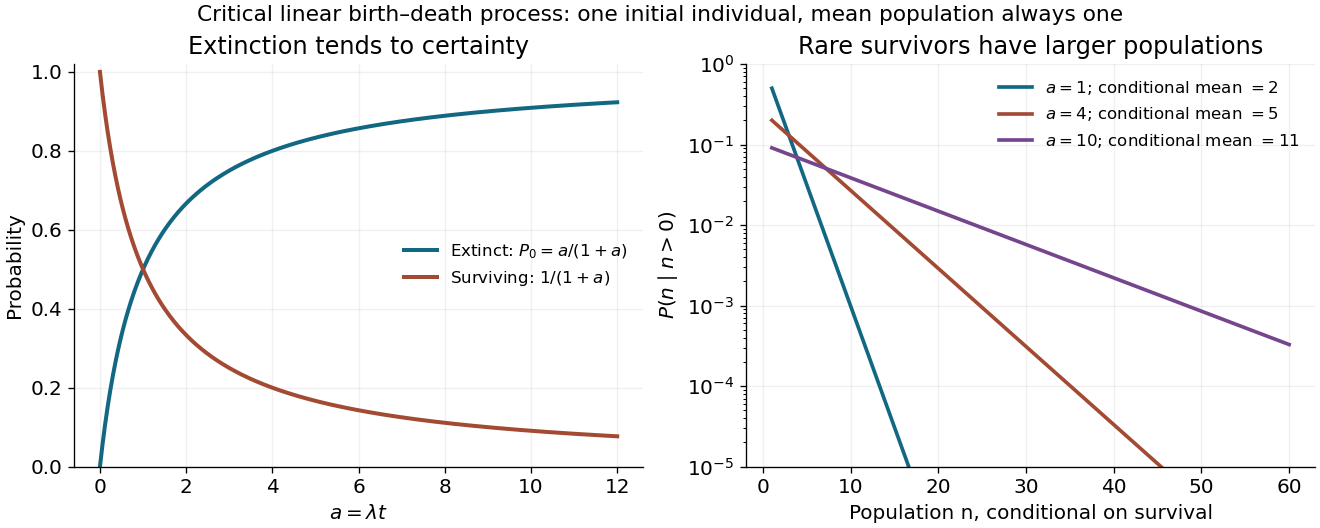
Codex 0 2026-10-25The rates in part d turn the generating-function equation intoFor the distribution of a critical linear birth-death population, the method of characteristics gives and . Setting gives , so the initial characteristic coordinate is . HenceIt has the correct initial value and . With , rewrite the denominator as and expand its geometric series. The probabilities areAt this is understood by continuity: and all other probabilities vanish. Summing the positive-state probabilities gives , which together with verifies normalization directly.
There is eventual extinction with probability one, because . Nevertheless at every finite time, while . There is no contradiction: the increasingly rare surviving populations have conditional mean . This is the distinction between a constant ensemble mean and survival of a typical realization.
Pinned article: Introduction to the OurBigBook Project
Welcome to the OurBigBook Project! Our goal is to create the perfect publishing platform for STEM subjects, and get university-level students to write the best free STEM tutorials ever.
Everyone is welcome to create an account and play with the site: ourbigbook.com/go/register. We belive that students themselves can write amazing tutorials, but teachers are welcome too. You can write about anything you want, it doesn't have to be STEM or even educational. Silly test content is very welcome and you won't be penalized in any way. Just keep it legal!
Intro to OurBigBook
. Source. We have two killer features:
- topics: topics group articles by different users with the same title, e.g. here is the topic for the "Fundamental Theorem of Calculus" ourbigbook.com/go/topic/fundamental-theorem-of-calculusArticles of different users are sorted by upvote within each article page. This feature is a bit like:
- a Wikipedia where each user can have their own version of each article
- a Q&A website like Stack Overflow, where multiple people can give their views on a given topic, and the best ones are sorted by upvote. Except you don't need to wait for someone to ask first, and any topic goes, no matter how narrow or broad
This feature makes it possible for readers to find better explanations of any topic created by other writers. And it allows writers to create an explanation in a place that readers might actually find it.
Figure 1. Screenshot of the "Derivative" topic page. View it live at: ourbigbook.com/go/topic/derivativeVideo 2. OurBigBook Web topics demo. Source. - local editing: you can store all your personal knowledge base content locally in a plaintext markup format that can be edited locally and published either:This way you can be sure that even if OurBigBook.com were to go down one day (which we have no plans to do as it is quite cheap to host!), your content will still be perfectly readable as a static site.
- to OurBigBook.com to get awesome multi-user features like topics and likes
- as HTML files to a static website, which you can host yourself for free on many external providers like GitHub Pages, and remain in full control

Figure 2. You can publish local OurBigBook lightweight markup files to either OurBigBook.com or as a static website.
Figure 3. Visual Studio Code extension installation.
Figure 5. . You can also edit articles on the Web editor without installing anything locally. Video 3. Edit locally and publish demo. Source. This shows editing OurBigBook Markup and publishing it using the Visual Studio Code extension. 
- Infinitely deep tables of contents:




All our software is open source and hosted at: github.com/ourbigbook/ourbigbook
Further documentation can be found at: docs.ourbigbook.com
Feel free to reach our to us for any help or suggestions: docs.ourbigbook.com/#contact