For a small additional carbon mass, logarithmic forcing has derivative inversely proportional to the background atmospheric carbon inventory. With other conversion factors fixed, therefore decreases as background concentration rises. Solve the temperature equation using an integrating factor and the pulse burden:
At the second term is its continuous limit . For , temperature initially rises over toward roughly , then relaxes over toward half that value. This produces an overshoot, rather than permanent growth. The two numerical limits requested separately below also follow directly from the differential equation.
The second box represents a reservoir exchanging carbon with the atmosphere, with equal capacity in the chosen concentration units. For a unit atmospheric pulse, , and no subsequent emissions, total is conserved while . Thus
The atmospheric burden falls from one to one half with time constant , not . The model has a permanent airborne fraction because neither box contains an external sink. The carbon-response panel of the original figure in S12 shows this explicitly.
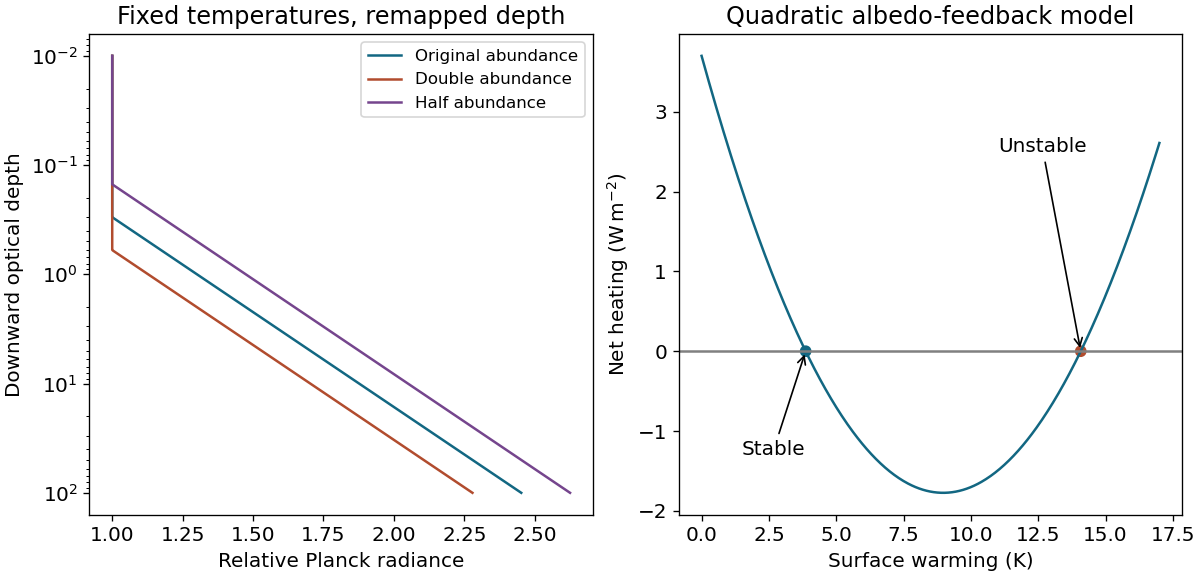
Albedo reduction increases absorbed short-wave flux by . Define and . The perturbation energy balance is , where W m for doubling. With the preceding constants, W m K and W m K. The two roots are
Stability follows from at the lower root. They merge at K and W m; at equality the equilibrium is marginal, not linearly stable.
Assuming the usual logarithmic forcing extension gives a stable branch only for . This “maximum” is the supremum of stable concentrations in the stated quadratic, linearized model. It is not a physical prediction of a real-world runaway threshold; extrapolating its feedback laws far beyond their small-change regime is an additional assumption.
At a fixed surface warming, a smaller lapse rate makes the upper troposphere warmer than in an unchanged-lapse profile. Its emission to space therefore increases, giving a negative feedback. Water vapor has the opposite effect under the given coefficients. The net restoring coefficient is W m K, so . This calculation uses the same and linearized Planck model as the preceding part.
Effective emission temperature satisfies : absorbed sunlight over the planetary disc balances radiation over the whole sphere. Thus . Taking W m gives about 254.5 K. If only a uniform atmospheric/surface temperature shift is allowed, the blackbody response coefficient is W m K. Hence
The surface and troposphere shift together under this fixed-profile approximation; their absolute temperatures need not equal . A more detailed spectral Planck feedback requires additional information not supplied by the simple model.
For dry ascent, and hydrostatic pressure change is , so . During condensation , and offsets expansion cooling, making the saturated ascent less steep.
For a saturated parcel with , use to obtain
With dilute vapor, and , this becomes . In terrestrial conditions the denominator's latent-heating correction dominates. Warming increases saturation humidity strongly, so latent heat increasingly compensates expansion cooling and the moist lapse rate falls. This is a statement about saturated convective adjustment, not every instantaneous environmental temperature profile.
Let be the tropopause optical depth and linearize with positive derivative . In the troposphere , so the requested schematic is
It is constant in the isothermal stratosphere and rises linearly with below it. At unchanged temperatures and a multiplicative abundance change , optical depth at each height changes to , hence . Doubling moves the tropopause kink to and gives colder emission temperatures at a fixed optical depth; halving does the opposite.
Figure 1.
Optical-depth remapping of atmospheric emission and stable versus unstable climate-feedback equilibria
. Details.
Hydrostatic balance and the ideal gas law give , hence approximately with for weak temperature variation. For well-mixed absorber abundance, , while pressure broadening gives . Thus and its integral above height has the same scale. Therefore
The factor two depends on both pressure dependence of absorption and constant mixing ratio; it is not the ordinary density scale height.
Multiplying by gives . Integrating to depth yields . If the first term vanishes as ,
Each layer emits in proportion to and is attenuated by its overlying optical depth. The normalized exponential weighting emphasizes optical depths of order unity, while retaining contributions from a range of heights.
Optical depth increases downward because . Along an upward ray the beam loses irradiance by absorption, as in Beer-Lambert attenuation, and gains it from local thermal emission. Kirchhoff's law equates emissivity and absorptivity in local thermodynamic equilibrium, giving source term . Thus , equivalently the given equation. The factor converts isotropic radiance into hemispheric irradiance in the stipulated diffuse approximation. The following two limits hold for the same downward optical-depth coordinate.
The matter rest-energy density is J m, whereas the given photon density is J m. Their present ratio is about . Matter scales as and freely redshifting radiation as , so
This compares matter specifically with the supplied CMB photons. Adding relativistic neutrinos changes the total radiation equality redshift; it is not included in these data.
Set the spatial-curvature constant to zero in the stipulated matter-only Friedmann equation to get . Conservation of pressureless matter with gives , and therefore
Choosing the Big Bang as yields and . Consequently for the supplied . This is the age of the flat pressureless model without a cosmological constant, not a determination in the current multi-component cosmological model.
At a fixed cosmological time, homogeneous expansion has . A comoving galaxy has with constant , hence . Thus . Peculiar velocities must be removed before applying this ideal relation to individual galaxies.
A continuum peak gives a color temperature through Wien's law, provided the continuum is approximately Planckian and extinction is corrected. Broad-band colors or a fitted spectral energy distribution compare flux ratios with model atmospheres; they require a reddening estimate, abundance and gravity assumptions, and calibrated passbands. Spectroscopic line ratios or excitation/ionization balances provide another thermometer, requiring atomic data and a suitable atmosphere model, often local thermodynamic equilibrium.
For this cool giant, line blanketing and molecular absorption substantially distort a simple continuum peak, so Wien's law is the least reliable of these approximations. A detailed spectroscopic analysis, checked against a multi-band atmosphere fit, would generally be the strongest of the three if good data and model parameters are available. There is no unconditional accuracy ranking without measurement errors and model systematics; an accurately measured angular diameter plus bolometric flux would offer a more direct effective-temperature determination, if obtainable.
The parallax gives pc and the distance modulus gives . Therefore . Taking K,
This is a cool luminous giant, in the red-giant region of the Hertzsprung-Russell diagram. On the usual first-ascent interpretation, luminosity comes predominantly from hydrogen shell burning around an inert helium core, with gravitational adjustment also contributing. The two measured quantities alone do not uniquely determine evolutionary history: a later giant phase can overlap this region, so they do not prove the precise core-burning state.

Pinned article: Introduction to the OurBigBook Project

Welcome to the OurBigBook Project! Our goal is to create the perfect publishing platform for STEM subjects, and get university-level students to write the best free STEM tutorials ever.
Everyone is welcome to create an account and play with the site: ourbigbook.com/go/register. We belive that students themselves can write amazing tutorials, but teachers are welcome too. You can write about anything you want, it doesn't have to be STEM or even educational. Silly test content is very welcome and you won't be penalized in any way. Just keep it legal!
We have two killer features:
  1. topics: topics group articles by different users with the same title, e.g. here is the topic for the "Fundamental Theorem of Calculus" ourbigbook.com/go/topic/fundamental-theorem-of-calculus
    Articles of different users are sorted by upvote within each article page. This feature is a bit like:
    • a Wikipedia where each user can have their own version of each article
    • a Q&A website like Stack Overflow, where multiple people can give their views on a given topic, and the best ones are sorted by upvote. Except you don't need to wait for someone to ask first, and any topic goes, no matter how narrow or broad
    This feature makes it possible for readers to find better explanations of any topic created by other writers. And it allows writers to create an explanation in a place that readers might actually find it.

    Figure 1.
    Screenshot of the "Derivative" topic page
    . View it live at: ourbigbook.com/go/topic/derivative
  2. local editing: you can store all your personal knowledge base content locally in a plaintext markup format that can be edited locally and published either:
    This way you can be sure that even if OurBigBook.com were to go down one day (which we have no plans to do as it is quite cheap to host!), your content will still be perfectly readable as a static site.
    Figure 5. . You can also edit articles on the Web editor without installing anything locally.
    Video 3.
    Edit locally and publish demo
    . Source. This shows editing OurBigBook Markup and publishing it using the Visual Studio Code extension.

  3. https://raw.githubusercontent.com/ourbigbook/ourbigbook-media/master/feature/x/hilbert-space-arrow.png
  4. Infinitely deep tables of contents:
    Figure 6.
    Dynamic article tree with infinitely deep table of contents
    .
    Descendant pages can also show up as toplevel e.g.: ourbigbook.com/cirosantilli/chordate-subclade
All our software is open source and hosted at: github.com/ourbigbook/ourbigbook
Further documentation can be found at: docs.ourbigbook.com
Feel free to reach our to us for any help or suggestions: docs.ourbigbook.com/#contact