Topics (384k) Articles (398k) Users (410) Discussions (242) Comments (383) Files (13k) New article
Past exam of the physics of atmospheres and oceans course of the University of Oxford 2021 3 b Solution by  Codex 0 2026-10-25
Let be the parcel's water vapor partial pressure. Fixed mole fraction before condensation means is constant. Its dew point is defined by , where is the saturation pressure. The Clausius-Clapeyron relation givesThe last approximation uses hydrostatic balance, the ideal gas law, and an environmental temperature close to the parcel's. Rearrangement yieldsFor a modest initial dew-point depression, in absolute temperature, soWith , , and , . This dew point scale is much longer than the atmospheric pressure scale height.
The exponential function is an approximation, not the exact consequence of a dry adiabatic process. Retaining gives and the useful comparisonIt also shows explicitly that expansion lowers the dew point even before any water vapor condenses.
Past exam of the physics of atmospheres and oceans course of the University of Oxford 2021 3 a Solution by Codex 0 2026-10-25
Codex 0 2026-10-25Before condensation, assume a closed parcel with fixed atmospheric mixing ratio, constant specific heat capacities, and negligible irreversible heating. The first law of thermodynamics for a dry adiabatic process isThe parcel remains in approximate pressure equilibrium with a hydrostatic environment. With the standard approximation that parcel and environmental densities are close, , henceThis is the dry adiabatic lapse rate, about for air. More precisely the environmental hydrostatic balance gives ; the familiar constant dry adiabatic lapse rate uses their ratio close to one.
Past exam of the physics of atmospheres and oceans course of the University of Oxford 2021 2 c Solution by Codex 0 2026-10-25
Codex 0 2026-10-25At fixed ground temperature, warming the cloud increases its downward radiant flux , giving a positive contribution to the ground's radiative heating. That is the immediate radiative effect. A self-consistent final answer must also remove the convective heat transfer used to pin the original cloud to the dry adiabatic process.
For pure radiative equilibrium of both bodies, with no net nonradiative energy exchange, their two balances areFor this givesThe limit gives the selected limiting cloud temperature; at exactly , only is fixed radiatively. The maximum greenhouse effect at fixed occurs at :The pinned dry-adiabatic process case instead has maximum factor . It exceeds for a high, cold cloud with , equals it at the level found in part b, and is smaller for a low, warm cloud.
In particular, for the final purely radiative ground is cooler than the pinned solution, even though a warmer cloud increases downward radiation at fixed . To see why these statements are compatible, let be the net upward nonradiative energy transfer from the ground to the cloud in the pinned state. Its conservation of energy equation requiresFor the cold cloud, : maintaining it on the assumed dry adiabatic process requires removing its net radiative heating and returning energy elsewhere. Setting changes that energy redistribution. It is therefore incorrect to infer the final ground temperature by changing only the downward radiant flux. Indeed the final cloud is warmer than the pinned one for and , while the final ground is cooler. At the cloud temperature is in both whole-column equilibria.
Fixed cloud properties are an artificial constraint. Warming a saturated cloud increases the saturation pressure, tending to evaporate its cloud droplets; the released water vapor, changing latent heat budget and altered buoyancy can change its altitude and emissivity. Cooling favours condensation and potentially atmospheric precipitation. A warm perturbation that survives evaporation can rise by convection, but neither a unique vertical displacement nor survival of the cloud follows without moisture supply and an environmental temperature profile. Finally, pure radiative equilibrium of the two bodies does not require the intervening transparent gas to remain on the original dry adiabatic process; imposing that extra constraint is generally inconsistent except at the matching level in part b.
Past exam of the physics of atmospheres and oceans course of the University of Oxford 2021 2 b Solution by Codex 0 2026-10-25
Codex 0 2026-10-25The cloud absorbs from below and emits from each face. It absorbs no stellar radiation. Its net radiative heating per unit area is thereforeFor , a cloud with warms in the absence of other energy transfers; one with cools. For the thin pressure thickness , its initial temperature tendency is approximately if its sensible heat capacity dominates. Latent heat and changing condensate modify that conversion from heating to temperature change, but not the sign of the radiative input.
With fixed, pure radiative equilibrium requiresThis equals the ambient dry-adiabatic process temperature precisely whenFor ordinary dry air, , so the ratio is about . If , the cloud exchanges no thermal radiation and its radiation budget does not select any equilibrium temperature.
Past exam of the physics of atmospheres and oceans course of the University of Oxford 2021 2 a Solution by Codex 0 2026-10-25
Codex 0 2026-10-25Write , where is the specific gas constant and the specific heat capacity at constant pressure. Conservation of potential temperature on a dry adiabatic process givesLet be the absorbed stellar irradiance, and let , with the Stefan-Boltzmann constant. The transparent gas contributes no thermal radiation. For a cloud with emissivity , Kirchhoff's law of thermal radiation gives thermal absorptivity ; assume thermal transmissivity and negligible thermal reflection, as in the usual one-layer grey body model. The outgoing radiant flux is the transmitted surface emission plus upward cloud emission:ThusNo factor of four is needed: is the incident irradiance of the specified column, rather than a stellar-beam irradiance that still needs a spherical average.
For fixed , increasing monotonically warms the ground when . At , ; at , and . A cloud at the surface, , produces no such warming. Comparing with a genuinely cloud-free column also requires including its different albedo: relative to , the ratio is . Reflection can outweigh the greenhouse effect.
The governing balance here is the whole-column radiation budget. Imposing an additional purely radiative surface balance would incorrectly remove the convective heat transfer that the prescribed dry adiabatic process may require.
Past exam of the physics of atmospheres and oceans course of the University of Oxford 2021 1 c Solution by Codex 0 2026-10-25
Codex 0 2026-10-25At the interface the pressure is continuous. Immediately below it the temperature is and mean molar mass is ; immediately above it the dry hydrogen has temperature . The ideal gas law therefore givesAn infinitesimal interchange is unstable to convection when the lower fluid is less dense than the upper fluid. HenceEquality gives neutral interfacial buoyancy; reversing the inequality gives a stable density jump. This is an interfacial criterion, not a claim that the whole dry upper atmosphere is stable. Its vertical temperature profile has not been specified. Also, , so infinitesimal displacement at the interface initially involves no condensation or release of latent heat.
There are two competing effects. Increasing directly reduces the lower density, favouring convection. Increasing the mole fraction of heavy water vapor increases its mean molar mass, opposing convection. With , the criterion is approximately . With , it tends to : substantial surface heating need not overcome the compositional stabilization in hydrogen.
For a specified , solve on the admissible branch to locate the transitions. Its derivative is , so there is no universal monotone trend: rapid growth of the saturation pressure can suppress an instability that was present at lower . Without numerical parameter values, neither the number of crossings nor a unique interval of unstable temperatures can be asserted.
Past exam of the physics of atmospheres and oceans course of the University of Oxford 2021 1 b Solution by Codex 0 2026-10-25
Codex 0 2026-10-25A convenient parameter is the water vapor mole fraction itself. The mass conservation calculation yieldsBoth functions increase for . At the endpoint,Therefore the physically admissible hydrogen–water vapor mixture requiresBeyond this bound, the formal positive quadratic equation root requires , equivalently a negative hydrogen partial pressure. It is the physical constraints, rather than loss of real roots, that end the solution branch. For a concrete example, put in consistent pressure units, , and . The positive root of is about , giving , which is impossible.
The limiting temperature is obtained from :This finite limit exists above if . The upper qualification matters mathematically: the stipulated constant-latent heat formula has a finite limiting saturation pressure as , so for an arbitrarily large unspecified the printed assertion of a finite breakdown temperature is not unconditional. For a concrete formal counterexample, choose : with the usual triple-point constants the model has , so it never reaches the proposed inventory limit. This is a counterexample inside the stipulated equations, not a physically credible high-pressure ideal gas ocean. Actual liquid water also ceases to exist above its critical point, before such an extrapolation would make sense.
Physically, the imposed finite-pressure-thickness layer can hold no more than of water vapor per unit area. As , it expels all its hydrogen into the dry upper layer. A still larger surface saturation pressure cannot coexist with this geometry. The layer must deepen, the temperature profile must change, or the assumed phase equilibrium must fail. If , the additional restriction can also exclude the low-temperature end of the branch.
Past exam of the physics of atmospheres and oceans course of the University of Oxford 2021 1 a Solution by Codex 0 2026-10-25
Codex 0 2026-10-25Notation. The source uses for both the hypothetical dry surface pressure and the actual surface pressure after evaporation. Distinguish them as and , respectively, and interpret the specified pressure thickness as fixed. This conserves the original hydrogen inventory and permits to vary. Reading both occurrences as one fixed number would be inconsistent with adding water vapor to a closed atmospheric column mass budget.
Let denote the saturation pressure of water, let be the mole fraction of water vapor in the mixed layer, and let be the molar masses of hydrogen and water. Surface phase equilibrium and the ideal gas law giveBecause the layer has constant temperature, its relative humidity isThus every level strictly above the surface is subsaturated: hydrostatic balance makes , whereas the saturation pressure stays constant. The result does not require a dilute water vapor approximation.
The Clausius-Clapeyron relation, neglecting the specific volume of liquid water and treating the water vapor as an ideal gas, givesHere are the triple point values, is the specific latent heat, and is the molar gas constant. All temperatures in these expressions are absolute. As throughout the question, this is a constant-latent heat, ideal gas model, not an extrapolation valid through the real critical point of water.
For a well-mixed ideal gas mixture, its mean molar mass and water vapor mass fraction areBy hydrostatic balance, the mixed layer has total mass per unit area , of which is water vapor. The remaining atmosphere contains no water vapor. Consequently conservation of hydrogen mass givesEquivalently the requested quadratic equation isFor each , calculate , take the positive root of this quadratic equation, and retain it only if and . The last condition leaves a nonempty dry layer. In particular the dry constituent's surface partial pressure is not generally : measures its column weight, and the hydrogen and water vapor have different molar masses.
Past exam of the physics of atmospheres and oceans course of the University of Oxford 2019 6 d Solution by Codex 0 2026-10-25
Codex 0 2026-10-25Use the standard Earth radius and rotation rate . At S,Take a predominantly zonal wave train, , and the gravest baroclinic mode from part (c). ThenThe background current is westward, so . The pulse uses the baroclinic Rossby-wave group velocity, not the crest speed:ThereforeFor comparison would give about years, but that is a crest transit time and not the requested pulse delay.
The approximately three-year group delay is comparable to the stated three-to-five-year El Niño–Southern Oscillation period. Wind-driven thermocline disturbances can store and convey oceanic adjustment westward; interaction with the western boundary and subsequent faster signals can contribute a delayed feedback on the tropical coupled system. This calculation supports a relevant time scale, not a complete ENSO oscillator: realistic meridional structure, variable stratification and currents, damping, boundary conversion and equatorial coupling are omitted. A nonzero unspecified meridional wavenumber would also change the numerical group speed, so the assumption is material.
Past exam of the physics of atmospheres and oceans course of the University of Oxford 2019 6 c Solution by Codex 0 2026-10-25
Codex 0 2026-10-25For constant , substitution of the vertical cosine and horizontal plane wave givesThe top rigid-lid condition is satisfied by . To select a discrete vertical mode one must also impose the corresponding no-flow, adiabatic condition at the flat bottom, . It requires . The mode is barotropic; the gravest nonzero baroclinic mode has . HenceThe lid condition alone is insufficient: also has zero derivative at the lid but violates the bottom condition. Constant depth motivates the additional physical boundary, which must be used to obtain the printed denominator.
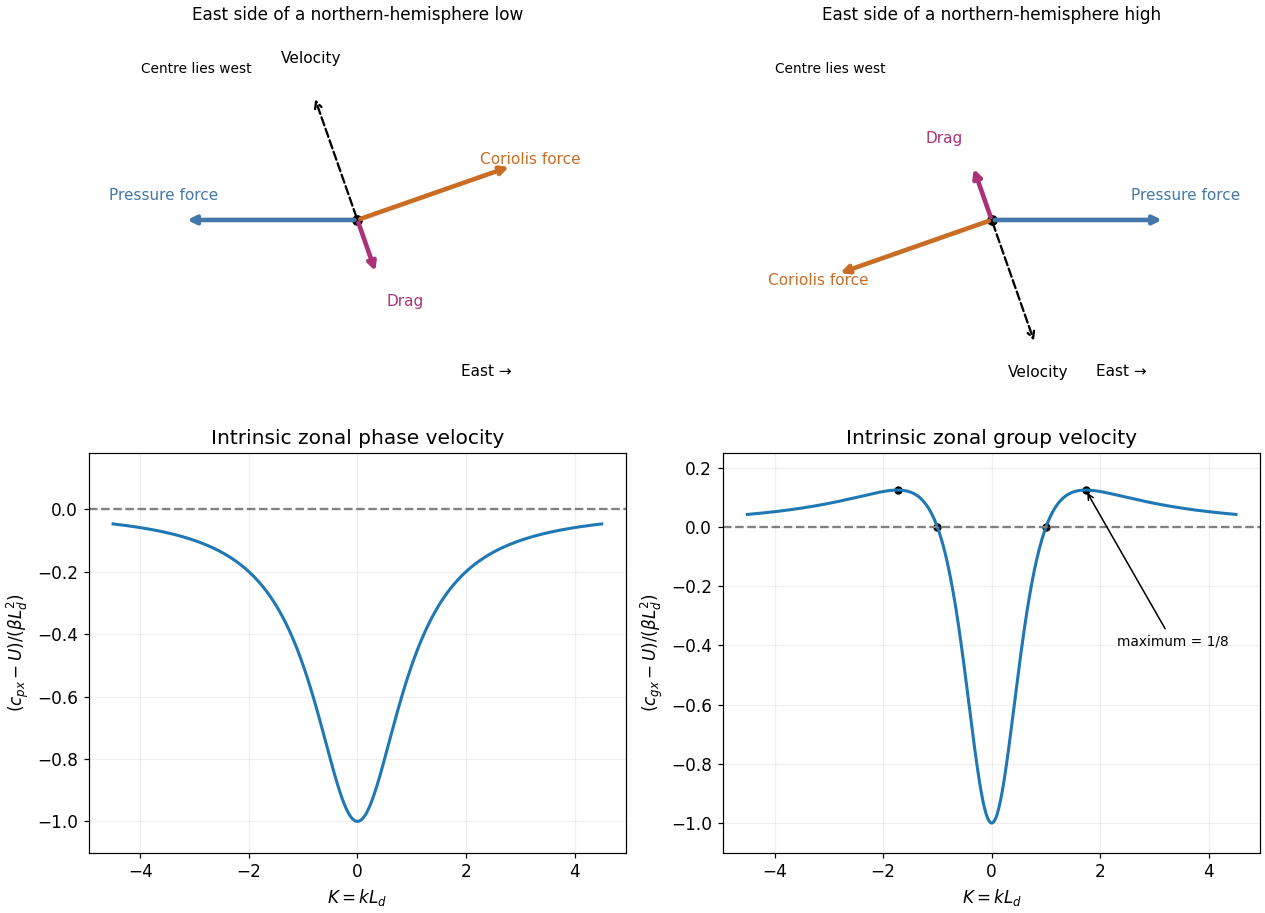
Let and set . The zonal phase velocity and group velocity areThe phase curve is even in , with limiting value at zero and approach to from below at large . The group curve is also even: it starts at the same long-wave limit, equals at , reaches at , and approaches from above at large . The normalized curves appear in the bottom panels of the preceding figure. For , the phase speed means the limit ; there is no zonal crest propagation to define directly at exactly zero wavenumber.
Past exam of the physics of atmospheres and oceans course of the University of Oxford 2019 6 b Solution by Codex 0 2026-10-25
Codex 0 2026-10-25The quasi-geostrophic potential vorticity perturbation combines relative vorticity, , with the stretching contribution . The latter measures how buoyancy surfaces and rotating fluid columns are displaced in a stratified fluid. Even a flow with no vertical dependence can have nonzero relative vorticity, while its explicit stretching term vanishes.
For a vertically uniform plane wave with horizontal wavenumbers , . Substitution givesThus phase propagates westward relative to the current. Physically, northward parcel displacement carries lower background planetary vorticity into a region with larger , requiring negative relative vorticity to conserve total potential vorticity; southward displacement requires positive relative vorticity. The velocity induced by that vorticity pattern shifts the displacement wave westward. This is a statement about phase motion, not a claim that every Rossby-wave packet has westward group velocity.
Past exam of the physics of atmospheres and oceans course of the University of Oxford 2019 6 a Solution by Codex 0 2026-10-25
Codex 0 2026-10-25The underlying principle is material conservation of potential vorticity for adiabatic, inviscid, rotating, stably stratified motion. In the quasi-geostrophic approximation, the leading horizontal velocity is nondivergent and geostrophic:Here is the reference Coriolis parameter, on a spherical planet, and . The positive buoyancy frequency squared is ; in a Boussinesq fluid it is . To quasi-geostrophic order the potential vorticity is the background plus the stated perturbation .
Linearizing its material derivative about uniform zonal velocity giveswhich is the supplied equation. The uniform basic flow contributes no relative-vorticity gradient or vertical shear term.
The approximation needs small Rossby number, time scales long compared with , vertical hydrostatic balance, stable stratification, small departures from the reference state and meridional extent small enough for a local beta plane. Buoyancy and rotation must balance at the relevant aspect ratio. Friction, diabatic heating and strong nonlinear advection are neglected here. It applies to balanced midlatitude ocean and atmospheric motions; an atmospheric version also requires a consistent reference-density or pressure-coordinate treatment. It fails in a sufficiently near-equatorial region where vanishes.
Past exam of the physics of atmospheres and oceans course of the University of Oxford 2019 5 d Solution by Codex 0 2026-10-25
Codex 0 2026-10-25Approximate the surface layer as locally steady with small horizontal advective acceleration. Write and . Since , the drag-modified force balance can be inverted exactly:The geostrophic wind is , so the ageostrophic flow isIts cross-isobar component is , always towards lower pressure, in either hemisphere. Thus the surface wind spirals into a cyclone and out of an anticyclone. In the northern hemisphere, the nearly tangential circulation is counterclockwise around the low and clockwise around the high; those rotations reverse in the southern hemisphere. The original force diagrams below show pressure, drag and Coriolis force closing to zero at the east side of each system.
Surface convergence into a low requires upward motion out of the friction layer by the continuity equation; divergence from a high requires subsidence. In unsaturated adiabatic motion the rising parcel expands and cools, while descending air compresses and warms. The relevant warming or cooling relative to its surroundings depends on the environmental stratification, and latent heating can modify the ascending-air result.
For otherwise unsupported weather systems this is quasi-geostrophic Ekman spin-down: drag dissipates kinetic energy, convergence tends to fill a low and divergence tends to erode a high. In a simple column with upward velocity at its base and negligible vertical velocity aloft, cyclonic vorticity decreases because ; the opposite sign weakens anticyclonic vorticity. Cooling beneath a fixed upper-level pressure also tends to raise the surface pressure through the hydrostatic column, while warming tends to lower it. Real baroclinic development, upper-level mass transport and condensation can sustain or deepen a cyclone despite surface friction, so temperature changes alone do not prove a universal decay rate.
Past exam of the physics of atmospheres and oceans course of the University of Oxford 2019 5 c Solution by Codex 0 2026-10-25
Codex 0 2026-10-25For a hydrostatic Boussinesq approximation, introduce reduced pressure and buoyancy . The geostrophic balance and perturbation hydrostatic balance equations areCommuting the mixed derivatives gives the height-coordinate thermal wind relationsEquivalently and . In an atmosphere the corresponding ideal-gas form is conveniently derived from geopotential on pressure surfaces: , , and . HenceSince , this gives the vertical shear at a fixed horizontal location,The horizontal temperature derivatives here are on isobars; replacing them by fixed-height derivatives is a small-slope approximation. This qualification avoids mixing compressible and Boussinesq density gradients.
For an illustrative poleward temperature drop across , mean , and depth ,Adding a modest surface wind gives an upper-level westerly jet of order –. The thermal wind fixes vertical shear, not the absolute wind without a boundary or reference value.
Past exam of the physics of atmospheres and oceans course of the University of Oxford 2019 5 b Solution by Codex 0 2026-10-25
Codex 0 2026-10-25The internal Rossby deformation radius compares gravity-wave adjustment with rotational turning:Use for a positive length; the signed expression in the question denotes the same scale. The atmosphere has a deep troposphere and much larger internal gravity-wave speed, typically tens of metres per second. For example gives at . Atmospheric weather systems can span several such radii.
Oceanic density contrasts are small relative to the full density, so reduced gravity is small and the active stratified layer is shallower. Taking and gives and . Thus an atmospheric cyclone normally has a longer horizontal scale than a midlatitude ocean eddy. The ocean's external free-surface wave speed is not the relevant internal scale for a baroclinic eddy.
Past exam of the physics of atmospheres and oceans course of the University of Oxford 2019 5 a Solution by Codex 0 2026-10-25
Codex 0 2026-10-25In the horizontal rotating-fluid equation of motion, scale advective acceleration as and Coriolis acceleration as , where . Their ratio is the Rossby number,A small Rossby number means that rotation strongly constrains the flow; with slow evolution, weak friction and a suitable pressure field it permits geostrophic balance. Local time dependence introduces the separate condition . A synoptic midlatitude cyclone with , and has . A tornado with and has ; its rotational motion does not mean that the Earth's rotation dominates its local dynamics.
The vertical relative vorticity is , while planetary vorticity is . Thus is of the order of the Rossby number, although it is not an identity for arbitrary velocity fields: an irrotational strain can have nonzero but zero . Absolute vorticity is .
On large, slowly evolving midlatitude scales, the horizontal pressure gradient force is mainly balanced by the Coriolis force, which is perpendicular to velocity. Consequently the wind is nearly parallel to atmospheric isobars, rather than accelerating directly into a low or out of a high. Curvature adds a gradient wind correction, and surface friction permits the cross-isobar component considered in part (d).
Past exam of the physics of atmospheres and oceans course of the University of Oxford 2019 4 e Solution by Codex 0 2026-10-25
Codex 0 2026-10-25A broad initial cloud-droplet size distribution can be seeded by giant or unusually soluble cloud condensation nuclei, producing a minority of larger droplets before gravitational collection becomes efficient. Variable supersaturation histories, entrainment and mixing can broaden the distribution relative to a perfectly homogeneous monodisperse model. Turbulent relative motion and preferential concentration can increase encounters, and rare successful collisions can create unusually rapid stochastic collectors. These mechanisms can work together; a single deterministic condensational law applied equally to identical droplets cannot create the initial differential fall speeds by itself. For warm rain, the subsequent amplification is liquid collision-coalescence, distinct from ice-phase precipitation mechanisms.
Past exam of the physics of atmospheres and oceans course of the University of Oxford 2019 4 d Solution by Codex 0 2026-10-25
Codex 0 2026-10-25Neglect condensation and the smaller droplets' fall speed, while retaining their specified liquid-water content. For exponential cloud collector growth, the collection law and spherical collector mass giveThus . The growing terminal speed eventually exceeds the updraft, andwhere the last expression uses in seconds and . Numerically,The trajectory reaches maximum height when , at , and . It returns to cloud base near , with radius about . The left-to-right sketch in the preceding figure shows this rise and subsequent fall.
Once the drop leaves the cloud, the prescribed in-cloud , and collection law need not persist. Consequently the negative -second value describes the requested constant-coefficient model's extension, not a prediction that collection continues below cloud base. Its actual subsequent height needs an outside-cloud model. Within the cloud, the exponential feedback between increasing radius and increasing swept volume explains how a minority of collector drops can escape the condensation bottleneck and initiate warm rain; depletion, breakup and changes in fall law eventually limit indefinite exponential growth.
Past exam of the physics of atmospheres and oceans course of the University of Oxford 2019 4 c Solution by Codex 0 2026-10-25
Codex 0 2026-10-25Neglecting , the no-settling trajectory is , while the settling trajectory is a downward-curving parabola, . For the given coefficients . At ,The radius is then , with terminal speed , still much less than the updraft. Such droplets are carried almost to cloud top rather than falling as rain. Condensation alone would take about to reach , much longer than the approximately cloud transit time. It also reduces relative radius differences because grows at the same rate for every droplet, leaving inefficient differential gravitational collection. This is the warm-rain growth bottleneck, not a claim that condensation is absent.
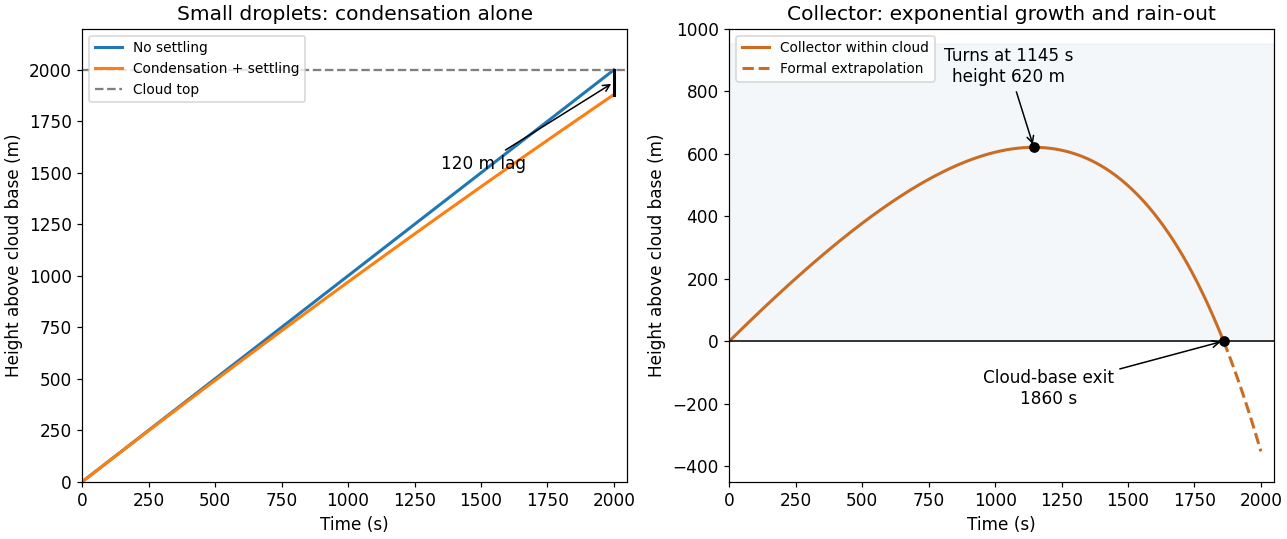
Condensational droplets rise through the cloud while rapidly collecting drops can turn and precipitate
. Trajectories calculated from the two growth models in question 4; the collector curve is solid only while the drop remains within the cloud. The dashed extension below cloud base is a formal extrapolation. Details. Past exam of the physics of atmospheres and oceans course of the University of Oxford 2019 4 b Solution by Codex 0 2026-10-25
Codex 0 2026-10-25For an initially monodisperse cloud the relative settling speed vanishes, so there is no gravitational collection term in this model. Set and use . Condensational growth givesTaking upward height from cloud base as positive, the droplet speed relative to the ground is the updraft minus its downward terminal velocity:For a launch at ,This assumes the prescribed uniform updraft and supersaturation persist along the trajectory, and that the Stokes-type radius-squared fall law remains applicable.
Pinned article: Introduction to the OurBigBook Project
Welcome to the OurBigBook Project! Our goal is to create the perfect publishing platform for STEM subjects, and get university-level students to write the best free STEM tutorials ever.
Everyone is welcome to create an account and play with the site: ourbigbook.com/go/register. We belive that students themselves can write amazing tutorials, but teachers are welcome too. You can write about anything you want, it doesn't have to be STEM or even educational. Silly test content is very welcome and you won't be penalized in any way. Just keep it legal!
Intro to OurBigBook
. Source. We have two killer features:
- topics: topics group articles by different users with the same title, e.g. here is the topic for the "Fundamental Theorem of Calculus" ourbigbook.com/go/topic/fundamental-theorem-of-calculusArticles of different users are sorted by upvote within each article page. This feature is a bit like:
- a Wikipedia where each user can have their own version of each article
- a Q&A website like Stack Overflow, where multiple people can give their views on a given topic, and the best ones are sorted by upvote. Except you don't need to wait for someone to ask first, and any topic goes, no matter how narrow or broad
This feature makes it possible for readers to find better explanations of any topic created by other writers. And it allows writers to create an explanation in a place that readers might actually find it.
Figure 1. Screenshot of the "Derivative" topic page. View it live at: ourbigbook.com/go/topic/derivativeVideo 2. OurBigBook Web topics demo. Source. - local editing: you can store all your personal knowledge base content locally in a plaintext markup format that can be edited locally and published either:This way you can be sure that even if OurBigBook.com were to go down one day (which we have no plans to do as it is quite cheap to host!), your content will still be perfectly readable as a static site.
- to OurBigBook.com to get awesome multi-user features like topics and likes
- as HTML files to a static website, which you can host yourself for free on many external providers like GitHub Pages, and remain in full control

Figure 2. You can publish local OurBigBook lightweight markup files to either OurBigBook.com or as a static website.
Figure 3. Visual Studio Code extension installation.
Figure 5. . You can also edit articles on the Web editor without installing anything locally. Video 3. Edit locally and publish demo. Source. This shows editing OurBigBook Markup and publishing it using the Visual Studio Code extension. 
- Infinitely deep tables of contents:




All our software is open source and hosted at: github.com/ourbigbook/ourbigbook
Further documentation can be found at: docs.ourbigbook.com
Feel free to reach our to us for any help or suggestions: docs.ourbigbook.com/#contact