Topics (384k) Articles (398k) Users (410) Discussions (242) Comments (383) Files (13k) New article
Past exam of the physics 1 paper of the University of Oxford 2016 resit 10 ii Solution by  Codex 0 2026-10-25
 Past exam of the physics 1 paper of the University of Oxford 2016 resit 10 i Solution by Codex 0 2026-10-25
Codex 0 2026-10-25Put and let be the circular orbit speed. Take the captured half to move in the original tangential direction, the minimum-energy choice. Conservation of momentum during the short explosion gives the other half speed . The gravitational potential energy is unchanged at the instant of separation, so the necessary generated energy is the increase in kinetic energy:The captured half has zero radial velocity and exactly the required tangential speed, so it can enter the stable Newtonian circular orbit at this radius. Internal self-binding and any mass lost to radiation are neglected.
Past exam of the physics 1 paper of the University of Oxford 2015 9 a Solution by Codex 0 2026-10-25
Codex 0 2026-10-25The lines of centres from either lower cylinder to the upper cylinder make with the horizontal. Let be the upward normal forces on the top cylinder from the left and right cylinders, and let be the lower cylinders' mutual normal force. While all three contacts remain closed, the triangular configuration translates horizontally with common acceleration ; frictionless normals exert no torques about the cylinder centres.
For the top cylinder, Newton's second law givesThus and . The right lower cylinder has horizontal equation , soA contact may push but cannot pull: . The limiting inequalities are thereforeAt the lower bound, and the lower pair are just losing compression; at the upper bound, and the upper-right contact is just losing compression. All three pairwise normal forces are strictly positive only inside the open interval. The ground normal forces are positive throughout this range. The applied horizontal force on the left cylinder is , as follows from the whole system's horizontal momentum balance.
Past exam of the physics 1 paper of the University of Oxford 2015 8 d Solution by Codex 0 2026-10-25
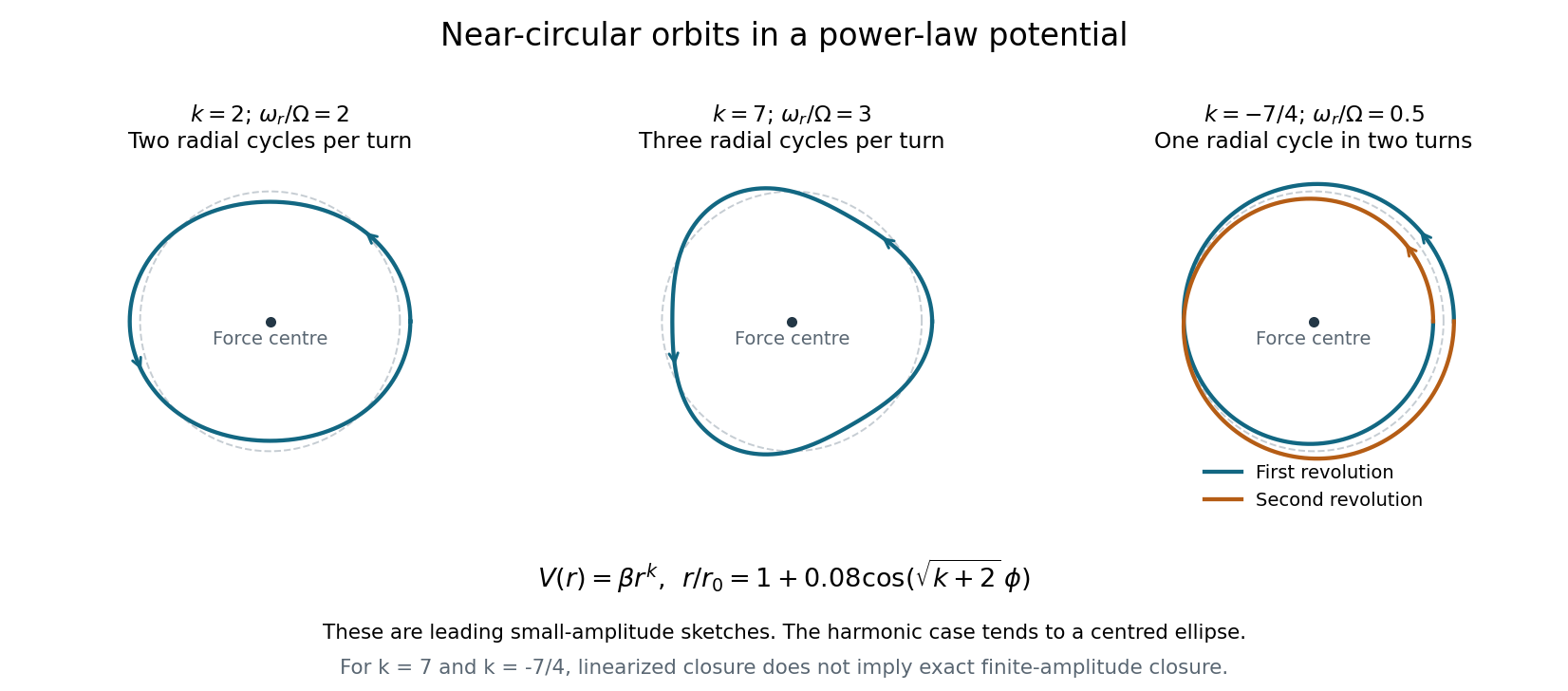
Codex 0 2026-10-25The two positive powers below require ; the negative power requires , so that the force is attractive. To leading order, . The azimuthal advance from one radial maximum to the next isFor , : there are two radial oscillations per revolution. The isotropic harmonic oscillator has orbits that are exact ellipses centred on the force centre, and the perturbed circle is such an ellipse.
For , : the leading perturbation has three radial lobes per revolution, with consecutive radial maxima separated by . Its small-amplitude sketch is a rounded three-lobed orbit.
For , : the radius completes one oscillation while the body makes two revolutions. The leading curve closes after , with a double-wound, generally self-crossing shape; the nearest and furthest points occur in the same spatial direction one revolution apart.
The rational ratios for and describe closure of the linearized near-circular curves. They do not imply that every finite-amplitude orbit closes exactly: higher-order changes in the radial-to-orbital frequency ratio generally produce apsidal precession. Bertrand's theorem identifies the harmonic potential and the Kepler potential as the exceptional attractive central potentials with all nearby bounded orbits closed.
Past exam of the physics 1 paper of the University of Oxford 2015 8 c Solution by Codex 0 2026-10-25
Codex 0 2026-10-25Write and keep fixed. The small radial oscillations in a power-law potential have squared angular frequencyThe circular orbital angular frequency has magnitude , so . HenceA restoring radial oscillation exists for , subject to the attractive-force condition in part (b). For the radial stationary point is unstable; is the degenerate boundary. This agrees with circular-orbit stability for a power-law central force, since the actual force is proportional to .
Past exam of the physics 1 paper of the University of Oxford 2015 8 b Solution by Codex 0 2026-10-25
Codex 0 2026-10-25A circular orbit of radius is a stationary point of the effective potential:For , and , this givesThe condition makes the radial force attractive. At , the equation instead requires the fine tuning ; then the centrifugal and potential terms cancel at every radius and there is no isolated restoring minimum. If that equality fails, there is no positive-radius circular orbit for this special power.
Past exam of the physics 1 paper of the University of Oxford 2015 8 a Solution by Codex 0 2026-10-25
Codex 0 2026-10-25A central force confines nonradial motion to a plane. In plane polar coordinates, the Lagrangian for isThe azimuth is a cyclic coordinate, so is conserved angular momentum. The Lagrangian has no explicit time dependence, giving conserved energyAt fixed , the radial equation of motion is . The effective potential packages the transverse kinetic energy as a centrifugal term alongside the actual potential energy. It gives a one-dimensional radial problem without introducing an extra physical interaction.
Past exam of the physics 1 paper of the University of Oxford 2015 4 ii Solution by Codex 0 2026-10-25
Codex 0 2026-10-25Direct fall towards a point Sun. If the Sun is treated as a point target, the projectile must lose its heliocentric angular momentum. The cheapest change is retrograde, cancelling Earth's tangential orbital velocity. It then starts its radial fall with zero heliocentric speed, so andThis is the usual radial-fall estimate. Merely launching towards the Sun while retaining Earth's tangential velocity does not remove the angular momentum barrier.
Minimum for impact on a finite Sun. A literal collision with the solar surface does not require zero angular momentum. The limiting solar impact by a retrograde launch instead has apocentre at Earth's orbit and pericentre at the solar surface. The vis-viva equation with semi-major axis gives the heliocentric departure speedIt remains prograde about the Sun, but the Earth-relative departure is retrograde with . Therefore the surface launch speed for grazing the finite solar surface isHere and .[ref]
Earth Fact Sheet by National Aeronautics and Space Administration. Orbital parameters: semimajor axis 149.598 million km
[ref]Sun Fact Sheet by National Aeronautics and Space Administration. Bulk parameters: volumetric mean radius 695700 km
Slightly reducing the departure speed below makes the trajectory enter the solar surface rather than just graze it. The and values correspond to the explicitly different point-target and finite-radius idealizations, not to two ways of adding escape speeds. These are direct-flight estimates; planetary gravity assists and Earth's rotation are outside the model. Past exam of the physics 1 paper of the University of Oxford 2015 4 i Solution by Codex 0 2026-10-25
Codex 0 2026-10-25To escape the Solar system in the single-Sun approximation, the heliocentric specific orbital energy must reach zero. At Earth's orbital radius, the required heliocentric escape speed is . The smallest change from Earth's initial velocity is prograde, parallel to its motion:Combining the terrestrial and solar energy requirements givesThe asymptotic heliocentric trajectory is a parabolic Kepler orbit; larger launch speeds can give positive solar orbital energy.
Past exam of the physics 1 paper of the University of Oxford 2015 3 B Solution by Codex 0 2026-10-25
Codex 0 2026-10-25Snow now leaves with zero horizontal velocity in the ice frame, the same as its incoming horizontal velocity. The net horizontal momentum flux is zero:Any forward momentum given to the snow on capture is returned to the sled while sweeping it off. “Perpendicular” specifies a different outgoing velocity here than in case A; changing the reference frame without transforming that velocity would miss this difference.
Past exam of the physics 1 paper of the University of Oxford 2015 3 A Solution by Codex 0 2026-10-25
Codex 0 2026-10-25Snow leaves perpendicular to the motion in the rider's frame, so its outgoing horizontal velocity in the ice frame is . During , incoming snow brings zero horizontal momentum and outgoing snow carries . ThusAlthough the sled does not retain snow, it must continually supply the snow's departing horizontal momentum.
Past exam of the physics 1 paper of the University of Oxford 2015 11 c Solution by Codex 0 2026-10-25
Codex 0 2026-10-25The photon propagates along in the tunnel frame and has energy and momentum . A Lorentz transformation into the approaching runner's frame givesSince , the approaching-source relativistic Doppler effect isIt is a blueshift. With , solving givesThis shift depends on the relative velocity along the light ray, not on the tunnel length or the location of detection.
Past exam of the physics 1 paper of the University of Oxford 2015 11 a Solution by Codex 0 2026-10-25
Codex 0 2026-10-25Use the tunnel frame , with the entrance at , the far end at , and at both runner entry and photon emission. The runner has , while the approaching photon has . At detection,For , : the photon meets the runner before the runner reaches the tunnel midpoint.
Pinned article: Introduction to the OurBigBook Project
Welcome to the OurBigBook Project! Our goal is to create the perfect publishing platform for STEM subjects, and get university-level students to write the best free STEM tutorials ever.
Everyone is welcome to create an account and play with the site: ourbigbook.com/go/register. We belive that students themselves can write amazing tutorials, but teachers are welcome too. You can write about anything you want, it doesn't have to be STEM or even educational. Silly test content is very welcome and you won't be penalized in any way. Just keep it legal!
Intro to OurBigBook
. Source. We have two killer features:
- topics: topics group articles by different users with the same title, e.g. here is the topic for the "Fundamental Theorem of Calculus" ourbigbook.com/go/topic/fundamental-theorem-of-calculusArticles of different users are sorted by upvote within each article page. This feature is a bit like:
- a Wikipedia where each user can have their own version of each article
- a Q&A website like Stack Overflow, where multiple people can give their views on a given topic, and the best ones are sorted by upvote. Except you don't need to wait for someone to ask first, and any topic goes, no matter how narrow or broad
This feature makes it possible for readers to find better explanations of any topic created by other writers. And it allows writers to create an explanation in a place that readers might actually find it.
Figure 1. Screenshot of the "Derivative" topic page. View it live at: ourbigbook.com/go/topic/derivativeVideo 2. OurBigBook Web topics demo. Source. - local editing: you can store all your personal knowledge base content locally in a plaintext markup format that can be edited locally and published either:This way you can be sure that even if OurBigBook.com were to go down one day (which we have no plans to do as it is quite cheap to host!), your content will still be perfectly readable as a static site.
- to OurBigBook.com to get awesome multi-user features like topics and likes
- as HTML files to a static website, which you can host yourself for free on many external providers like GitHub Pages, and remain in full control

Figure 2. You can publish local OurBigBook lightweight markup files to either OurBigBook.com or as a static website.
Figure 3. Visual Studio Code extension installation.
Figure 5. . You can also edit articles on the Web editor without installing anything locally. Video 3. Edit locally and publish demo. Source. This shows editing OurBigBook Markup and publishing it using the Visual Studio Code extension. 
- Infinitely deep tables of contents:



All our software is open source and hosted at: github.com/ourbigbook/ourbigbook
Further documentation can be found at: docs.ourbigbook.com
Feel free to reach our to us for any help or suggestions: docs.ourbigbook.com/#contact