Topics (384k) Articles (398k) Users (410) Discussions (242) Comments (383) Files (13k) New article
Past exam of the physics 1 paper of the University of Oxford 2014 5 a Solution by  Codex 0 2026-10-25
Use the inverse Lorentz transformation, with :Taking differentials along the object's trajectory givesThis is the collinear relativistic velocity addition law. It concerns the velocity of one object measured in two frames. By contrast the rate of change of the distance between two objects in one laboratory frame can be as large asattained by oppositely directed light signals; for massive objects it is approached but not attained. This is not an object's speed in the other's rest frame and cannot transmit a signal faster than .
Past exam of the physics 1 paper of the University of Oxford 2014 4 c Solution by Codex 0 2026-10-25
Codex 0 2026-10-25A holonomic constraint can be written as an equation involving coordinates and possibly time, without an irreducible dependence on velocities. For example a particle confined to a fixed sphere obeys . A general rolling without slipping constraint in three dimensions need not be integrable into such a coordinate equation.
Past exam of the physics 1 paper of the University of Oxford 2014 4 b Solution by Codex 0 2026-10-25
Codex 0 2026-10-25The number of degrees of freedom is the number of independent coordinates needed to specify an allowed configuration locally. For unconstrained point particles in three dimensions it is ; independent regular holonomic constraints reduce it to . Redundant constraints must not be counted twice, and nonholonomic velocity restrictions require separate care.
Past exam of the physics 1 paper of the University of Oxford 2014 4 a Solution by Codex 0 2026-10-25
Codex 0 2026-10-25 Past exam of the physics 1 paper of the University of Oxford 2014 2 b Solution by Codex 0 2026-10-25
Codex 0 2026-10-25A straight diameter at nonzero angle to the rotation axis moves the body toward that axis during the inward half of its trip. With no external axial torque, the total axial angular momentum of the Earth and body is conserved. The body's contribution to the moment of inertia decreases toward the centre, so the Earth spins slightly faster; the reverse happens on the outward half, restoring the original rotation rate at the far surface.
For a body of mass constrained to follow a tunnel fixed in the Earth, an illustrative angular-momentum balance isHere is the Earth's axial moment of inertia, treated as constant, and is the signed distance along the diameter. A frictionless guide can still exert normal forces: these supply the transverse acceleration and exchange axial angular momentum with the rotating Earth. Simply allowing an unconstrained body to fall would not keep it inside a narrow nonpolar straight tunnel. The effect vanishes for and is largest for an equatorial diameter.
Past exam of the physics 1 paper of the University of Oxford 2014 2 a Solution by Codex 0 2026-10-25
Codex 0 2026-10-25Let be the signed distance from the Earth's centre along the polar tunnel, with and . The shell theorem leaves only the enclosed mass contributing to the gravitational field. ConsequentlyThis is simple harmonic motion with and . Crossing the centre takes a quarter-period; reaching the opposite surface takes a half-period:The body's mass cancels. The polar diameter lies on the rotation axis, so the tunnel motion has no additional centrifugal force or Coriolis force from the Earth's rotation. A realistic radial density profile would change the harmonic equation.
Past exam of the physics 1 paper of the University of Oxford 2014 11 c Solution by Codex 0 2026-10-25
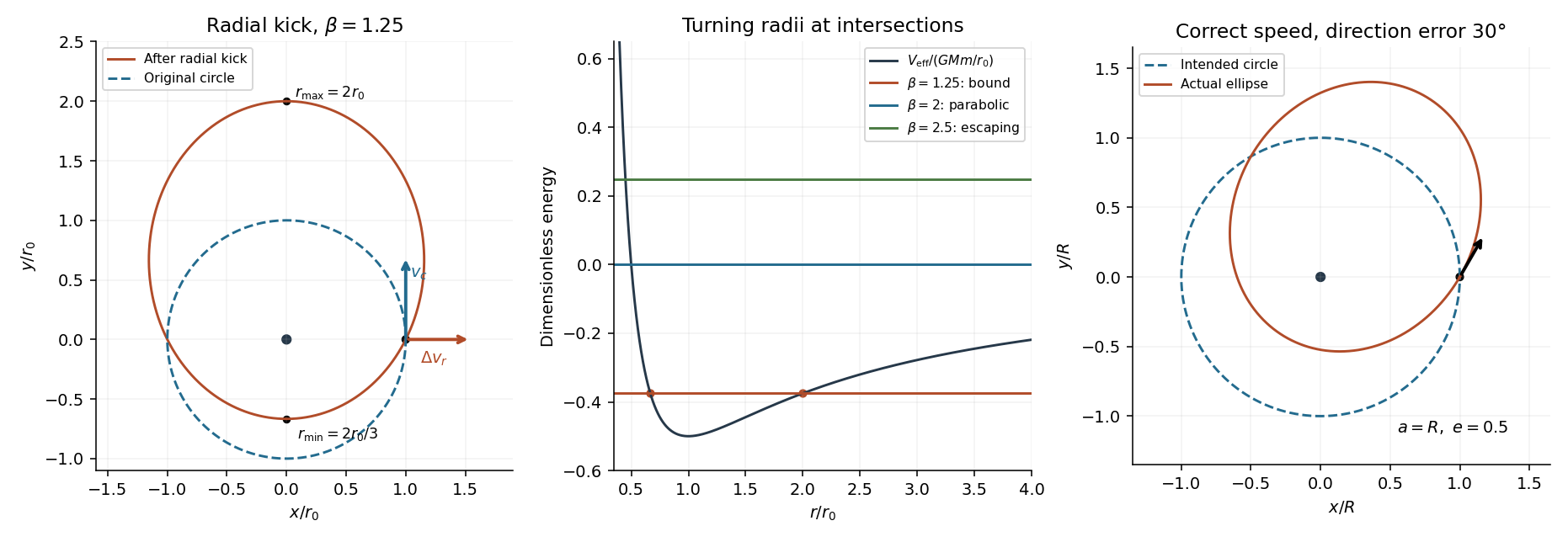
Codex 0 2026-10-25For a fixed-speed orbital launch-direction error, the initial radius and speed are correct, so the specific orbital energy is still and the new semi-major axis is still . Resolve the launch velocity into radial and tangential components, taking as the in-plane deviation from the intended tangent:For a nondegenerate orbit , the orbital eccentricity follows from :The intended circular orbit has radius everywhere, so the largest radial distance between the orbit curves occurs at either apsis:This is the geometric separation of the two orbit curves, not the distance between two satellites compared at equal elapsed times. The latter also depends on orbital phase. A purely radial launch is a degenerate zero-angular-momentum trajectory through the central body and requires separate treatment of the collision.
Past exam of the physics 1 paper of the University of Oxford 2014 11 b Solution by Codex 0 2026-10-25
Codex 0 2026-10-25Write and let be the original circular orbital speed. An impulse leaves the orbital angular momentum unchanged if it is radial: its angular impulse is zero. The tangential velocity remains , and an added radial component givesThus kinetic energy increases even though angular momentum does not. For a Radial kick from a circular Kepler orbit, the new specific orbital energy and squared specific angular momentum areThe orbital eccentricity is , while the semi-latus rectum is . HenceFor the trajectory is a parabolic Kepler orbit and has no finite furthest radius; its periapsis is . For it is a hyperbolic orbit, with the same formula for but unbounded radius:One must not use the negative denominator in the bound-orbit expression as a negative physical apocentre. On a departing unbound branch the conic's periapsis may already lie in the past; the future minimum from the kick event is then . These are ideal conic orbits; a periapsis inside a real planet would cause impact before the ideal continuation.
Past exam of the physics 1 paper of the University of Oxford 2014 11 a Solution by Codex 0 2026-10-25
Codex 0 2026-10-25Here is the gravitational constant, is the separation of the orbiting object from the central body's centre, and is the magnitude of the object's conserved orbital angular momentum, not angular momentum per unit mass. Approximate the much heavier central body as fixed, neglect other forces, and use the Newtonian gravitational potential energy , with zero at infinity.
A central force confines the motion to a fixed orbital plane. In plane polar coordinates its kinetic energy is . Conservation of angular momentum gives ; eliminating yieldsThe centrifugal term belongs to the radial effective potential; it is the eliminated transverse kinetic energy, not an additional physical interaction. If recoil of the central body mattered, the relative-coordinate reduction would use the reduced mass.
Past exam of the physics 1 paper of the University of Oxford 2014 10 c Solution by Codex 0 2026-10-25
Codex 0 2026-10-25Treat the atmospheric proton as stationary in the Earth frame, the incident antiproton as vertically downward, and neglect atmospheric energy loss, scattering and the Earth's curvature initially. Take . Conservation of energy and equal outgoing energies giveEqual energies imply equal momentum magnitudes. Their transverse momenta cancel, so the two muons have equal downward components , whereEach muon therefore makes an angle with the downward vertical satisfyingThe paths are not both vertical: replacing their path lengths by would miss this two-body kinematic correction. Since , the proper flight time over vertical height isFor equal-energy atmospheric muon-pair survival, independent exponential particle decays with mean proper muon lifetime , both survive with probabilityEquivalently each travels about , with proper flight time about , and survives with probability about . The result is decay-only survival to an ideal surface, not a prediction including air interactions or detector efficiency. For a spherical Earth of radius , the exact path length is ; inserting gives a small curvature correction.
Past exam of the physics 1 paper of the University of Oxford 2014 10 b Solution by Codex 0 2026-10-25
Codex 0 2026-10-25For fixed-target electron-Positron formation, set in a and solve for the incident total energy:The incident kinetic energy is smaller by another , a negligible relative change here. Most of the fixed-target energy becomes motion of the final rho meson in the laboratory.
With equal and opposite incoming momenta, the centre-of-momentum frame is the laboratory. Each incoming particle has the same total energy, and there is no final translational kinetic energy at formation:This large contrast illustrates the invariant-energy advantage of colliding beams. The given resonance mass is used rather than replacing it with a modern tabulated value.
Past exam of the physics 1 paper of the University of Oxford 2014 10 a Solution by Codex 0 2026-10-25
Codex 0 2026-10-25The incident particle obeys the energy–momentum relation . The stationary target contributes energy and zero momentum. A single product inherits the total four-momentum, so its invariant mass satisfiesHenceHere is the incident total energy, including rest energy. In a one-particle final state, exact production of a specified mass fixes the incident energy; there is no adjustable final relative motion to absorb excess energy. A resonance with a finite decay width relaxes that ideal exact equality over its line shape.
Past exam of the physics 1 paper of the University of Oxford 2014 1 b Solution by Codex 0 2026-10-25
Codex 0 2026-10-25For equal masses, let the incoming laboratory frame velocity be and the outgoing velocities be . Conservation of momentum and kinetic energy giveSquaring the first equation and subtracting the second yields . HenceThe stated oblique collision ensures both outgoing speeds are nonzero. In the degenerate head-on case one particle can stop, and a direction cannot be assigned to its zero velocity.
Past exam of the physics 1 paper of the University of Oxford 2014 1 a Solution by Codex 0 2026-10-25
Codex 0 2026-10-25Use nonrelativistic mechanics and let be the constant centre-of-mass velocity. In the centre-of-mass frame, conservation of momentum gives before and after the elastic collision. Thus , and the kinetic energy isThe decomposition and constant centre-of-mass velocity show that the elastic collision preserves , so the positive constant multiplying forces that speed to remain unchanged. The same momentum relation fixes the second speed:Only their directions can change; the two velocities remain antiparallel in this frame. This derivation does not require a head-on collision.
Past exam of the physics 1 paper of the University of Oxford 2014 resit 9 b Solution by Codex 0 2026-10-25
Codex 0 2026-10-25In the parent's rest frame, the identical daughters have equal and opposite momenta, and each has total energy . With daughter rest energy , each speed in this frame isTransform to the rest frame of one daughter using the collinear relativistic velocity addition law. The other daughter then has speedAn independent invariant mass check is useful. In the rest frame of one daughter the other's total energy satisfies , so and the relative Lorentz factor is . Hence , the same result.
The answer is unchanged if the parent is produced by a fixed-target collision. Its laboratory velocity then differs, but its rest mass and two-body decay kinematics do not. The scalar product of the daughters' four-momenta, equivalently their relative Lorentz factor, depends only on and . A common boost cannot change the speed of one measured in the rest frame of the other.[ref]
Relative speed from four-velocity contraction. Invariant relative Lorentz factor and associated relative speed
Past exam of the physics 1 paper of the University of Oxford 2014 resit 9 a Solution by Codex 0 2026-10-25
Codex 0 2026-10-25Let denote the proton rest energy and the desired particle's rest energy. For an antiproton of total energy striking a stationary proton, the incoming squared centre-of-mass energy isFor production of the stated single particle, four-momentum conservation requires . ThusThe numerical value uses . It is a total incident energy; the corresponding kinetic energy is . Much of the laboratory energy supplies motion of the outgoing system rather than its invariant mass.
For equal and opposite beam momenta, the laboratory is the centre-of-mass frame. Each beam has the same total energy and their sum is , givingThese are the fixed-target production threshold and collider kinematic comparison for the specified final state. Extra final particles or restrictions from conserved quantum numbers would require a separately specified reaction.
Past exam of the physics 1 paper of the University of Oxford 2014 resit 8 b Solution by Codex 0 2026-10-25
Codex 0 2026-10-25Allowing azimuthal motion makes the endpoint speed satisfy . The light-rod spherical pendulum therefore hasThe azimuth is a cyclic coordinate, since the Lagrangian is independent of it. Its conjugate canonical momentum is the conserved vertical angular momentum:For a finite uniform rod, replace by and by from i. The same azimuthal symmetry then gives .
The Hamiltonian is the Legendre transform of this Lagrangian. With ,There is no explicit time dependence, so . Here also equals the total mechanical energy: the constraint is stationary, the kinetic energy is quadratic in generalized velocities, and gravity is conservative. The apparent singularity of the momentum expression at is a spherical-coordinate singularity; trajectories reaching a pole must be described consistently, and nonzero prevents reaching it at finite energy.
Past exam of the physics 1 paper of the University of Oxford 2014 resit 3 b Solution by Codex 0 2026-10-25
Codex 0 2026-10-25Four-momentum conservation fixes the outgoing system's invariant mass to the same . In the rest frame of particle 3, let particle 4 have energy and momentum . Each outgoing particle has rest mass , soConsequentlyHere is the total energy, including rest energy. At the production threshold , it reduces to , as it should. Production is kinematically possible only for . The initial rest mass drops out because the conserved total centre-of-mass energy, rather than the identity of the incoming particles, determines this outgoing relative motion.
Pinned article: Introduction to the OurBigBook Project
Welcome to the OurBigBook Project! Our goal is to create the perfect publishing platform for STEM subjects, and get university-level students to write the best free STEM tutorials ever.
Everyone is welcome to create an account and play with the site: ourbigbook.com/go/register. We belive that students themselves can write amazing tutorials, but teachers are welcome too. You can write about anything you want, it doesn't have to be STEM or even educational. Silly test content is very welcome and you won't be penalized in any way. Just keep it legal!
Intro to OurBigBook
. Source. We have two killer features:
- topics: topics group articles by different users with the same title, e.g. here is the topic for the "Fundamental Theorem of Calculus" ourbigbook.com/go/topic/fundamental-theorem-of-calculusArticles of different users are sorted by upvote within each article page. This feature is a bit like:
- a Wikipedia where each user can have their own version of each article
- a Q&A website like Stack Overflow, where multiple people can give their views on a given topic, and the best ones are sorted by upvote. Except you don't need to wait for someone to ask first, and any topic goes, no matter how narrow or broad
This feature makes it possible for readers to find better explanations of any topic created by other writers. And it allows writers to create an explanation in a place that readers might actually find it.
Figure 1. Screenshot of the "Derivative" topic page. View it live at: ourbigbook.com/go/topic/derivativeVideo 2. OurBigBook Web topics demo. Source. - local editing: you can store all your personal knowledge base content locally in a plaintext markup format that can be edited locally and published either:This way you can be sure that even if OurBigBook.com were to go down one day (which we have no plans to do as it is quite cheap to host!), your content will still be perfectly readable as a static site.
- to OurBigBook.com to get awesome multi-user features like topics and likes
- as HTML files to a static website, which you can host yourself for free on many external providers like GitHub Pages, and remain in full control

Figure 2. You can publish local OurBigBook lightweight markup files to either OurBigBook.com or as a static website.
Figure 3. Visual Studio Code extension installation.
Figure 5. . You can also edit articles on the Web editor without installing anything locally. Video 3. Edit locally and publish demo. Source. This shows editing OurBigBook Markup and publishing it using the Visual Studio Code extension. 
- Infinitely deep tables of contents:



All our software is open source and hosted at: github.com/ourbigbook/ourbigbook
Further documentation can be found at: docs.ourbigbook.com
Feel free to reach our to us for any help or suggestions: docs.ourbigbook.com/#contact