Topics (384k) Articles (398k) Users (410) Discussions (242) Comments (383) Files (13k) New article
Past exam of the physics 1 paper of the University of Oxford 2017 resit 2 b Solution by  Codex 0 2026-10-25
A radial outward kick has no angular impulse about the centre. ThereforeThe initial position is on the outward-moving portion of a bound elliptic Kepler orbit, between pericentre and apocentre, rather than at either turning point. The eccentricity is and the semilatus rectum remains . The orbital energy change is second order: it vanishes to first order in the impulse but is positive for any nonzero kick.
Past exam of the physics 1 paper of the University of Oxford 2017 resit 2 a Solution by Codex 0 2026-10-25
Codex 0 2026-10-25Adding tangential velocity along the existing motion increases both orbital energy and angular momentum:For a sufficiently small kick the Kepler orbit remains an ellipse. At the kick point its radial velocity vanishes and its tangential speed exceeds the circular orbital speed, so that point becomes the pericentre. The ellipse extends farther outward than the original circle.
Past exam of the physics 1 paper of the University of Oxford 2017 resit 11 d Solution by Codex 0 2026-10-25
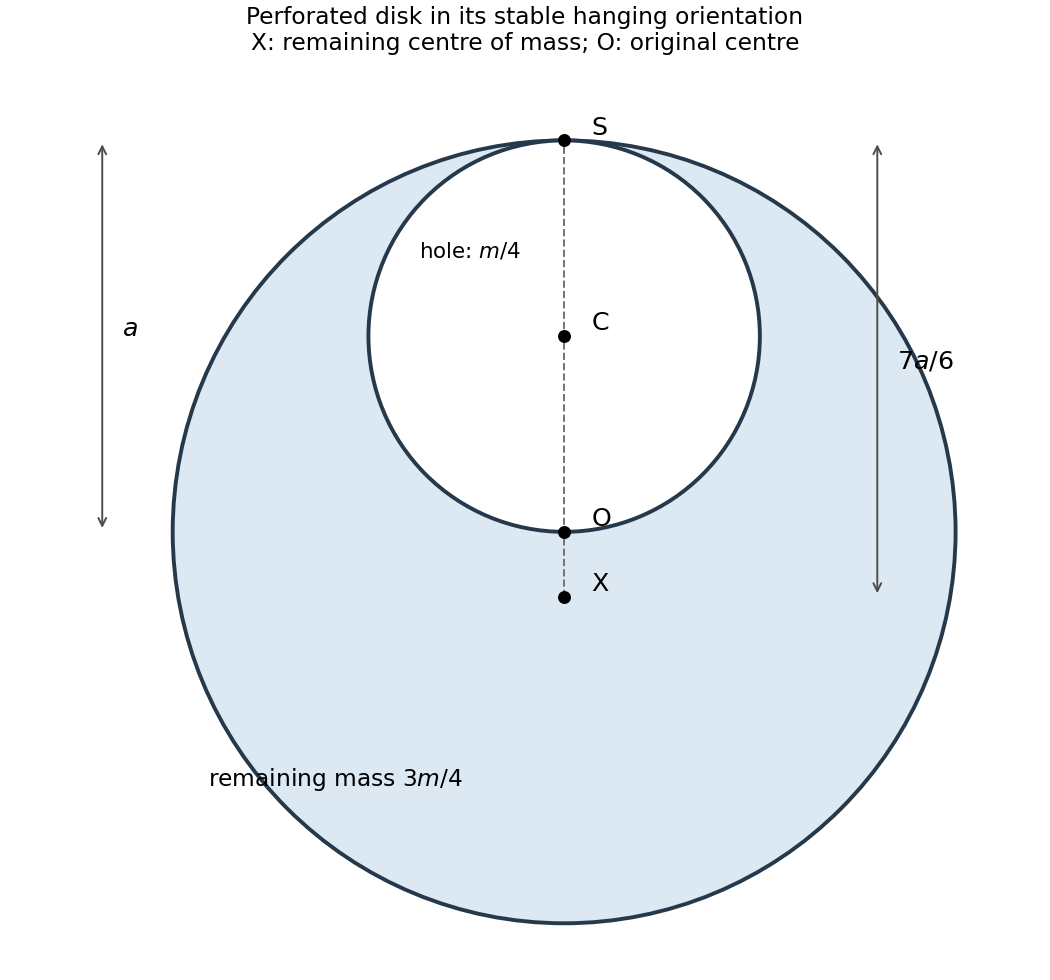
Codex 0 2026-10-25Take the positive coordinate from toward . The centre of mass of the remaining material has coordinateThus . If is the small angular displacement from the stable hanging orientation, gravity gives torque about the suspension point. The physical pendulum equation isUsing the small-angle approximation gives simple harmonic motion withBoth the reduced mass and displaced centre of mass matter; changing only the moment of inertia would give an incorrect frequency.
Past exam of the physics 1 paper of the University of Oxford 2017 resit 11 c Solution by Codex 0 2026-10-25
Codex 0 2026-10-25Let be the original disk centre and the hole centre. The source geometry has , , all collinear. The removed disk has mass , since its area is one quarter of the original disk's. Use the parallel axis theorem for both the original disk and the removed disk:Subtracting the missing material's moment of inertia givesHere continues to denote the original unperforated disk mass; the earring itself has mass .
Past exam of the physics 1 paper of the University of Oxford 2017 resit 11 b Solution by Codex 0 2026-10-25
Codex 0 2026-10-25For a uniform disk, the surface mass density is . Integrate concentric annuli of mass about the central perpendicular axis:The result is specific to a uniform thin disk and that axis; it is not the diameter-axis moment of inertia, which is by planar symmetry and the perpendicular axis theorem.
Past exam of the physics 1 paper of the University of Oxford 2017 resit 11 a Solution by Codex 0 2026-10-25
Codex 0 2026-10-25For a planar lamina in the -plane and three mutually perpendicular axes through one common point, the perpendicular axis theorem is . Indeed , while and . Planarity and the common axis intersection are essential.
For two parallel axes, one through the centre of mass and one a perpendicular distance away, the parallel axis theorem iswhere is the total mass. Expanding the squared distance in the defining moment of inertia integral leaves a cross term proportional to . The second axis need not pass through the body, and uniform density is not required, but the reference axis for must pass through its centre of mass.
Past exam of the physics 1 paper of the University of Oxford 2017 resit 10 c Solution by Codex 0 2026-10-25
Codex 0 2026-10-25Alison's outbound proper time is years. Her return Earth-frame duration is years, with time dilation factor . Adding the two segments,Alison is two years younger than Belinda at reunion. Her turnaround changes inertial frames, and the faster return segment accumulates less proper time per unit Earth-frame time. The twin paradox is resolved by comparing the complete worldlines, not by applying one constant time dilation factor to Alison's whole journey.
Past exam of the physics 1 paper of the University of Oxford 2017 resit 10 b Solution by Codex 0 2026-10-25
Codex 0 2026-10-25Belinda remains in one inertial frame with , so the time dilation factor is . Her elapsed proper time isThe reunion event is shared by both twins, making their clock readings directly comparable without any convention for synchronizing separated moving clocks.
Past exam of the physics 1 paper of the University of Oxford 2017 resit 10 a Solution by Codex 0 2026-10-25
Codex 0 2026-10-25Alison reaches the station at years. Her return worldline iswhile Belinda's is . Equating them givesThis is the elapsed Earth-frame time, measurable by synchronized clocks in that inertial frame. A signal announcing the reunion reaches a clock physically on Earth later; its light-travel delay is not part of the requested frame-time comparison.
Past exam of the physics 1 paper of the University of Oxford 2016 10 v Solution by Codex 0 2026-10-25
Codex 0 2026-10-25Use the supplied planet mass , , and adopt mean Earth radius . For a geostationary orbit, use one sidereal day, . The adopted radius and rotation period follow NASA's fact sheet.[ref]
Earth Fact Sheet by National Aeronautics and Space Administration. Bulk parameters: volumetric mean radius6371.000km; orbital parameters: sidereal rotation period23.9345hours
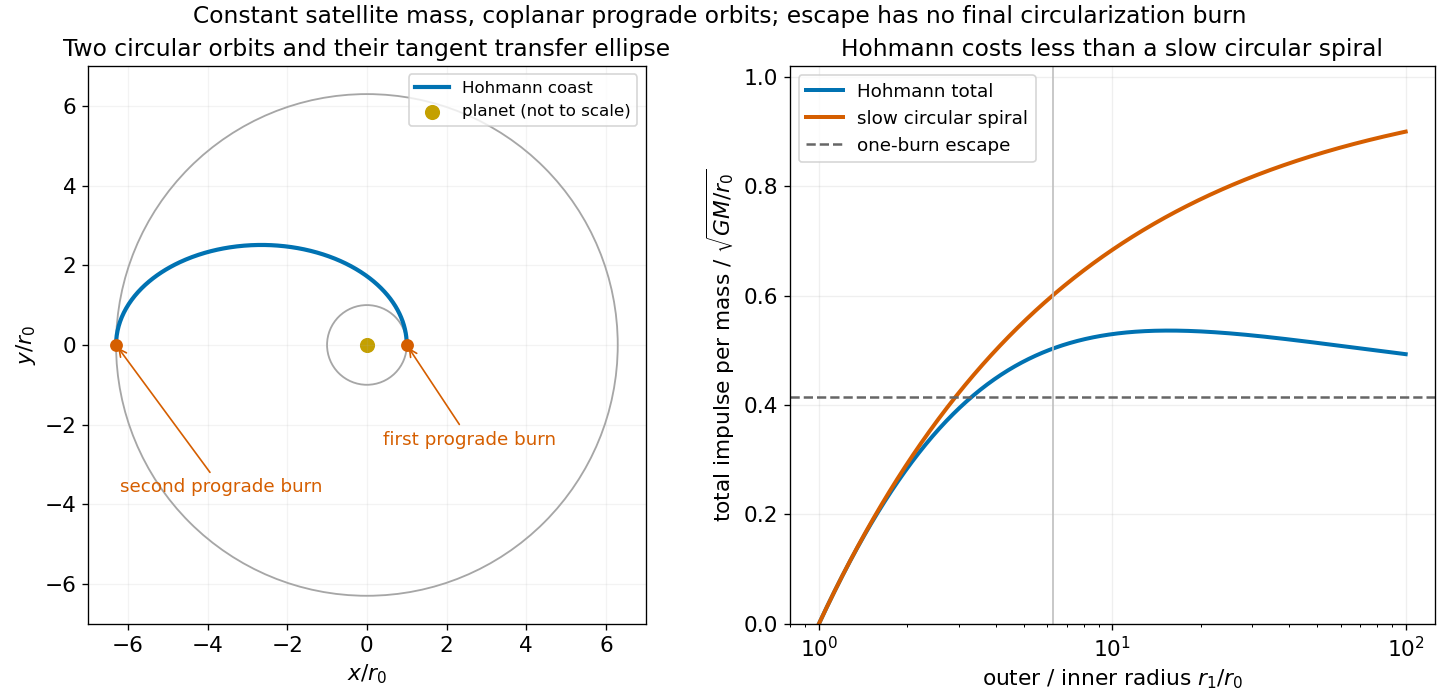
The slightly smaller radius than the usual terrestrial value follows from using the question's smaller Earth mass. For coplanar prograde orbits, the preceding formulas giveThe escape transfer has , so its first tangential burn reaches the local escape speed . No final circularization at infinity is needed:Thus the geostationary transfer requires about more total impulse, or about 22 percent more, despite leaving the spacecraft gravitationally bound. Reaching the outer radius and circularizing there are separate requirements. Changing the starting orbit's inclination would add a plane-change cost absent from this calculation. Past exam of the physics 1 paper of the University of Oxford 2016 10 iv Solution by Codex 0 2026-10-25
Codex 0 2026-10-25In a quasi-circular spiral transfer, a small tangential thrust supplies power while the orbit stays approximately circular. Differentiating and using givesThis is the integrated thrust magnitude per unit constant mass, not the net vector change of orbital velocity.
For comparison, write . Adding the two Hohmann transfer impulses and subtracting the slow-transfer result yieldsThe bracket is negative because for . Thus the Hohmann transfer uses less total impulse than the slow circular spiral for these ideal coplanar transfers. The Hohmann transfer compared with a slow spiral does not establish a global optimum over every possible transfer family or propulsion constraint.
Past exam of the physics 1 paper of the University of Oxford 2016 10 iii Solution by Codex 0 2026-10-25
Codex 0 2026-10-25At the outer tangent point, the vis-viva equation gives . This is below the outer circular Kepler orbit's speed . The second impulse is therefore also prograde:It raises the pericentre to the outer radius, completing the circularization.
Past exam of the physics 1 paper of the University of Oxford 2016 10 ii Solution by Codex 0 2026-10-25
Codex 0 2026-10-25For the Hohmann transfer orbit, the inner and outer circular radii are the ellipse's pericentre and apocentre distances, so . The vis-viva equation gives the transfer speed at the inner tangent point,Both old and new velocities are tangential there, so the required first impulse is prograde, with
Past exam of the physics 1 paper of the University of Oxford 2016 10 i Solution by Codex 0 2026-10-25
Codex 0 2026-10-25The assumed orbital energy is . At a point a distance from the planet,This is the vis-viva equation. The semi-major axis and radius are measured from the gravitational focus where the planet lies.
Past exam of the physics 1 paper of the University of Oxford 2016 resit 8 iii Solution by Codex 0 2026-10-25
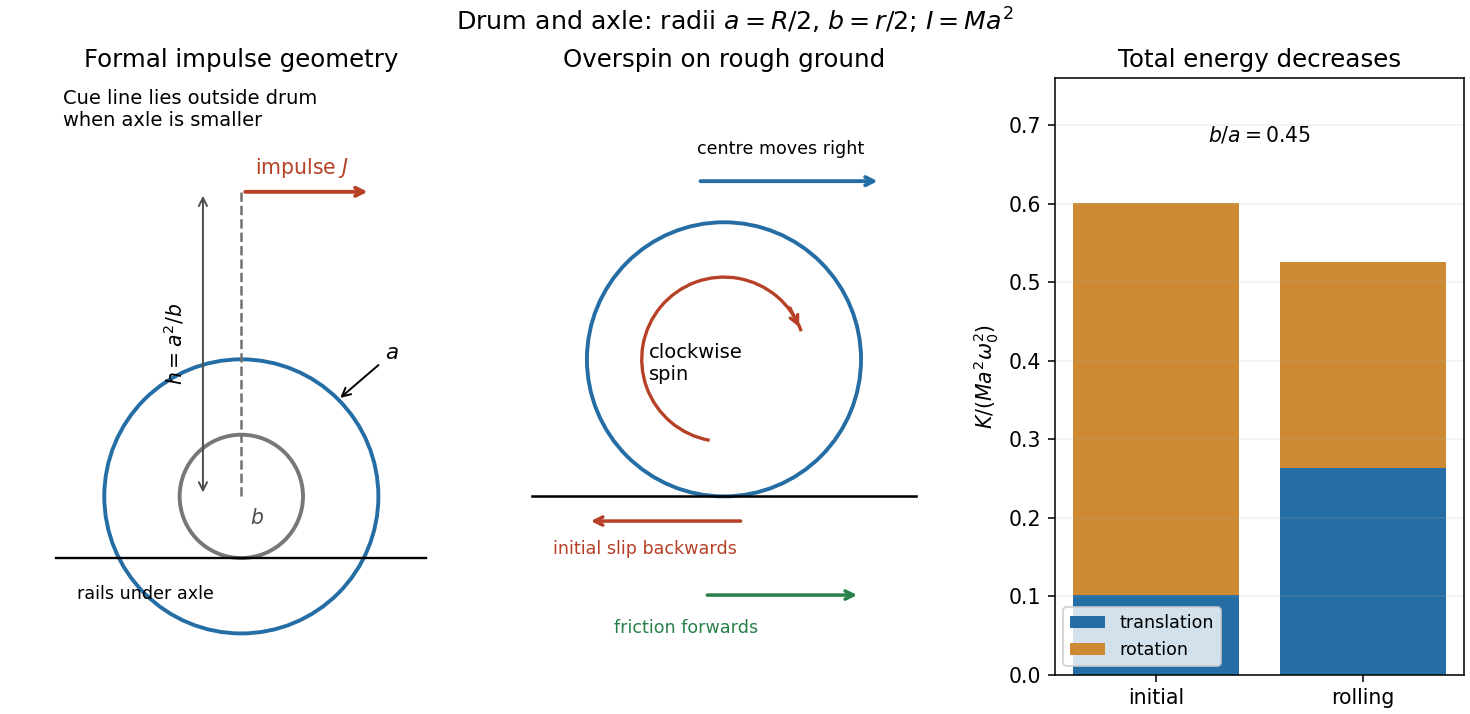
Codex 0 2026-10-25For the frictional conversion of spin to rolling, consider the horizontal slipping stage on the rough surface, whose contact radius is now , and neglect extra vertical impact or height-change energies at the transition. A friction impulse changes by and clockwise spin by . Thus is conserved. At the end , givingBecause , the final total kinetic energy is . Subtraction yieldsThe result is independent of the friction coefficient, provided sufficient contact time allows rolling without slipping to be regained. Initially , so the contact point slips backwards. Friction acts forwards and can increase translational kinetic energy, while decreasing rotational kinetic energy by more. A finite vertical drop or inelastic landing would require additional geometric information; the boxed expression describes the horizontal rolling-conversion loss.
Past exam of the physics 1 paper of the University of Oxford 2016 resit 8 ii Solution by Codex 0 2026-10-25
Codex 0 2026-10-25With clockwise rotation taken positive and , the total kinetic energy isAngular momentum needs an origin. Its spin about the centre is , in the clockwise direction. About a fixed point in the horizontal rail plane, spin and orbital contributions add toHere the drum centre is height above that plane. The signed clockwise convention fixes the displayed signs; the associated vector points perpendicular to the vertical plane of motion.
Past exam of the physics 1 paper of the University of Oxford 2016 resit 8 i Solution by Codex 0 2026-10-25
Codex 0 2026-10-25The symbols in the question are diameters: write drum radius , axle radius . For a thin hollow drum, . A rightward horizontal impulse applied at height above the centre gives and clockwise angular velocity . Rolling on the axle requires , soThe frictionless rails do not create the required rotation; the initial impulse must give exactly this ratio of linear to angular motion. For the usual case , the required height is greater than the drum radius. It cannot be reached by striking the bare cylindrical surface horizontally; an extension or equivalent applied couple would be needed. This geometric limitation should accompany the formal result.
Past exam of the physics 1 paper of the University of Oxford 2016 resit 11 c Solution by Codex 0 2026-10-25
Codex 0 2026-10-25Replace the frame speed by , requiring . With ,The outbound leg is now the longer one and the inbound leg the shorter one. Doubling the speed also changes the Lorentz factor; it is not enough to swap the two original leg times. A proposed doubled speed at or above does not define an inertial observer frame.
Past exam of the physics 1 paper of the University of Oxford 2016 resit 11 b Solution by Codex 0 2026-10-25
Codex 0 2026-10-25In the original rest frame each leg takes , so the round trip takes . For the moving frame, use the coordinate differences between the same three events. The Lorentz transformation givesThe outbound leg is shorter because the mirror approaches the outgoing ray; the inbound leg is longer because the source retreats from the returning ray. Their sum is larger than the original round-trip proper time by the time dilation factor .
These are coordinate times for return to the original source, not a claim that the pulse returns to the second observer's body at event . If that observer starts at , it intercepts the returning light at a different event, earlier than , at its own time . Distinguishing those events is necessary when interpreting “seen” or “return”.
Past exam of the physics 1 paper of the University of Oxford 2016 resit 11 a Solution by Codex 0 2026-10-25
Codex 0 2026-10-25Use emission, reflection and return-to-source events . In the source-and-mirror rest frame their coordinates are , and . The laser and mirror have vertical worldlines; the two light rays have slopes on a diagram with equal spatial and scales.
For a frame moving with velocity along the outgoing beam, let and . A Lorentz transformation givesBoth laser and mirror now move towards negative , with worldlines and . Light still has slopes . The moving observer's own worldline is ; it should not be confused with the moving source worldline.
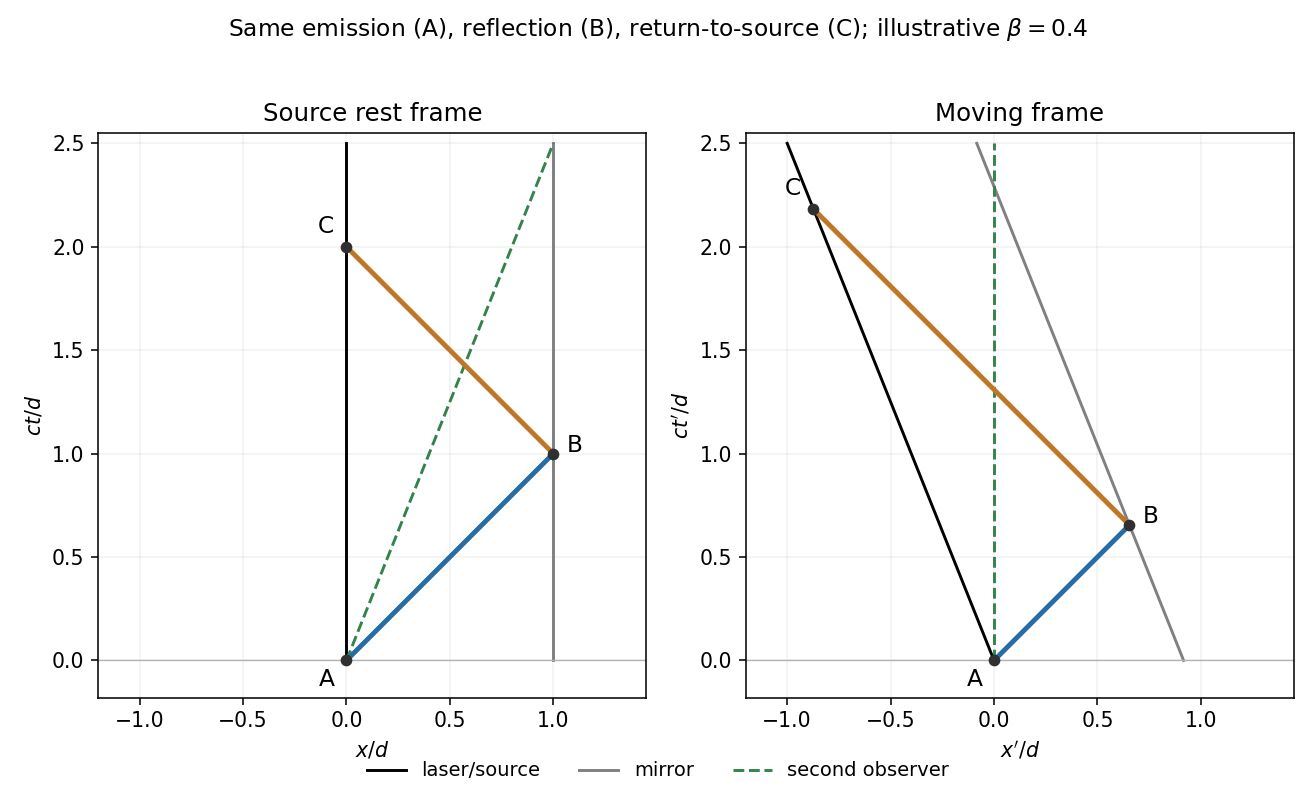
Emission, mirror reflection and return to the original source in the rest frame and a moving Lorentz frame
. Details. Pinned article: Introduction to the OurBigBook Project
Welcome to the OurBigBook Project! Our goal is to create the perfect publishing platform for STEM subjects, and get university-level students to write the best free STEM tutorials ever.
Everyone is welcome to create an account and play with the site: ourbigbook.com/go/register. We belive that students themselves can write amazing tutorials, but teachers are welcome too. You can write about anything you want, it doesn't have to be STEM or even educational. Silly test content is very welcome and you won't be penalized in any way. Just keep it legal!
Intro to OurBigBook
. Source. We have two killer features:
- topics: topics group articles by different users with the same title, e.g. here is the topic for the "Fundamental Theorem of Calculus" ourbigbook.com/go/topic/fundamental-theorem-of-calculusArticles of different users are sorted by upvote within each article page. This feature is a bit like:
- a Wikipedia where each user can have their own version of each article
- a Q&A website like Stack Overflow, where multiple people can give their views on a given topic, and the best ones are sorted by upvote. Except you don't need to wait for someone to ask first, and any topic goes, no matter how narrow or broad
This feature makes it possible for readers to find better explanations of any topic created by other writers. And it allows writers to create an explanation in a place that readers might actually find it.
Figure 1. Screenshot of the "Derivative" topic page. View it live at: ourbigbook.com/go/topic/derivativeVideo 2. OurBigBook Web topics demo. Source. - local editing: you can store all your personal knowledge base content locally in a plaintext markup format that can be edited locally and published either:This way you can be sure that even if OurBigBook.com were to go down one day (which we have no plans to do as it is quite cheap to host!), your content will still be perfectly readable as a static site.
- to OurBigBook.com to get awesome multi-user features like topics and likes
- as HTML files to a static website, which you can host yourself for free on many external providers like GitHub Pages, and remain in full control

Figure 2. You can publish local OurBigBook lightweight markup files to either OurBigBook.com or as a static website.
Figure 3. Visual Studio Code extension installation.
Figure 5. . You can also edit articles on the Web editor without installing anything locally. Video 3. Edit locally and publish demo. Source. This shows editing OurBigBook Markup and publishing it using the Visual Studio Code extension. 
- Infinitely deep tables of contents:




All our software is open source and hosted at: github.com/ourbigbook/ourbigbook
Further documentation can be found at: docs.ourbigbook.com
Feel free to reach our to us for any help or suggestions: docs.ourbigbook.com/#contact